

I’m a HoH (a person with hearing loss) and I’m a traveler. Last week, as a HoH On The Road, I went to Eugene, Oregon to participate in theatrical accessibility event called Traveling with Hearing Loss. (By now, you get what this article is about: hearing loss, travel, and hearing loops.)
Eugene must surely be one of the most looped small cities in the United States. Or it will be soon, thanks to the passionate advocacy by some of its citizens, especially those on the Hearing Loop Committee of the John G. Shedd Institute for the Arts (aka the Shedd Center). Because of their efforts, loops of all sizes are now available around Eugene in performing spaces, tourism bureaux, doctors’ offices, hotels and restaurants, classrooms and even in a large outdoor tent. The list of looped spaces is growing.
Hearing loops and hearing aid telecoils are a simple and effective solution to help us HoHs on our travel journey. And in case you aren’t clear on what hearing loops are or what they do, Juliette Sterkens, an audiologist and renowned hearing loop advocate, describes the system on her website.
A hearing loop provides a magnetic, wireless signal that is picked up by the hearing aid when it is set to ‘T’ (Telecoil) setting. The system consists of a microphone that picks up the spoken word, an amplifier which processes the signal, and an induction loop, which is a wire placed around the perimeter of a space or in a portable device. The magnetic signal radiates directly into a user’s hearing aid or cochlear implant, and the user hears the sound as if he or she is mere inches away from the sound source. The loop provides improved speech understanding because the listener receives a clear signal without any background noise.
The Shedd Center is crazy about loops. It has looped not only its main theater (and other rooms) to help its patrons hear, but recently also looped its stage. This means that performers, if they have hearing loss and use telecoil-equipped hearing aids, can now hear themselves better while talking, singing, or performing to music. And when you hear yourself better, you perform better.
Loops are game-changers.
 Ginevra Ralph, the Shedd Center’s Director of Community & Cultural Services, is a driving force behind the quest to loop both the Center and Eugene. To celebrate the new stage loop, she organized Traveling with Hearing Loss, an evening of entertainment and information.
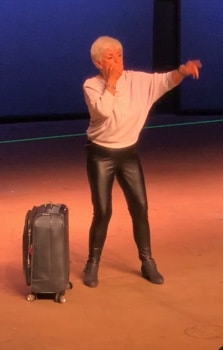
I kicked off with a 20-minute comedic piece about the challenges and barriers that people with hearing loss face when they travel: unintelligible public address announcements, lack of informational signage, low knowledge of hearing loss by travel professionals, and a lack of adequate safety protocols for hotel guests with hearing challenges. No matter how loud they are, I do not hear hotel fire alarms or someone knocking at the door at 2am!
Also on stage were other performers who have discovered the joys of a looped stage. Alito Alessi is the Artistic Director of DanceAbility® International. Alito has hearing loss and was finding it difficult to hear the music while performing. By switching his hearing aid to telecoil, he now hears the music to which he is dancing. Members of Eugene’s unique Radio Redux repertory theater company performed a cheesy but hilarious old-timey radio show. The cast included Bill Barrett for whom the stage loop was originally installed because he couldn’t hear his cues. Two of his fellow actors discovered they couldn’t hear them either and are now loop users.
Hearing loops keep us in the loop. They provide access for people with hearing loss in a way that Bluetooth can’t yet do. But to use them, we need telecoils in our hearing aids. So, a shoutout to hearing professionals: we love Bluetooth, but we also need and want telecoils! If you want to create accessibility and change in your community, be like Ginevra, Juliette and Dr. David Myers (who started it all): become looping advocate!

Dr. Juliette Sterkens, Me, Dr. David Myers
Top Video Still: A HoH On The Road