

(Alert! If you don’t think people should be wearing masks – at all – perhaps this article isn’t for you.)
It’s been a year and two-thirds since the pandemic became real. 20 months of obsessive hand washing and sanitizing. Of nervous distancing, sheltering at home, making too much food and watching too much Netflix. And then, finally coming out of hiding to start talking again – with a new population of masked people.
Somewhere in there, I caught an unexpected flying covid-kiss from my three-year-old granddaughter. Boom! Instant family covid, followed by lingering long-covid symptoms. I’m sure that one day, my sense of smell will improve and I will be able enjoy cilantro and Dijon mustard again.
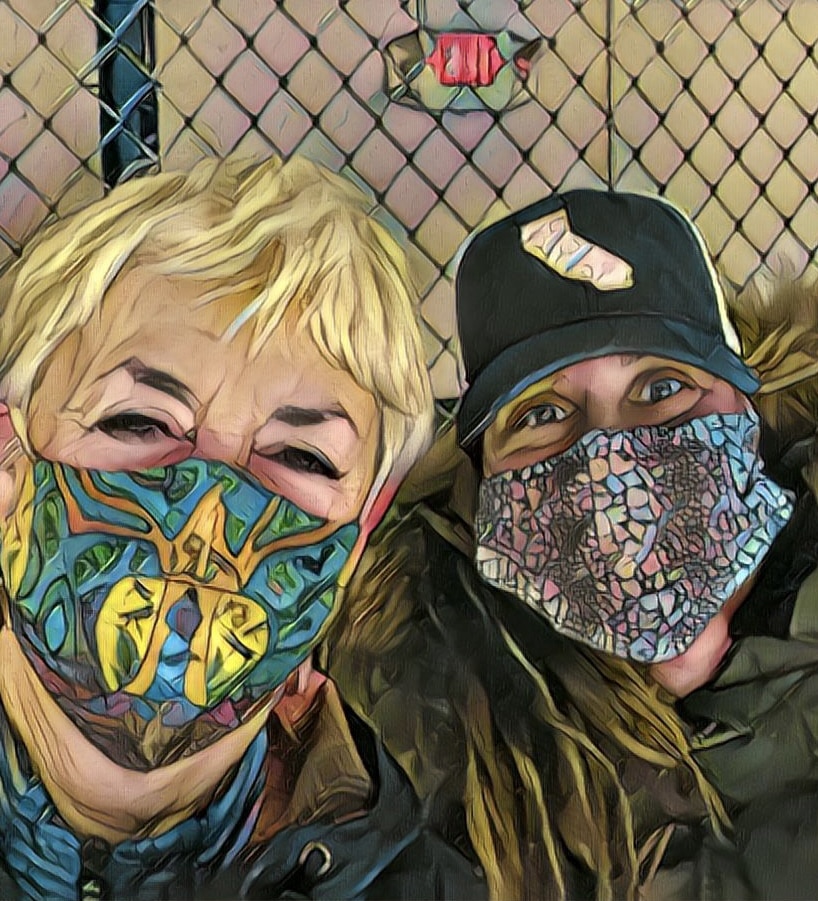
But here’s what I really would like to enjoy again: not having to talk through masks. For the entire 20 months, that has been the biggie problemo. Frankly, for people with hearing loss (PWHL), covid-communication has been a b***h. I don’t care how pretty your mask is; when all I see are the bumpy movements of a person’s lips beneath pieces of cloth and I all I hear are muffled, monotone words, I am not going to understand very well, if at all. And unless I simply want to walk away or play guessing games about what’s being said, which I don’t, I have to resort to pandemic communication survival skills.
It starts by advocating for myself. No one is going to look at me and say, “Hey! I betcha that person can’t hear very well.”
Let’s assume I’m talking with a cashier who is the requisite 6 feet away and/or is separated from me by a solid plexiglass shield. The cashier says something from behind a highly decorated, colorful mask. I don’t understand her. I sigh and roll my inner eyes. Here we go again.
Action: I explain that I have hearing loss and I read lips. I mime how she could show me hers.
Desired Outcome: She will get what I’m saying, hook her mask with her pointy finger, pull it down below her lips, and repeat herself. This is happening with increasing frequency these days, but it’s far from the norm. However, when it does happen, my response is always a thank you or a big smile or both.
However, the Usual Outcome: The cashier’s eyes grow larger and she looks around wondering what to do. Or perhaps she’s looking for help from the gods; she doesn’t want to lose her job and she was instructed to Wear Your Mask at All Times. Then she says in a louder voice, “I can speak louder.”
Another sigh. I can respond in one of several ways.
• I can lob the ball back to her with: “Still deaf. Still reading lips.” But nicely, you know? Then, hopefully, she will give me the Desired Outcome.
• I can get my back up. Maybe I’m tired or maybe I’ve had a bad hearing day or maybe her stupid mask irritates me. Whatever the reason, I just look at her until she comes up with a solution on her own. Which could be holding up a bag, if she’s been asking if I need bags. She could hold up the chicken, asking if I want it separately wrapped. If I wasn’t so grumpy today, I could have told the cashier as I started to put my food on the conveyer, and before she has a chance to speak, “Hi, I’m deaf, I have my own bags, don’t wrap the chicken, here’s my points card, and I’ll be paying by credit card.”
• OR, I could whip out my smartphone, quickly find my speech-to-text app (I use Otter), and ask her to repeat herself, explaining what I’m doing. And I will try not to feel the impatience of the people in line behind me because, hey, I’m a customer too and I deserve to be able to understand what’s going on. Plus, they would do well to notice my win-win solution because it could help them, too.
I now often use the grocery store self-checkout option, so that I don’t have to talk to anyone. I’ve also just started packing a few disposable clear masks to hand out with problem communicators. But I haven’t had to offer one yet, because, truly, people are getting better, not only about communicating safely, but in understanding the frustrating challenges of masked communication.
And, over these 20 months, maybe I’m getting nicer.