

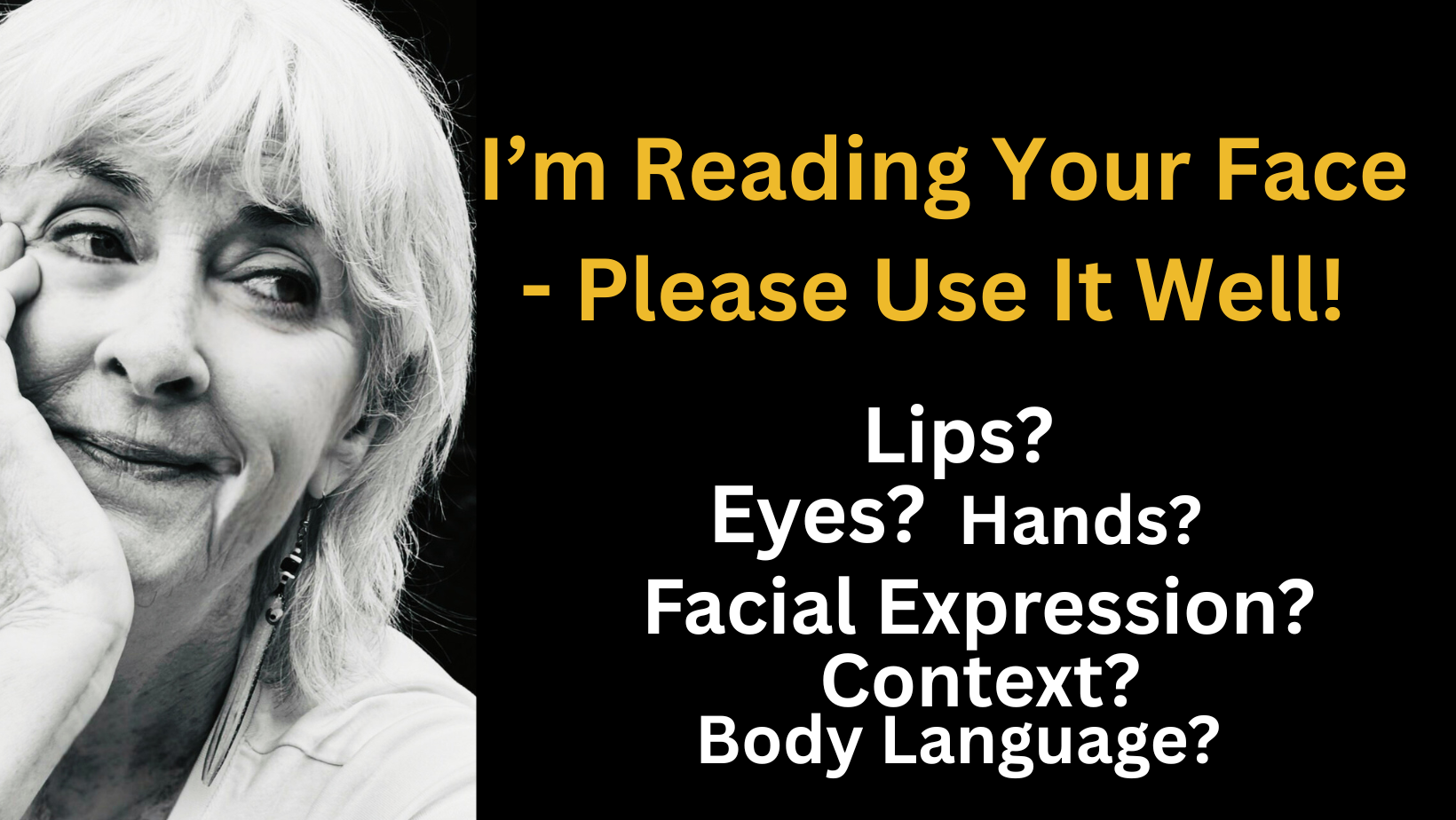
As I waited for a recent flight, I passed some time watching the couple sitting across from me have a discussion. I couldn’t hear them and I had no clue to their topic, but I had nothing else to do and I’m a seasoned reader of faces.
I was fully engrossed in their minor argument based solely on lip movements, facial expressions and hand and body gestures. I was familiar with those raised eyebrows, jaw drops, sharp head movements, the agitated shifting in their seats, and not a smile between them.
This doesn’t mean I always read faces correctly, even when I have sound and the person is talking directly to me, but I depend on what I see almost as much as what I hear to understand what’s being said.
Comedian Dave Barry once said, “I would not know how I am supposed to feel about many stories if not for the fact that the TV news personalities make sad faces for sad stories and happy faces for happy stories.” It’s more difficult to do that now because most news is not the happy kind. Thank heavens for captioning.
Practitioners of Traditional Chinese Medicine (TCM) use face reading, known as Mien Shiang, to help diagnose a patient’s health, their character and potential life paths. I analyze people’s faces to help myself. Speechreading is a major item in my comprehension toolbox. Hearing aids are my battery-driven motor; speechreading is my solar-powered flashlight. (I don’t read faces in the dark.)
Even hearing people depend on speechreading occasionally. This was a shocking discovery when we all donned masks during the pandemic and mouths were no longer visible. But for people like me, face reading is constant. It means the difference between comprehension and inclusion – and the dark void of non-communication.
When I’m chatting with you, I’m working hard. I’m using my vision, hearing, and knowledge of the subject matter to decipher what you’re saying. And all this hard work shows because apparently, I frown. A lot. Our energy output is enormous, and it can show on our faces. I was horrified to see this unattractive frown when reviewing videos of my presentations, and these days I’m trying to remember to smile more. (This may be confusing for my audience when a grin suddenly and inexplicably replaces a frown on my face.)
Speechreading a natural process, but not a perfect one – only 20%-50% of speech is ‘readable’ with success depending on both the articulator and the speechreader. However, it’s a skill that can be sharpened wth training and practice. Like other people with hearing loss, I suck clues from the speaker: what the lips seem to say, what’s shining out of the eyes, and facial expressions. I also note how the person uses their hands and arms, how their head tilts, and how they stand, sit or shuffle around. And, of course, I can hear their voice, imperfectly. The speaker is like a composer, conducting all these instruments in a symphony that the audience (me) must interpret.
Sometimes, though, it’s clear that something’s a little off. When the lips are saying one thing, but the eyes are saying something different, people with hearing loss must check if they have misinterpreted. “Uh, did you just say you’re meeting your mother at five? Oh, you said your brother’s lucky to be alive.” (Unfortunately, some speakers use the same expression for either of those statements.)
Although I’m a good speechreader, I’m not a mind reader. I can only go by what I see and hear; unlike TCM specialists, my face reading skills don’t give me special insight into what a person is thinking or where they’re heading. So, I’d be very grateful if you, the speaker, would use your face and voice clearly, so that I don’t have to work so hard. Let’s work on it together, shall we?