

by Kerry Roberts
Born in 1970 in rural Newfoundland, I had a genetic hearing impairment that was not immediately identified. In my earliest years, the world sounded whole. I laughed, played, and listened, as well as any child might!
When my music-making family came together, the music was always present for me in a different way. It lived quietly in the background—at gatherings I listened to from the sanctuary of my bedroom, in the guitars resting in corners whose strings I’d pluck while trying to hum along, and in the instinctual way I tapped or hummed to the diesel engine rhythm of a boat chugging out to the fishing grounds. Long before anyone knew my hearing would fade, music had already claimed its place in my life.
Around the age of six, things began to change. Sounds that once felt clear grew muffled. Voices blurred. The audible world slowly retreated behind a thick pane of glass. My hearing deteriorated year by year, and with it came the assumptions of others. People generally meant well, but their words carried a weight I didn’t know how to handle. “You can’t sing,” they would say. “You’ll never be able to. You just can’t hear well enough.”
When you’re young, you tend to believe the voices around you, even when they’re wrong.
But music had already taken root in me. I started playing drums at four years old, when my hearing was still intact. I loved its sounds—the snap of the snare, the thump of the kick, the brightness of the cymbals, although people in my house didn’t share my enthusiasm at 5 in the morning! When my hearing began to fade a couple of years later, the rhythm stayed with me. Even as the world grew quieter and more distorted, my musical instincts didn’t disappear. If anything, they sharpened. I couldn’t hear like others and the world sounded very different to me, but I could tell when a band member hit a wrong note. Something in me recognized it instantly—an internal sense of pitch and rhythm that stayed sharp in spite of hearing loss.
By twelve, my Uncle Ivan and I had formed a small garage band. He sang and played guitar, I played drums, and with two other members, we performed locally for a few years. During practices, I’d catch myself humming along—and every now and then, quietly, I knew I was humming in key. But I never believed singing could truly belong to me.
Everything began to shift in 2016 when I acquired my first pair of digital hearing aids. Suddenly, music was more than mere memory and instinct—it had shape again. I could hear melodies more clearly, and for the first time, I could hear my own voice well enough to match more of the notes. Subtly, a door opened, a door I had assumed to be permanently locked.
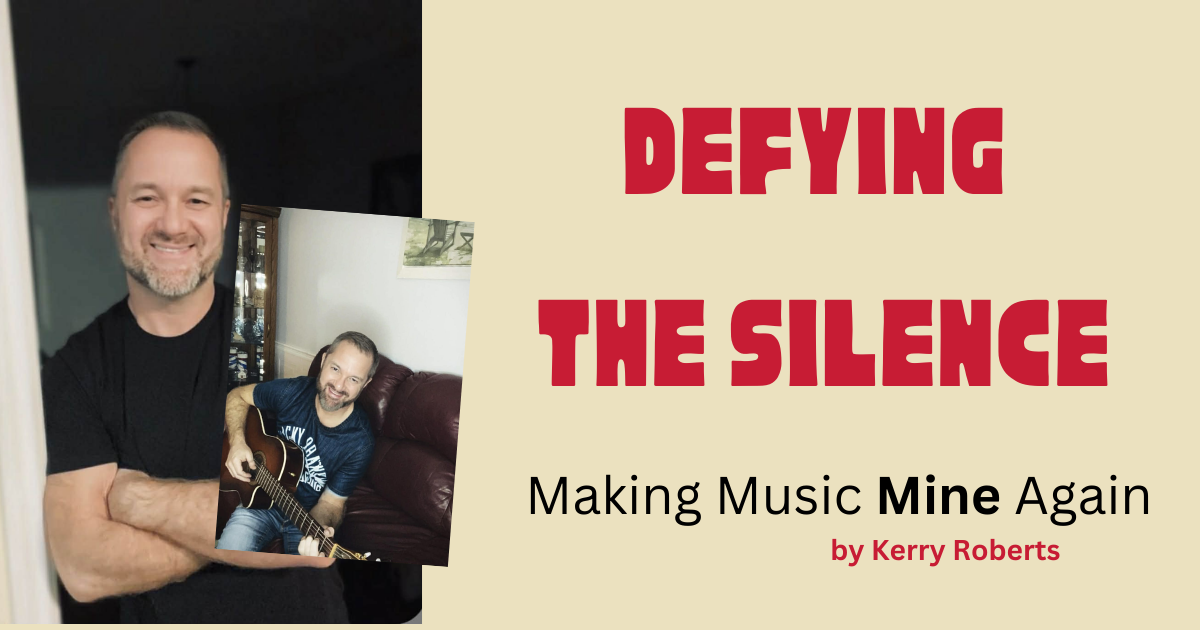
In 2020, I received a cochlear implant. It brought new sounds, new distortions, and a long period of adjustment, but it also expanded the world in unexpected ways. I started playing and singing on my own with my guitar, and to my surprise, I did fairly well. That small success encouraged me to keep going. I downloaded a karaoke app and began singing my favourite songs, working at them, shaping them, improving them one take at a time.
Another breakthrough in 2025: a new digital hearing aid in my left ear offered technology far beyond what I had in 2016. With its dedicated music setting, my hearing world expanded again. I could hear notes that had been out of my reach, background instruments I didn’t know were being played, and layers of sound that had always been hidden from me. For the first time in my life, music felt whole, alive, and detailed.
And then came my amazing partner, Katie, an incredible singer and musician, who offered me more than mere encouragements—she gave me permission to be unafraid. She taught me to sing without worrying who might be— and not to care if anyone was! Her belief in me filled a space that had been empty for practically a lifetime.
Today, I sing. Not because I overcame my hearing impairment, but because I stopped letting it define what I was allowed to attempt. Singing—whether the notes land perfectly or drift off course—brings me peace, joy, and a sense of connection, of being present. Music has always lived in me. Now I get to live in it too—again.
And the best part is simple: I sing because the music is mine. I sing because it feels good. And after everything, I finally can.