

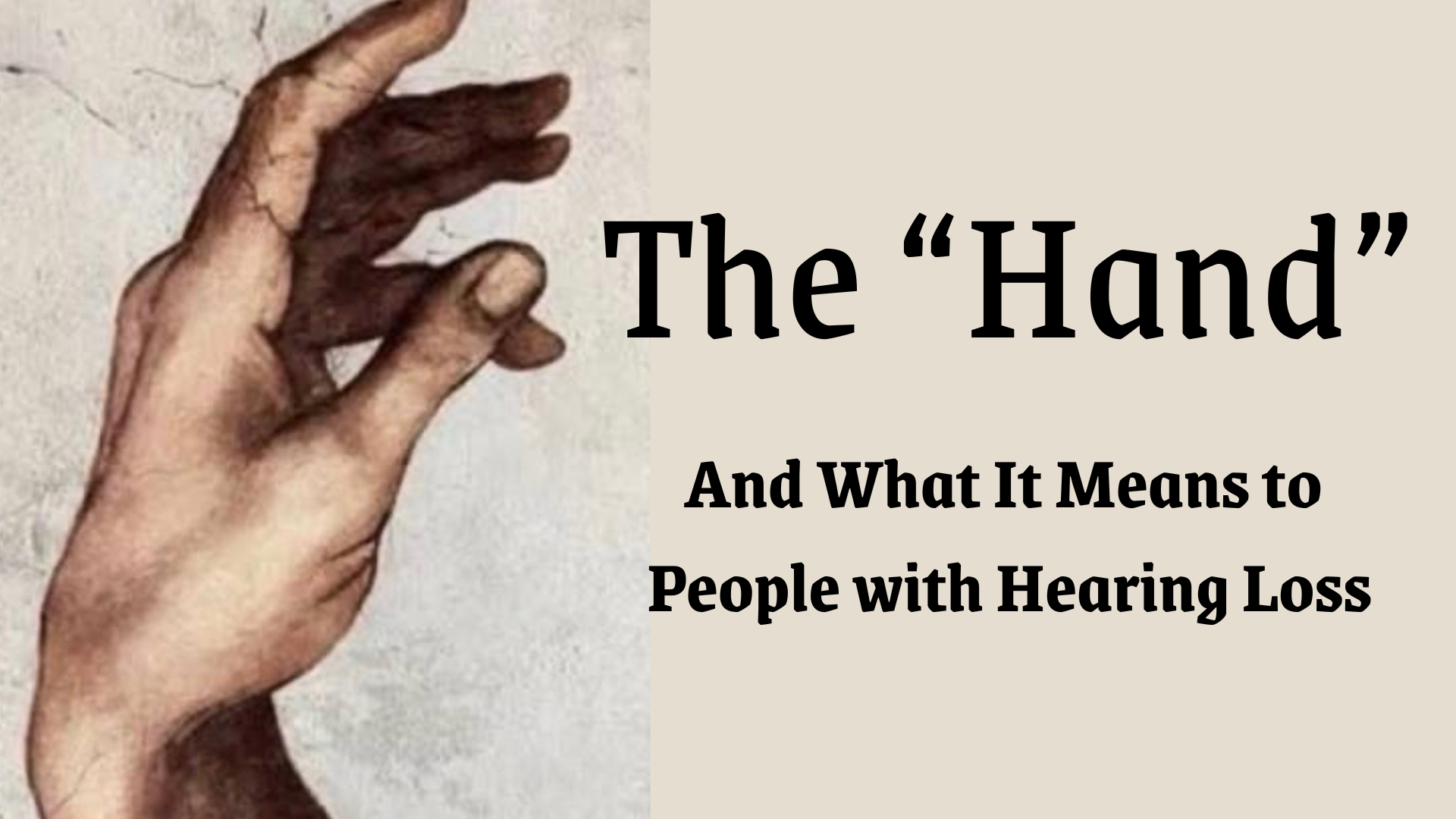
I’ll be honest – I have a love/hate relationship with ‘the hand’.
A hand is the body part at the end of a human arm used for grasping, touching, and feeling. I’m good with all that. I can pick things up with my hand. I can touch your face or punch you in the arm. And, a new skill that’s important in today’s world, I can use my phone with – get this – one hand! It rests in my palm, propped by fingers while my opposable thumb does the hard work.
For people who have hearing loss, hands have a special role that surpass the physical. When loose in the air, hands carry meaning and emotion. They tell us stuff, boosting our understanding what a person is saying, especially when we can’t hear all the speech sounds.
This is not the sign language of Deaf people. It is movement and manual emphasis that people with any degree of hearing or hearing loss use in their communication. In many languages, it’s fundamental to cultural expression. Italian people use about 250 distinct hand gestures to add emphasis, emotion, and clarity in spoken conversations.
But what do these hands tell me?
I frequently need to ask for repeats which don’t always happen immediately. A hand may go up, warning me that “wait, that person there is talking”. This is ‘overtalking’ and it’s embarrassing to be caught doing it, to the point that we might back out of the conversation completely.
Then there’s the dreaded and angry-making hand signal, the little wave away that means oh never mind. This should never be acceptable. If it’s worth saying once, it’s worth repeating. Even if it truly was a piece of verbal nonsense, let us be the judge. Otherwise, we feel dismissed, not worth the time.
More commonly, hand gestures simply frame the meaning of what is being expressed by voice. With an unlimited range of movement, hands intensify the meaning behind the words – the humor, confusion, joy, love and personality of the people we’re talking with.
Hand gestures aren’t limited to conversations with people who have hearing loss, but we depend on and benefit more from this extra information. Hand movements are part of speechreading, which is a better term than ‘lipreading’ to describe what we’re actually doing.
When we’re talking, I don’t just look at your lips. I take in your eyes and facial expressions, along with your body language and hand movements. People with hearing loss do this naturally, often without realizing it, and sometimes we get the wrong message, because people’s eyes or facial expressions don’t always match their words. We may even misinterpret hand movements or find them distracting if the person seems to be swatting invisible flies. We do the best we can with the information we’re given.
We don’t care what your hands look like. Whether they’re smooth and pretty or veined and wrinkled, they’re beautiful to us because they are instruments of meaning.
So, yes, I hate your hand when you use it to dismiss me. But I love your hand (and you) when you use it connect with me.