


Hear In Private Practice

Featured image for “A Closer Look at Pendred Syndrome”
Mar. 31, 2015

A Closer Look at Pendred Syndrome

Hearing Health & Technology Matters
In this last of the series of syndromes that started in the January 20 post on early identification of syndromes using hearing loss, we come to Pendred Syndrome. Pendred Syndrome derives its name from the physician Vaughan Pendred who first described its symptoms in the late 19th century. This genetic disorder causes early hearing loss in children afflicted with it. The progressive
Featured image for “Earwax and “Dark Magic””
Mar. 24, 2015

Earwax and “Dark Magic”

Bob Martin
Genève returned to our office the other day with a hearing aid that was dead for the fourth time this year. The instrument, a high-tech receiver-in-the canal (RIC) model, had a little wax on the dome, but the dome was not plugged. I then checked the internal filter on the receiver. It was completely plugged with wax. I looked in
Featured image for “Defensive Audiology: Balancing on your back leg”
Mar. 17, 2015

Defensive Audiology: Balancing on your back leg

Hearing Health & Technology Matters
By Marshall Chasin, AuD The following post originally appeared in The Hearing Review and is republished here by permission. online pharmacy buy estrace with best prices today in the USA I am a black belt in karate and always spar or fight from my back leg. I am also 60 years old. I can easily take on a 7-year-old but
Featured image for “Let There Be MORE Light”
Mar. 10, 2015

Let There Be MORE Light

Bob Martin
  I have headlamps, fiber-optic otoscopes, and light bars in all my treatment rooms. You would think that would be enough light–but it’s not. There are times, say, when I’m at the front desk changing an internal filter on a RIC or doing some other task that requires extra-high visibility. That means I need more light. Sometimes I need a
Featured image for “Alport Syndrome”
Feb. 25, 2015

Alport Syndrome

Hearing Health & Technology Matters
The next in our series of syndromes that hearing loss may help identify is Alport Syndrome. The areas that are affected most in Alport are kidney disease, hearing loss, and eye abnormalities.  Kidney disease in of itself is linked to hearing loss as described in an earlier post,  but those with Alport syndrome have a progressive loss of kidney function to the
Featured image for “Patients Will Enjoy Helping Design a Listening Program Just for Them”
Feb. 16, 2015

Patients Will Enjoy Helping Design a Listening Program Just for Them

Bob Martin
This week, in our continuing series of posts about creating and using listening programs, I would like to talk about helping hearing aid wearers hear better in “fun” places, such as bowling alleys. Many years ago, when remote controls first came onto the market, I had a patient who wanted to hear when she went bowling. “I love going to
Featured image for “Jervell Lange-Nielsen Syndrome”
Feb. 03, 2015

Jervell Lange-Nielsen Syndrome

Hearing Health & Technology Matters
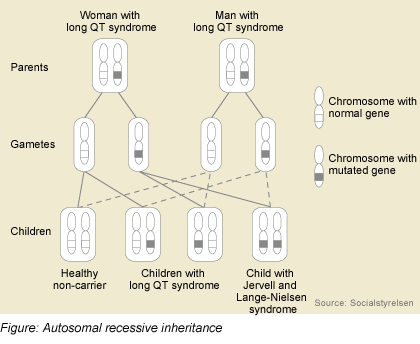
Jervell Lange-Nielsen syndrome is the highlight of this week’s post. There are times when a failed hearing screening in the hospital is the first indication that there may be other health concerns for a newborn as discussed in our post a couple of weeks ago online pharmacy albuterol online with best prices today in the USA .  Jervell Lange-Nielsen syndrome
Featured image for “How to Program Hearing Aids for T-Coil Use”
Jan. 27, 2015

How to Program Hearing Aids for T-Coil Use

Bob Martin
There are many different ways a hard-of-hearing person can use a telephone with their hearing aids. The three most common are: (1) Holding the telephone near the microphone on the hearing aid. (2) Using a telecoil (T-coil), holding the hearing aid against the phone, and (3) Connecting the hearing aid to the telephone by means of Blue Tooth technology (usually
Featured image for “Hearing Screening and Early Identification of Syndromes”
Jan. 20, 2015

Hearing Screening and Early Identification of Syndromes

Hearing Health & Technology Matters
By Judy Huch, AuD and Carly Copeland, AuD Genetic hearing loss can be associated with hidden potentially life threatening diseases if they go undiagnosed. Hearing loss is often the first clue to detecting these serious syndromes. Most babies with these diseases look healthy at birth and have no family members affected with the disease. Four serious autosomal recessive diseases associated
Featured image for “How to Reduce Background Noise and Improve Speech Understanding”
Jan. 13, 2015

How to Reduce Background Noise and Improve Speech Understanding

Bob Martin
In my last couple of blog posts I discussed the use of “listening programs” to improve hearing. Today I want to continue this discussion and cover the difficult topic of “How to enhance word understanding and simultaneously reduce background noise.” When I tackle this problem, hearing when it is noisy, I first ask myself, is it possible for this patient