


Examples of good communication access are sometimes few and far between, so when they do occur, it is important to celebrate them. Gratitude and acknowledgment are powerful motivators.
A Hearing Access Success Story
Attending a comedy show can be risky business for someone with hearing loss, especially if the comic uses sarcasm and subtle voice intonations to amuse.
How will we understand the jokes if we can’t hear them? Will we catch the nuance? What if the assistive listening system fails?
We had a past good experience at the venue where the show was being held—a wonderful performance of Richard Einhorn’s luscious Voices of Light—so we decided to give it a go.
We purchased cheap tickets in the balcony to minimize our losses in case this experiment in spoken word entertainment was a failure. And employed the number one Hearing Hack for theater performances—arriving early to troubleshoot any hearing access issues.
Best Practices in Action
 The good news began immediately. The box office staff was knowledgeable about the assistive listening devices and well-trained in communicating with someone with hearing loss, maintaining good eye contact, and speaking slowly and clearly throughout our interaction.
My listening device was clean, fully charged, and I was pleased to see that I could plug my own headphones into it, which would make it more comfortable for me to use.
The ushers advised me to test the device before the show began. The venue plays a recorded message through the assistive listening system for this purpose before each show. If I could hear the recording from my seat, I would know that the device was working.
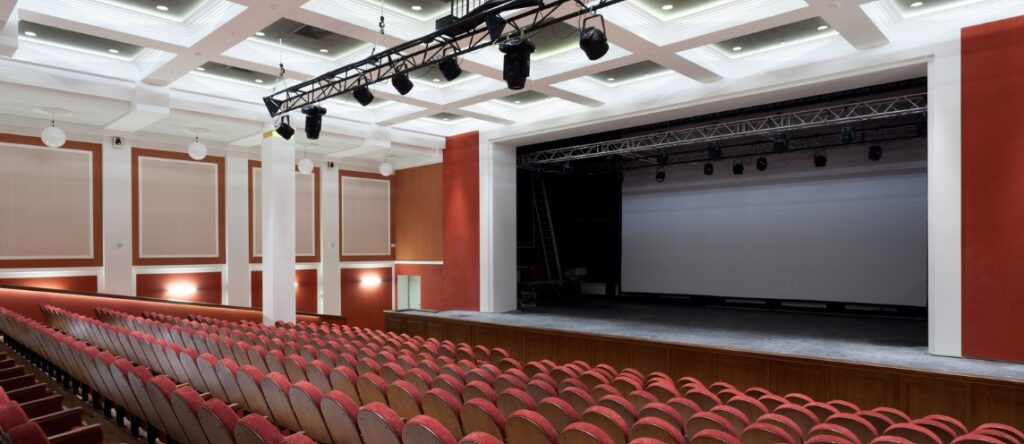
Since we were early, my husband and I milled around the lobby before heading to our seats, people-watching and reading the historical displays on the walls. The Bardovan has an interesting pedigree, boasting performances by Mark Twain, Frank Sinatra, Aretha Franklin, and many others during its 150-year history.
The manager approached.
“Are you the person with the listening device?” he asked me with a smile. I nodded but immediately got nervous. Maybe the system was out?
“Terrific! I’m glad I found you. We realized the listening system doesn’t work as well from your seats. Please take these instead,” he said, handing me two tickets for seats in the second row of the orchestra section.
Wow! These new seats were close enough so that I could speechread in addition to listen. I barely missed a word of the performance, laughing with the crowd at almost every joke.
How Can Other Venues Replicate this Stellar Experience?
If you host performances at your theater or performance space, use this checklist to provide an equally inclusive experience for your guests with hearing loss.
-
Install quality assistive listening system(s) and make sure that they work well.
-
Ensure that devices are clean, well-maintained, and fully charged.
-
Train staff not only about the listening systems, but also in how to best communicate with patrons who have hearing loss.
-
Create checks in the system (i.e., a pre-recorded test message) that let patrons know that the devices are working ahead of the show.
-
Stellar execution: When an issue arises, encourage staff to find a solution before it impacts the consumer experience.
Thank you to everyone at The Bardovan for making my visit so delightful! If readers are ever in the Poughkeepsie area, I highly recommend a visit.

Shari Eberts is a passionate hearing health advocate and internationally recognized author and speaker on hearing loss issues. She is the founder of Living with Hearing Loss, a popular blog and online community for people with hearing loss, and an executive producer of We Hear You, an award-winning documentary about the hearing loss experience. Her book, Hear & Beyond: Live Skillfully with Hearing Loss, (co-authored with Gael Hannan) is the ultimate survival guide to living well with hearing loss. Shari has an adult-onset genetic hearing loss and hopes that by sharing her story, she will help others to live more peacefully with their own hearing issues. Connect with Shari: Blog, Facebook, LinkedIn, Twitter.