


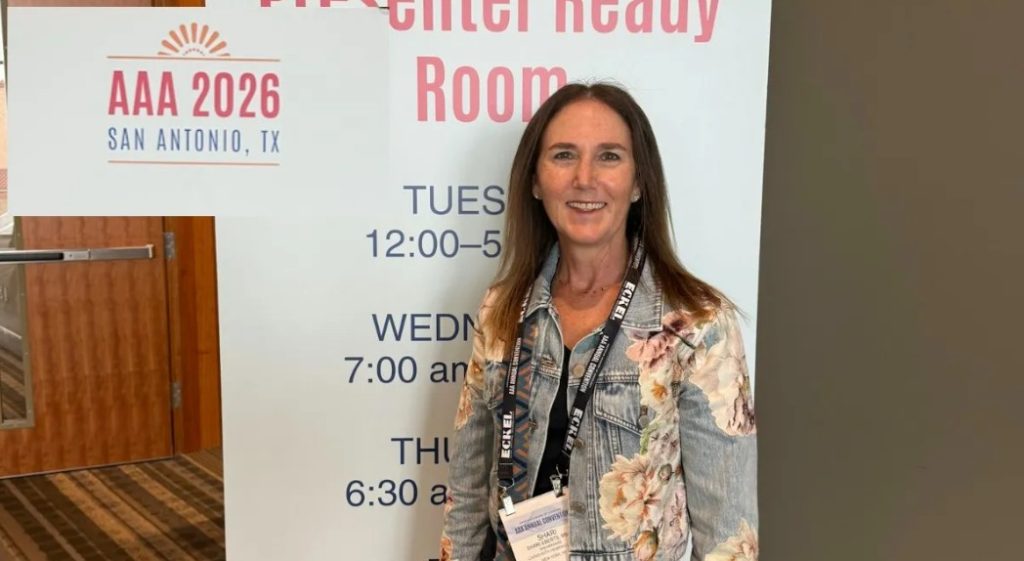
The American Academy of Audiology’s annual conference is always an exciting event, and one where the worlds of clinical audiology and lived patient experience intersect in meaningful ways.
This year at AAA 2026, I presented on a topic close to my heart: how shifting patient attitudes about hearing loss unlocks improved self-advocacy, stronger communication skills, and ultimately, better hearing outcomes.
Here’s what I shared.
The Emotional Reality of Hearing Loss
Before we can talk about solutions, we need to acknowledge the lived reality of hearing loss. It touches every part of life — self-image, relationships, career opportunities, and daily interactions. It also carries a heavy emotional load: grief, frustration, isolation, and sometimes shame.
Too often, these emotions go unaddressed in clinical care. But they matter. They shape the attitudes patients bring into the appointment, and those attitudes directly influence how patients engage with treatment, technology, and communication strategies.
The 3-Legged Stool
In Hear & Beyond: Live Skillfully with Hearing Loss, we describe a framework for living skillfully with hearing loss built on three interconnected legs: Technology, Communication Behaviors, and MindShifts.
Hearing aids and other technologies are powerful, but they can only carry so much of the load. True success comes when all three elements work together. Of these, MindShifts — the way we think about our hearing loss — are often the most overlooked, yet also the most transformative.
What Is a MindShift?
A MindShift is the process of transforming a limiting belief into an empowering one. Many patients arrive at your office with thoughts that quietly undermine their success. These beliefs can become self-fulfilling barriers. But they are not fixed. They can change.
For example:
- “Why me?” can become: “I have the power to influence my journey.” This shifts the focus from what happened to us to what we can do about it. It restores a sense of control and possibility.
- “I want to hear better, the way I used to.” can become: “I want to communicate better — and that takes more than just hearing aids.” This reframing opens the door to a broader set of tools and strategies.
These shifts in thinking may seem simple, but their impact is profound. When patients move from passive frustration to active participation, everything changes.
Helping Patients Make the Shift
Changing mindsets takes time and practice. During my talk, I shared several strategies to help patients move from limiting beliefs to more empowering ones.
Optimize Rather Than Perfect
Perfect hearing is unlikely for most people with hearing loss, even with the best technology. When perfection is the goal, frustration is inevitable. But when the goal is improvement, we gain options and control. Patients can adjust their environment, choose better seating, reduce background noise, or advocate for clearer communication. Focusing on what can be improved creates more opportunities for success.
Practice to Build Confidence
MindShifts require repetition. I advise starting small, in low-stakes situations. For example: introducing yourself to a seatmate and asking them to share important announcements. These moments build confidence and often challenge our fears. Most people are willing to help. Each successful interaction makes the next one easier.
Prioritize Self-Care
Mindset is closely tied to overall well-being. Managing stress, getting enough rest, and practicing habits like gratitude or meditation can make a real difference. For me, self-care helps me manage tinnitus, reduces the impact of communication missteps, and supports a more resilient outlook. When we feel better, it’s easier to adopt and sustain positive MindShifts.
A Powerful Clinician-Patient Partnership
One of the most important messages I shared with audiologists is that better outcomes come from a strong patient-provider partnership.
Clinicians must set realistic expectations, work to understand each patient’s lifestyle and communication needs, and look beyond technology alone. Guiding patients toward communication strategies, educational resources, and peer support is also critical.
Patients, in turn, benefit when they feel safe being honest about their struggles, remain open to new approaches, and recognize their own role in the process. When they do, they transform from passive recipients of care to active participants in their own success.
When both sides are engaged, the dynamic shifts. Care becomes more collaborative, more personalized, and more effective.
Living Skillfully with Hearing Loss Is Possible
Hearing loss is challenging, but it is also manageable — especially when patients adopt more empowering attitudes. These MindShifts not only improve daily communication but also strengthen the clinician-patient relationship.
I hope that audiologists left my session thinking not just about what’s happening in their patients’ ears, but also in their minds. Because that’s where real change begins.

Shari Eberts is a passionate hearing health advocate and internationally recognized author and speaker on hearing loss issues. She is the founder of Living with Hearing Loss, a popular blog and online community for people with hearing loss, and an executive producer of We Hear You, an award-winning documentary about the hearing loss experience. Her book, Hear & Beyond: Live Skillfully with Hearing Loss, (co-authored with Gael Hannan) is the ultimate survival guide to living well with hearing loss. Shari has an adult-onset genetic hearing loss and hopes that by sharing her story, she will help others to live more peacefully with their own hearing issues. Connect with Shari: Blog, Facebook, LinkedIn, Twitter.