


When I finally committed to wearing my hearing aids consistently, it wasn’t a clinician who pushed me there. It was my children. Watching them watch me — retreating from noisy rooms, missing the joke, going quiet at family gatherings — I recognized my own father. He had hidden his hearing loss for decades, and I had spent years following in his footsteps. Seeing that pattern play out in front of my kids was the thing that finally made me change.
I share this because it points to something often underdiscussed in the clinical encounter: for many patients, family is the most powerful catalyst for hearing loss acceptance and help-seeking behavior. Understanding that dynamic — and knowing how to engage with it — can meaningfully improve outcomes.
Stigma Travels Through Families
Patients don’t arrive at your office as blank slates. Many have spent years absorbing negative messaging about hearing loss — from family members who hid it, from media portrayals that mock or infantilize people who mishear, from a culture that still equates hearing loss with decline.
By the time they sit across from you, resistance to treatment may be less about cost or vanity than about deeply internalized shame.
Asking patients about their family history of hearing loss — not just audiologically but experientially — can open a window into that shame. Did they grow up watching a parent struggle? Did that parent seek help or hide? Those early models shape unproductive attitudes, and naming them can be a first step toward dismantling them.
Family as a Clinical Lever
In my experience, patients who are ambivalent about treatment often become willing to act when they recognize the impact on the people they love — or when they realize they are modeling avoidance for family members who may one day face the same condition themselves. This is clinically actionable.
Questions like “How does your hearing loss affect your family at home?” or “What do you want the people closest to you to learn from watching how you handle this?” can surface motivations that an audiogram-focused framing misses.
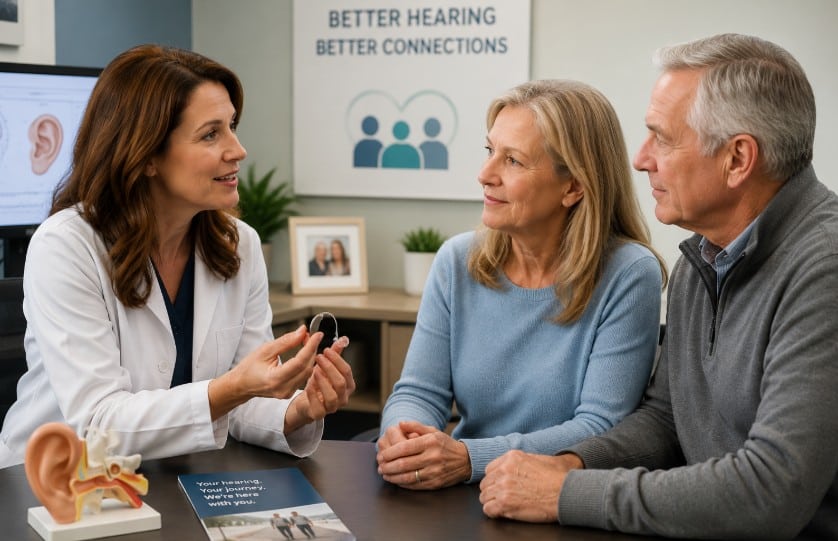
Patients are often more willing to act for others than for themselves. Meeting them there is a legitimate and effective clinical strategy.
Beyond Technology: The Full Picture
Living well with hearing loss requires more than a well-fitted device. In Hear & Beyond: Live Skillfully with Hearing Loss, we describe our formula for skillful living as a stool with three critical legs: Technology, MindShifts, and Communication Behaviors.
Technology — hearing aids, assistive devices, captioning tools — is the leg audiologists know best, and it matters enormously. But a perfectly fitted hearing aid worn inconsistently produces poor outcomes. The other two legs matter just as much.
MindShifts are about accepting hearing loss and being willing to disclose it. When patients turn negative self-talk on its head, they are more willing to effectively advocate for their needs.
Behavioral Change means using practical strategies to supplement technology: optimizing seating for sightlines, using visual cues, and preparing communication partners with specific and actionable guidance.
Patients who develop these softer skills enjoy better outcomes in real-world listening situations. Attitude and behavior work belongs squarely within the counseling that surrounds every fitting.
Enrolling the Family
The families of patients with hearing loss are an underutilized clinical resource. In my own family, the most impactful shift wasn’t any single technology — it was the collective decision to make accommodation a shared habit rather than my individual burden.
For example, when entering a restaurant, we’d quickly assess where I should sit before getting comfortable. At the movie theater, my husband would grab a captioning device while I got the kids settled in their seats. These weren’t elaborate gestures. They took seconds. But they communicated something important: this is a family matter, not a me problem.
Clinicians can encourage this reframe by inviting family members to attend at least one appointment and by providing personalized communication guidelines rather than generic tips. Explicitly naming the family’s role in treatment success can shift dynamics at home in ways that no fitting adjustment can achieve. It’s also worth telling patients that their families won’t get it right every time — and that the goal is not perfection but consistent, patient practice.
What Patients Wish You Would Ask
Patients wish their audiologists would ask more questions about their lives. Not just “In what situations do you struggle?” but “How is your hearing loss affecting your relationships?” or “Are there moments where it’s getting in the way of the person you want to be for the people you love?”
These questions do more than gather data. They communicate that you see the whole person, not just the hearing loss. For patients who have spent years hiding, that recognition can be the thing that finally tips them from avoidance to action.
Technology will keep improving. But the patient sitting across from you needs something no device can provide: the sense that their experience is understood, and that the path forward is not one they have to walk alone. You can help set that tone.

Shari Eberts is a passionate hearing health advocate and internationally recognized author and speaker on hearing loss issues. She is the founder of Living with Hearing Loss, a popular blog and online community for people with hearing loss, and an executive producer of We Hear You, an award-winning documentary about the hearing loss experience. Her book, Hear & Beyond: Live Skillfully with Hearing Loss, (co-authored with Gael Hannan) is the ultimate survival guide to living well with hearing loss. Shari has an adult-onset genetic hearing loss and hopes that by sharing her story, she will help others to live more peacefully with their own hearing issues. Connect with Shari: Blog, Facebook, LinkedIn, Twitter.