

I recently attended the World Congress of Audiology in Seoul, Korea, where I had the honor of presenting on a project close to my heart: weaving community-engaged learning into audiology student education. It was a full conference for me — I also shared two posters, “The Three-Legged Stool of Skills Needed to Live Well with Hearing Loss” and “Person-Centered Care from the Patient’s Perspective.”
It was wonderful to explore such a dynamic city, and to visit with many of audiology’s leading thinkers and change makers. I also had the chance to demo Auracast at a GN Hearing event featuring Big Ocean, the world’s first K-pop boy band whose members all have hearing loss. More on that experience in another post.
What Is Community-Engaged Learning? Why Is It Important?
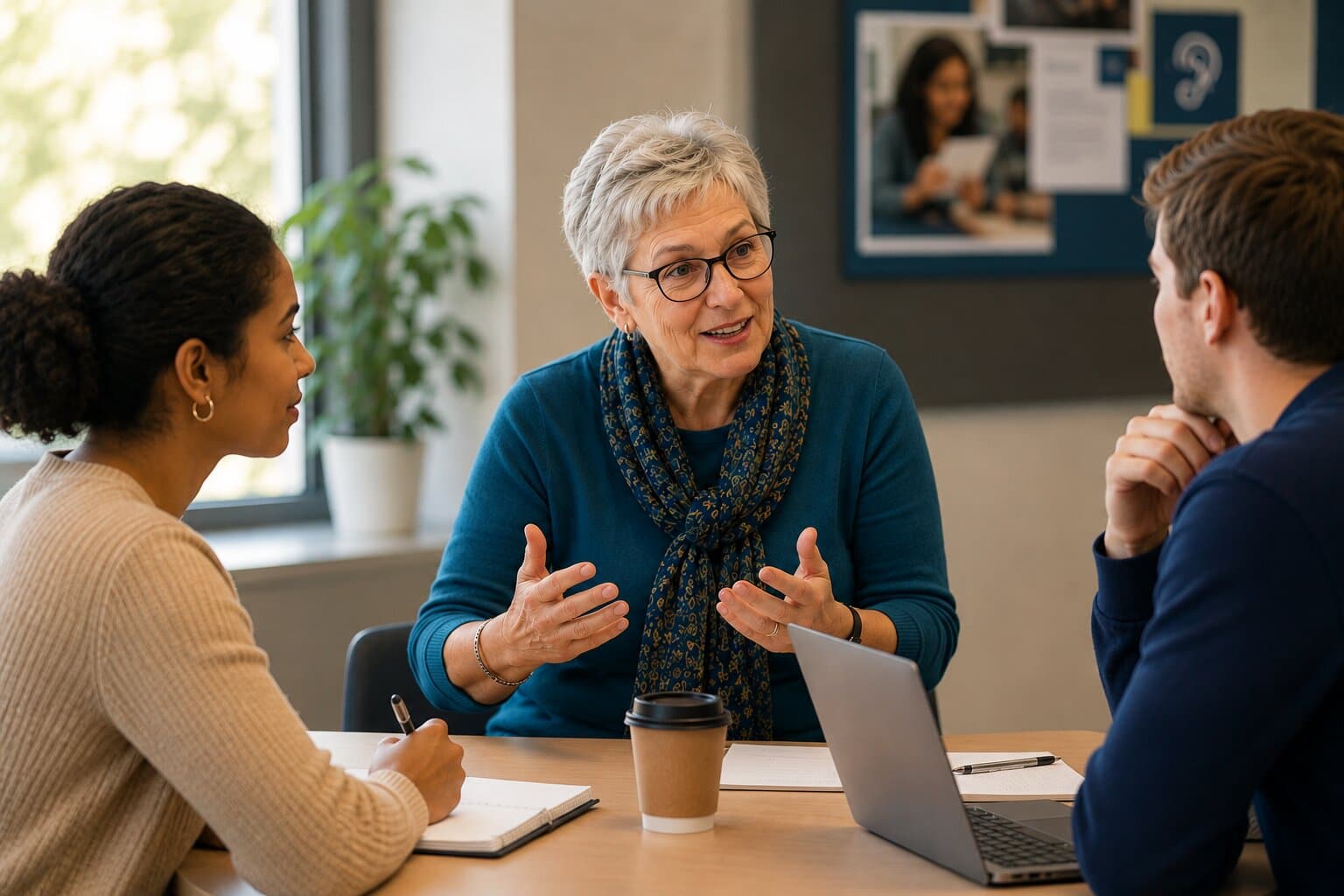
Community-engaged learning (CEL) is an educational approach where students engage in community-based experiences as part of their academic training. It connects classroom knowledge to real-world needs, gives students a chance to apply academic theory and concepts in practical settings, and builds critical thinking skills alongside social responsibility. This concept is relatively new in audiology, but I believe it is a critical tool for pushing the industry farther down the path to more person-centered care.
Why is CEL important? Audiologists are usually the first hearing care provider a person sees, and that first encounter has the power to shape their entire hearing loss journey. Too often, care can end up centered on the device rather than on the person using it.
When empathy and understanding are built into training right from the start, students build a true foundation for person-centered care. Stronger patient-provider relationships and better hearing outcomes follow naturally from there. This belief is what drove our experiment.
Our Experiment: Rethinking a Hearing Aids Course
Rather than a traditional service-learning placement, Dr. Kathy Cienkowski, Associate Professor and Program Director of Audiology at the University of Connecticut, built two complementary experiences into her graduate-level hearing aids course.
The first was a book review of Hear & Beyond: Live Skillfully with Hearing Loss, the book I co-wrote with Gael Hannan, including a lecture from me. The goal was to use real patient journeys and road-tested practical communication tools to help inform the way students think about clinical practice.
The second was firsthand exposure to the hearing loss community. Students attended an in-person meeting of a Hearing Loss Association of America (HLAA) chapter and completed a guided reflection afterward. For many of them, it was the first time they had spent time with people living with hearing loss outside of a clinical encounter.
Both experiences map onto a framework discussed in Hear & Beyond: the three-legged stool of skills needed to live well with hearing loss. The three legs are:
- Technology of all types
- MindShifts, changing the attitudes we hold about our hearing loss
- Communication Behaviors, or practical strategies we can use to enhance conversation
Audiology training tends to excel at the technology leg. CEL helps bring the other two legs into the classroom, too.
What the Students Told Us
The feedback demonstrated the immediate and positive impact CEL can have on future audiologists.
After reading the book, one student wrote that it “should be studied and read by clinicians so we can understand how people cope before coming to see us for the first time, and how our clinical choices are interpreted, whether right or wrong.” Another reflected, “We learn in our classes about the struggles and problems for people with hearing loss, but sometimes I feel like we have lost the human aspect.” A third put it simply: as a future clinician, she wanted every patient to know “they deserve to participate in their life.”
The HLAA meeting produced additional insights. One student wrote that she realized how little she knew about the resources available to patients once they leave the clinic. Another said the experience reframed her sense of professional purpose: she didn’t want to merely serve a population, but to support people as they move through a world that isn’t built with them in mind. A third left thinking about advocacy — and her own role in providing it.
These are not comments from students checking a box. They are the reflections of future clinicians whose understanding of hearing loss has expanded past the audiogram.
Community Partners Gain, Too
CEL benefits the hearing loss community as well because it lets people like us influence the perspective of the next generation of audiologists. Our experiences help shape a more empathetic, person-centered approach to care and ensure that psychosocial realities and practical, road-tested communication strategies are included in the curriculum.
There’s also something powerful in being asked to share. Having our lived experience treated as expertise — not just anecdote — validates what we’ve been through. It builds our confidence, strengthens our self-advocacy, and motivates us to take a more active role in our own care.
Looking Ahead
Dr. Cienkowski and I designed this as an experiment, but based on what we heard from the first cohort of students, I’m convinced that CEL belongs in more audiology programs, not as an add-on, but as a core part of how future clinicians learn to see the whole person in front of them.
My thanks to Dr. Kathleen Cienkowski for her vision and partnership on this project, to the UConn audiology students for their openness and thoughtful reflections, and to the HLAA members who welcomed them in. You can find our full paper on this project here.
Would you like to incorporate CEL into your audiology program? Please be in touch!
Shari Eberts is a passionate hearing health advocate and internationally recognized author and speaker on hearing loss issues. She is the founder of Living with Hearing Loss, a popular blog and online community for people with hearing loss, and an executive producer of We Hear You, an award-winning documentary about the hearing loss experience. Her book, Hear & Beyond: Live Skillfully with Hearing Loss, (co-authored with Gael Hannan) is the ultimate survival guide to living well with hearing loss. Shari has an adult-onset genetic hearing loss and hopes that by sharing her story, she will help others to live more peacefully with their own hearing issues. Connect with Shari: Blog, Facebook, LinkedIn, Twitter.