

Best practices and ethical guidelines in audiology support the use of real ear probe measurements.{{1}}[[1]]Much of this post was contributed by my colleague Jennifer T. Lamfers, AuD[[1]] But, how many practitioners use it in their practices? Some conduct real ear measures on every patient, using the measures to adjust hearing aids to reach target gain to ensure audibility. Dispensing audiologists are well educated, many with clinical doctorates, yet only approximately 40% use real ear technology to measure and demonstrate aided benefit to their patients. If the technology is good enough to make it into the guidelines, why is utilization among knowledgeable professionals so low?
Two common responses to that question are equipment cost and time required to perform the procedure. No doubt, the equipment is expensive and the procedure is usually bundled into the cost of the hearing aids so it does not generate revenue. And real ear does take time. 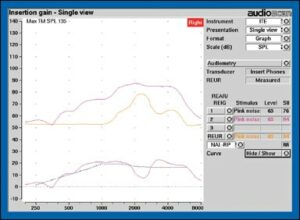
Time and money are compelling arguments, but there are other arguments for the importance of real ear measures in the fitting process. Real ear measurement is considered especially vital in pediatric fittings by many audiologists. Best practices recommend a simulated version of real ear, which quickly measures the resonance of a child’s ear and uses that information to fit the child’s hearing aids to target gain. This approach is preferred in pediatrics because it is quick and allows adjustments without the cooperation of the child.
Reimbursement provides another argument for incorporating real ear measurements into daily practice. Such measures may help with third party payments by providing an objective validation of hearing aid fittings.
Yet another reason–and one of the main reasons I use real ear –is that is provides face validity to the patient and spouse, or other family and friends that participate in the fitting process. Real ear can help patients and others learn about the fitting processing by enabling them to see the overall correction of hearing on a computer screen, as well as the effect of hearing aid adjustments on the real ear measures. It is also useful in our practice when working with RIC hearing aids and different types of ear tips.
Starting next week, Scot Frink, MS will become co-editor of Hearing in Private Practice. He has contributed other posts
to Hearing Health Matters. We are excited to have more to share and welcome Scot to this page!