

From time to time we see clients clinically who have very significant sensory, and possibly neural, damage. The question always arises in my mind whether to amplify the sound reaching that ear, or to remove the ear from the auditory environment. There is no clear test for this. In some cases it can be the result of end-stage Meniere’s disease, and others, it may be related to a sudden sensory neural hearing loss, whether from a skull fracture or an unexplained reason.
One of the first tests that I perform after establishing a significant hearing loss is to walk them over to my clinic piano. The client is asked to play all adjacent notes (white and black keys) from about middle C (a little over 250 Hz) up to the top end of the keyboard (a little over 4000 Hz). If two adjacent notes do not sound to be a different pitch, then this is evidence of a dead region in the cochlea in that frequency region(s). For those who don’t have a clinic piano, you can pick up a 1970s style electronic keyboard at almost any garage sale for $5- it’s not the quality of the sound; it’s just a matter of “same” or “different” and for this purpose, a $5 used electronic piano is just as good as a Steinway. One can also perform the TENS test that was designed by Dr. Brian Moore and this will provide similar information.
However, the clinician is still stuck – do we amplify that region, transpose away from that region, or in the case of many severely damaged frequency regions, do we simply make an earplug for that ear (and perhaps consider a CROS arrangement)? Removal of a severely damaged ear from the listening environment can be very useful especially when listening to, or the playing of music.
If I am consulting with another audiologist and have seen this client for a “second opinion”, I have tried to be as encompassing as I could be:“Let’s try amplification, but perhaps we should try attenuation?” Other than this statement providing no direction, are there devices in the marketplace that can provide both amplification on one setting and attenuation, or negative gain, on another setting?
I have been recommending the MusicPro earplug in the past from Etymotic Research. This is a hearing protector (for loud sounds) as well as a mild hearing amplifier (for soft sounds) that uses a version of the 1988 K-AMP analog circuit. On one user selectable setting, it provides some amplification, about 5-10 dB, which would be perfect for listening or playing music, even for someone with a moderate sensory neural hearing loss. On another user-selectable setting, the MusicPro provides attenuation, or negative gain of 12-15 dB which may be sufficient to remove that damaged ear from the listening environment.
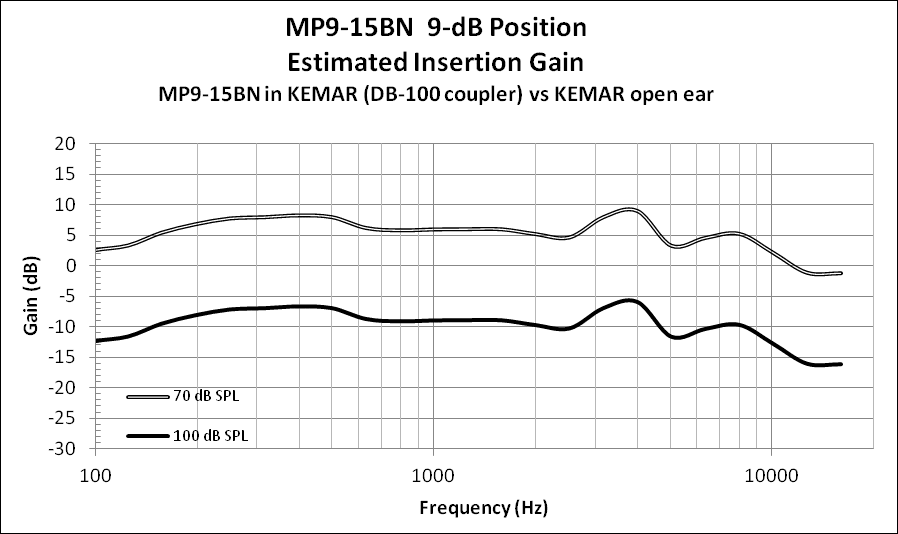
A caveat is that the microphone noise may become audible, especially in quieter situations. However, when listening to music, I would be very skeptical if the internal hearing aid noise would reach audibility. If there is concern, the expansion circuitry can be implemented that would reduce the sound level of the offending internal noise.

This is a low-tech solution to a clinical problem where ultimately the hard of hearing consumer will use that device in a number of situations. In the past, there has been success, with the hard of hearing person using the “negative gain” setting in some situations and slight amplification in others. There is no clinical test, but the trial period can provide significant information. Comments such as “I can now hear each of the pipes individually in my pipe organ” are received and that may come from slight amplification or “merely” removing the severely damaged ear from the listening environment.