


“Time out. Our … conversation … has to be based in fact. It can’t be based in fantasy or wishing…” Dawn M. Zier, Nutrisystem CEO
When major news bureaus start running articles entitled “Why Do Hearing Aids Cost More than Laptops?” you know it’s time for a change up in how Audiologists are positioning themselves, especially considering the burgeoning increase in computer ownership for those over 55. We can’t keep Pricing the way we do and expect consumers to separate fantasy from fact. Wishing they would won’t make it happen.
The “Why” article tried to stick to facts but relied too heavily on online providers to arrive at any truths. Online sellers of hearing aids use aggressive sales techniques, chief among them promulgating dubious “facts” and painting audiology with a broad, black brush. This is where Audiologists need to jump in and make their case in clear terms by addressing assertions made in the media and accepted as truth by consumers.
A Closer Approximation to Truth
For those who like to read the last page of the book first, here are the conclusions of this post:
- Premium hearing aid technology costs about the same as a good laptop.
- Lower priced instruments are more costly than equivalent laptop purchases.
- When wireless communications costs of Internet, WiFi and Bluetooth are factored in, the cost of owning a hearing aid with wireless capability drops to about half the cost of owning computer technology.
That last is an odd equivalency since a person with hearing loss who wants to communicate with the world can get by with one computer but usually needs two hearing aids. The table below grapples with that.
Striving for Equivalent Numbers and Comparisons
Computer prices come unbundled, hearing aid prices come bundled, except that hearing aids are priced as single units and most people need two. It’s hard to compare, especially in your head. Everyone’s costs differ depending on needs and preferences, but it is worthwhile to sit down and sketch out long-term costs to arrive at a reasonable price comparison for yourself. Or, in the case of Hearing Economics, to do our small part to rid the media of unsupported claims about hearing aid prices.
Table 1 below makes theoretical comparisons of what it costs to buy and operate a hearing aid or a computer for 4 years. The 4-year cutoff was chosen for several reasons:
- Warranties at the time of purchase–limited or comprehensive–rarely if ever extend beyond 3 years for either type of devices;
- Average time to replacement is 4.5 years for computers, close to the recommended 5-year mark for hearing aid replacement;
- Repairs increase with older devices, complicating the cost picture and influencing new purchase decisions. It is difficult to compare the costs for a person who elects for repair with those for another person who applies the same funds to new technology.
Everyman Scenarios
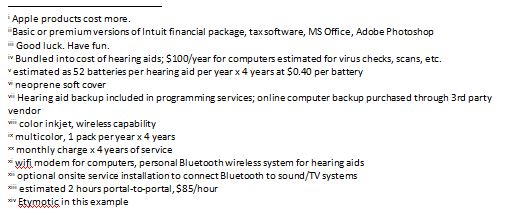
Table 1 uses reported data and numbers when available and otherwise tries for defensible assumptions to arrive at two Everyman Scenarios. For instance, printers are included based on market analyses indicating that they are the “key accessory” in personal computer purchases.
Color printers and photo software are included in both computer packages because family communications and pictures are an important lifestyle component for many Seniors, who may also have hearing loss; also, because both items are falling in price, getting smaller and more user friendly. In the same vein, Internet access via WiFi is included in both scenarios due to its high and growing prevalence in the US (61%) and other countries.
The first scenario, shown in columns 2 and 3, compares the costs of “basic” hearing aid and computer purchase and use. The second, shown in the last two columns, assumes purchase of a premium hearing aid from a dispensing practice and purchase of an average high-performance laptop (e.g., Intel Core i5 processor). Laptop purchase locations are left to the price-conscious, informed consumer.
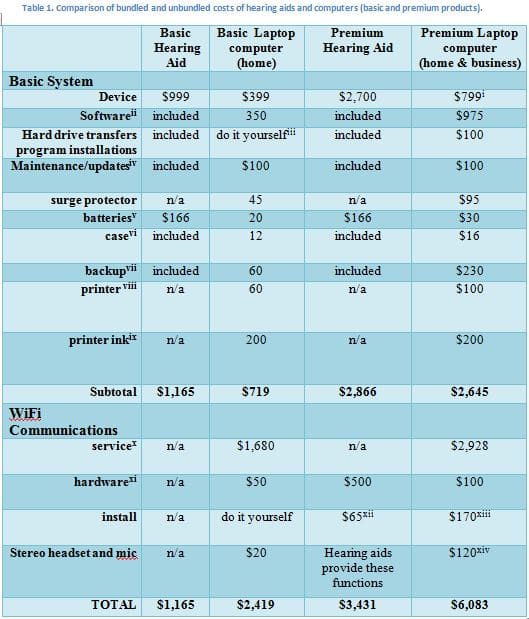
By the time laptop purchasers get their computers locked and loaded with software, pictures, email, data, and printer, they will spend in the neighborhood of $700 to $2650 over the device’s 4.5-year lifetime. The amount depends on how much they want their computers to do, how much installation and maintenance work they want and are able to do, and how they treat their computers. And, despite the “computer in a box” concept of user-friendly PCs, consumers are increasingly switching modes from “do-it-yourself” (DIY) to “do-it-for-me” (DIFM) in response to increasing technological complexity.
In comparison, their hearing aid choices and use over four years will run between $1150 to $2650, depending on what they want their hearing aids to do and how they treat them. In both cases, routine maintenance will reduce repairs and negligence and accidents will increase costs.
Basic Everyman will pay 62% more for his medium-performance hearing aids than he will for his basic computer functionality. Premium Everyman will pay just 8% more for his high-performance instruments than for his good laptop functionality.
If either Basic or Premium Everyman uses Internet and WiFi in his home, his computer costs will increase to $2500 to $6000 over four years. Most will pay that cost because, like a printer, access to the Internet is a key accessory for most computer users: as of June 2013, there were 88 million high-speed Internet subscribers in the United States, “meaning they all use modems…routers…and other household small network equipment.
”
Everyman won’t mind paying the monthly Internet premium because it’s a natural extension of the computer, enabling access to a myriad of communication options. But these new costs change the picture: hearing aid costs are about 50% less than computer costs, even if Premium Everyman adds Bluetooth, at a sunk cost of around $500 (for two aids, not one) and no monthly service fee. Now he has hands-free WiFi connections to his phone, TV, computer and music systems.
Go for the Gold
Table 1 is inherently idiosyncratic and readers will want to plug in their own numbers and categories to arrive at meaningful comparisons. There are also Everyman Scenarios 3 and 4, which I have not discussed but which are available in the Table by assuming Basic Hearing Aid man purchases Premium computer technology or vs. As always in Economics, the conclusion reached is “It Depends.”
I have not included any comparisons of warranty, though it is important to point out to consumers that good hearing aids, be they basic or premium, almost always come with Loss and Damage coverage for at least the first year, with options to purchase extended L/D at the time of purchase or at annual intervals. In contrast, L/D is almost never an option for laptops, perhaps because their theft appeal is higher. Thus, in both Everyman Scenarios, device loss changes the Price comparison substantially.
A previous post suggested that purchasers of “average” hearing aid technology were absorbing some or much of the cost of selling premium technologies. Today’s post, though based on individual choices and lacking in economic data, suggests the same thing. Those who purchase premium products that are properly fit, adjusted and maintained are benefiting not only by optimizing their hearing over time, but also benefiting economically by obtaining more functionality at a lower percentage cost.
Now that’s what I call a bargain. It’s certainly a sufficient argument to give pause to those who insist that hearing aids cost more than laptops. Hope so.
(Editor’s note: This is Part 17 in the multi-year Hearing Aid Pricing series. Click here for Part 16 or Part 18).
title photo courtesy of cafe press