

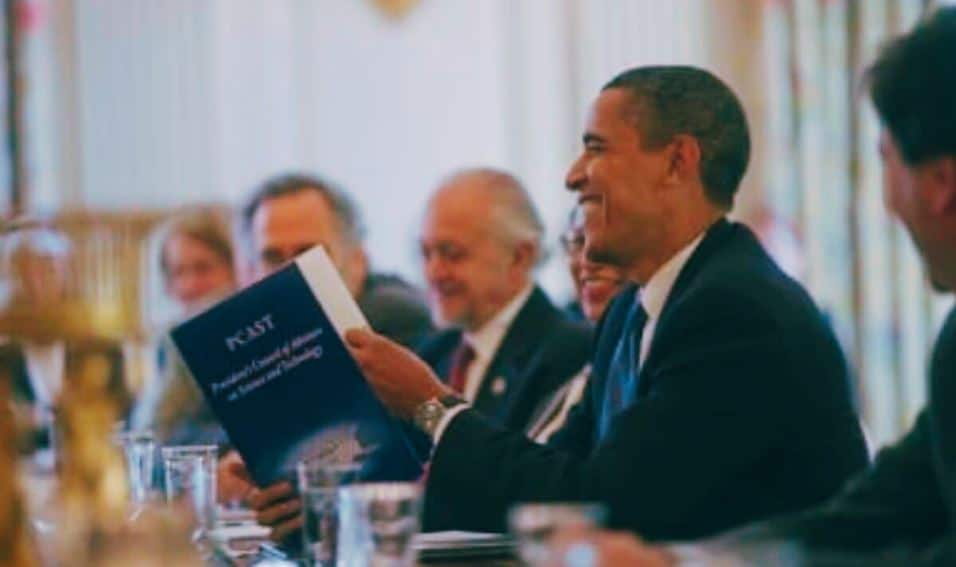
WASHINGTON, DC — The key message during Friday’s (9/18) public meeting of the President’s Council of Advisors on Science and Technology (PCAST) was that 30 million Americans do not have access to hearing care.
The PCAST, originally chartered in 2001, has a broad mandate to advise the President in areas of science and technology. One of the main goals of the council is the use of science-based principles to raise awareness of public health issues.

Christine Cassel, MD
Dr. Christine Cassel, a geriatrician and member of the PCAST council, reviewed several issues surrounding the impact of age-related hearing loss–including the disconnect between the cost of hearing technologies and their access to the majority of Americans with hearing loss. In addition, she reviewed many of the medical and social consequences associated with age-related hearing loss.
Dr. Cassel stated during her 20 minute presentation archived on the web that the current situation involving the cost and under-utilization of hearing aids is one “ripe for a technological solution helped by federal action.”
Prices High & Access Complex
One of the main topics of discussion during the September 18th meeting was the barriers to adoption due to the cost of technology presents many Americans.
Panel members shared with the audience that the average cost is $2400/instrument, and $4000-$8000 is a typical price range; costs which are often not covered by insurance.
Another consumer barrier discussed during the meeting was achieving access to hearing aids and the many complexities associated with it. As the panel indicated, aging adults who suspect hearing loss often must seek out an audiologist without the help of their primary care physician.
The consequences of individuals with age-related hearing loss waiting too long also were reviewed by the panel.
Path Forward
Although the panel has yet to make a formal recommendation, three stated goals with the intended purpose of improving access to hearing care were stated:
1) Reduce the overall costs of hearing technologies
2) Stimulate innovation and technological development
3) Increase the number of people with hearing loss who use this technology
To achieve these goals it is widely speculated that the group’s final recommendation will include technology-based changes in federal regulation to promote innovation in order to improve access. Toward that end, specific items mentioned in the meeting to foster more “consumer shopping” included, allowing consumers to shop for the best value, making internet shopping for hearing technology more accessible, and allowing new entrants into the market more easily.
Possible Longterm Implications
 PCAST makes policy recommendations in areas such as understanding of science, technology, and innovation to the President and the Executive Office of the President on pertinent issues of the day related to public health and science. Recent PCAST reports have addressed antibiotic resistance, online education technology, cybersecurity and climate change.
Although President Obama was not in attendance during the meeting on hearing loss, historically, presidents often follow recommendations of the council when establishing new policies and initiatives.
A random sampling of audiologists and other prominent industry leaders knowledgeable of the PCAST findings suggest many hearing care professionals are bracing for some significant changes in the hearing instrument marketplace. Several speculated these changes are likely to occur in the near future.
Some possible changes mentioned by professionals, who were queried, include changes to the FDA hearing aid regulations, greater consumer access to PSAPs and other hearables for the mild to moderately impaired and possible Medicare coverage of low cost hearing devices.
Given the recent announcement of the IntriCon/ADA partnership, earVenture, the industry may be already adapting to some of these possible forthcoming changes.