


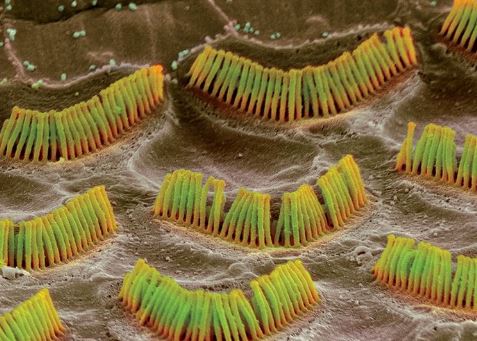
Even though so-called disruptive technology, e.g, over-the-counter hearing aids, has been a big focus of the National Academy of Sciences recommendations to changes in hearing health care, other more futuristic innovations may hold sway in the treatment of hearing loss.
 Hair cell regeneration is one of these potential breakthroughs, and it is the cover story in the summer, 2016 issue of Acoustics Today, a publication of the Acoustical Society of America. The article, authored by Rebecca Lewis, Edwin Rubel and Jennifer Stone from the Virginia Merrill Bloedel Hearing Research Center at the University of Washington in Seattle, provided an update on hair cell regeneration and its potential use as a treatment for hearing loss.
Focusing on Strategy
After reviewing the underlying biomechanics of auditory hair cells, the authors focus on three general strategies researchers are using to coax supporting cells in the mature mammalian inner ear to regenerate hair cells.
The first research strategy involves evaluating the process of hair cell development in the organ of Corti during the embryonic period when these cells move through a complex series of steps controlled by an array of molecular activity. The second research strategy entails a systematic evaluation of how other tissues in the human body, such as skin, intestines and some parts of the brain regenerate, and how these other tissues could be co-opted to trigger hair cell regeneration in the cochlea. Finally, the third research strategy touches on the use of molecular genetics and how hair cell regeneration in birds and fish could be applied to the human cochlea.

Anatomy of the Organ of Corti. Courtesy Brittanica
The authors also provided an update on the use of stem cells and how these cells might one day be placed in the Organ of Corti where they could spur regrowth of hair cells.
According to the article, substantial progress toward hair cell regeneration in humans has been made since 1985, when researchers discovered it was possible to regenerate hair cell in vertebrates. However, several challenges, namely knowing how many of each type of hair cell – inner and outer -needs to be regrown to improve hearing, remain. Although clinicians are unlikely to use hair cell regeneration as a treatment within the next decade or more, research in this area remains promising.
*featured image courtesy newscientist