



LYON & MONTPELLIER, FRANCE – CTIBIOTECH, a leading innovator in human tissue engineering and 3D bioprinting, has been selected by SATT AxLR and CILCARE to support the development of the OrgaEar project, a groundbreaking initiative to create the first 3D bioprinted inner ear organoids dedicated to drug screening for hearing disorders.
Addressing a Critical Public Health Need
Hearing disorders represent a growing global health crisis. According to the World Health Organization (WHO), one in four people will experience hearing loss by 2050, with over a billion young individuals already at risk due to unsafe listening practices, notably through the prolonged use of high-volume headphones.
Beyond the individual impact on quality of life, mental health, and cognitive function, the economic consequences are considerable. The WHO estimates the global cost of unmanaged hearing loss at $980 billion (USD) annually, including lost productivity, special education, and healthcare expenses.
Despite the magnitude of the problem, no pharmacological treatment currently exists to prevent or restore hearing loss. While hearing aids and implants improve sound perception, they do not target the biological causes and remain only partially effective—particularly in noisy environments. Developing innovative therapeutic solutions is therefore an urgent and strategic public health priority.
A Breakthrough Collaboration
The OrgaEar project brings together CTIBIOTECH’s expertise in 3D bioprinting with CILCARE’s hearing disorder research capabilities and SATT AxLR’s support for technology transfer and innovation. The collaboration aims to generate advanced pharmacological screening tools that serve as a bridge between traditional cell lines and animal models.
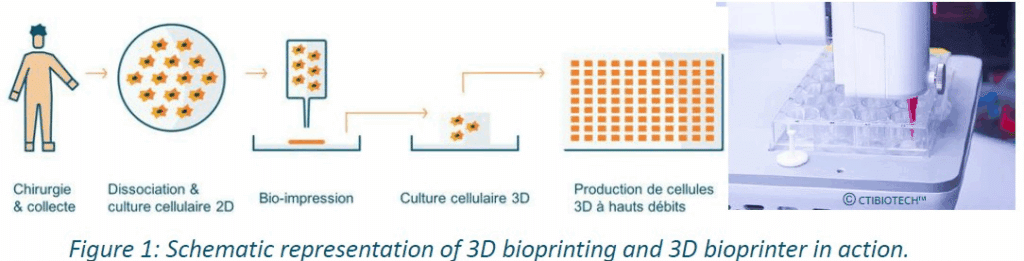
Using human induced pluripotent stem cells (hiPSCs) and CTIBIOTECH’s proprietary 3D bioprinting process, the project will establish standardized, reproducible, and scalable inner ear organoids. This approach ensures reproducibility, optimal quality and yield, and paves the way for industrialization in the medium term.

Protocols for inner ear organoid production were developed by the Bioengineering and Nanosciences Laboratory (LBN) at the University of Montpellier. SATT AxLR selected CTIBIOTECH for its 15 years of pioneering research and development in human tissue biomanufacturing. The company, which recently achieved the world’s first computer-connected skin model with a sensory nervous system, will now apply its biofabrication and automation technologies to the inner ear.
By advancing non-animal New Approach Methods (NAMs), this collaboration positions CTIBIOTECH at the forefront of a cell-based bioassay market projected to reach €28 billion (~$30 billion USD) by 2028 (CAGR > 7%).
“We are honored to have been selected for this pioneering project. Our expertise in 3D bioprinting of complex human tissues, including our ability to integrate functional nerve structures, is particularly well suited to the challenges of this project. Inner ear organoids represent one of the most sophisticated models in tissue engineering, and we are convinced that our bioprinting automation approach will significantly accelerate research into hearing disorders.”
–Prof. Colin McGuckin, President and Chief Scientific Officer of CTIBIOTECH
“This support perfectly illustrates our mission: to put our 3D bioprinting technology at the service of biomedical innovation,” commented Dr. Nico Forraz, Chief Executive Officer of CTIBIOTECH. “Working alongside CILCARE and SATT AxLR, we are helping to develop tools that will accelerate the discovery of treatments for hearing pathologies affecting more than one billion people worldwide. This collaboration fits perfectly with our strategy of reducing drug development costs and time through innovation in automation.”

Advancing Next-Generation Research Tools
The development of 3D bioprinted inner ear organoids represents a major step forward in hearing research by enabling:
• Accelerated pharmacological screening: Standardized, reproducible models for rapid testing of new drug candidates.
• Reduced animal testing: Providing an ethical, more predictive alternative for hearing disorder research.
• Improved clinical relevance: Human organoids offer superior predictive power compared to traditional mouse models.
• Industrial-scale production: 3D bioprinting allows mass production with consistent quality and reproducibility.
“Organoids are set to become essential tools in medical research,” said Philippe Nérin, President of SATT AxLR. “The research program financed by SATT AxLR and the support of CTIBIOTECH, in this key stage, will enable CILCARE to accelerate the development of new therapeutic solutions and thus become the leader in the treatment of hearing pathologies.”
“Organoids are changing the way we think about preclinical research: they reduce the time needed to discover and validate new therapies while improving their biological relevance. This is a key step towards faster, more responsible medical innovation.”
–Sylvie Pucheu, Director of Preclinical Innovation and Co-Founder of CILCARE
About CTIBIOTECH
CTIBIOTECH is a biotechnology company specializing in the development of advanced human tissue models for research, drug discovery, and cosmetic testing. Using state-of-the-art bioprinting and tissue engineering techniques, CTIBIOTECH creates highly realistic and functional human tissue models that provide superior predictive power and ethical alternatives to traditional testing methods.
Learn more at ctibiotech.com
About CILCARE
CILCARE is a biotechnology company specializing in hearing sciences, developing innovative solutions for the characterization, diagnosis, and treatment of hearing disorders and related diseases. Founded in 2014 by three visionary female entrepreneurs, CILCARE now includes a team of 45 international collaborators supported by a scientific advisory board. The company combines an advanced R&D platform, a growing portfolio of drug candidates, and the use of artificial intelligence and machine learning to better understand hearing loss.
Learn more at cilcare.com
About SATT AxLR
SATT AxLR is a technology transfer accelerator that supports the maturation and commercialization of innovations from public research. Based in the Occitanie Est region of France—one of Europe’s most dynamic research ecosystems—SATT AxLR collaborates with nearly 200 laboratories and 11,000 researchers. Since its creation, the organization has financed over 200 innovation programs, invested €80 million (~$87 million USD), signed more than 220 transfer contracts, and supported 150 startups.
Learn more at axlr.com
Source: Cilcare, SATT AxLR, CTIBIOTECH