


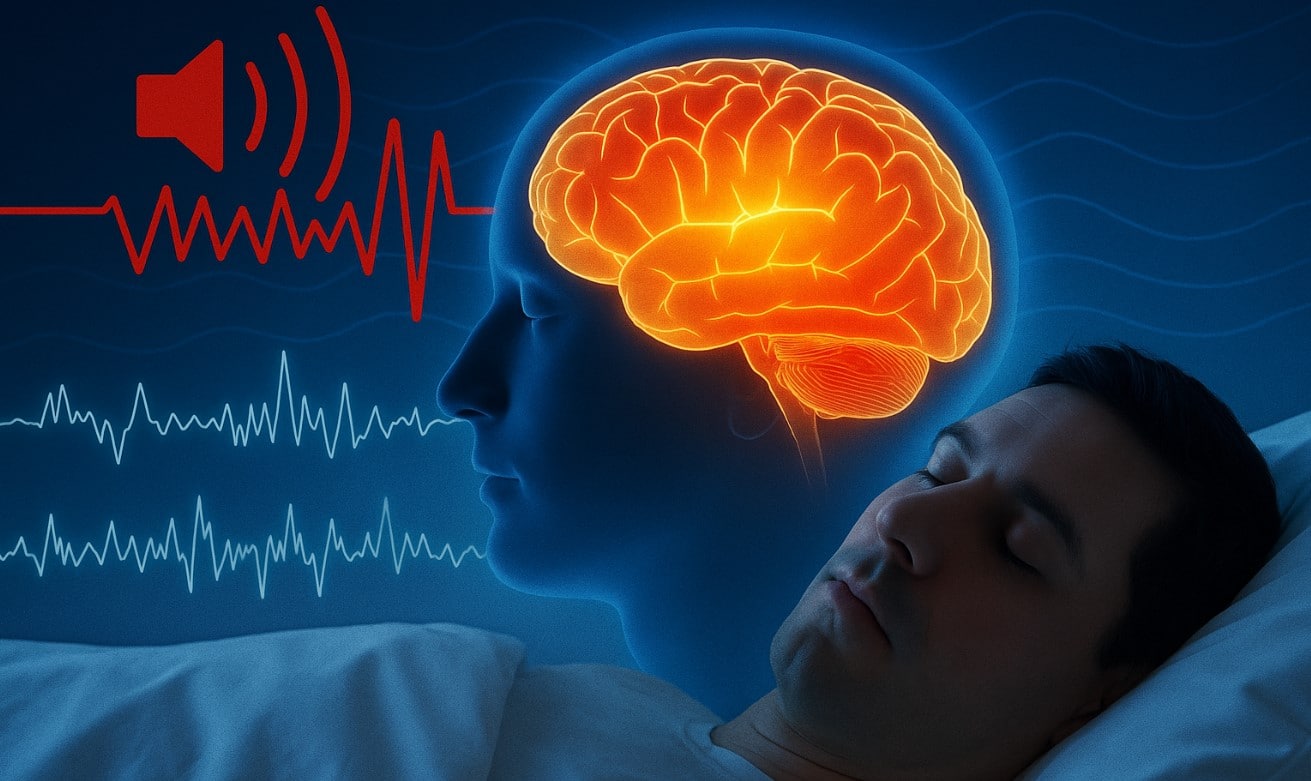
Researchers from the University of Geneva (UNIGE) and the Institut Pasteur have uncovered new evidence that the human brain continues to process threatening sounds even while we sleep. The study, published in Scientific Reports, reveals that “rough” sounds—such as human screams and alarms—evoke distinctive patterns of brain activity that signal heightened awareness, even without waking the sleeper.
This discovery provides new insight into how the brain balances the need for restorative sleep with the evolutionary imperative to remain vigilant to potential threats. It also sheds light on why certain sounds are so disruptive to sleep—and why they have such a persistent emotional impact.
How the Brain Sorts Sounds During Sleep
While it is well known that sleep allows the brain to disconnect from sensory input, researchers have long suspected that certain types of sounds may continue to be monitored. This study focuses specifically on the property of “roughness”—a measure of rapid fluctuations in sound intensity. Roughness is an acoustic property characterized by rapid modulations of sound intensity, between 40 and 100 times per second.
“Unlike speech, where syllables occur at a rate between 4 and 8 Hz, rough sounds hit the auditory system at much higher frequencies, producing a shrill and often unpleasant sensation,” explained Luc Arnal, a researcher at the Institut Pasteur who co-directed the study.
“This quality—typical of audible alarms, human screams, and infant cries—is precisely what makes them so effective: they automatically capture our attention to signal imminent danger.”
These rough sounds are known to directly activate the amygdala, the region of the brain responsible for emotional and threat-related processing. But until now, it was unclear how the brain handled such stimuli during sleep.
Testing the Brain’s Reactions to ‘Roughness’
To explore this question, researchers recruited 17 volunteers to sleep in acoustically controlled rooms while their brain activity was recorded using EEG. During sleep, participants were played various human vocalizations—some manipulated to include high levels of roughness, and others more neutral in tone.
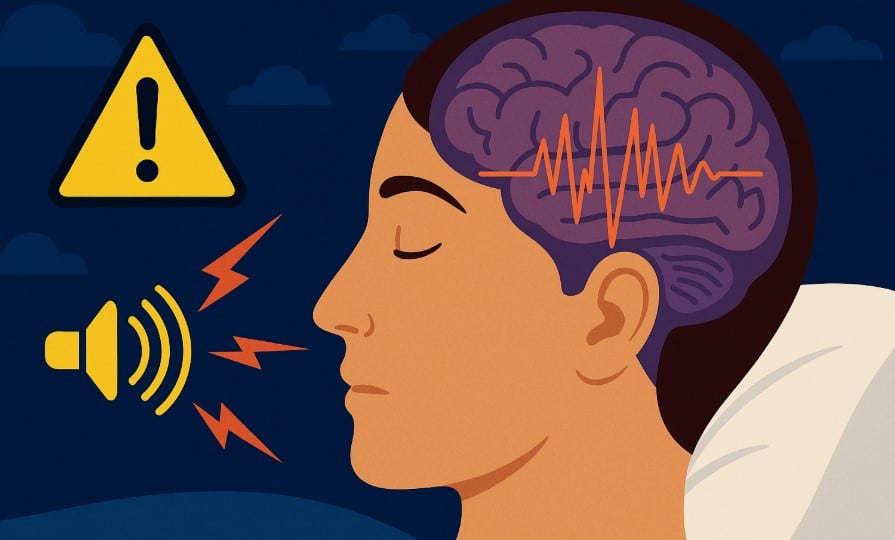
“We then played various types of human cries and ‘false cries’ at low volume, manipulating pitch and roughness to elicit brain responses without waking the participants,” said Guillaume Legendre, a researcher in Sophie Schwartz’s team and first author of the study.
“And it was indeed the roughness—regardless of whether the sound was high- or low-pitched—that activated the brain’s alert systems.”
Not only did rough sounds consistently elicit neural responses, but they also triggered a specific type of brain activity known as sleep spindles—short bursts of electrical activity believed to play a role in processing external stimuli while preserving sleep.
“These are short bursts of brain activity elicited in response to a sensory, and potentially disturbing, stimulus during sleep,” said Legendre.
What Makes Rough Sounds Special?
Previous research has shown that emotional salience can influence whether certain sounds disrupt sleep. For instance, parents often wake more readily to their own baby’s cry than to other infants’ cries. But roughness appears to go even deeper—operating at the level of basic sound structure rather than learned associations.
“Sound roughness is not commonly encountered in everyday environments. In both humans and animals, it’s typically reserved for urgent, high-stakes communication,” noted Arnal.
“However, overexposure to these sound frequencies can evoke very different emotional reactions depending on the individual—sometimes irrational or even aggressive.”
The team’s findings suggest that rough sounds are wired into our nervous system as highly salient, even at low volumes. This could help explain why certain sounds—like alarm clocks, emergency sirens, or even disruptive snoring—are so effective at interrupting sleep.
Implications for Sleep Health and Neurological Conditions
Beyond revealing how the brain processes threat signals during rest, the findings have broader implications for understanding sensory processing disorders and neurological conditions.
“This research is essential not only for understanding disorders such as hyperacusis, but also for evaluating the serious impact of nighttime noise on health,” said Sophie Schwartz, full professor in the Department of Basic Neurosciences at the UNIGE Faculty of Medicine and co-director of the study.
More broadly, the researchers believe this work contributes to understanding the emotional pathways linked to sound. These pathways are involved in a range of psychiatric and neurological conditions, including hyperacusis (extreme sensitivity to sound), tinnitus, epilepsy, and Alzheimer’s disease—many of which involve disrupted auditory or emotional processing.
“And as we live in increasingly noisy environments, especially in cities, it is vital to understand how sounds affect our brain during sleep—and by extension, our physical and mental health,” added Schwartz.
Reference:
Legendre, G.Y.T., Moyne, M., Domínguez-Borràs, J. et al. Scream’s roughness grants privileged access to the brain during sleep. Sci Rep 15, 16686 (2025). https://doi.org/10.1038/s41598-025-01560-8
Source: UNIGE, Scientific Reports