


A 2025 study published in the Journal of Translational Medicine reports a nanoparticle system that could keep medications in the ear longer and improve how much drug reaches the cochlea—potentially reducing the need for repeated injections to treat certain types of hearing loss.
The approach uses polydopamine-coated, mucoadhesive nanoparticles (“Dopa-NPs”) to help medicine stick to ear tissues and cross into the inner ear more efficiently after a standard intratympanic (middle-ear) injection.
Why This Matters
Current local drug delivery methods often lose medication through the eustachian tube before enough can pass through the round window membrane—the main doorway between the middle ear and the cochlea.
Enhancing retention near that membrane could increase drug uptake and improve treatment outcomes for conditions such as sudden hearing loss or drug-induced cochlear damage.

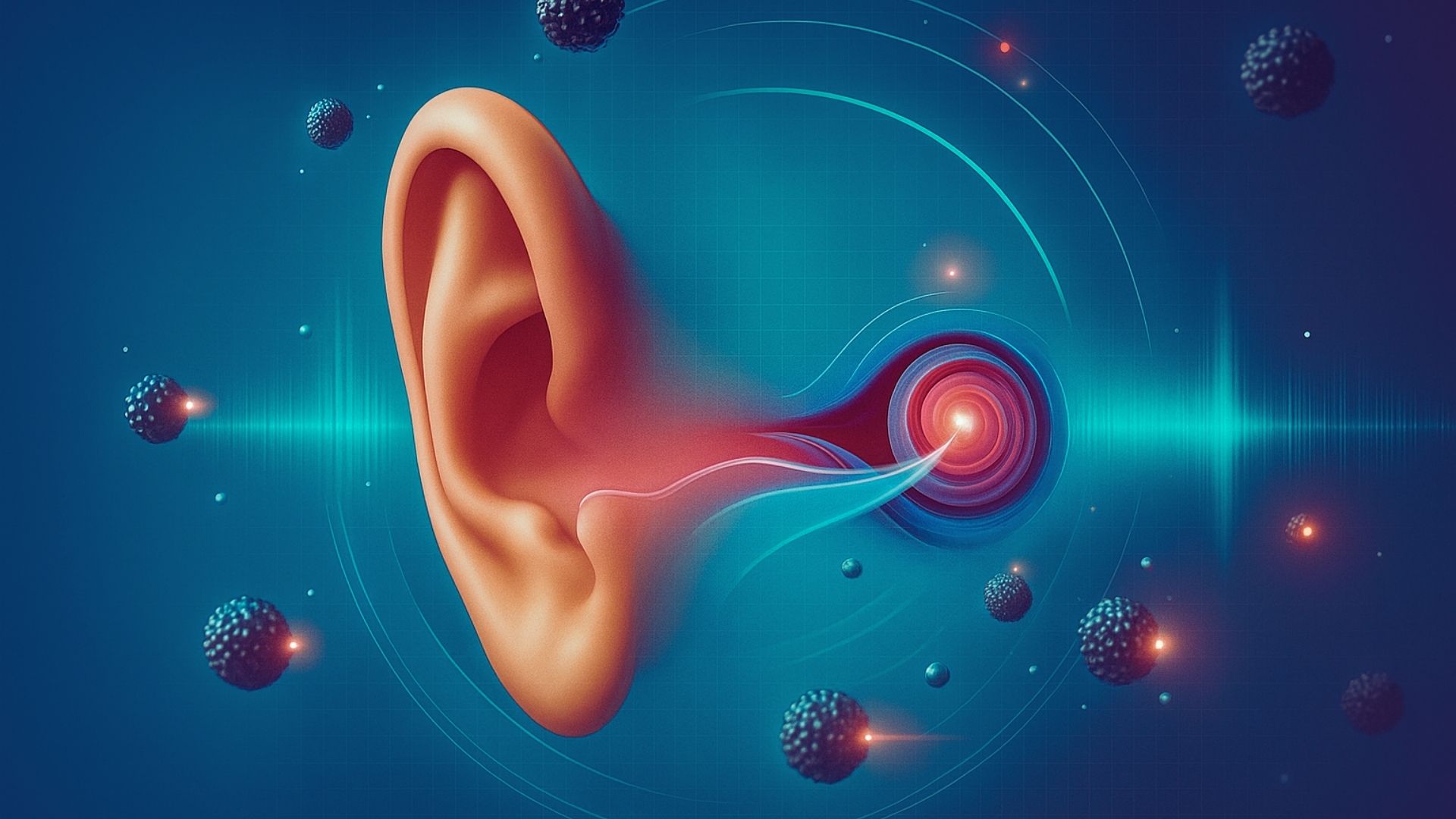
Schematic showing how polydopamine-coated nanoparticles (Dopa-NPs) enhance drug delivery in the inner ear. The coating improves adhesion to the round window membrane, allowing more medication to reach and remain in the cochlea, while uncoated particles are cleared through the eustachian tube. Image credit: Kim et al., Journal of Translational Medicine (2025).
What the Researchers Built
The research team developed a polydopamine surface coating inspired by the adhesive proteins found in mussels. This coating allows nanoparticles to attach more effectively to mucosal surfaces and can be applied to different carriers and drug types—not just a single medicine or material. In principle, the same coating could support delivery of steroids, anti-inflammatory compounds, or even RNA-based therapeutics.
Key Findings in Preclinical Testing
In laboratory and animal studies, Dopa-NPs demonstrated:
-
Stronger cochlear uptake and distribution: In mice, the coated nanoparticles spread widely through the inner ear, concentrating in critical hearing structures such as the modiolus and organ of Corti.
-
Improved drug delivery: When loaded with the steroid dexamethasone, Dopa-NPs produced significantly higher drug levels in the cochlea compared with uncoated nanoparticles or standard dexamethasone solution. Drug concentration peaked about three hours after injection, suggesting a sustained release profile.
-
Hearing protection: In a model of drug-induced hearing loss, mice treated with the coated nanoparticles maintained better hearing thresholds, especially at high frequencies, than those treated with standard injections.
-
Safety: The Dopa-coated particles were non-toxic to auditory cells in culture. Mice that received middle-ear injections showed no long-term hearing damage—only a brief, reversible hearing threshold shift one week after treatment.
Potential for Future Therapies
Because this method enhances how well medications remain near the round window membrane, it could make existing intratympanic treatments more effective and reduce the need for repeat procedures.
The technology also offers a potential delivery platform for future inner-ear therapies, such as regenerative or gene-based medicines.
Looking Ahead
The study’s authors plan to refine drug-loading efficiency and test the coating system with additional therapeutic compounds. While the work remains in the preclinical stage, the findings highlight a promising step toward longer-lasting, targeted inner-ear drug delivery—an advance that could eventually improve care for millions affected by hearing loss worldwide.
Reference:
- Kim S, Cheon SY, Yang KJ, et al. “Mucoadhesive polydopamine-coated nanoparticle-mediated inner ear drug delivery for hearing loss treatment.” Journal of Translational Medicine (2025); 23:1066. DOI: 10.1186/s12967-025-07103-z.