


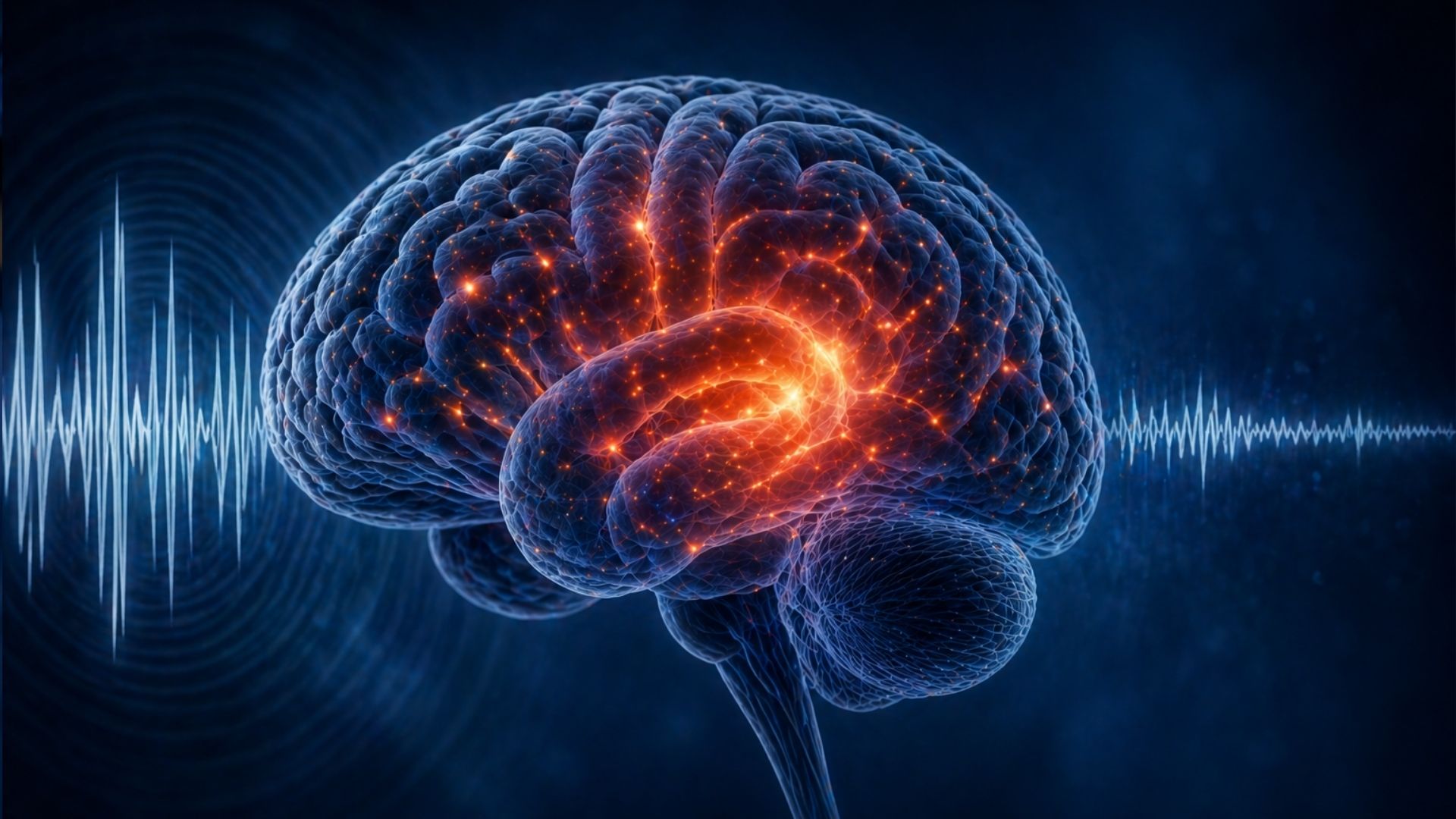
PORTLAND, OREGON — New research from Oregon Health & Science University and Anhui University in China suggests that serotonin, a neurotransmitter commonly targeted by medications for depression and anxiety, may also play a role in worsening tinnitus symptoms.
The study, published April 20 in the Proceedings of the National Academy of Sciences, found that elevated serotonin levels in the brain were associated with increased behavioral signs of tinnitus in a mouse model. Researchers identified a specific serotonin-related brain circuit that connects directly to the auditory system and appears capable of inducing tinnitus-like effects.
Tinnitus, often described as a constant ringing or buzzing in the ears, affects an estimated 14% of people globally. For some, symptoms are mildly irritating, while for others they can contribute to significant distress, anxiety, and reduced quality of life.
Serotonin Circuit Linked to Auditory System
Researchers focused on serotonin-producing neurons that project from the dorsal raphe nucleus to the dorsal cochlear nucleus, a region of the auditory brainstem associated with tinnitus-related hyperactivity.
Using optogenetics, a method that uses light to precisely activate specific neurons, the team triggered activity in serotonin-producing neurons and observed corresponding activity in the auditory region of the brain. The mice then displayed behavioral responses consistent with tinnitus-like perception.
“When you stimulate these serotonergic neurons, we can see that it stimulates activity in the auditory region in the brain,” said Laurence Trussell, Ph.D., professor of otolaryngology in the OHSU School of Medicine and a scientist in the OHSU Vollum Institute and Oregon Hearing Research Center.
“We also saw that animals then behaved as if they were hearing tinnitus. In other words, it’s producing symptoms that we would expect to be experienced as tinnitus in humans.”
The study also found that turning off the circuit significantly reduced tinnitus-related behavior in mice.
“We’ve suspected that serotonin was involved in tinnitus, but we didn’t really understand how,” said co-senior author Zheng-Quan Tang, Ph.D., of Anhui University in China. “Now, using mice, we’ve found a specific brain circuit involving serotonin that goes straight to the auditory system, and found that it can induce tinnitus-like effects. When we turned that circuit off, we were able to ameliorate the tinnitus significantly.

“This gives us a much clearer picture of what’s going on in the brain — and points toward new possibilities for treatment.”
Potential Relevance for SSRIs and Patient Reports
The findings may be especially relevant for people with tinnitus who take selective serotonin reuptake inhibitors, or SSRIs. These widely used medications are commonly prescribed for moderate to severe depression and anxiety and work by increasing serotonin levels in the brain.
According to the researchers, the results are consistent with reports from some patients who say their tinnitus worsens after taking serotonin-elevating medications.
“People with tinnitus should work with their prescribing physician to find a drug regimen that gives them a balance between relief of psychiatric symptoms, like depression and anxiety, while minimizing the experience of tinnitus. This study highlights the importance of clinicians recognizing and validating patient reports of medication-associated increases in tinnitus.”
Researchers Point to Need for Targeted Approaches
 While the study was conducted in mice and does not establish the same effects in humans, the findings provide new insight into how serotonin may influence auditory processing and tinnitus-related behavior.
Trussell said the research points to the possibility of more targeted treatments that affect serotonin activity in specific brain regions rather than broadly increasing serotonin throughout the brain.
“Our study suggests a delicate balance,” he said. “It may be possible to develop cell- or brain region-specific drugs that steer the elevation of serotonin in some brain regions but not others. In that way, it may be possible to separate the beneficial and important effects of the antidepressant from the potentially harmful effects on hearing.”
The research builds on previous work published in 2017 and was supported by the National Institutes of Health, award R01DC004450. The authors noted that the content is solely their responsibility and does not necessarily represent the official views of the NIH.
Reference:
M. Yu, Z. Dai, S. Wang, K. Wang, C. Qin, Y. Zhou, X. Guo, C. Pan, J. Sun, J. Sun, W. Chen, Y. Jin, Q. Wu, L.O. Trussell, & Z. Tang, A discrete serotonergic circuit involved in the generation of tinnitus behavior, Proc. Natl. Acad. Sci. U.S.A. 123 (17) e2509692123, https://doi.org/10.1073/pnas.2509692123 (2026).
Source: PNAS, OHSU