



MONTPELLIER, FRANCE – Cilcare has announced that its INEAR3D project has been selected by the Companies & Campus initiative, supported by the University of Montpellier and its Pôle Universitaire d’Innovation (PEI). The initiative awarded a €50,000 grant to the project in recognition of its scientific relevance and alignment with PEI’s focus on health and sustainability.
Led by Dr. Sylvie Pucheu, Director of Preclinical Innovation at Cilcare, the INEAR3D project aims to develop a human-derived in vitro model of the round window membrane (RWM) using 3D bioprinting technology. Conducted in collaboration with the Institut Charles Gerhardt de Montpellier (ICGM), the project brings together expertise from both academic and industry partners.
Hearing loss remains the most common sensory disorder worldwide and presents ongoing challenges for therapeutic development, particularly in drug delivery to the inner ear. The RWM serves as a critical barrier between the middle and inner ear, limiting diffusion and bioavailability of pharmaceutical compounds.
“The inaccessibility of the cochlea and lack of human cellular models are two major barriers to developing effective treatments for sensorineural hearing loss. With INEAR3D, we aim to overcome these limitations by providing a highly reliable, human-cell-derived platform that more accurately reflects human biology than traditional animal models. This biomimetic tool will enable us to better study and predict how drugs pass through the complex membranes of the inner ear.“
–Dr. Sylvie Pucheu
INEAR3D proposes to recreate the RWM using stereolithography-based digital light processing (DLP), a 3D bioprinting method that allows for the fabrication of multilayered hydrogel structures incorporating specific human cell types and extracellular matrix components.
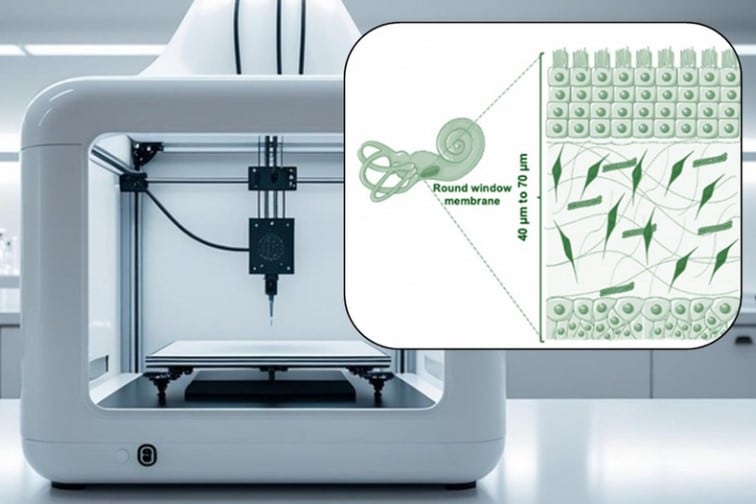
The goal is to establish a predictive and reproducible in vitro platform that can support early-stage drug development.
A 3D Bioprinted Model to Replace Animal Testing
In addition to enabling high-throughput testing of drug diffusion and formulation strategies, the platform is intended to reduce reliance on animal models, aligning with the 3Rs principle (Replace, Reduce, Refine).
“This model will allow us to test compounds and biotherapies more ethically and more efficiently, ultimately accelerating the discovery of new hearing loss therapies”
According to Cilcare, the INEAR3D model is expected to contribute to regulatory data packages for clinical trial applications and investigational new drug (IND) filings. The project also includes the recruitment of a CIFRE PhD student and is part of Cilcare’s broader strategy to advance translational tools for auditory drug development.
The company states that INEAR3D reflects its continued commitment to scientific innovation and its role in strengthening the biotechnology ecosystem in the Occitanie region.
Source: Cilcare