

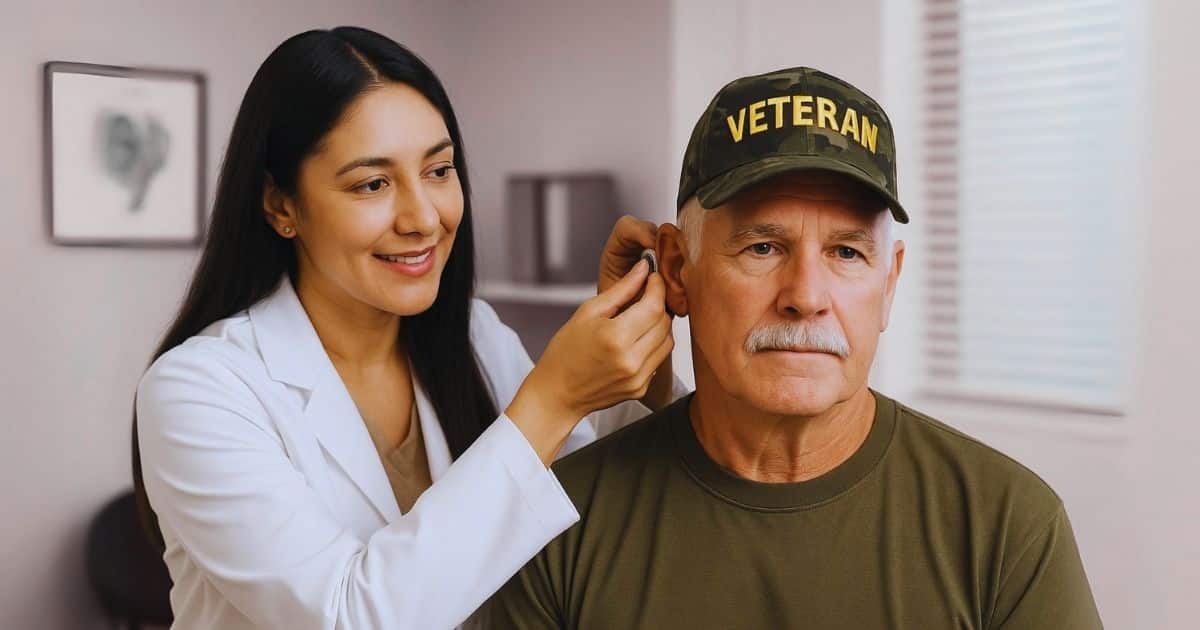
The environments where hearing aids matter most are often the ones they’ve historically struggled to serve – noisy, chaotic, real-world places where multiple people speak at once and the listener is expected to keep up. For audiologists treating veterans, this problem is even more acute.
Veterans bring unique needs into the clinic: high rates of noise-induced hearing loss, elevated prevalence of tinnitus, and the lived experience of environments where communication can carry life-or-death consequences. Add to that the demands of the modern world – frequent group interactions, digital connectivity, and mobile-first lifestyles – and the challenge becomes even more complex.
In this context, understanding speech in noise isn’t just an academic metric – it’s a quality-of-life issue. And recent research is helping the audiology industry reframe what “best-in-class performance” truly means in this critical domain.
A Study That Simulates Real Life
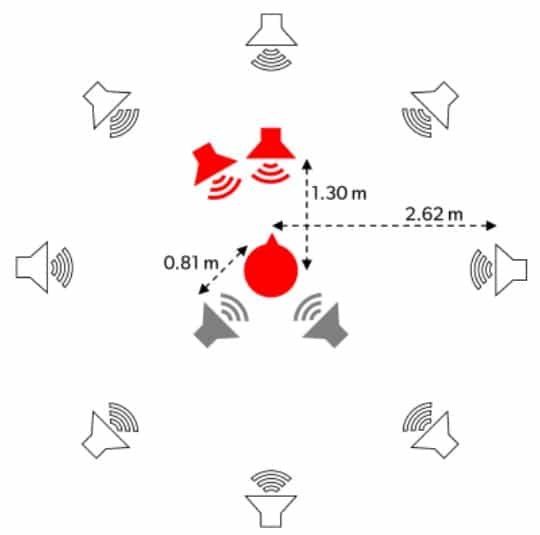
Loudspeaker setup used to simulate a group conversation involving three people. The participant was seated in the center of the setup, and target sentences were presented alternately from the two red loudspeakers, interfering speech noise was presented from the two gray loudspeakers, while ambient canteen noise was presented from the eight white loudspeakers. The distances to the loudspeakers are measured from the middle of the participant’s head (without the participant being present).
A recent third-party study published by Hörzentrum Oldenburg took a fresh approach to evaluating hearing aid performance. Rather than assessing single-speaker comprehension in controlled background noise – a common setup in most manufacturer-sponsored studies – this research recreated a group conversation with multiple speakers and diffuse background noise surrounding the listener. It sought to simulate the real-world scenarios that hearing aid wearers, especially veterans, find most challenging: dinner tables, community gatherings, or support group meetings.
The outcome was noteworthy. The hearing aids using Signia’s Integrated Xperience (IX) platform achieved a 1.5 dB improvement in signal-to-noise ratio, corresponding to a 24% increase in speech intelligibility compared to a leading competitive product with an AI co-processor. Perhaps most significant, 86% of participants performed better using the Signia IX-based hearing aids.
The true differentiator in this study lies in its methodology. The inclusion of multiple talkers, spontaneous attention shifts, and head movements made the simulation more environmentally valid and clinically relevant. This is exactly the kind of test environment audiologists treating veterans have long wanted to see reflected in clinical literature.
Reinforcing Clinical Data with Real-World Proof
Of course, even the best lab simulations still fall short of the messiness of real life. That’s why a second study – this one conducted in a busy food court by the University of Western Ontario – was designed to put the same technology to the test in an uncontrolled, reverberant, and speech-dense environment.
Participants compared hearing aids with and without multistream processing while engaging in group conversation. They overwhelmingly preferred the advanced split processing solution in categories like speech clarity, background noise reduction, and listening effort.
Together, these studies form a compelling case: adaptive, multistream processing isn’t just a new feature – it’s a necessary advancement in solving one of the most persistent pain points in audiology.
What This Means for Veteran Audiology
For veterans, speech-in-noise comprehension can be more than an annoyance – it’s often the chief reason they seek care. It’s also one of the hardest challenges to address, especially in complex social situations where more than one person is speaking. Solutions that excel in quiet, one-on-one settings may fall short when patients return to noisy, communal realities.
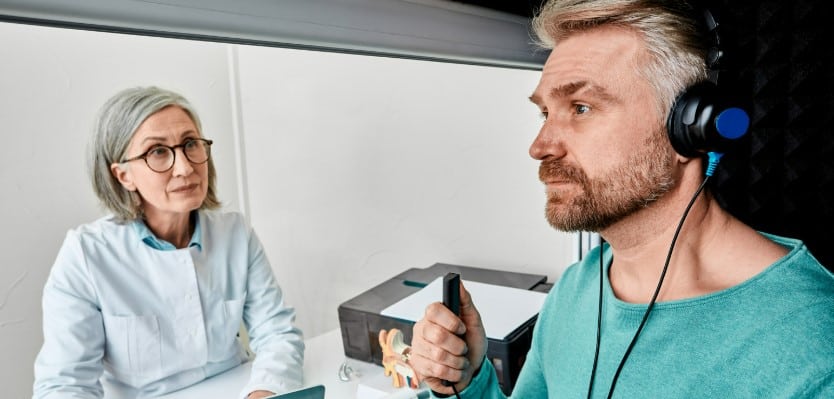
VA audiologists, therefore, face the dual challenge of managing clinical complexity and operational scale. High patient volumes, diverse hearing profiles, and time constraints are the norm. Hearing aids that reduce follow-ups, fit efficiently, and support everyday functionality without compromise are essential.
That’s where the latest generation of IX-powered hearing aids enters the picture. One such example is Signia’s Pure Charge&Go BCT IX, which was recently made available through the U.S. Department of Veterans Affairs. Built on the same IX platform validated in the above studies, it was engineered specifically with VA workflows and veteran lifestyles in mind.
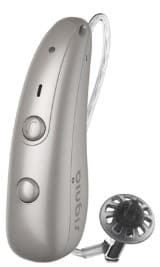 Hearing aids equipped with technologies like Bluetooth Classic compatibility, AI-assisted in-situ adjustments, and SCIF compliance show what’s possible when devices are purpose-built for the needs of veteran patients. These are features that reduce administrative friction for VA audiologists while expanding real-world usability for their veteran patients.
Addressing the Broader Spectrum of Veteran Needs
Speech-in-noise performance is just one dimension of effective hearing care for veterans. Many also experience tinnitus, and increasingly seek hearing solutions that go beyond masking to offer more targeted relief. Approaches like Signia’s Notch Therapy, which reduce amplification at the tinnitus frequency, can be part of a multi-modal strategy to improve outcomes in this area.
There’s also the issue of security – particularly in classified work environments. Some veterans, especially those still working in classified government roles, require SCIF-compliant devices that can disable wireless transmissions.
With Signia, this adjustment can be made directly in the office, eliminating the need to send devices back for reconfiguration. This expands the VA’s ability to serve this segment without compromise.
A New Standard – Not Just for Veterans, but for the Industry
The significance of these studies extends beyond the VA. They challenge the industry to elevate how performance is measured and how technology is applied to real-world needs. For veteran patients, the stakes are high, and the bar should be, too.
The data make it clear that solving speech-in-noise challenges in multi-talker environments is possible. It requires rethinking how hearing aid platforms are designed, tested, and validated – not just in labs, but in the kinds of places our patients actually live and listen.
For the audiologists serving our nation’s veterans, that shift is already underway. The goal isn’t simply better hearing – it’s better outcomes, better participation, and better quality of life for those who’ve given so much.
About the Authors
 Sheena Oliver, AuD, MBA, is the Chief Clinical Officer at WSA, where she focuses on maximizing patient and provider outcomes across WSA companies in the U.S. In this role, she leverages her deep understanding of clinical practice and healthcare delivery to enhance the impact of hearing care services.
Previously, Oliver served as Chief Marketing Officer for WSA Americas region, overseeing marketing and branding initiatives for wholesale and retail brands, including Signia, Widex, Rexton, and HearUSA. She also led the integration of brand teams throughout the U.S., Canada, and Latin America.
Since beginning her career as an audiologist, Oliver has held leadership positions in the hearing aid industry for over 20 years. She brings a unique perspective to her work, grounded in a deep understanding of the needs of hearing care professionals and their patients. Her leadership is focused on driving awareness, delivering value, and increasing profitability by building and inspiring high-performing teams. Oliver holds a BA and MBA from Temple University, an MA from the University of Pittsburgh, and a Doctor of Audiology degree from Salus University.
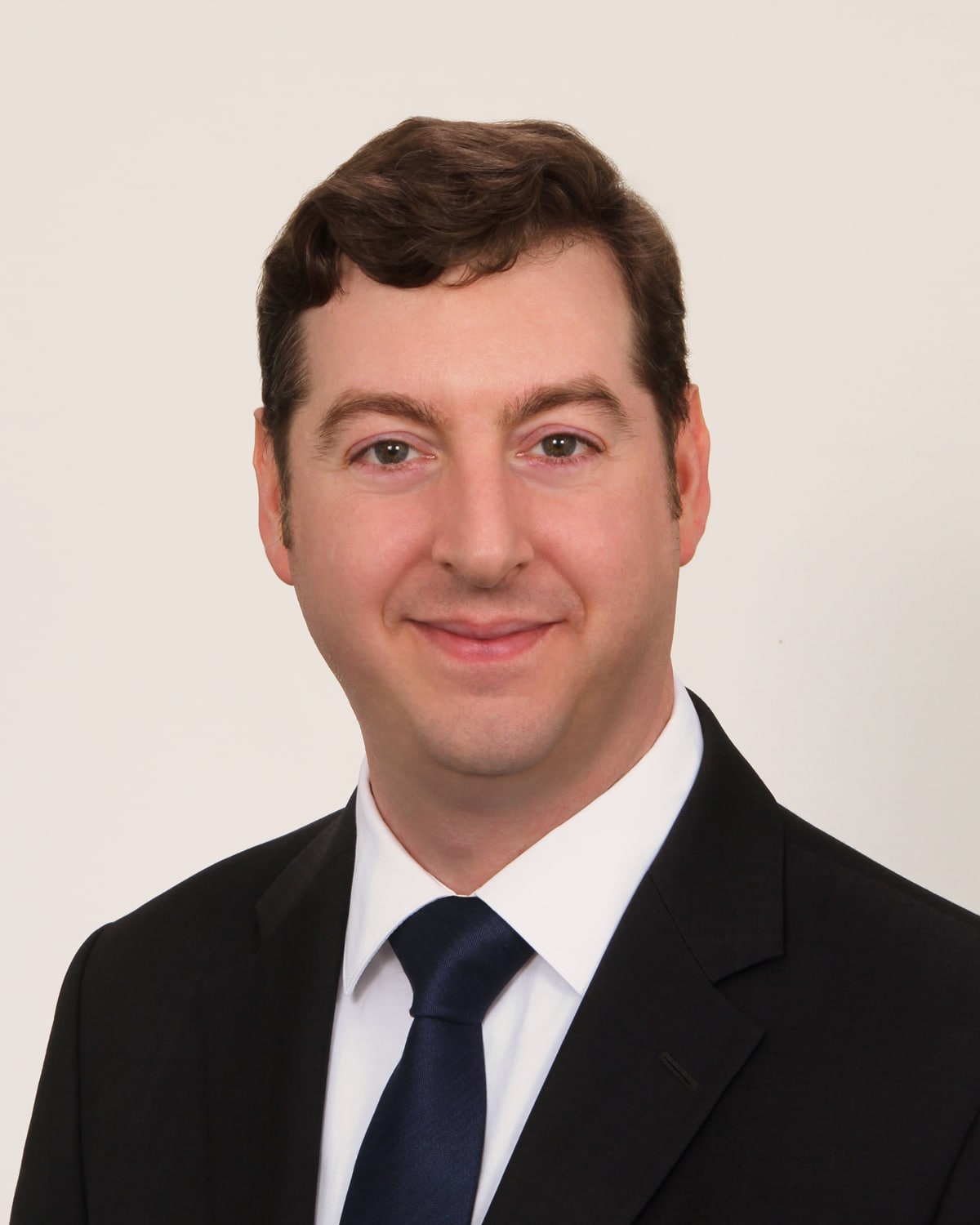 Eric Branda, AuD, PhD, is the Director of Hearing Technology and Research for WS Audiology in the USA. For over 25 years, Eric has been involved in audiological, technical and research initiatives around the globe. He specializes in investigations on new product innovations, as well as with research partners, helping WSA fulfill its goal of creating advanced hearing solutions for all types and degrees of hearing loss. Dr. Branda received his PhD from Salus University, his AuD from the Arizona School of Health Sciences and his Master’s degree in Audiology from the University of Akron.