

The British Irish Hearing Instrument Manufacturers Association (BIHIMA) has released its Q4 and full-year 2025 market data, showing continued overall growth in hearing instrument sales across the UK and Republic of Ireland (ROI), alongside some quarterly variation across sectors.
Public (NHS) hearing instrument sales increased by 6.5% in 2025, reaching 1,886,835 units, compared to 1,771,579 units in 2024. Private hearing instrument sales also rose, climbing 10% year-over-year to 520,818 units, up from 473,961 units in 2024.
Quarterly figures showed mixed performance. Public sector sales increased in Q4 compared with Q3, while private practitioner sales and ROI figures declined over the same period.
According to BIHIMA, UK public (NHS) sales rose 15% quarter-to-quarter, increasing from 438,765 units in Q3 to 503,462 units in Q4. In contrast, UK private sales declined 5%, falling from 136,550 units in Q3 to 129,371 units in Q4, while ROI sales decreased 13%, from 29,263 units to 25,506 units.
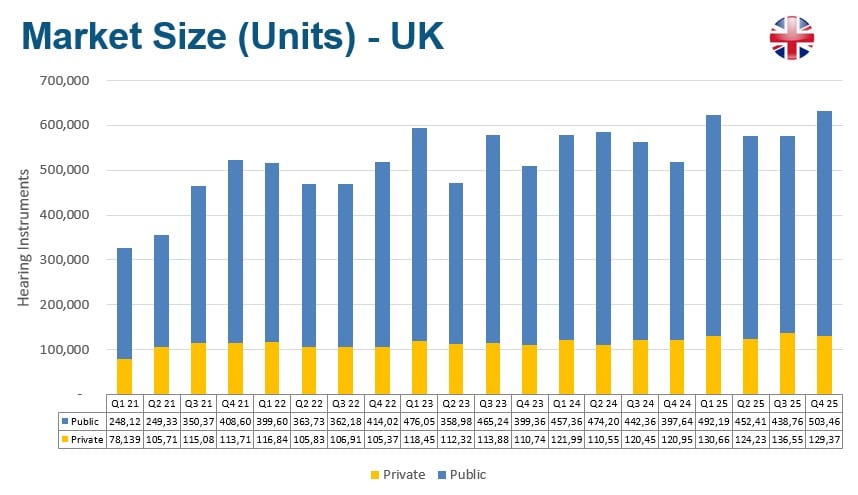
Despite these fluctuations, the full-year results highlight continued market expansion. Total hearing instrument sales across the UK and ROI reached 2,407,653 units in 2025, representing a 7% increase compared to 2024 and building on gains seen in the prior year.

Breaking down the totals, UK public sector sales accounted for 1,886,835 units, including 783,999 devices dispensed by independent retailers under NHS contracts, reflecting steady growth in public provision. Private UK sales remained strong overall, finishing the year at 520,818 units, even with a modest dip in Q4.
Rechargeable hearing instruments continued to dominate the market. While rechargeable uptake remained stable in the public sector during Q4 and declined slightly in private sales, rechargeable devices still represented over 91% of private sector sales. In the ROI, rechargeable adoption increased further, with more than 76% of hearing instrument sales now rechargeable.
“These results show continued momentum in hearing instrument acquisition across the UK and ROI. The levels of demand for hearing care are well documented, and while quarterly shifts in the data reflect normal market dynamics, the annual growth suggests increasing access and prioritisation of hearing care.”
–BIHIMA Chairman Paul Surridge
“We look forward to reflecting on hearing instrument data in the year ahead, which will continue to provide vital insights for clinicians, policymakers and industry stakeholders seeking to understand how service access, technology advancements and consumer behaviour shape the hearing instrument market,” said BIHIMA Chairman Paul Surridge.
Overall, the 2025 data reflects quarterly variability but a continued upward trajectory in hearing instrument adoption across the UK and Ireland.
About BIHIMA: