



Qualia Oto has received a $1.84 million Phase II Small Business Innovation Research (SBIR) award from the National Institute on Deafness and Other Communication Disorders (NIDCD). The two-year grant will support continued research and development as the company advances toward commercialization of its shape-adaptive polymer technology for cochlear implant electrode arrays and the development of an FDA Device Master File.
The award follows Qualia Oto’s previously announced NIH Phase I SBIR grant, which supported development of robotic-assisted, shape-conforming cochlear implant electrode arrays.
“The significance of this award cannot be overstated. From a business standpoint, this Phase II grant is a milestone for the company, highlighting the external recognition of our innovative significance, providing resources that will push us towards market, and strengthening our commercial relationships. From a scientific perspective, the incorporation of our novel electrode arrays into cochlear implants can provide safer surgeries and more resolute implant functionality for new patients.”
–Benedict Voit, Chief Operating Officer and Chief Financial Officer
Qualia Oto’s technology is designed to address several longstanding challenges in cochlear implantation, including variability in electrode insertion, the risk of intracochlear trauma, and the potential impact of electrode positioning on speech outcomes. The company’s shape-adaptive electrode arrays are intended to improve insertion while reducing trauma and optimizing placement within the cochlea.
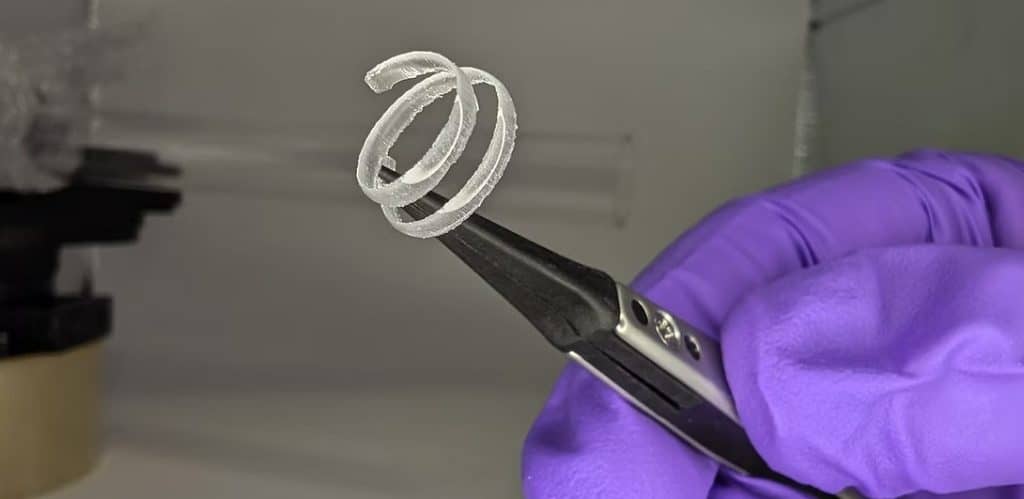
Once straight, this innovative shape-adaptive polymer has coiled upon reacting to higher temperatures. Image credit: Qualia Oto
Technology Aims to Combine the Benefits of Existing Electrode Designs
Currently, cochlear implant surgeons often balance the advantages of lateral wall electrodes, which are generally associated with less traumatic insertion and better preservation of residual hearing, against perimodiolar electrodes, which provide closer proximity to the modiolus and may improve electrical stimulation efficiency and speech perception.
According to the company, its proprietary shape-adaptive polymer technology is designed to bridge this gap. Following insertion along the lateral wall, the electrode array gradually curls toward the modiolar wall within the cochlea, potentially combining atraumatic insertion with improved electrode positioning.
“This Phase II award is a testament to the years of diligent work of a great team that truly believes in the importance of our inventions,” said Qualia Oto cofounder, Chief Medical Officer, and otologist Dr. Kenneth Lee. “I am excited as the CMO of what this will mean for Qualia Oto, and I am even more excited as an otologist of what this will mean for future patients whose lives will be positively impacted.”
Grant Will Support Preclinical Development Through 2028
Senior Research Engineer Dr. Jimin Maeng serves as principal investigator on the grant.
“We are thrilled about the growth this grant will make possible,” Dr. Maeng said. “In Phase II, we will fabricate our shape-adaptive cochlear implant electrode arrays, carry out a sheep implantation study, assess long-term polymer performance through accelerated aging, and complete all required biocompatibility evaluations. By integrating mechanical, chemical, electrophysiological, and imaging analyses, we aim to rigorously validate the technology and build the evidence base necessary for future commercialization.”
As part of the project, the University of Iowa will lead large-animal studies evaluating the safety, viability, and efficacy of the technology. Qualia Oto is also collaborating with NAMSA, North American Science Associates, on preclinical testing and biocompatibility studies, while MCRA, Musculoskeletal Clinical and Regulatory Advisers, will support regulatory strategy, bench testing, toxicological risk assessment, technical documentation, and preparation of an FDA Device Master File.
The Phase II SBIR award will provide funding through June 2028.
About Qualia Oto
Qualia Oto is a biomedical device company developing next-generation cochlear implant technologies using proprietary shape-adaptive polymers. The company’s goal is to improve cochlear implant performance by enabling less traumatic electrode insertion, optimized positioning within the cochlea, and more targeted neural stimulation for individuals with hearing loss.
Source: Qualia Oto