


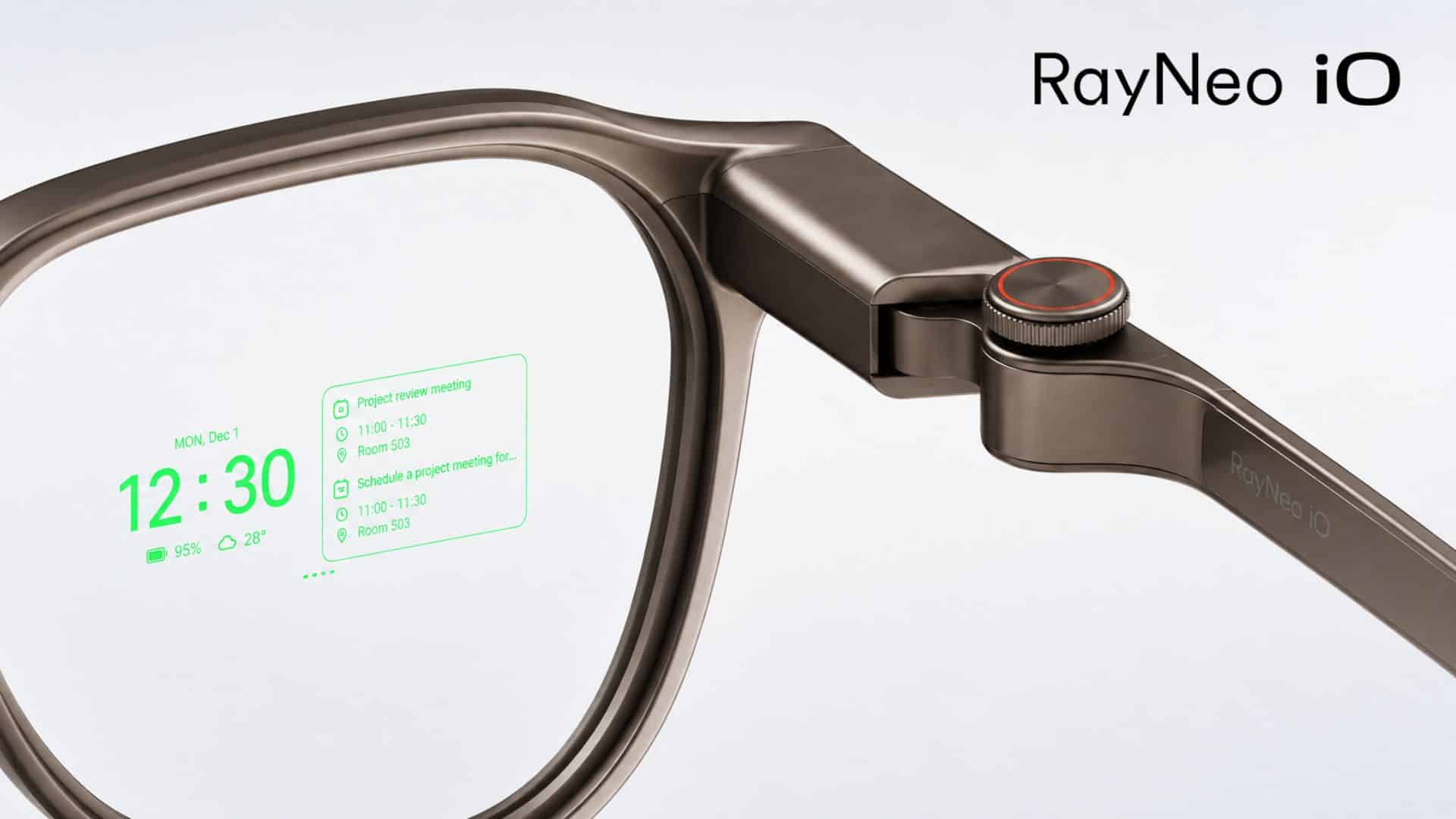
LOS ANGELES, CALIFORNIA — RayNeo has announced the RayNeo iO Smart Glasses, a lightweight pair of augmented reality (AR) glasses that can display transcribed speech within the wearer’s field of view. The company has highlighted the technology’s potential as a communication tool for people who are Deaf or hard of hearing (DHH), allowing spoken conversations to be presented as visual text without requiring users to continually look down at a phone or other screen.
The 33-gram glasses combine a transparent heads-up display with a four-microphone array, bone-conduction voice sensing, AI-assisted features and live translation. The iO was announced alongside the new RayNeo GT and RayNeo GT Max, two AR glasses designed primarily for entertainment and large-format virtual viewing.
According to Counterpoint Research Q1 2026 data cited by the company, RayNeo held a 23.7% share of the global consumer AR smart glasses market by shipment volume. Both product lines are scheduled to go on sale September 4, 2026.
“RayNeo iO and the GT Series represent a fundamental commitment to purpose-built spatial hardware. Rather than compromising with a single device that tries to do everything, we designed two dedicated experiences: the iO as an invisible, all-day assistant for heads-up productivity, and the GT Series as an uncompromising personal cinema for travel and entertainment. Together, they deliver intuitive tools tailored precisely to how people work and relax every day.”
–Howie Li, Founder and CEO of RayNeo
RayNeo iO Smart Glasses: Heads-Up Transcription and AI
For people with hearing loss, one of the more notable aspects of the RayNeo iO Smart Glasses is the ability to present transcribed speech directly within the wearer’s field of view.
RayNeo describes the iO as a visual-first device with no built-in speakers, using its display to provide information while allowing users to remain visually engaged with their surroundings.
Key specifications and features include:
- Transparent heads-up display: The iO uses a 0.085cc monochrome green Firefly Nano Engine and diffractive Blue Lake waveguide. RayNeo specifies 97% optical transparency and up to 1,300 nits of eye-level brightness. According to the company, displayed text remains visible to the wearer while being effectively invisible to people viewing the glasses from the outside.
- Voice capture and transcription: A four-microphone array is paired with a bone-conduction sensor designed to isolate the wearer’s vocal vibrations. RayNeo says the system is intended to support transcription in noisy environments. The iO is a visual-first design and does not include speakers.
- Live translation: Powered by Timekettle BabelOS 3.0, the glasses support real-time streaming text translation across 55 languages and 109 accents. RayNeo reports approximately one-second latency, with translated speech presented visually within the user’s field of view.
- Ambient AI productivity: RayNeo’s Ambient AI Life Log can operate in a low-power background mode to capture schedule and conversation context. Following meetings, the system can identify action items and suggest calendar updates, which users can confirm with a head gesture.
- Multiple AI models: Core features are powered by RayNeo AI and Gemini 3.1 Flash Lite. An optional Multi-Model AI Selection tier allows users to choose among several large language models through the companion app, including Gemini, ChatGPT, Claude and DeepSeek.
- Auto-Teleprompter: The glasses can synchronize scrolling text with the wearer’s speaking pace, allowing scripts to remain visible during presentations without manual scrolling.
- Lightweight design: The iO weighs 33 grams and uses a 50:50 front-to-rear weight distribution. The frames incorporate AZ91D magnesium-aluminum alloy and dual aerospace-grade titanium temples.
- Controls and connectivity: A physical Smart Crown rotary dial is located on the right temple. The glasses support Bluetooth 5.4, Apple MFi licensing for compatibility across Android and iOS devices, and IP54 dust and water resistance.
- Privacy indicator: A hardwired LED status light illuminates whenever recording or translation functions are active.
- Battery life: The 240mAh battery is rated by RayNeo for up to two days of typical use, 18 hours of continuous recording or 6.2 hours of continuous translation.

RayNeo GT Series: Spatial Viewing and Entertainment
RayNeo also introduced the RayNeo GT and RayNeo GT Max as part of the announcement. Unlike the iO, which emphasizes heads-up information, transcription and AI-assisted features, the GT Series is primarily designed around movies, gaming and other forms of spatial entertainment.
The GT Series uses a dedicated dual-chip architecture featuring RayNeo’s Vision 4000 Display Chip and Zone 360 3DoF Chip.
Key specifications and features include:
- Up to 59° field of view: The GT Max uses the Peacock Optical Engine 3.0 Max and a 5.5th-generation Tandem MicroOLED display to provide a 59-degree field of view. Users can select among virtual screen sizes equivalent to 227, 267 or 307 inches. The standard GT provides a 46-degree field of view with virtual displays up to 231 inches.
- Dolby Vision support: When paired with the RayNeo Pocket TV Pro, the GT Series supports native Dolby Vision playback along with real-time AI SDR-to-HDR conversion.
- Hardware-based 3DoF tracking: The Zone 360 processor supports Steady Mode, which is designed to reduce the effects of movement during travel; Pinned Mode, which anchors the virtual display in 3D space; and Follow Mode.
- Bang & Olufsen spatial audio: The glasses feature a quad-speaker system co-tuned by Bang & Olufsen, including head-tracked spatial audio and Whisper Mode directional sound transmission.
- Weight and fit: The RayNeo GT weighs 68 grams and the GT Max weighs 78 grams. The GT Max is offered in three physical interpupillary distance (IPD) sizes: Small for less than 64 mm, Medium for 64–67 mm and Large for greater than 67 mm.
RayNeo iO, GT and GT Max Compared
| Specification | RayNeo iO Smart Glasses | RayNeo GT | RayNeo GT Max |
|---|---|---|---|
| Primary Function | Ambient Heads-Up Productivity & AI | Portable AR Media & Gaming | Cinema-Grade AR Display |
| Weight | 33g | 68g | 78g |
| Optical System | Firefly Nano Engine (0.085cc MicroLED) | Birdbath (BB) | Peacock Optical Engine 3.0 Max |
| Field of View (FOV) | 23.5° | 46° | 59° |
| Display Sizing | Heads-Up Text Overlay | Up to 231-inch (136″/201″/231″) | Up to 307-inch (227″/267″/307″) |
| Audio Configuration | Visual-First (0 Speakers / Bone Conduction + 4-Mic) | Quad Speakers (Co-Tuned by B&O) | Quad Speakers (Co-Tuned by B&O) |
| Tracking & Controls | Smart Crown Dial & Head Gestures | Zone 360 Native 3DoF Chip | Zone 360 Native 3DoF Chip |
Availability
The RayNeo iO Smart Glasses and RayNeo GT Series are scheduled to become available September 4, 2026, through the RayNeo website and the company’s Amazon store.
The RayNeo iO Smart Glasses will be offered in Polar Night (Dark Grey) and Dune (Gold). The GT Series will be available in RayNeo GT and RayNeo GT Max configurations, with custom prescription lens inserts supported across both GT models.
Both product lines are also scheduled to be demonstrated at IFA 2026 in Berlin from September 4–8, 2026.
About RayNeo
RayNeo™ is a global leader in consumer Augmented Reality (AR) glasses. Incubated by TCL Electronics and serving as an Official Worldwide Olympic Partner in the AR glasses category, the company develops wearable spatial computing hardware. RayNeo’s portfolio includes the full-color spatial computing X Series, the portable Air Series, the cinematic GT Series, and the ambient productivity iO Series. To learn more, visit www.rayneo.com.