

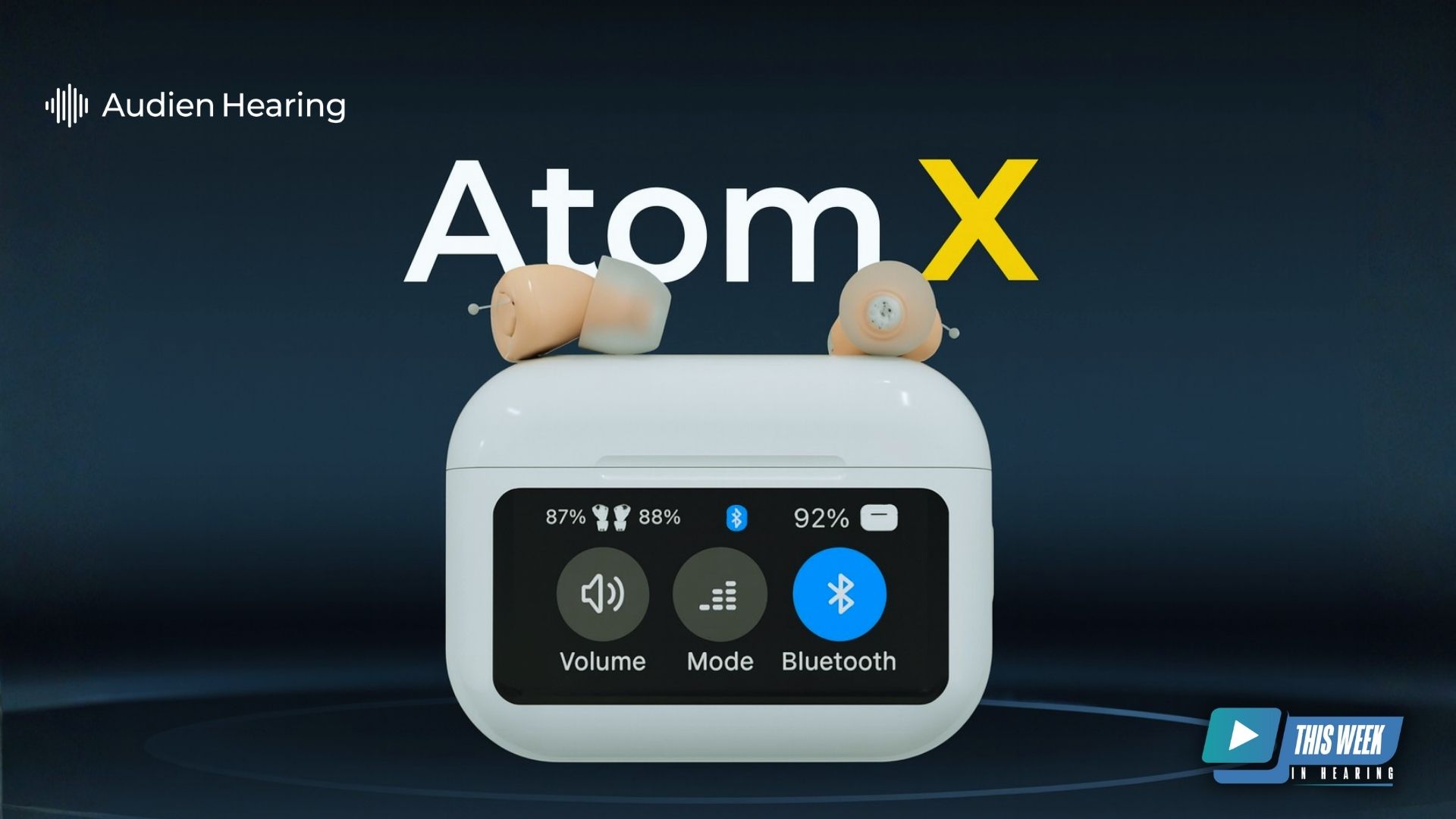
With the Atom X, Audien introduces a new touchscreen-based hearing aid designed for simplicity and accessibility. Andrew Bellavia speaks with Audien Hearing CEO Ishan Patel about the device’s key features and the company’s broader mission to make hearing care more approachable for people around the world.
In this conversation, Patel explains how user feedback from over a million customers shaped the design of the Atom X, which replaces traditional buttons and smartphone apps with an intuitive touchscreen charging case. Andy shares his impressions after testing the device, discussing how its straightforward controls, sound performance, and streaming functions align with Audien’s goal of removing barriers to hearing aid adoption.
Together, they explore how innovations like the Atom X represent a shift toward simpler, more affordable solutions in the growing over-the-counter hearing aid market—and what that could mean for expanding access to hearing care globally.
Full Episode Transcript
Speaker 1: Hello, everyone, and welcome to This Week in Hearing. As hearing aids have gotten increasingly sophisticated, one issue confronting those who design them is the user interface. Traditionally, programs, volume, and other features have been controlled by the buttons on the hearing aids themselves. But as the number of user options increases, remembering all the button controls can be daunting, especially if there’s only one button per side. The answer to that problem has become the smartphone. The visual interface can make complicated options simple. The only problem is that according to the new MarkeTrak 2025 survey, barely more than half of hearing aid users in the United States use their hearing aid smartphone app. Is there something in between that gives hearing aid users without smartphone proficiency good control over their devices? Audien thinks so, having just introduced their new model Atom X with a touchscreen on the charging box. Here to discuss the AtomX and how it fits into the hearing aid market is Audien co-founder and CEO, Ishan Patel. Ishan, welcome to This Week in Hearing.
Speaker 2: Thanks for having
Speaker 1: a bit about your background. You’re welcome. Please share a bit about your background and your path to forming the company.
Speaker 2: You know, hearing loss for me started at home, I think like it does for most people. I grew up with my grandfather having pretty significant hearing loss and watched it effectively destroy my ability to have a relationship with him for a full decade, if not longer. As as a young child, you don’t understand that Grandpa can’t hear. You think, “Why does Grandpa seem so unhappy on his birthday today?” Or, “Does Grandpa not like me? Does he not want to spend time with me?” So, it was something that was just integrated every day into my life experience, and yet for some reason back then, nobody talked about it. When we finally went to go get him help, you know, we were quoted $6,000 for a pair of prescription hearing aids that had to be saved up for, put on a long payment plan, and just was really a challenging thing to access and I know that so many people can’t access. So, fast-forward to 2018 when I actually heard that the over-the-counter industry was being created and that regulations were on the horizon. I actually started working in the online hearing aid space back then, and I’ve taken a grassroots approach. I actually worked pretty much every single position that now exists in the company I have today starting with cleaning and testing hearing aids to understand how the products worked, to doing customer service, to eventually actually doing the phone sales side of it to hear the stories personally of thousands of individuals, their hopes, their dreams, their fears, their concerns. And I learned that everybody goes through a deeply emotional process with this medical condition. This is not just, you know, some take a pill and fix your blood pressure type moment, right? This is something that kind of affects every interaction you have and everything you do in your life. So, I gained a very deep and personal appreciation for that. When I then eventually started Audien Hearing in March of 2020 you know, we wanted to create the most affordable, accessible, and frictionless, ultimately, hearing aid company and hearing aid products that the industry had ever seen, you know, in the OTC category. And that led to us now having over a million, almost 1.5 million customers and being the number one selling over-the-counter hearing aid company in the world.
Speaker 1: Okay, thanks for that background. and your story, I hear a version of your story so often where people have experience with hearing loss either from a family member or personally, and that drives them towards the industry. I’m actually the opposite because I was in the hearing industry first with a company called Knowles. When I finally addressed my hearing loss, I had been with them about five years or so. So, I come at it backwards. But it is interesting and maybe it’s because of the emotional impact of hearing loss that so many people enter the industry and make an impact or try to make an impact based on their personal experience. And so I can see that’s obviously the case with you as well. Now, I mean, I’ve been following Audien for a while and I do see the company has evolved. Like, what direction are you taking now and into the future? how do you see this going?
Speaker 2: Yeah, absolutely. So, you know, first of all, shout out to Knowles. They’re they’re powering the device in your ears right now, I believe, and a great partner of ours. So, with the hearing industry and Jeff, you know, their CEO, he’s a great guy. So I was just with him last week. But, you know, for the industry, I think we’re taking about a 180 approach from what I’ve seen historically. And I know the narrative around over-the-counter is, “Hey, look, let’s bring more affordable hearing aids to the world,” and of course, more accessible. But I think that there’s kind of a component that Audien has which is we can’t just make an affordable hearing aid. We can’t just make an accessible hearing aid. We also have to make a frictionless experience. And that means easy to use with world-class lifetime service that gives the consumer or the user or their loved ones what they need on their terms. So, that really kind of powers everything Audien does. We’re very consumer-centric and data-driven in the sense that we listen to our customers, okay? We started a hearing specialist program. We’re pacing now without growth, and believe me, it’s growing, 100,000 specialist appointments in a year, right? Over 8,000 a month we’re currently executing. We get tens of thousands of phone calls and emails a month. And what we learn-… is the hopes, the dreams, and the stories of every single person that just, you know, that reaches out to us. And, and we’re so grateful for it because the way we evolve our products is rather than making a great product that’s engineered very well, that all the audiologists love, which by the way, we do all that stuff, right that we work with, we start with, what does the end customer want, or their caregiver, by the way? Because in this world, in this new world of OTC, giving a loved one a hearing aid without needing their involvement to get it to them is such a barrier removal. You know, I know my family, I can’t tell you how many I’ve gifted out to the people I love, and these individuals would never have taken that step on their own. So, that’s a critical component as well, is how do you think about the people that are using the hearing aids and then the people that are getting them the hearing aids in the first place and what they need? And what they need is an affordable, accessible, and frictionless solution. You cannot just do one or two of the three. So that’s how we think about every single product and service evolution that occurs. And if you’ve been following us, I’m sure you’ve been seeing that develop pretty rapidly in real time.
Speaker 1: Yes. And one of the things you mentioned there that I want to have a few words about before we talk about the Atom X specifically was the hearing specialist program. So you have access to hearing specialists. Customers have access to hearing specialists now. Is that correct?
Speaker 2: That’s correct. So we, you know, we, we had our head of audiology, Dr. Rachel Trincker, in, in collaboration with, of course, all these, you know, a, a group of wonderful audiologists that helped develop our products and that we advise with, right, ultimately trained a team of specialists that understand how to help somebody end to end, whether it’s setting up the hearing aid, going through the modes, picking the right dome, changing the wax guard, cleaning the devices, or even just emotionally supporting the user, telling them that they can do it, helping them adjust to this new world, and encouraging them and being there for them as sort of a lifelong support member of their, let’s call it family. You know, people don’t realize how important that is. Andrew, I can give you a phenomenal hearing aid, but if you don’t feel good about it, if you don’t feel good wearing it, you don’t feel you look good wearing it, and if you don’t feel encouraged about your future with hearing aids, it doesn’t matter how phenomenal the technology in your ear is. It will be worthless to you because to you, you’ll never have that moment of, “Wow, this is something I absolutely need and love in my life.” And that’s what we drive towards.
Speaker 1: Okay, so to me, that’s a very good thing because… And, and I suspect Audien did the same, is that at the beginning of OTC, everybody thought ordered online, start using it, everything’s good to go. But, you, know, we found out as an industry that people need ongoing support, even if they bought it on their own in the first place. And I’m assuming you found that out too, and plus now you’re capturing a lot of user data.
Speaker 2: Absolutely. I mean, it, it’s the backbone of what we do. We, you know, we did put out the first sub $100 hearing aid offer ever seen in the industry and, and that’s our sort of like claim to fame on the price point standpoint, right, which which allowed a, a bootstrap company from a garage with $500 and $0 in funding to become the largest selling over-the-counter hearing aid company in the world. And by the way, to this day, we’ve taken no funding, no institutional money whatsoever. But the reason we are still here and still standing is because we listened to our customers and we, rather than doing what I think a lot of the industry tries to do, which is, “Hey, we got… We made the money.” We… These are really challenging interactions. These are really risky interactions for our business. We’d prefer if they’re able to succeed on their own and we don’t have to kind of do anything, right? Like ’cause, ’cause there’s no money in that for us, perhaps is how some people think about it. We went the complete opposite. We want, we want to hear from you. We want to learn from you. We want to grow with you, and we want to make sure that when you’re sitting at home thinking, “You know what? I just… I just feel like this ear dome isn’t right,” or, “You know what? I just… I just have question about this situation that I want to use my hearing aids in,” you can pick up the phone and call us. You can schedule an appointment. I mean, you can reach a lifelong support infrastructure that is there not just to, you know, keep your business and, and, and, and try not to talk to you and not be bothered. It’s the complete opposite, to learn from you, to hear from you, and to grow with you, because this is a lifelong thing, Andrew. You know, we’re not shedding off a few pounds and loving our new bodies, right? We’re… We are, we are retraining our brains. We are changing every communication we have. We are reimagining and rediscovering that love for life that you don’t even realize you’re losing, but the people around you absolutely do realize. So, that, that’s really at the root what we do here. I always say Audien isn’t really a hearing aid company, although that’s, that’s the, that’s the absolute tool we utilize to help people. We’re really like a social and cognitive wellness company because why do people wear hearing aids? It’s not just to hear. Why do you hear? It’s to connect, right? It’s to live. Without that, it’s really challenging to have a fulfilling life. And, and so many people are struggling, a billion people in the world, right? And they say 70 to 80% do not use hearing aids. I mean, to me, that’s one of the biggest travesties I’ve ever heard. We’ve got an industry that’s almost 100 years old and yet, to this day, almost 80% of the global market remains unserved. that was the first indication that something had to change.
Speaker 1: Well, our next podcast is going to be about the global situation, right? And what it takes to meet that need on a global basis, which it sounds like you’re obviously aware of and thinking about.
Speaker 2: I’ve got a great plan for that one and, and I’m excited to do that.
Speaker 1: Okay. Excellent. Excellent. But no… I, in, in listening to you, you’re doing your very best to make sure the people who buy Audien hearing aids actually keep them and use them. How about on the front end of that funnel? Do you do anything to pre-qualify people to make sure that their hearing loss is appropriate for the device so you don’t see a large number of returns just based on unsuitability?
Speaker 2: Yeah, I mean, that’s a great question. It’s funny, yeah, the timing is so, so fun. We literally just had a, another meeting about this exact topic in the past week alone, on how to continuously evolve that muscle on the company. I think when we started, it was kind of like letting the world know that this existed, right? And letting people suspend disbelief and start to reignite, rekindle hope, that, wait a minute, there is a company out there that cares. There’s a product out there that I could try that could work for me, right? And that was the focus at first. really just trying to bring in as many people into the opportunity as humanly possible. And as we’ve developed the company, we’ve learned more and more how to fit the right people to the right products. But we remain laser focused on consumer perception. Again, I can tell you what product you need. I can test you potentially. I can fit you potentially, right? Like, in terms of the… I mean, I can’t, but the industry can, right? But if you don’t like it, if you don’t want it, and if you don’t use it, all of it, that’s irrelevant, right? It’s like, if you hand me a Ferrari and I can’t drive, it doesn’t matter, or I won’t drive, it doesn’t matter, right? So that is how we sort of look at the pre-qualification process initially, and it’s evolving very much towards the direction you’ve been describing, but we want to make sure we do it consumer first user first, not like medical clinical perspective first, because I think that matters. Is what circumstances do people connect with in their life? You’ll look at the Atom X that we’ll talk about in a few moments here, I’m sure, and you’ll see the different modes, right? How are they communicated? They’re communicated to match the circumstances that people experience in their daily life and that they can relate to in needing hearing aids. Now, behind the scenes on the tech side, does every mode have a different frequency adjustment, different sound profile settings and different technical advantages depending on the type of hearing loss you have? Of course it does. But if I sat here and told, maybe not you because you come from the industry, but somebody like my grandfather, “Hey, we’re going to adjust for your 3 to 5000 hertz frequency loss with this decibel gain,” and, you know, to them it’s, it’s meaningless, right? So when we talk about pre-qualifying, we really try to take the user’s perspective and to them it’s, okay, will this feel good and look good? Will this work for me if I want to watch TV, go to dinner, talk to my children, right? Will this fit in my ear? You know, can I take a phone call? Do I want to, right? Like that’s the first step, is matching them circumstantially to what they feel they want, what they feel they need. And then we, what we do is on the back end, of course, if there’s any misalignments that they determine in daily use, we, we quickly are able to move them and match them to the right product, which is why our return policy is 100% money back guarantee, which is why our service is lifetime and unlimited, right? And which is why we, we embrace feedback to, to help people land in the right product for their situation, from their perspective, not from my perspective. So hopefully that answers the question.
Speaker 1: Okay. And, and the implication there then is if I want to, I can talk with one of your people before purchasing the hearing aid and make sure I have the right fit for me.
Speaker 2: Absolutely. Absolutely. You can go online, you can look at the, the different information on, and pick what’s best for you. You can call our team, they’ll walk you through it. You know, you, you could there’s, yes, whatever way works for you, Andrew, we’re here for it.
Speaker 1: Okay. Okay. And so then how did this lead to the Atom X? Why did you decide that the smartphone case was actually needed versus controlling with the buttons or having an app? mean, I kind of gave away the… right? But tell me how you thought about this and how this ended up arriving on the scene.
Speaker 2: Yeah, absolutely. So first of all, we had to take some critical learnings, which is that… And maybe we’re giving away a little secret sauce here, but it’s already done, so it should be okay. We’ve a billion people in the world with hearing loss, okay? We know approximately 70 to 80% don’t use hearing aids, and that applies to this country as well, right? Why? So affordability, accessibility and ease of use. Let’s, let’s limit it to three for the sake of example. So when we considered bringing out products, we have to hit all three. And we started on the most, the lowest barrier to entry for the consumer, which is how do we bring a product to market that’s a single button touch control, in the ear form factor, which Andrew, here’s a surprising fact probably. I mean, you know this, but with Audien’s internal data, last I checked, about 85% of the global prescription hearing aid market is a, is a RIC or BTE fitted behind the ear form factor, right? We, we know the obvious technological advantages of this form factor and that’s why we have it in our own company. But let’s go back to what people care about, what they think. Nobody wants to wear that. So many people see that, non-starter. And even though I can clinically prove all day it’s a better product than anything else out there, it’s irrelevant because it’s a non-starter. So what we found was, especially in the OTC world and, and getting people to take that step earlier in the hearing journey, is this, is an in the ear form factor…. was such a better approach to what people wanted versus what they potentially needed. Now, I’m not saying people don’t need this and they’re not succeeding wildly with it, which they are, right? I’m just trying to tell you how we approached that. So that was the first piece, and we proved that out with our first million customers, right? Irrefutably. The second piece was ease of use. Okay, mobile apps, like you mentioned at the beginning of this call, and to add some more data. They say about 61% of people, seniors are using smartphones. Okay. Let’s just say about half of those people, or even less than half are even using iPhones, and then what fraction of those people want to interact with mobile apps to have to control any devices? as you go down the list, it becomes a very small portion of people, right? You mentioned that half of the hearing aid users are using smartphones, but the hearing aid users only represent 20% of the hearing loss population. So when you take half of them, that’s 10%. Only one in 10 people with hearing loss uses a hearing aid and uses a smartphone. So that tells you it’s not half… the miss is not half, the miss is 90% of the market. So that was another component, which was how do we bring something to the world that the other 90% of people will love and need virtually no instruction to succeed with? How do you make a hearing aid so smart that it’s simple? In fact, how do you make it simple… or, I’m sorry, how do you make it smart because it’s simple? Right? And that was how we landed on the Atom X. We wanted to create a product that when you use it, it is easier to just hold the screen up than to even explain what you’re looking at because the brain so clearly intuitively understands the controls on there, because it is the mixture of a TV remote and your smartphone, and every… between, between those two types of technology, everyone on planet Earth virtually can, can intuitively pick that up and understand that. And we wanted to find that beautiful middle ground and then take the customer forward and continue to evolve that from where they’re at by meeting them where they’re at. So that’s how the Atom X was born, by listening to our million customers, looking at the gap in the market and viewing those people as the people that we are here to serve versus the people that don’t spend money, the people that don’t make the industry billions, and the people that have been ignored for 100 years. We said those are the people we want to champion and we want to bring something to the world that they will love and that they will succeed with, because if we can help them take that first step on the hearing journey and be with them through their life, the ripple effect of that will literally change the world.
Speaker 1: And it’s very clear that making it simple for people was one of the goals, and, and I could see that applied in another way too. You actually don’t have different presets. So in other words, the hearing aid is providing a fixed amount of gain for each given situation and so I guess I have a question. Where does that fit then within the range of mild to moderate, and how did you decide to stick with one preset only versus using the smartphone case to give people a couple of different fitting options?
Speaker 2: So I will, I will nuance what you said a little bit because it’s, it’s halfway correct, which is that those modes actually do… although the volume, of course, adjusts the literal amplification output and that, that form of gain. Those modes actually were carefully constructed from rigorously split testing with our, with our customers on what works best for those presets. So actually, in some of those modes, you will see different gain amplification on different frequency spectrums, right? And you will see different kind of environmental responses considering like a, a crowd versus a TV mode. So while the, the user is not manipulating that and, and that mode is preset in that way, each mode allows for kind of a a simulated effect of having total control without feeling like you need to be responsible for the control. So the way we did that was by split testing different frequency and gain settings across each mode within our previous hearing aids. So we would put out iterations of modes and we’d literally hear from the customers and look at their response on where they were succeeding and why, and how we needed to adjust the the… sort of the programming on the back end and then roll out a new set of programming within the same form factor of the same product to then test it again. So this was actually very… like, the, the four you’re looking at right now, we didn’t, we didn’t just choose them because of the four most common sort of environmental settings that people like. We actually chose them… let me rephrase that. You chose them because the
Speaker 1: Yeah. You essentially crowdsourced the settings, correct?
Speaker 2: Yeah.
Speaker 1: if I’m working in the quiet situation mode, you’ve essentially crowdsourced what the median gain would be to satisfy the most people and just fixed it there.
Speaker 2: Exactly right, because at the end of the day the goal is to impact as many lives as humanly possible and by listening to those people, you know, we learn not everything we need to know, but as much as we possibly can know and, and continue to learn in that way.
Speaker 1: Okay. And so I can see like the Atom X is the next evolution of what you’ve been doing and you’ve got both RIC and-in-ear form factors, and all this is against the backdrop of OTC continuing to evolve. So, you know, at a high level, without giving away anything confidential, how do you see OTC continuing to evolve over time and what path will you take going forward in order to continue to meet those evolving needs?
Speaker 2: So those are, those are kind of two different questions, but they, they, they blend into each other. So it’s how do I see OTC continuing to evolve? I see the way … people are using OTC, and then I see the way that we, the direction we’re going, which again, is, is frankly just different from the industry. So to speak to the, to the, to the standard industry sort of approach that I’m seeing is people, based off of, again, my experience and my, my, my perspective here, people have used OTC as a way to reduce the barrier to entry for, for medical products that are necessary, and let’s talk specifically hearing aids here. But they also, unfortunately or fortunately, you know, big business enterprise look at as, look at it as a money-making opportunity, right? You know, as an opportunity to capture a sector of the market that wasn’t captured before, and, and, and, and, and capitalize sort of on momentum from that. And I think that’s why OTC hearing is, is being dominated by Audien, right, and why we outsell, to the best of my knowledge, if you were to take the second, third, and fourth place companies in terms of unit sales, we’d probably outsell all of them combined at this point, right? Because the way we look at OTC is letting us take the broken healthcare system and the highly evolving consumer product industry and marry them together. It’s how we will consumerize healthcare while providing, let’s call it, clinical grade service and experiences, but consumer-forward and consumer-first solutions. So Audien Hearing will ultimately become, and is already becoming, a health platform, not just a hearing aid company, because yes, I can give you a hearing aid, but what are you doing with it, Andrew? You’re living life. And now that you can live your life better, what else do you need, right? How else can we serve you? And how can we leverage this incredible direct relationship we have with the consumers, direct communications we have with consumers, to provide them what they need in their life and help them understand, these hearing aids are just the tip of the spear. You know? they’re just the, the, the tip of the iceberg. What can you now go do with this newly empowered life? What connections can you make? How can we tackle social, social isolation, stress, Alzheimer’s, dementia, brain health, cognitive function, and even physical health? Because now you can go to the gym, go to your trainer, and hear them, feel happy, feel empowered to interact. You know, that is how we look at OTC. OTC is the doorway to bringing the type of healthcare and support that the American people and the global population desperately need and have, frankly, been begging for, that the big sort of giants in the industry don’t want to give because guess what? Now instead of charging thousands of dollars for an interaction that can be handled for free by Audien, or hundreds of dollars for an appointment that that can be handled potentially for free by Audien, they have to face the reality that they would be putting people first, not profit. And that’s not… You know, we’re the opposite here at Audien. So I think that that’s that’s, to me, what OTC means and why it’s the most powerful, one of the most powerful regulations in the history of this country and, and therefore the world. You know, when I looked at the, the, the vote, right, when this vote was done on OTC back in 2017, in what could be considered a very divisive political climate, and I think like, you know, many can agree with that, the beautiful thing I saw was that this vote was passed with 95 votes, 94 to one approval. You know, Andrew, I can’t name a single other thing that went from being a political discussion to a human discussion. You know
Speaker 1: So you must be talking about the vote in the Senate when you say 95, and I don’t remember the numbers. But I also have to say what you say about the industry and your place in it has some validity, but not necessarily across the board. So for example, with the severity of my hearing loss, an OTC is inappropriate.
Speaker 2: Absolutely.
Speaker 1: Nor would I be able to get to the place I’m at without the use of a professional audiologist.
Speaker 2: 100%. Yeah. When I, when I speak, that’s why you said, “How do you see OTC?” I’m specifically speaking to the segment of the, of the world population that can succeed in the mild to moderate range, and by no means you know, infringing on the, the incredible value and success that, you know, your experience has had. I will say to give a teaser, you know, we’d like to be hearing for everyone, not hearing for almost everyone. So there, there, there is a, there is a path and a future to, to bring our worlds together, and I think take everything that you’ve learned and experienced, everything we’ve learned and experienced, and create a path that, that hopefully anybody can succeed with.
Speaker 1: Well, and this is a good point because there are many places in the world where audiologists don’t even exist or barely
Speaker 2: That’s
Speaker 1: including rural parts of the US where you might have to drive 50 miles to get to one, and who might be, you know, booked out for months, let alone places in the world, for example, I’ve gone a half a dozen times for a different purpose to rural Honduras, which is where people live in, in small communities up in the mountainside, and there’s a few audiologists in the two big cities within Honduras, and they’re hours away, and you’re talking about people who don’t have cars.
Speaker 2: Absolutely.
Speaker 1: So how do you serve them? And clearly you have ambitions to serve populations like that one too, am I correct?
Speaker 2: 100%. It’s, it’s, it’s why we exist. You know, I’ll, I’ll say something being a lifelong lover of Apple and a and a diehard fan, right? I’ve got the new phone on the way. So by no means is this shade, Tim Cook, if you see this. I have a lot of respect and love for the company and for Steve Jobs, who sits rightfully so on my, on my bookshelf right there. But, you know, as incredible and breaking is this piece of technology is, there’s just one thing about it that I feel is sort of amiss, which is that like-… the rural population in Honduras will never get an iPhone. It is simply cost and access prohibitive. So, the question for me was not just how do we make affordable hearing aids, but how do we make them so affordable in some circumstances that the farmer in Africa or in Zambia, Lusaka, where my dad was born and where he’s from, right? You know the, the, the teacher in Honduras, right? Like, how do we make it so that people can access and afford that? And you know, when you have a $98 entry price point and then you can go talk to governments and institutions and get support to execute a program that could change millions of lives for, for a fraction of the dollars that are spent in the traditional healthcare systems, which will then produce a a community of people that live happier, healthier, longer, better, higher GDP lives. Like, it… why not have it all? Why not benefit and stimulate an economy while changing and saving lives? So Andrew, that is, that is, you know, not just a focus of mine, but a mission. Like a, a, a… almost a target, I would say. And I’m already beginning to have incredible conversations with different people and different world leaders in different areas without spilling too much that I’m hearing that the world is wanting this. You know, the people are wanting this. and governments even see it as a very real thing that needs to be solved. So, the same way we spent the last five years kind of pioneering the OTC industry, you better believe the next five years are going to be spent bringing it to the world.
Speaker 1: I love it. Music to my ears. I very much appreciate your attitude towards serving the global population, so… and also appreciate you spending some time with me to go through it all. Any final words before we close it out?
Speaker 2: No, no. Thank you so much. You know, it’s, it’s rare to have somebody with your experience in the industry, your experience with prescription, and really a three-dimensional view of the world, so it’s been a really great conversation… of the hearing world. You know, it, it’s been a really great conversation and I, I relish in the opportunity to learn from individuals like yourself as well because I truly believe, like, this isn’t a prescription/OTC divide. This isn’t a, a, a big pharma versus the little guy divide, although there’s a lot of that happening, I’m sure. This is a human condition that a billion people need and that we all should be working together to solve. So that’s kind of my closing comment, is Audien Hearing’s slogan is “Hearing for Everyone,” and that means everyone. So that’s sort of my closing remark.
Speaker 1: Excellent, and I’m looking forward to watching as you fulfill the global ambition of spreading effective and affordable hearing care throughout the world. So, thank you for spending some time with me and thanks to everyone for watching or listening to This Week in Hearing.
Speaker 2: Thank you so much.
Speaker 1: Thanks to Audien for sending me a set of Atom X to take on a test drive. The touchscreen interface is simple and easy to use. Mode changes cannot be done on the earbuds themselves, but require the screen. This may have been done for simplicity, and I’m okay with that. While switching modes on the screen, both devices change together. That’s great, but volume control is another matter. Each ear must be adjusted separately. An option to link them together would’ve been nice. This is also true of the buttons. With the case responding to volume changes on the buttons, it could then transmit the volume command to the other ear. Then I wouldn’t have to fiddle with each ear in turn. I tried the Atom X both in quiet and noise. In doing so, I had to keep my experience in context. With my hearing dipping into severe territory at 2 and 4 kilohertz, no hearing aid in this class, with single mics and without beamforming, is going to satisfy me in noise. That proved to be the case here. My question was, how will it do in quiet? If I’m at home and my daughter sings to me a tune, like in that famous heartwarming ad, will I hear her better wearing the Atom X? The answer was a clear yes. I wore them for hours at home and in several shops. Unsurprisingly, as this is an OTC device, I did have to put the volume to max. Then I found speech was clear and occlusion was not excessive. For situations like these, Atom X is a viable starter device. Streaming music quality wasn’t bad for a hearing aid either. The case controls then offer streaming volume and four levels of ambient. The streaming volume controls the earbuds, not the phone volume, at least on Android. If the phone volume is too low, there’s no way to increase it to a usable level with the case controls. Set the phone volume to about three quarters and the case control will cover the full range you desire. When talking about the need for hearing care solutions to fit global circumstances, I’ve always said that a 70% solution is better than a 0% solution. I was encouraged about Ishun’s global goals after trying the Atom X. A version of this device, designed for local environments, could easily be fitted at local health clinics and enable people to hear better. When I think about the small town that serves as our base in rural Honduras, loud restaurants are less of an issue than conversations in quiet, or on the phone. I have the privilege of affording high performance prescription devices. Many people in the world do not. This device, and its cousins, are also meant for them.
Be sure to subscribe to the TWIH YouTube channel for the latest episodes each week, and follow This Week in Hearing on LinkedIn, Instagram and X.
Prefer to listen on the go? Tune into the TWIH Podcast on your favorite podcast streaming service, including Apple, Spotify, Google and more.
About
 Andrew Bellavia is the Founder of AuraFuturity. He has experience in international sales, marketing, product management, and general management. Audio has been both of abiding interest and a market he served professionally in these roles. Andrew has been deeply embedded in the hearables space since the beginning and is recognized as a thought leader in the convergence of hearables and hearing health. He has been a strong advocate for hearing care innovation and accessibility, work made more personal when he faced his own hearing loss and sought treatment All these skills and experiences are brought to bear at AuraFuturity, providing go-to-market, branding, and content services to the dynamic and growing hearables and hearing health spaces.
 Ishan Patel is the co-founder and CEO of Audien Hearing