

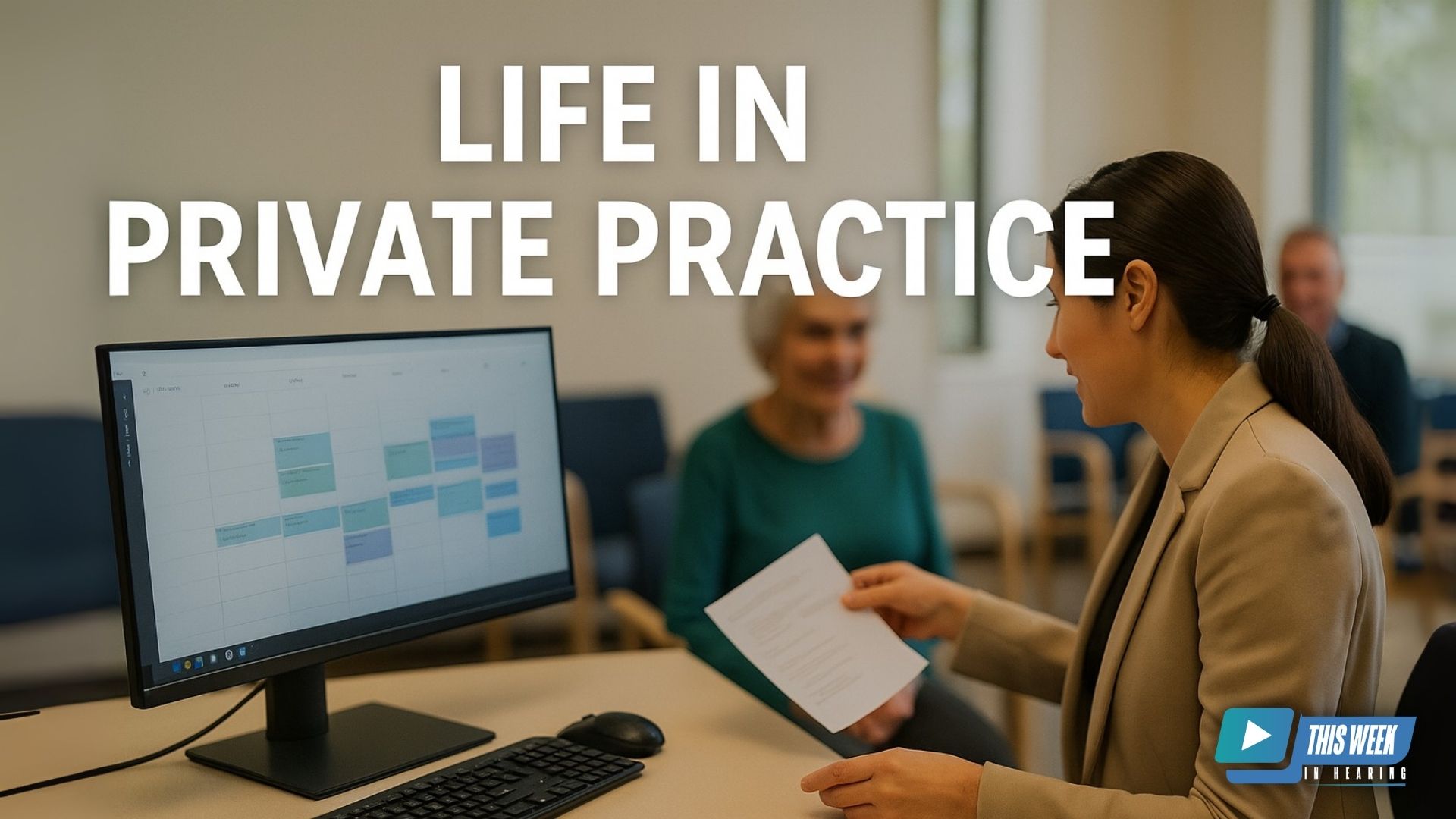
What does it really take to keep a private audiology practice running smoothly? In this episode, Operations Manager Carla Taghvaei of A&A Audiology in Scottsdale, Arizona, offers a behind-the-scenes look at the daily challenges and rewards of managing a growing clinic.
Carla shares how her practice organizes patient scheduling, handles insurance and third-party billing, manages staff training, and creates a welcoming experience for every patient who walks through the door. She explains why consistency, communication, and proactive planning are essential to success—and how even small details, like confirming appointments or checking equipment orders, can make a big difference in patient care.
Whether you’re an AuD student, new graduate, or someone aspiring to own or operate a private practice, this conversation provides candid insights into balancing business operations with a patient-first philosophy. Carla also offers advice on leadership, team management, and the importance of building trust with both staff and patients
Full Episode Transcript
Speaker 1: Hello, and welcome to another episode of This Week in Hearing. I’m your host, Brian Taylor. And this week, we’re gonna take a little bit of a departure from what we normally talk about, which is research and the latest developments in the business world and things like that, and we’re gonna take a deep dive into daily practice. We’re gonna call this episode ‘A Day in the Life of an Audiology Practice Manager’ and the primary audience for what we’re gonna talk about today are students and audiologists who aspire to own and operate their own practice. And with me to discuss this is Carla Taghvaei, who is an operations manager at A&A Audiology, which is a private practice with a couple of locations in the Phoenix, Arizona area. Carla, I wanna thank you for taking time out of your busy schedule to share a little bit about the day in the life of a practice manager.
Speaker 2: You’re welcome. Thank you for having me. I’m very honored. Thank you for asking.
Speaker 1: Well, we’re gonna talk a lot about the different aspects of operating a practice from the perspective of somebody who is kinda behind the scenes, so to speak. But before we do that, maybe, Carla, if you could share a little bit about your background and a little bit of background on A&A Audiology.
Speaker 2: Well, I’ve been in healthcare for, oh, I’d say, over, I guess now, 15, 16, 17 years. I was in staffing. I did staffing for nursing facilities. I was the staffer for over 63 facilities in the Jersey/New York area for PTs, OTs, and SLPs. And since my husband’s an audiologist and kinda wanted to start his own practice, he asked for my help because I tried to pride myself on being really organized. I feel like I’m a people person. And he’s like, “Maybe you can just help me out, like answering the phones and helping me with some paperwork to get the ball rolling.” And that was in 2019, and here we are. I’m… So it’s a, it’s a work in progress. I’ve learned a lot, but it’s really. For me, it’s really great. Like, I really enjoy people. I really enjoy doing my part to try and make a difference. And all the providers at our practice have a total passion in patient care and hearing healthcare, so it makes it fun working with all the providers. They all have different you know, strengths and dynamics, but at the end of the day, they are 100% about hearing healthcare. And I never really knew much about it until, obviously, my husband decided to become an audiologist. I mean, I I don’t even think I said the word properly at the when he was in school.
Speaker 1: Well, that’s exactly why I wanted to have you on for this, because I think you’re the ideal person. You sort of had to learn this on the fly and become an expert in a lot of different areas.
Speaker 2: Yes.
Speaker 1: Before we, before we jump into some of the details share a little bit about the practice. I know you have a couple of locations, you have multiple practitioners. Tell us more about that.
Speaker 2: Yes. So Dr. T when he was in… When we lived in Jersey, he worked for a, you know, he works for big Monday through Fridays, he calls it, his real job, and then he started doing… He really missed the patient care and the patient dynamics, so he was like, “I’m gonna I’m gonna find somewhere that I can work on Saturdays so that I can still be involved with the regular work, but still be involved with patient care.” And so he got a job at, like, I don’t know, at HearUSA or something like that in Jersey and he worked on Saturdays, and he really, really enjoyed it. So then when we moved back to Arizona and I I worked My company was in Jersey, and this was before COVID, and I worked remote, they were starting to kind of be like, “Oh, you know, we may not need the position because of Medicare issues.” So Dr. T’s like, “Ooh, well, maybe we can start this Saturday program. Like, I’ll just come in on Saturdays like I used to in Jersey to start this practice.” And I said, “Okay.” And that was right before COVID happened. And then right when he got the ball rolling and we were like, “Let’s start, like, reaching out to people,” COVID happened and everything went on lockdown. And Dr. T his, “Oh, no, what about the patients? This is a terrible, this is terrible for the elderly who have hearing loss and need to be cared for. This is like… They’re already in isolation. This is really bad news.” So he asked for me to reach out to all the skilled nursing facilities and the few patients that we did have and offer them home services. And so he started the practice by going into people’s homes and then only working Saturdays. And now we have five providers and we’re open Monday through Saturday, and we have a Scottsdale office and a Mesa office. So I’m really proud of him.
Speaker 1: Yeah, I mean, that’s incredible to think
Speaker 2: Really proud of him. And we have a lot of work to do because we’ve got big time competitors and, you know, it’s really hard. I’m biased ’cause I personally feel like we’re the best, so, it’s hard for me to say that ’cause then people think I’m… that’s the wife in me speaking. But I really, 100% I All of our providers are truly, like, fantastic people and they’re even, they’re even better audiologists. They’re really good at what they do.
Speaker 1: Well, thanks for sharing all that. Let’s jump into some of the topics at hand. The first thought I want you
Speaker 2: Yeah.
Speaker 1: elaborate on for us would be patient scheduling and the overall sort of flow of the office. So, my first question is, how do you schedule patients for the different types of audiology appointments? Like,… what’s the process what’s the time allotment and that kinda thing?
Speaker 2: Well, that’s a great question and one that’s kinda hard to answer because everybody has a different reason as to why they need an audiologist. One is their kids are sick and tired of shouting at them. Two, they can’t hear the TV. There’s something, it’s very rarely the patient. It’s a family member or someone where they live that’s like, “Hey, this patient needs to come in.” And then it’s really based on insurance because we advocate big time that we take insurance and that we’re partnered with pretty much all the third parties because we feel that, again, it’s about patient care and we want the patient to be cared for. So I mean, I guess the money is in making in selling hearing aids, like as a private, but we really want to endorse and market that, yeah, we take your insurance and we wanna do our part to help. So in order to do that and here we’re not really biased to any or partnered with any manufacturers. So for us, we always tell the patient if they’re new, that they need to come in to get a hearing test to find out what type of hearing loss they have. And then based on that hearing loss, what type of lifestyle that they live so that we would know which manufacturer was best ’cause each have a different factor into why you would use one versus the other. So a new patient appointment is normally about an hour, an hour and 15 minutes because you wanna kind of build a small rapport with them, explain what type of hearing loss you have. There’s paperwork that needs to be filled out. And then once their audio is done, the doctor kind of sits with them and shows them, “This is the type of hearing loss you have, this is where your hearing loss is, and this is what we recommend.” And then at that point, if they weren’t referred to us by a third party, then we do our part to reach out to their insurance. We also offer six-month clean and checks because again, you know, their, like, software’s always being added to various manufacturers. So we wanna check their hearing aids, make sure they’re up to date with their software, make sure that they’re changing their wax guards. We show them all that at their fitting appointments. I feel like we’re really thorough. We provide, like, communication strategies and troubleshooting guides at each fitting. And then we do a follow-up appointment after every fitting. We do a follow-up appointment like four to six weeks after their fitting because sometimes if they’re new patients and they’ve never worn hearing aids before, it’s very overwhelming for them. They’ve heard noises that they’ve not heard before, so it sometimes, like, frightens them or, like, “I hear an echo,” or, “Now I can hear myself chew.” It’s like, welcome to what we all hear. Like, “I didn’t hear that bird before.” “Well, it was there.”
Speaker 1: But I think what you’re saying there, which is really interesting, is it’s not just the audiologist that’s sharing that information with the patient. It’s also everyone else on the support staff that shares that.
Speaker 2: Oh, yeah. Oh, yeah. And we all try, you know… You do build a rapport because they call in and sometimes they need a lot of handholding. Some people, you know, the doctors they feel are really good about letting them know, “Yes, you have hearing loss, but please understand even when you get hearing aids, you’re not gonna hear like you did when you were, you know, 40 years old. Like, that’s not happening. You know, there’s gonna be a change in your hearing and because of that change, we all need to This is a learning process for all of us.” So there’s all different. like I said, and then we also provide we do custom molds. So depending on the person’s hearing loss, if it’s significant enough, the providers will for sure recommend, you know, custom molds to provide, you know, better hearing. If they’re already gonna invest that much in hearing aids, you might wanna just take that extra measure to get the custom molds. And then we do musician molds, hunting molds, swimming molds. So I would say our biggest appointments are new patient appointments fittings, follow-up fittings, six-month clean and checks, annuals, and then we’re also you know, partnered with the VA for other circumstances, so we also get VA appointments. So you kinda have to know how to handle every patient ’cause they’re all different. And most of the time, the new patient when they come in, new patient and fitting appointments normally always have someone with them, whether it’s a spouse a family member someone to either endorse, yes, they’re really losing it, or to support the doctor to be like, “Yeah, this is how we’re gonna take care of it.”
Speaker 1: Right, right. A third party. A second
Speaker 2: Definitely, yes.
Speaker 1: And I’m guessing that when you when your front office folks make that appointment, they probably ask or request for them to bring another person with them.
Speaker 2: It varies. they normally ask, like, “Is it okay if I bring my wife with me?” Or, “My granddaughter’s gonna be bringing me, is it okay if she sits in…” We welcome it big time. It’s better because sometimes it’s the person who has the hearing loss and is recommended the hearing aids, I mean, it took them a long time to even get here, right? So they sometimes don’t believe it. “Oh, it’s-” … fine. I’ve been doing just fine. And the other person is the one that’s like, “No, I’ve been shouting for the last year for you to hear me to come to dinner.” So sometimes they’re, they’re endorsing, you know, they’re helping support the provider who’s recommending it. Because a lot of the time, it’s the pushback from the patient that does not want to come to terms with the fact that they may need hearing aids.
Speaker 1: Exactly. Let’s talk
Speaker 2: Thankfully, there’re so many new hearing aids, and they all look so hip and cool that sometimes … It’s definitely getting easier, now that there’s smaller ones, and there’s so many different options. I think that that is huge for a lot of the patients to see all the various options.
Speaker 1: That’s a great point that the, the fact that maybe stigma’s becoming less of an, issue with people. And you, you can
Speaker 2: Yeah, and I feel like the doctors really kind of gently point it out to them. Like, if you had a, you know, vision loss, you wouldn’t just ignore getting glasses. You wouldn’t walk around blurry all the time, so why do you walk around fuzzy all the, like hearing-wise?
Speaker 1: Mm-hmm.
Speaker 2: So when you put it kind of sometimes in that as simplest terms, they then are like, “Yeah, actually, you’re right. I, I wouldn’t walk around not being able to see very well.”
Speaker 1: Let’s, let’s talk … I have a few more questions about scheduling and workflow. You know, in, in many areas of healthcare no-shows and cancellations are, you know, a real big problem.
Speaker 2: Yes.
Speaker 1: Can you talk a little bit about how your office handles cancellations and no-shows?
Speaker 2: We really don’t have a policy. And one, I would like to implement, but to be honest with you, when we started our practice, as I mentioned, it was right before COVID, and then we opened and survived through COVID. So we really were really, really appreciative to all the patients that we did have, and Dr. T was just like, I don’t wanna… We didn’t wanna scare them away, to be like, “Hey, if you didn’t come, we’re still gonna charge you.” But now that we’re getting a little bit bigger, and there are people that are on a waiting list, and, you know, we have limited times, I definitely feel that that needs to happen. But, you know, for every person who does that, they’re gonna find someone who doesn’t. I mean, you will find people who think that just ’cause they’re holding an insurance card, they have, like, freedom everything’s, like, free. Like, I don’t know who told them that, so even spending $5, let alone charging them a no-show fee would be like, I will find someone new, okay.”
Speaker 1: Yeah, no, I understand that.
Speaker 2: Please
Speaker 1: I guess what I’m wondering though is do you have, like, a policy to remind people, like you call them a day before?
Speaker 2: Oh, yeah. We call
Speaker 1: You’re an app?
Speaker 2: days in advance. So we call them two days in advance, and in our outgoing message, we kind of, we reiterate it. Dr. T kind of said, you know, if everybody reads the script until it becomes memory, it, it provides the patient kind of ownership. So we, we do call them two days before their appointment, and we let them know, like, “You know, this is what we have down, this is the office that we show you at. Please, you know, if you are unable to make your appointment, please call us. Otherwise, we will see you on this day at this time.” And, you know, then we have a system on our operating system that shows, like, if they were confirmed or if a message was left or if maybe their phone was disconnected. You know, we, we as an office then kinda know what’s coming our way and what’s not. Thankfully, we don’t have a lot of no-shows, and I really do think it’s probably because we
Speaker 1: Mm-hmm.
Speaker 2: to remind them of their appointment.
Speaker 1: Exactly.
Speaker 2: And especially if, depending on the appointment, if it’s an annual, I call twice. Meaning if I call them and I leave them a message on Tuesday, and I haven’t heard from them, I just say to the girls, like, “Hey, just send a friendly reminder,” because an annual appointment was done a year ago. Like, a lot can happen in a year, right? So they may or may not have it. Maybe they got a new phone, the calendar got wiped out, so for sure, we call to, to … ‘Cause you also don’t wanna waste the doctor’s time. I mean, that’s you still have to pay the doctor, you still have to pay your staff, and if no one’s here, that’s just wasteful ’cause there are someone who wanted that time, for sure.
Speaker 1: Yeah, exactly. Another, I think another challenge is, related to the schedule, is walk-ins. I know when I was in practice, Monday mornings, there’d always be a couple people that showed up with a hearing aid that didn’t work, had a question, wanted to get in right away. So I’m, I’m wondering how you handle walk-ins. Do you see a lot of walk-ins? And what’s your policy for those?
Speaker 2: Yeah, we are not a walk-in clinic, that for sure. We are appointment only. We definitely kinda have a more kind of a boutique concierge approach because, again, when we do our scheduling, all of the providers that we have, I’ve never worked in the audiology field, so I don’t know what it’s like to work in an ENT office or any other practice other than the one I’m working at now. But from what I hear from the other audiologists, like, normally, they have, you know, eight, nine, 10 patients a day. No, that’s not the case here. Here, it’s it’s six to eight patients total for the day because, again, it’s all about patient care. But of those six to eight patients, if a walk-in came in to say, like, my hearing aid, we have a, like a repair request form that they leave with the patient care coordinator upfront, and they kinda fill it out, and they know that they’re leaving it, and we’ll do our part to check it in between. It may not be done today, it may be done the next day, but yeah, we don’t, we don’t necessarily take walk-ins. They have to schedule an appointment. And even when they call to schedule an appointment, if it’s handholding, like, “My Bluetooth isn’t working with my phone,” that’s not an appointment. Here’s the number that you can call of the manufacturer. “i think my, you know, receiver, like it’s, I hear no sound,” chances are you probably need to change the wax guard. So we do a lot of, like, troubleshooting over the phone before we will schedule them appointment, and it took us some time to get there. We used to just take them, and then it would be literally that. Like, “I don’t know, my my phone’s not working anymore.” Whoa, whoa, whoa, I do not need to take a doctor’s time for you to figure out what your Apple ID is and how to put your app back on the phone. That’s not happening. So now that we’ve kind of-… Learned that process. We definitely have a system for why they’re calling. Like, let’s first find out why are you why do you need the appointment? If it’s a new patient, that’s pretty cut and dry, if it’s a fitting, that’s pretty cut and dry, follow-up. But if they’re calling because they need something, what exactly is that need, and is that something that one of the girls up front can handle instead of making an appointment?
Speaker 1: I mean, that’s a great example of how the front office folks and the audiologists work together to make sure that things run smoothly.
Speaker 2: Yeah. Oh, Dr. T is really big about he’s really big about knowledge is power. So he’s like, “If my front staff doesn’t know what my audiologists do, that’s never gonna work.” ‘Cause all they’re ever gonna say is, “I don’t know. I don’t know.” And the patient who’s you’re talking to is not gonna feel confident if the person is, keeps saying, “I don’t know, I’ll ask. I don’t know, I’ll ask.” So his theory is, let me give you a summary of how this works or why we’re recommending it or why we do it this way at our practice so that you slowly kind of visually see when it all comes into place. And I think, I think it works. They all seem to really… They’re like, “Oh, I get it,” or, “Oh, I know how to change this wax guard,” or, “Oh my gosh, yeah, they don’t need an appointment for that,” or, you know.
Speaker 1: Well, again, the lesson there, I think, for aspiring practice owners students that might wanna get into practice is that they can’t keep their front office people in the dark. They have to make sure that they know as much as possible
Speaker 2: Oh, yeah.
Speaker 1: … all these things.
Speaker 2: Yeah. I mean, everybody has a role. Like, I, we don’t ever try and pretend we’re audiologists, but we definitely try and understand why it is that way, and, you know the providers are really good and really patient about explaining that to us. Like, I’ve been I’ve been here since it started. If you ask me to accustom mold on a receiver, that, we’re not doing that. Like, let’s not be silly. I don’t know. Doctor G probably showed me 100 times. I don’t. The other girls know how to it, but I don’t. That’s okay.
Speaker 1: Yeah.
Speaker 2: There’s other things I
Speaker 1: think you, hit the nail on the head though when you said that you’re trying to… You, you don’t wanna… You wanna make sure that they’re spending their time, the audiologist is spending their time on the right thing.
Speaker 2: Right.
Speaker 1: And that’s
Speaker 2: Yeah.
Speaker 1: you could fix it from the front office.
Speaker 2: Right. Right. Yeah, that’s true.
Speaker 1: Let’s move on to the next set of questions I have here for you, and that’s around patient communication and just the overall experience that a person might have when they come to your practice. So I guess my first question is what’s the process that you and the staff have for welcoming new patients, both in person and, maybe on the phone?
Speaker 2: That is a really big one, ’cause again, Dr. T is like, they’re the, you’re the first point of contact, so how you answer the phone and how you greet them when they walk in already sets the tone for the entire appointment or the upcoming appointments. So definitely smile through the phone and anybody who walks in, you don’t wanna assume that the person walking in is the person for that appointment time, because like I said, we are partnered with the VA as well, so when we get VA patients, their appointment could be at 4:00 and they walk in at 1:00, like, “I didn’t know where the office was, so I just, you know, decided to come early.” “Sir, you are three hours early.” So you don’t wanna assume that guy that walked in three hours early is the appointment for the 11:00. So again, it’s like if, when they call, it’s, “Hello. Thank you for calling,” and you say your name so that they already have like a name of who they’re gonna address and you do your part to like answer their questions. The new patient appointments we take an intake form, which just kind of provides basic but important information, you know. How did you find out about us your name, birthday, address phone number. If they have an email ’cause they wanna fill out the new patient packet before they come in, we can email it to them. And then we ask them, “When was the last time you had a hearing evaluation? If you have any hearing evaluation paperwork to please bring it at your appointment so we have a baseline to kind of understand where you started and where you are.” And then ask them what type of insurance they have, and then we kinda go over just quickly like what, for them to expect when they come to a appointment. Like, this is how much your copay may be based on, you know, whatever type of insurance they have or third party. And then if they come in the door, the same thing, we welcome them, “Hello,” you know, “how can I help you? What is your…,” you know. And they normally say, “Oh, my name is, you know, Carla. I’m here for, you know, my 9:00.” And we provide them a new patient packet, and then they start filling it out and we kinda take it from there. And in that new patient packet, it asks various questions that the audiologist would need to kind of assess why they’re there and, and, yeah.
Speaker 1: It sounds like you have a process then, and I think that’s the main point here is that there’s a
Speaker 2: Yes.
Speaker 1: … in place. Is that something that’s written that you teach a new hire?
Speaker 2: Yes. Everything is scripted. Again, Dr. T is really big on consistency. He’s like, “If everybody’s doing the same thing, there’s, there’ll be less hiccups, there’ll be less speed bumps, because everybody’s reading and answering the phone the same way, everybody’s greeting the person the same way, the patient’s filling out the same new patient packet so you know exactly what to look for to make sure nothing is missing before you provide it to the doctor.” So you know, he’s a very proactive than reactive person, so everybody here at the clinic has definitely picked up, you know, we’re all… We wanna do our part to, like, not have any issues versus you know, someone saying, “Oh,” this, that, or the other. So
Speaker 1: Right.
Speaker 2: proactive approach.
Speaker 1: Yeah, and I, I, I think that the whole… The key there is to have the documented process that everyone kind of can buy in into, and it takes away the mystery and the, and the guessing.
Speaker 2: Well, and it also, also when you have a new hire, they’re already nervous, ’cause they’re new, right? And they don’t know. And sometimes people don’t ask questions because that question may be presumed, like, they don’t know or they weren’t paying attention or they’re not understanding. But if then it’s written down for them to read at a later time, maybe without asking you, like, “Hey, how do I do this again?” to not sound like they aren’t smart or not paying attention, then they have something to reference on their own time, or when they’re in the office alone and I’m not here to ask. You know. I don’t want them to I don’t want anybody to ever feel not supported and not know the answer to the question. So if I’m not here and I can’t answer it, it needs to be written down or it needs to be known.
Speaker 1: exactly. That’s a great point. I know that they’re rare, but occasionally a patient will have a complaint about something.
Speaker 2: Yes.
Speaker 1: So I’m kinda curious what’s your office process or protocol for handling complaints?
Speaker 2: It varies, because not that we don’t make mistakes, because everybody that works here is human and we all make mistakes. However, I am really surprised when we get them, because I know how thorough our providers are. Like, no one walks out of this door not knowing how to clean their hearing aids, not knowing how to change the volume on their hearing aids, not being told what the out-of-pocket cost is gonna be for their hearing aids, not being told the process of it. So, for anybody to leave here and, and then pretend, like, “Oh, I didn’t know about this,” I’m gonna be honest, that’s a lie. ‘Cause there’s no way that someone did not tell them that. It And if I answer the phone, there’s definitely no way that it’s a surprise. So, because we’re so I think, proactive, we don’t get a lot of complaints, knock on wood. Now, when we do get the complaints, it’s normally because of someone else, to be honest. Like, the other day we did have a lady who was furious we haven’t called her back with her hearing aid benefit. And I said, “Ma’am, I don’t work for said third party.” Like, they are the ones who send you your hearing aid benefit packet. But I think sometimes that’s the disconnect, which makes me mad as the office manager, because I can make my own mistakes by myself, and I try really hard not to. So when others don’t do their part and it’s a reflection of our practice, that’s a real quick way to get me mad. Because, like, we did our part, we gave our recommendations, we welcomed them into our office, we said that we would reach out to their insurer, we did all that. And now because the other person didn’t do their part, the last person they spoke to was somebody at our office. The business card that they’re holding is from our office. So to them, they’re not interested as to who dropped the ball, because all they know is that it was done at our place. So that’s sometimes the finessing that you need to do. But once you kind of, like, back it up and let them get all their whatever they need to get out, and you reel them back in and make them understand, like, the ownership falls on someone else, and sometimes it’s frankly them they’re, they, the silence becomes deafening because then they’re like, “Oh.”
Speaker 1: Yeah.
Speaker 2: “Oh.”
Speaker 1: Well, you know, it’s been said that a complaint is a gift, and I think sometimes it’s just letting you know where the weak link is in the whole chain of what happens with a patient with third parties and everything else. You know, there’s a lot that can go wrong. And as you said, ultimately they have your business card, so they come to you, and you know, the way that you handle it makes all the difference in the world.
Speaker 2: Yeah. And, you know, a I say to, at least for my front staff, like, when I train the, you know, front staff and whatnot, I always say to them, like, “Just be aware of the demographics.” I mean, with all due respect, we’re dealing with elderly, right? So they already get kind of scammed a little bit. They get you know, “Oh, do this.” They find everything on an infomercial. If it’s not from QVC, like, is it really real? Like, if I… You know. Like, they have all these ideas in their head. And sometimes, you know, they’re alone. We’re the only person that they’ve spoken to all day or that they’ve seen all day. And, you know, maybe their breakfast was garbage. So don’t internalize it. Just, like, try and figure out, like, what is going on. Like, it could honestly just be them. Let them vent. And move about your day.
Speaker 1: Yeah, no, that, those are excellent points. Let’s move to another topic, which is insurance and billing. I know this one’s a complicated we don’t wanna, you know, we’re not gonna get into the weeds here. But I guess from your perspective as an office manager and somebody who works with front office professionals this is a good one to kinda talk a little bit about. So my first question in this area would be just kinda give us a lay of the land when it comes to the types of insurance plans that you typically work with.
Speaker 2: So we’re pretty much partnered with all the major insurers like Blue Cross Blue Shield, Aetna, Humana all the big ones and all of the third parties. And I didn’t understand what that meant when I started all this. I didn’t know what a third party was. Like, I just have an insurance card, so I don’t know what that meant. But now that I’ve kind of been in this, it definitely… It matters, because every insurer is different. Doesn’t matter which one it is. Sometimes it’s direct through them, so if the patient has a hearing aid benefit, you go directly through to the insurer. And sometimes the insurer has partnered with a third party and they want nothing to do with the claim, and they want you to call the third party that that specific insurer’s partnered with, whether it’s TruHearing, Hearing Care Solutions, Amplifon, whatever it may be. And that’s where it kinda gets a little… That’s where you have to politely educate the patient, because they don’t… That’s a lot of words and that’s a lot of… To them, that’s just a lot of more roads to take, when at the end of the day, it is another step, but it’s a step that we at the office are taking. They, as the patient, aren’t really enduring anything different. But they need to understand that their hearing aid benefit is from coming not from Blue Cross Blue Shield, not from Aetna. It’s coming from TruHearing or Hearing Care Solutions. A lot of the time they think because they have Medicare that they have, like, this amazing insurance, and then when you tell them that Medicare doesn’t help with hearing aids or anything like that, like, they are overwhelmed and it’s, “Oh my gosh, this is unbelievable.” And then you say, “Then that probably means you’re partnered with a third party,” and you have to kinda just slowly educate them on what that means and why it’s that way. And that’s the tricky part, because… And it’s also hard for my front staff, to be honest with you, because they don’t know, like, am I supposed to collect a co-pay from this patient or is this one under a third party? Because if it’s a third party, you can’t do anything other than smile when they come in for the first year. and that’s crazy
Speaker 1: yeah.
Speaker 2: because they try and take advantage of that, so we kind of figure out a way to skew that disadvantage. Like, you don’t need as much handholding if you paid attention at your fitting appointment and you paid attention at your follow-up.
Speaker 1: Mm-hmm.
Speaker 2: And then after that, you should really only need an annual unless you choose a six-month clean and check. But because they, again, think that they have Medicare and everything’s free, you just need to patiently educate the patient and then educate the front staff, like… And I try and leave notes for the girls so that they, when they see it, they can understand, like, oh, this is why I’m collecting a co-pay, or, oh, this is why I’m not collecting a co-pay, oh, this is when I can collect a co-pay. So it’s definitely a lot of… You know, I mean, you just have to be aware of it, ’cause it is changing all the time.
Speaker 1: Yeah, I guess my question would be, like, if I’m a patient calling your office, what’s the first… Like, what’s the process of verifying the insurance coverage? Do do they collect the the information and then they make a call to the insurance company or the third party?
Speaker 2: What I say… Well, it’s funny you ask. Today someone called and that exactly happened. So I try and kind of put the ownership back on them a little bit while offering to help so that their insurer, who is who they deal with, is the one who kinda educates them. So what I say to them when they say, “I found you on my directory and I wanted to make an appointment. Do you take my insurance?” If they found me on the directory, obviously we take your insurance, so yes, we do take your insurance. I then say, “However, because you’re being… You know, You’re on Humana or Blue Cross, I would recommend that you call the number on the back of your card and whoever answers the phone, ask two questions. ‘Do I have a hearing aid benefit?'” They will answer yes or no. Once they answer that question, then ask them, “Is it directly through you or is it through a third party? And if it’s through a third party, what is the name?” And I say to them, “Regardless of the answer, we can bill direct to your insurance, and if they say it’s through third party, we are partnered with that third party and we’ll go through the third party,” so that they can get that education, because if I try and do it, they’re gonna think I’m, you know, scheming or something like, “Oh , I can go, I can go to Costco.” “Okay. Well then, just an FYI, you can’t use your insurance at Costco and by all means go to Costco.” Like, whatever.
Speaker 1: Yeah, no that’s… Again, thank you. That’s great information how you you know, gently put it back on the patient use it as an educational opportunity, teaching moment for them. That’s
Speaker 2: Well yeah, because I say to them, “If you’re…” ‘Cause I… Then this is where it really… This is when they then wanna get involved, because what I say to them is, “If your third party makes the appointment for you, they cover your co-pay.” … if you make it yourself and then we find out later that you have a hearing aid benefit and it was through a third party, that’s too late. So your co-pay would be this if you came in on your own, or if you wanna call and find out if you’re with a third party, they most likely will cover your hearing evaluation, which is true. They will do that.
Speaker 1: Mm-hmm.
Speaker 2: I let them try and, if they want to do that, and then that, when they call, that third party’s gonna educate them on what they’re gonna get. So it kind of takes it off of my plate.
Speaker 1: Exactly, and it’s a teaching moment for them, for sure. And we won’t even get into the difference between a third party that contracts with the insurance company. We’ll leave that for another day.
Speaker 2: Yeah.
Speaker 1: but that’s another level of complexity that I know is not easy to deal with in the clinic, and it’s very confusing for many patients as well. All right. I, one other question about sort of, it’s around financing. We all know that hearing aids are a fairly substantial out-of-pocket expense for many, and I’m wondering what type of payment plans or financing options you provide for your patients.
Speaker 2: Well, we’re partnered with CareCredit, so we do, if they ask, a lot of patients already are, so they’ll ask, like, “Do you take CareCredit?” If they aren’t, we let them know that we are. As far as financing goes, honestly, we don’t really. I mean, I know in the past with some of our patients that we’ve had for a while they’ll be like, “Hey, can I buy a service plan and I just pay you, you know, every three months for this?” And that’s maybe been done once or twice. But for the most part, you know, if it’s through a third party, they’re, they’re, they have to pay them. They’re not… And we definitely make sure, and I, all of the girls up front and myself, when we say to them, “Oh, this is your out-of-pocket cost,” we always say, “This is your out-of-pocket cost that you’ll be paying Hearing Care Solutions, that you’ll be paying TruHearing. The name on your credit card is not gonna say A&A because you did not pay us for these hearing aids. You have paid your blah, blah, blah.” So they definitely are aware of that too, because I don’t want them to think that they’re paying us. So if they have an issue, they have a question about that, you need to call your third party.
Speaker 1: Yeah. It, it, all of what you’re, all the things you’re saying, Carla, just demonstrate how you know, with third parties and different vendors out there, how complicated it is and there’s a lot to learn.
Speaker 2: Oh, it, there is a lot to learn. it’s so, it’s wild. It’s so, it’s so expensive. I mean, it’s, it’s, you know, there’s some people who, you know, like could not even afford the lowest model ’cause they’re still in the thousands of dollars. And it’s heartbreaking to say that, like, “Hey, this is how much it’s still gonna cost you,” but you know, I didn’t come up with those numbers.
Speaker 1: Well, all I, my perspective is, you know, 30 years ago, insurance was a no-go for everybody. There were no third party Medicare Advantage programs, and there were no real places to finance. So today yes it can be costly, but there are many different options for financing and to have insurance coverage. So it just adds more complexity.
Speaker 2: And, Dr. T, I would say in the last year, we’re definitely getting he definitely is wanting us to kind of put it more in play within the last six months. But you know, a lot of people they love to, like announce, “Well, I can just go to Costco then.” You know, they, like, “I can go to Costco and get these for $2,000.” Great. Like, then I’m not sure why you’re here. Feel free to do that. So Dr. T was like, “I don’t wanna necessarily lose these patients,” because at the end of the day, he is all about hearing healthcare and taking care of the community. But he’s like, “If that’s the pricing that they want,” like, you know, we need to have something that’s comparable to that so that we can offer that to them. And I know that an audiologist is taking care of their hearing healthcare then instead of a, you know, tech at Costco.
Speaker 1: Yeah. So then, know you brought Costco up a couple times, which tells me that you know, they have a presence in your community.
Speaker 2: Oh, big time.
Speaker 1: Yeah, so…
Speaker 2: ‘Cause there’s so many retirees out here. I mean, you there are so many people from the Midwest and whatnot that come out here and they, you know, that’s all they do. They shop at Costco and Sam’s Club and, and that’s it. So that’s all they know.
Speaker 1: Right, But I guess my question to you would be, how do you differentiate your practice from Costco and how do you communicate to that, to somebody that brings it up, brings Costco up?
Speaker 2: Oh, it’s, it’s so easy. I mean, we we’re all everybody here is an audiologist. So I mean, that’s one thing people will ask, “What’s the difference of an audiologist and a tech?” I mean, I would, no one’s ever asked that, but they, I think they understand like there they’re not getting an audiologist. I think there they know that they’re just getting hearing aids. And here you’re getting hearing aids, but you’re also, your hearing healthcare is also being cared for. We let them understand that at our establishment, we do what’s called real ear measurement, which kind of brings the, it, you know, it programs their hearing aid to as close to their hearing loss capabilities as it can. Whereas at Costco or even at some of these big, you know franchises, they don’t do real ear measurements. And so once the patient hears like, “Oh, wow,” or, or you know, like, “I didn’t have that kind of test done,” or things like that, I think they open up a little bit. I mean, people wanna feel… People wanna say they go to the best place, right? “I got the best hearing aids with, for the best price.” Okay, well, don’t you want, like, the best doctor then putting on those best hearing aids? You do.
Speaker 1: Mm-hmm.
Speaker 2: So what’s the point of having the best hearing aids if they’re not programmed properly? They’re irrelevant.
Speaker 1: Right, and I guess that speaks to consumer choices. And I think one of the differences, of course, would be when you walk into a Costco, I mean, it’s a large retail environment versus when you walk into a community owned, you know-… somebody that lives in the community that owns the clinic, it’s a medical practice.
Speaker 2: Right.
Speaker 1: Much different feel and look.
Speaker 2: Right. Well, when I do say people, when I have had patients that sometimes are a little bit snarky, like, you know, “I can just go to Costco,” and I say, “You know, that’s great.” Like, I, I can provide you hearing aids too. What I can’t provide you that Costco can is a hot dog on the way out of your appointment. So, we offer candy. That’s it.
Speaker 1: That’s good. That’s good. Let’s talk a little bit about clinic operations. I’m curious as your role as a, you know, a clinic… You’re the, you’re the manager director of the clinic. What does that what do those responsibilities entail on a day-to-day basis?
Speaker 2: Scheduling. I’m in charge of all the schedules. I reach out to whoever the staff is for the next day based on the appointment once they’re confirmed ’cause I’m not gonna have a doctor or anybody come in if, let’s say the nine o’clock appointment canceled ’cause they’re sick and the next appointment isn’t until 10:30, I’m not having someone come in at nine o’clock for no reason. And the doctors don’t either. Like, no one… mean, no one wants to come in just to sit here. So it’s… I’m very involved with the scheduling. I’m making sure that, you know, we don’t, we don’t do double bookings, that everybody has like a little gap in their day. There’s various appointments from new patients to fittings to follow-ups, so I just make sure that, you know, everybody understands like what is expected. We, we have… Our operating system has… it’s great in communicating, like to put little journal notes. We all communicate to one another as to like what, what’s happening. I think we never work on the day that we’re in. We always work ahead. So today, no one’s… No one should be doing anything for today’s patient other than welcoming them and scanning their charts and, you know, checking them out. Everything today should be prepping for tomorrow. Do I have all the chart notes for tomorrow ready? Is there anybody who canceled? Is there a fitting that’s done? Is the fitting put together? Are… You know, when deliveries come in don’t just assume that what came in is correct. Go to the chart note, open up the patient’s chart to see is what was ordered what arrived. When the mold came in, does the mold… Does it look like a skeleton mold or what is that shape? It says it’s for a P receiver. If you were to pretend and put a P receiver in that hole, does a P receiver go in or did they accidentally make it for an M receiver? ‘Cause you don’t want to assume everything was right and then the patient comes in and the doctor opens up the box and they’re like, “These were supposed to be silver and this was supposed to be a canal lock mold. Why is this skeleton?” So again, very proactive. Like let’s look into the day. If there’s a gap, let’s try and move that gap so no one’s, you know, sitting around. Very… I mean, if there’s referrals, let’s get the referrals called. There’s every, every call or every email has a specific task and we kind of have like, a front desk printout bible is what I call it, and for everything, there’s something that’s there. Like if a delivery comes in, this is how you handle it. If a repair comes in, this is how you handle it. For new patient appointments, this is all that you need to gather from them. It’s a follow-up, this is the follow-up paperwork that the patient needs to do so that there’s not like, “Oops, I forgot.” That will really frustrate a lot of people if, you know, especially when you have everything kind of outlined. I mean, we have binders for everything. Like
Speaker 1: I, I guess that’s the lesson here is that it’s all spelled out, documented, written down so people can follow it.
Speaker 2: Yes. I try and be really organized and even no matter how organized I am, Dr. T will still find something. He’s like, “You know, we could have had this like in place.” Okay, well, we’ll get that in place.
Speaker 1: Yeah. I, I guess a question about… You know, a lot of audiologists talk about something called block scheduling where they set up… They wanna fill their schedule with opportunities that are with new patients. Is that something that you think about when you’re
Speaker 2: Yep. I do this. I do the calendars for like, I would say, like a month in advance. And for each day, they’ll have they’ll… And each day, they’ll either have a new patient or an annual, a follow-up or a six-month clean and check, a fitting or a, you know, VA appointment. So from their six to eight appointments, they have a little bit of everything. There’s sometimes that if one of the provider wants to pick up the day, they may say like, “Hey, can I just move all my fittings to this day?” Or, “Hey, can I make this day be all VA appointments?” Because those are You know, sometimes that’s just a quick and easy day for them. It’s the same thing over and over and over. They kinda know what’s gonna happen. But it’s a little mix of everything to just kinda not make it … a boring day. But yeah, it’s definitely their calendars are broken out so that they can see what’s going on. Let’s say we offered the VA an appointment at 10:00 and they didn’t take it. If a patient calls in and that appointment is equivalent to the time slot that was for, that we offered to the VA, we the girls now are comfortable enough to be like, “Hey, Carla, I switched the unused VA appointment to a follow-up and impression appointment since it fit in that time slot.” And, and then we know.
Speaker 1: Right. another thing that you I wanted to, to point out was you mentioned checking in new orders when you get a repair back, when you get a new hearing, set of hearing aids back, ear molds, so on. I think that’s something a lot of students probably don’t realize that the office manager or the front office staff does. Can you talk a little bit about more how much time it takes to do that stuff?
Speaker 2: Well, from what I understand from all of the providers that have joined our practice, they are all extremely grateful that we do, as they say, everything for them. And by we, I mean the front staff and the PCCs. So they don’t handle any of their own paperwork, they don’t process any of their orders, they don’t speak about any insurance, they don’t talk about any out-of-pocket costs with their patients. They are solely the healthcare provider for that patient regarding hearing loss. Any paperwork, any insurance, any repairs, any deliveries, all of that is done by the front staff. So the front staff, you know, they, they place the orders, and then when the orders come in, they, they reference, because it could’ve been Natalie who placed the order and Amanda who received it. But Amanda is capable of checking to see in the chart note what was ordered and what, what are we supposed to be getting. And then the front staff puts it all together, the receiver, the mold, the, dome. That we have a little process, we provide them a communication strategy, a troubleshooting guide, the number to the Bluetooth consumer hotline for that specific manufacturer, and we put it in a bag. And everything is ready for the doctor. So all the doctor has to do is take their chart, their clipboard, and take the patient, and everything’s already in place for them.
Speaker 1: That’s very nice. know,
Speaker 2: If it’s, if it’s a
Speaker 1: …
Speaker 2: Yeah. Yeah, they don’t, they don’t process anything. They don’t go into portal. They don’t do any of that. And all of them they really aren’t… like in each room, we have what’s called an impression room, the booth room, and the fitting room. And in each room, there’s an cart, a stainless steel cart that has the supplies for that specific room. And nothing frustrates Dr. T more than when he has to walk out of the room because something wasn’t on that cart to leave the patient alone. So everything should be for each room should be for that patient so that you don’t have to leave that room. But other than that, I mean, it’s, the front staff, I think, really does all of that so that the doctor can do their part, which is something that we, we don’t know how to do.
Speaker 1: Well, that’s a lot to learn. You used the term PCC, patient care coordinator, right?
Speaker 2: Correct. Mm-hmm.
Speaker 1: And what’s their role in your practice?
Speaker 2: They do all the front desk stuff. They, you know, answer the phones, they check in the new patients, they do the deliveries. If a repair comes, we have a repair request form that the patient fills out, and then once they’ve been trained by one of the providers or myself on how to clean and check and check a repair before we ask a, an audiologist to help us or before we send it off for repair, they now are trained on how to do that so that they can kind of fix it, you know, for them and, and the process that goes with that. So yeah, I feel like they, they really do. They’re kind of like little mini, I guess audiologists in a sense without the testing. But I mean, all of the
Speaker 1: They have to
Speaker 2: trained us on everything, like how to change a wax guard or how to change a receiver. Even if you change a or new pair of hearing aids come in and they don’t turn on, that doesn’t mean that they’re dead. You have, you know, it could be simple as something as that. So they’re really good about showing us what they’re, what they can do so that we can do our part to help them, because they’re so appreciative of like the help that we provide them. So I feel like the, the staff has a really good rapport with one another on that.
Speaker 1: It sounds like it. I’m, I’m curious to know this probably doesn’t happen very often, but when you have to hire a new patient care coordinator, somebody that works at the front in the front office, how do you go about making hiring decisions? What kind of profile do you typically look for?
Speaker 2: Yeah. Well, that’s a great question because I think people don’t want to work anymore. So they come in thinking that they’re just gonna pick up the phone and be like, “Welcome, Brian, to A&A Audiology.”
Speaker 1: Right.
Speaker 2: So I’m, I now tell them all kind of like I do patients, I used to be afraid, like, oh, that’s gonna scare them away, but now I, if you’re scared and you still wanna come back, we gonna get along great. Because I need you to understand like, we’re a business and we, you know, in order for me to pay you, we have to make money, and in order to make money, we have to be we have to be professional and we have to be approachable and we have to be polite to every person who calls and comes in. Otherwise, this isn’t gonna work. So it’s, it’s a lot of handholding and, you know, sometimes Dr. T will be like, “How many more days are you training her? Do you wanna see-” “… how many steps we do -” and then you want me to have them be really thorough?” Yeah, it’s gonna take a while. Like I wanna shadow them because I want to point out to them like, “Hey, don’t forget you do this because I…”There’s a lot of steps, and they’re all capable of doing it, but there are a lot of steps to support the audiologist and to be ready for the patient. And if everybody did it right, then it’s, it’s really it’s really easy. But there’s just so many steps, and when you just think you’re coming in to answer the phone, you’re… That’s not happening. Like, you’re not just here. You’re gonna be doing a lot more stuff. So I’ve now kind of come up with… I now do a lot… I’m much more thorough on my reference checks when I call to find out. Like, I ask, like, you know, if… Can… What are they like in this scenario? Because if someone were to call me and get a reference check, if I took a pause, they’re gonna know that it… I’m like, “Wait.” “I’m not sure you want me to answer this.” So I feel like reference checks are, are really good and, you know, we do a phone interview. We have them come in. I want them to see the practice. I sometimes have, like, one of the other front staff here to kind of see, like, what is your… Maybe I’m wrong. Maybe I’m reading into it or not reading enough. So sometimes just having another person in the office when you’re interviewing them to be like, “What was your vibe when they came in?” That actually is very helpful.
Speaker 1: Good advice. Thank you for that. Just a couple final questions, Carla, before I let you get back to work, and that
Speaker 2: Yeah.
Speaker 1: I guess if there was one thing that you could share with a new audiologist or a student to better understand the role of the front desk, what would you say to them?
Speaker 2: Be patient and appreciative because again, we’re the, we’re the, we’re the first and last person that the patient is gonna see. We’re the first person when they walk in, and we’re the last person when we check them out. So you just really need to have a, good rapport. There needs to be open communication and a, a teaching moment on both sides. Like, sometimes when the doctors bring us their chart note and it’s missing stuff, like, just because they’re the doctor and you don’t wanna say, like, “Oops, you forgot this.” Like, they don’t want to forget either. So, you know, a gentle reminder to them or the providers, like, “Hey, we’ve you know, this, this is how you do a clean and check.” So I, I would say just good, open communication and rapport, like training, you know. Training matters. When everybody understands and is confident in what they’re doing, that, that is, that’s golden, because then everybody feels powerful. Like, “Oh, I got this.” So I I’d say training and, and patience because everybody comes from a different background. Like, some of the audiologists are from ENT, so they’re like, “You mean I don’t have 11 audios today?” No. We’re not
Speaker 1: Yeah.
Speaker 2: … 11 audios today, you know?
Speaker 1: Yep.
Speaker 2: Or I only I, I don’t, you know… I get an hour for a fitting. I used to have to do a fitting in a half an hour. Dr. T would be like, “There is no way that you could do a proper fitting and care for the patient and show them what to do in a half an hour.”
Speaker 1: Right. Yep. Oh, my last question, Carla, is what advice do you have for students who may not have a lot of experience in clinical operations or business? What would you say with… What would you say to them?
Speaker 2: Oof. Well, we currently have a student who’s thinking of being an audiologist. So just be open to learn and just be open to, like, a new approach. Every, every practice is different, you know? Like, every… Do what’s best, I think, like for you. Some people, it really is about bringing in, like, the cash. They just need to pump in the money. That’s all that their approach is, rather than patient care. If it’s really about patient care, it takes time, because you have to build a rapport. You have to build trust with that patient and, and their family, ’cause at, at some point, a wife, a son, a daughter, someone else is gonna call you besides that patient or show up at that appointment, and you just… It’s a It’s about taking care of the patient, just having patience and, and know that the end all is to take care of them, you know?
Speaker 1: Right, and that, that’s great advice, and I think you also hit it on the head a few minutes ago when you said that you’re trying to run a business and you can’t pay your staff unless you have revenue coming in. So that all flows from taking really good care of people, you
Speaker 2: Yes.
Speaker 1: So it all kind of fits together.
Speaker 2: Yes. It’s all about it’s all about teaching them from the beginning or having them understand from the beginning, “This is how it’s gonna start, and this is how the… If everything goes well, this is how it should be.” And, and if they know that, they, they’re very open to it. You know, sometimes you get some, you know, people who ask a lot of questions, but whatever. We’ll answer them.
Speaker 1: Well, anyway, Carla, I can’t thank you enough. Carla Taghvaei who’s the operations manager at A&A Audiology in Scottsdale and Mesa, Arizona. Thank you so much for your time and expertise.
Speaker 2: Yes. Thank
Speaker 1: This has been a wonderful hour of learning.
Speaker 2: Well, I’m humbled that you asked, and I’m happy that I could help. Thank you.
Be sure to subscribe to the TWIH YouTube channel for the latest episodes each week, and follow This Week in Hearing on LinkedIn, Instagram and X.
Prefer to listen on the go? Tune into the TWIH Podcast on your favorite podcast streaming service, including Apple, Spotify, Google and more.
About the Panel
 Carla K. Taghvaei is the Operations Manager at A&A Audiology, Carla is responsible for overseeing the day to day operations, as well as implementing professional development strategies to ensure the clinic operates as efficiently as possible. Carla also oversees the continual goal of excellence in customer experience at A&A Audiology.

Brian Taylor, AuD, is the senior director of audiology for Signia. He is also the editor of Audiology Practices, a quarterly journal of the Academy of Doctors of Audiology, editor-at-large for Hearing Health & Technology Matters and adjunct instructor at the University of Wisconsin.