

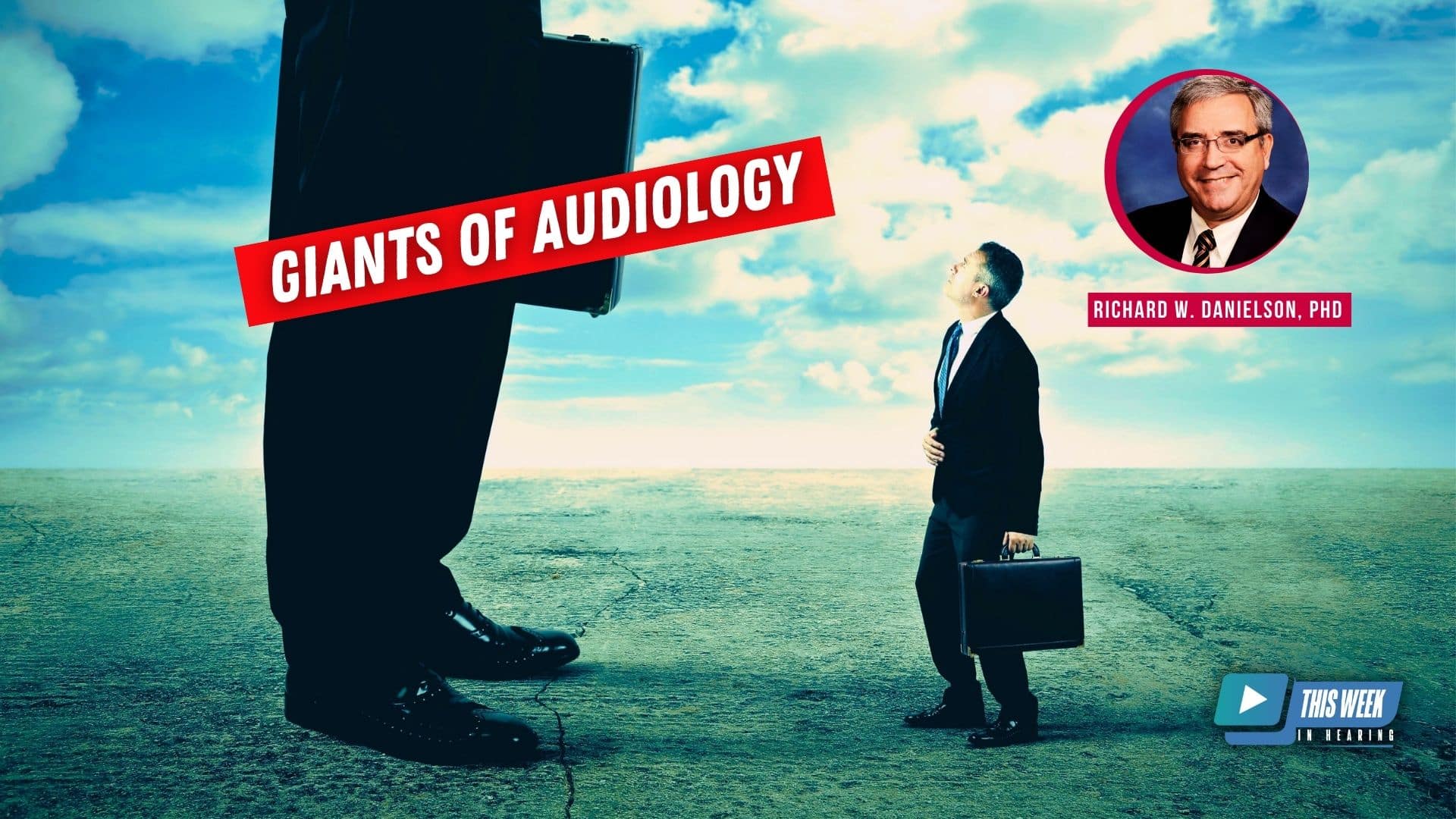
Dr. Richard W. “Dick” Danielson’s career in audiology spans decades of service, leadership, and innovation across the U.S. Army, academic medicine, and NASA. A retired Army Colonel and former manager of Audiology and Hearing Conservation at NASA’s Johnson Space Center, Dr. Danielson has dedicated his professional life to reducing the risk of hearing loss among military personnel, astronauts, and those who support them.
In this Giants of Audiology conversation, Dr. Danielson reflects on a remarkable journey that began in a one-room schoolhouse in rural North Dakota and led to leadership roles at major Army medical centers, deployment during Operation Desert Storm, and the development of hearing conservation programs for spaceflight and ground-based missions at NASA. Along the way, he shares stories of building audiology clinics from the ground up, mentoring generations of audiologists and audiology assistants, and shifting the profession’s focus from simply documenting hearing loss to actively preventing it.
Dr. Danielson discusses the evolution of military audiology, the critical role of hearing conservation in readiness and quality of life, and how interdisciplinary collaboration—rather than working in isolation—shaped his approach to leadership. He also reflects on the importance of mentorship, adaptability, and professional relationships, emphasizing that his career was built through collaboration with colleagues across audiology, medicine, engineering, and public health.
The discussion offers a thoughtful and often personal look at how audiology has evolved over the past several decades—and how one clinician’s commitment to service helped expand the profession’s impact far beyond the clinic walls.

Full Episode Transcript
Speaker 1: Welcome to This Week in Hearing and our special series, Giants in Audiology. Hello, I’m Bob Traynor, your host for this episode, and today my very special guest is a long-term friend and colleague, Dr. Richard W. “Dick” Danielsen, a retired military audiologist and former NASA audiologist who, who currently resides in Kingwood, Texas. Now, the way I usually like to start these off Dick, is with the bio that somebody would read prior to a presentation that you would, you would be presenting. And I know you’ve heard this a number of times in many presentations over the years. So here we go. Dr. Danielsen is a has dedicated his career to reducing risk of hearing loss among military personnel, NASA explorers, and those who support them. For 18 years, he was a faculty member at the Baylor College of Medicine in Houston, and served as the manager for audiology and hearing conservation at NASA Johnson Space Center. There, he led a program aimed at preventing noise-induced hearing loss during space flight and ground based missions, and also collaborated with NASA international partners toward the resolution of audiology or auditory and acoustic issues on the International Space Station. While serving as an Army audiologist for 28 years, Colonel Retired Danielsen directed audiology and hearing conservation programs at several United States Army medical centers, and led a unique task force that deployed during Operation Desert Storm. Dr. Danielsen has held leadership roles in many national and state audiology organizations, and had faculty appointments at multiple universities and medical colleges. So welcome to our special series Dick, Giants in Audiology.
Speaker 2: Thank you, Bob. It’s not gonna be I, prefer that this not be a talking speech. Let’s have a good time today. I’ve really enjoyed watching your other videos. And so thanks for inviting me kindly to record one for you today. You know, I know that you know some of the highlights about my past, so let’s see, let’s see how well this goes. I assume that you’re gonna ask me to share some stories today.
Speaker 1: Yeah, but, you know, the, the biggest one that… One of the bigger ones is, I heard you grew up in Cuba.
Speaker 2: Well, yeah. My family is from Cuba. I spent my childhood and first years of school there, but not the island in the Caribbean. The other Cuba, Cuba, North Dakota. You see, in 1882, my grandfather, Theodore, emigrated from Sweden to the Dakota Territory. He settled on the prairie in an area where the glaciers had once carved out many duck, duck ponds. And when the Soo Line Railroad was built there, the engineers looked around and gave the name Cuba to the watering station they built there, because it seemed like it was surrounded by water. You know, I can show you some more detailed pictures of the area thanks to NASA’s satellite mapping technology. Let’s look at it, and I’ll zoom in and show you where my Cuba is. So that red icon at the bottom, that shows the town of Cuba and the location of my one-room school. And the gold star that’s a little higher, that shows the Danielsen farm that’s in the picture. And I often walked that mile and a half to Cuba. I couldn’t hitchhike because no one ever drove by. The dark spots in the photo show where there many potholes were and where ducks and geeks ducks and geese rested when they migrated from Canada to Texas in the fall. And that’s when this photo was taken. You know, but let, let me show you another satellite map of Cuba. And this one’s done in the winter on the right, and the landscape looks kinda different when the snow covers everything and it’s 30 below zero out there in North Dakota.
Speaker 1: Having been around North Dakota at one time or another doing a some high school there I can appreciate just how cold it is in North Dakota, as well as the, the the, the landscape now that’s white on this photo. So so what’s Cuba, North Dakota like today?
Speaker 2: Well, our, our farm is, is still in the family. My brother Russ rents out the fields and maintains the homestead. It’s like, it’s like a beautiful park if you’re there in the right season, it’s looks great. My grandkids think it’s great to go visit the Cuba farm. They can run loose where there used to be a barnyard and play volleyball and pick peas in the garden. however, we only take them there to visit in the summertime.
Speaker 1: So tell us about your family a little bit there, and maybe some early school years, Dick.
Speaker 2: Well, okay. My parents had five kids. I was much younger than my siblings, especially my much older sister who’s not in this old photo. They’d all left the farm by the time I was eight, and they left me in charge. My brothers left me their big overalls that they’re wearing.
Speaker 1: Well, that was
Speaker 2: And all of us
Speaker 1: … nice
Speaker 2: Yeah. All of us kids, though, attended Cuba’s one-room elementary school. It’s in this photo. It was the same one that had hired my mother as the school teacher in the 1930s, and where she caught the eye of one of the bachelor farmers-… Rudy, who became my dad. It was in my fifth grade that Cuba had dwindled to a population of three people, and the elementary school only had seven kids in eight grades. So the next year, the district closed Cuba’s school and we merged with a district that It wasn’t much larger and wasn’t very strong. So as a former teacher, Mother Dee had always stressed education, and she wanted her kids to get the best education possible. So, she petitioned for the school board to … and got permission for me to attend a larger high school in the county, and it was becoming a private student, so, so to speak. But she had to pay the cost of my tuition, so she took a job in town to work nine-to-five in a, in a department store, and sacrificed a lot doing that. So, that put the pressure on me to not disappoint her. I went and I was originally timid about being around city kids mostly because there were over 100 kids that were all my age. And then I learned that somehow I had real advantages over the others because of what I’d learned on the farm. You see, ’cause I’d, I’d learned biology from raising livestock, and mechanics from fixing old farm equipment, and horticulture growing crops and gardening. They were all projects that taught real life, and, labor, and were taught in our 4-H club. So in this old photo it was taken when my 4-H club was on a tour of my garden vegetable plot. I think I, I think I’m naming the varieties of the vegetable plants to educate the kids.
Speaker 1: I don’t Looks to me like, like everyone’s having a moment of silence for one of your dead plants.
Speaker 2: Well, we, we did get kind of sensitive about the loss of crops and that sort of thing.
Speaker 1: Well, how does a guy from Cuba, North Dakota, population three in a one-room school, get to college? And where did you go? And, and actually how did you choose
Speaker 2: Yeah.
Speaker 1: out of all of that somewhere?
Speaker 2: Yeah, I know. Well, I told you Mother Dee expected everyone to go to college. But when I was finishing high school, my, my dad was nearly 70 years old preparing to retire off the farm, and that farm did not have any oil wells to pay for college. So, one night father was reading an the newspaper that said that the Army had an ROTC scholarship that would fund your school if you applied and agreed to serve your four years in the Army as an officer, which at the time possibly included going to Vietnam. So anyway, my father read that same newspaper ad three nights in a row.
Speaker 1: he had
Speaker 2: So I think I got the hint. I got the hint. I did. I, I applied, I enlisted my student organizations and good grades that I had because of thanks to Mother Dee’s encouragement and editing my term papers, and I got a four-year scholarship that would pay for my bachelor’s at any university that had a ROTC program.
Speaker 1: So, you had a free ride to any university in the country. Could be Harvard or Yale or Vanderbilt or Stanford or any of those kinds of places. Where did you choose?
Speaker 2: Well no, not them. I didn’t choose with a prestigious military science program like Texas A&M or The Citadel either. I chose North Dakota State University in Fargo, of course, because NDSU was my family’s school. It was local and I was already toughened up to survive cold winters there. It was okay.
Speaker 1: That might have been close to the one-room schoolhouse for for ROTC cadets.
Speaker 2: Well we managed to make it. I had enough to learn how to polish shoes and salute. So it there across the street in my Theta Chi fraternity house, though, that I first learned about something called audiology. I heard their stories about some legendary fraternity brother who’d graduated a couple of years earlier. He’d graduated and was now serving on active duty, and he was an Army audiologist. It was a career, I’d never heard of it before, but it seemed in the way he was reporting back to us that it was quite the good life. So I contacted this fella and I heard his breezy and persuasive promotion about the Army. It convinced me to change my major to audiology.
Speaker 1: So who was, who was that hardcore promoter that hustled you into the field of audiology, Dick?
Speaker 2: You know him, Bob. It was none other than your colleague, Dr. Gus Mueller. In fact, Gus was also responsible for several other brothers to become audiologists. We still get … … enjoy getting together. We’d go to national FCS football championships to cheer on the mighty NDSU Bison again and again. I’m really forever grateful for Brother Gus, really am, and his influence to help me encounter audiology. The timing was perfect ’cause it turns out that the army had just completed a landmark survey that revealed the extent of hearing loss among soldiers. They found that more than 50% of career soldiers with 10 years or more of active duty required a hearing profile, that is a hearing loss with sufficient severity to require some restrictions like changing their duty, reassigning them, or separating them from service. So it got to be a big deal for the army. So in response the army began recruiting audiologists to direct hearing conservation programs. And I was there at the right time. I scored one of those slots and became a military audiologist, so. And I never did serve as an infantry platoon leader in Vietnam.
Speaker 1: Well that was a semi-blessing for sure so you didn’t have to ground pound with a lot of the other troops that you were gonna serve as audiologists, as an audiologist.
Speaker 2: And, Bob, because I grew up in the plains of North Dakota where you take three lefts and you’re back where you started, I would get lost in the woods. I would have not made of the jungle, so I’m glad to be here today. So I got my bachelor’s in speech pathology and my commission at, as a second lieutenant in North Dakota State in 1973. And I took an educational delay from serving on active duty to go get my master’s in audiology and I got it at Minot State University in North Dakota.
Speaker 1: I did a site visit at Minot State one time back in, longer than I wanna say ago and I seem to remember that there were lots of Canadian students at Minot State.
Speaker 2: Oh, yeah. yeah. Yeah, well, it wasn’t legendary outside of North Dakota but it was in Canada because most of the audiology students had come down because it was equipped with all of the instrumentation was available and no PhD students were there to confiscate the equipment’s use. And mostly the professors were aware of Canadians’ needs and they were intent on preparing the students to function autonomously back in their practices ’cause they were going back to provinces where some of them would probably become the first and only audiologist in their region,
Speaker 1: Well as a guy from Cuba, you could kind of help them along a little bit somewhere along the line, right?
Speaker 2: Well, I’ll tell you what, it went the other way ’cause that unique training was pretty useful for me too because like the Canadians, my first army job would be in a place that had never had an audiologist before. In fact, when I first reported in my new assignment, there was a bit of confusion. The administrator officer at the desk thought that I had said I was a radiologist and he told me how to go find the X-ray department. So eventually I got to prove to my commander what an audiologist could do for the post-patients and the hospital’s mission and I was lucky to have a strong advocate in my ENT surgeon. In fact, he, he’d been so desperate to have me report for duty that he talked me out of going to airborne school. I probably, probably, I probably should have gone to jump school then. I was in the best shape of my life.
Speaker 1: Yeah, but during Vietnam, it probably wasn’t in your best health interest to do that.
Speaker 2: totally.
Speaker 1: You know, and, and when he thought you were a, the, a radiologist, these people thought… That’s not uncommon at that time ’cause I had a lot of people ask me, “What kind of stereos do you sell?” As well. So what was it like to start a clinic from scratch?
Speaker 2: Well I checked it out and learned that they had no clinical audiometer, just a four by four audiometric booth. So before I reported to that hospital in Virginia, I’d first gone to Walter Reed Medical Center in DC and I had picked up an old excess audiometer from their back room. It was a Beltone 15C vacuum tube audiometer just like the one in this photo which I later got at a silent auction at a Texas Academy of Audiology meeting. for many days I displayed this splendid old unit in my clinic. It was like how pilots would post a exhibit of their favorite aircraft model on their desks. So there at Fort Lee, I realized that I was the, I was the subject matter expert in audiology and I had free reign to design and equip an audiology clinic and introduce a set of policies for hearing conservation programs that the rest didn’t fully understand. So I was kind of freelancing and I often did that again in my career. Anyway, it was a great place to start and to make it even better, in my off duty time, I also met a wonderful young lady who became my wife Laura. I seriously thought that she and I would settle down in South Virginia when my active duty tour was over, but as you know, the army had more in store for me and I ended up staying on active duty for 28 years.
Speaker 1: Well, I, I was also an audiology officer in the, in the reserves as you know, and what would you say however was unique about being on active duty as an army audiology officer? As I remember from my reserve tours, they had a pretty wide range of duties, but the cool thing that I always appreciated about my army time as a reservist with you guys as the, as the active duty people was that lots of innovations were happening within the profession and many of them started in the army and in military audiology and so so how was that being an active duty army officer?
Speaker 2: Well at, at the time, the army wanted audiologists to spend 50% of their time as a clinician and then 50% as a preventive medicine officer, specifically working in hearing conservation. Sometimes the work seemed more like a total of 150%, but Bob, as you know, the Army supported audiologists with enlisted medics that had received specialized training in audiology and ENT. And these medics, they just had indispensable skills and supported us with routine care and admin duties, and they required minimal supervision so the audiologists, we could attend to more complex services and do our work. For instance, let me tell you about my first Army medic. It was PFC Debbie Goffinet. She was an invaluable resource. Debbie always was hungry to learn new features about audiology, would ask, and I was happy to explain them to her. And as a result, she consistently extended our services beyond what I could have done alone. Very capable. And I’m very proud that after her military discharge, Debbie used her GI Bill to become an audiologist, and she was a great one for many years in Colorado and Missouri. Debbie was the first of many outstanding people that worked with me as medics and lab assistants, audiology interns, and it was my pleasure to mentor them and see them succeed in their delegated tasks. They increased productivity and availability of services, no question. And then it was my privilege to, I was asked to co-chair a, a AAA taskforce that you might have known about it. It developed a position statement on audiology assistants, and the position paper implored all doctors of audiology to start beginning to use audiology assistants in their practices, and extend the services and improve the quality of patient care.
Speaker 1: I remember going on active duty and getting so used to somebody as an audiology assistant that when I went back to my practice, it was like, “Well, well, how come I have to do this?” I do see currently the everyone encouraging the increase of the use of audiology assistants, and in fact, I’ve included a chapter on their use in, in the most recent copy of Strategic Practice Management because it is moving along very nicely within the profession. So once again, the Army takes the lead in audiology practice, and what other experiences did you have as a young Army audiology officer?
Speaker 2: Well let’s just say I had a buffet table of experiences, and the Army liked to put more on my platter all the time. it just seemed like every, whenever I was feeling like the things were running smoothly where I was, the Army’s career assignments officer would call and offer another opportunity. And it was one that I felt was, always was beyond my potential. I was not ready for that, but they did. Remember my plans to settle down in Virginia? Well, what happened is that the Army lured me away from that by asking, “Hey, how would you like to go to Europe?” Well, Laura and I said, “Yes,” and we found ourselves headed to Germany, to Frankfurt and its Army Regional Medical Center. This picture shows it. It’s a German, old German Luftwaffe hospital. I was pretty young captain, and I got put in a slot that was meant for someone with much more experience than I had, and there I was alone with two ENT surgeons and a medical region that had 60,000 soldiers and hearing conservation programs out there, and, and they even provided remote support. We went to West Berlin to their hospital when there was still a Berlin Wall. So, I was given a map and, that showed where my 10 outlying clinics were in the region. I traveled out there. I got their medics trained up to do their mission, expanded my clinic’s facility and staffing, and I did snag a slot to help me with another audiologist, and again, thought, “Well, things are running okay.” So, of course, I got transferred.
Speaker 1: When I see you saying waving goodbye in this picture that’s up right … it’s kind of like “Hey, see you later. I gotta go build another clinic.”
Speaker 2: I came back to the States, and that job was being a consultant and a paper pusher. It was in the Army’s Hearing Conservation Program in Maryland for three years. In this consulting job, I traveled a lot. I surveyed oh, maybe 30 different Army posts and ammunition depots and entrance stations and, and even a nitroglycerin plant. You had be really careful there.
Speaker 1: Got
Speaker 2: felt like I was in front of a fire hose. I wrote and read policies and learned a lot of lessons. … there. And Bob it’s one that you know, the value of networking with other professionals instead of flying solo. I saw some officers and enlisted folks that could do their jobs far much more than was just required, so I looked to see how I could adopt and share their initiatives. And they… See, the… To my way of thinking, the army’s environment was free of proprietary ownership of ideas. I felt like the people worked together to meet mission objectives, and instead of competing against another practice in town, or a writer of another grant proposal for the same money, we worked together. And when I saw someone’s success I found a way to use it, and they let me, and I was happy to share that with… concept with others. You know, and I was also impressed by the military’s dominance in successful hearing conservation. It had created a model that non-military programs followed, and even now. So during that assignment, that’s when I found out what my mission in audiology could be, and I, I shifted my career’s focus to prevent hearing loss rather than just documenting hearing loss or attempting too late to restore hearing with amplification and, and counseling.
Speaker 1: You know, I think that’s a I think that all of us that were reservists working under and with you guys as, as active duty audiology officers one of the things we noticed all the time, every tour I took, I always got so much innovative kinds of information from colleagues that I was working with in the military installations. But So what about that paper pushing thing? Did that pay off for you as much as my reserve duty paid off for me?
Speaker 2: Well, let’s just say that… Here’s what was happening. The military was transitioning to a computerized audiometric database, and so it had designed a standardized audiogram and, and was collecting similar databases, the information for the database, instead of using a, a lot of different local styles and methods of collecting demographic data. So our agency’s lead, a Dr. Doug Olin an instrumental fellow for the army, insisted that this new database should start fresh and only use baseline audiograms that had been confirmed to be valid rather than collecting some hobnob when some of the thresholds weren’t even multiples of 5 dB. So we, we used this new form and the new demographics, and he then asked us to… four audiologists working for him took some extra desk duties, and that was the paper patient. Each of us had to review these paper audiograms 5,000 a month, for validity and completeness before they could be entered as a baseline into the new database. We were to reject the incomplete forms and then go call and coach folks on how to meet these new requirements . That job wasn’t flashy, but eventually the army’s compliance and completeness improved, and managers and epidemiologists could actually analyze these trends better. I made the best of that. Well, it was a really dull job, but like, I’m thinking, at least I don’t have to be the one who’s going to key punch these thresholds into this doggone database.
Speaker 1: You know, I did a tour at Aberdeen when Dr. Olin was there, and that group of colleagues had me doing some pretty hardcore paper pushing as well. So so I totally get it. And
Speaker 2: Well, there’s some… There were, there were some structured things there that paid off. One, one was that that’s when I first got involved in certifying medics and nurses to be occupational hearing conservationists. I’ve been doing that now for 47 years. Back in this consulting job at the Hearing Conservation Office people would come from all over to our office in Maryland for these certifications, that they were approved by the Council for Accreditation in Occupational Hearing Conservation, we call it CAOHC, but this training was really needed all over the world. So I proposed something, that we find a way to certify all army audiologists as CAOHC course directors or CDs so that they could go back and certify medics and others at their locations. So I wrote a proposal to CAOHC and asked for approval for the first time of someone doing a certification course other than that council, and it was for military personnel. That was about 1982, and it was at Fitzsimmons Army Medical Center in, in Denver, a, place you knew well, Bob.
Speaker 1: Oh yeah I, I knew that place really well.
Speaker 2: Mm-hmm. So it was held during our annual military audiology short course and meeting of what was called the Military Audiology and Speech Pathology Society or MASPS.
Speaker 1: Yeah, I think I remember that there was… Actually, I think the first army audiologist was a speech pathologist, if I remember Jerry Northern’s discussion with me correctly, and But there was once a… also a speech pathology officer in the Air Force as well, from what I gather.
Speaker 2: Yeah. That’s right that’s the first and only time. So later we changed MASPS from being a society to a, a new name, the Military Audiology Association, which still exists, and we petitioned CAOHC to offer MAA two slots on the CAOHC Council. I served on the council for 12 years in each of its major offices and boy, that was great. I got to team up with many prominent experts from professional disciplines like safety and industrial hygiene and noise control, and they become good friends and collaborators in, many of my projects.So
Speaker 1: So
Speaker 2: … I want to know… I wanna say this. I wanna clarify right
Speaker 1: Yeah, yeah, please.
Speaker 2: I am not a giant in this field, Bob.
Speaker 1: Oh, yeah, yeah, yeah.
Speaker 2: I am a humanoid. No, I’m a humanoid. I was built by a network of long-lasting professional relationships. They sparked these new I offered guidance to my care … they’re the ones that encouraged me to connect outside of the sound booth, that’s, that’s who happened to built me up.
Speaker 1: And, I honestly think that all of us are a product of our interactions and relationships, not only in the sound booth but outside of the sound booth as well. And that brings us to a discussion of what about your doc program? Where did you go and how did you get there and how did that happen?
Speaker 2: Well, the army offered me some long term training. It was, in a civilian institution and go work, earn a PhD in three years, that was the assignment. Once again, I, I doubted I wasn’t ready for that kind of a challenge but my great wife Laura encouraged me. She said, “Hugh, why, why not? Go tackle it.” So I chose to attend the University of Texas at Dallas which had an incredible academic team, principally the late Dr. Don Henderson and his young protege, Dr. Dick Salvi. They were systematically examining the scientific basis of noise-induced hearing loss at the time with several military grants. It was critical for the army medical department, they were really This faculty was really superb at seeing the options for applying basic research to real life especially the effects of noise on military weapons. I’ll never forget, when I first heard Dr. Henderson lecture at an ASHA conference, the room was so packed that when I got there, I had to sit on the floor and I heard his … Don’s insights and clarity about mechanical and metabolic effects of noise in the inner ear, it just really, just blew me away. I couldn’t take my notes or I couldn’t hurry my sketches of data fast enough so I chose him as my principal advisor and later I got to expand his research with my dissertation.
Speaker 1: Okay, so what was your dissertation topic? And we’ll get to that in a moment, but it had to be kind of a, kind of an interesting departure going from being this kind of hallowed officer in the military with a special parking place and the whole thing and, and being among all the generals and all these different people.
Speaker 2: Yeah, yeah.
Speaker 1: As, as well as then coming into being just a dude like a student, like everybody else.
Speaker 2: Yeah, I was. It, it was, it was humbling to go from the days when I got saluted when I passed somebody and having that parking spot reserved, to a lowly grad student and I was told “You, you go down in the basement and find a desk some place.” I I found one, I hunkered down in the basement near the animal lab and I shared this office was really the place where there was a 20-foot long acoustic shock tube and because I had to get out of there in three years at … I had to dig in because I sometimes slept overnight in a cot in evoked potentials lab. However, when I needed encouragement from the grind, I got boosted up from my wife Laura from clinician Dr. Ross Roser who reassured me that, “Yes, Dick, yes one day you shall return to clinical audiology and test humans rather than chinchillas.” But they … UT Dallas was this perfect fit. I had a strong faculty and was … And they were very supportive to my work in graduating in, in three years. So I investigated the effects of temporal patterns of traumatic noise exposure like signal impulses, bursts of impulses, salvos of impulses. It, it was a new variable that hadn’t been applied in reviews of the equal energy hypothesis regarding noise risks at the time. So I’m truly glad and grateful for for that sort of support and I returned back to the army, got back.
Speaker 1: So after this intense period of research, sleeping on the couch in the … And … And being a dude like the rest of us what did the military have you do after graduation?
Speaker 2: Well, I got a good haircut, I shaved off my mustache. I found my army boots and I drove to Fort Lewis in the beautiful Pacific Northwest with my pregnant wife and two kids. I was now assigned to the army’s only medical center on the West Coast and I was supposed to direct its audiology clinic and then join its faculty of ENT residency programs. I was also asked to plan a clinic again because Madigan Army Medical Center was building a … facility. It was to replace the World War II era hospital that you see in the photo. My son… One of my sons was born in one of those buildings someplace. I enjoyed teaching residents and, and working with staff otolaryngologists, including Dr. Rick Kopke, who… Rick was one of the early investigators in the benefits of antioxidant compounds in preventing and reducing noise-related hearing loss.
Speaker 1: You know, I remember that Madigan facility as, I think, 1990. I did a two-week tour up there with you when you were the chief.
Speaker 2: Yeah.
Speaker 1: and of course, those of us in in the reserve were coming from private practice, from university positions, and and… But we always had to go by what the chief was telling us to do, and that’s where… Those military clinics were one pathology after another pathology after another pathology, and then, and then, then practice with brainstem and practice with this and that. It was a fabulous experience not only in your facility but in some… in many of the other facilities which I visited. And So… But when we were there, you were the chief.
Speaker 2: Yeah, and you were one of several reservists I worked with and they… And was happy to have you come and prepare for deployment and, and possible active duty and, and certainly bringing your influence and your experience to us. Okay, I know that you’re thinking about your visit to Fort Lewis in 1990. We celebrated my birthday. We went to a baseball game between the USA and the USSR. Remember, it was part of Ted Turner’s goodwill athletic games in that cultural exchange. He, he was intending to foster goodwill between the Soviet Union and the United States and reduce Cold War tensions. The Americans did win that three-game baseball series. And who knows? These… Maybe these sports competitions caused the Wall to come down.
Speaker 1: You know, we’ve talked … over the years about this game a number of times. But I remember I’m in there doing this complex masking problem and, and, and trying to figure out… I think it was a, a bilateral otosclerosis case or something like that, after I just got done doing a an acoustic neuroma case prior to that. And I’m sitting in there and I’m working my head on this masking problem and, and the chief sticks his head in the door and says, “Captain Traynor, I need to speak with you immediately.” And so I’m thinking, “Well, geez I’ve only been here a couple of days. What the… What could I have done already?” And so I excused myself from the patient, walked out into the, into the hallway and and the chief says, “Hey, man it’s my birthday on Thursday and I just wondered if you’d be interested in going to the ball game.” And with a nice sigh of relief, I … “Really don’t have a whole lot going on ’cause I’m here for two weeks sitting in the barracks.”
Speaker 2: Okay.
Speaker 1: so, yes, I’d be most happy to go to that ball game.” And, and I know you know the story of this ball game a little bit better than I do, but I’ll throw some stuff in back and forth ’cause this is a, a fun kind of
Speaker 2: All
Speaker 1: … discussion.
Speaker 2: Oh, it’s… It’s definitely a a memory for me, especially since this was my first experience with the Russians and I ended up working with them for 18 years at NASA.
Speaker 1: And that was them, not me. I
Speaker 2: Yeah.
Speaker 1: … not Russian at all. So…
Speaker 2: ………………………. No. How about the uniform story?
Speaker 1: Yeah.
Speaker 2: Okay. So immediately after their first game we learned that the Russians who had come to the US with these original woolly uniforms, had sold off their wool use… uniforms to… everything to cash cow for crance… cash currency that was through the wire fence that the Americans were saying, “Hey, give me the hat.” They’d sold the hat, and they’d sold their pants and their jerseys, totally.
Speaker 1: And they might have sold their underwear as well.
Speaker 2: I don’t know.
Speaker 1: It’s probably worth few extra bucks, so…
Speaker 2: so then they still had two ball games left to play. So as a result, someone had to go to a sporting goods store in Seattle and they bought complete sets of nylon uniforms for the team and they ironed on those… ironed on CCCP letters to the shirts so they could get to use them in the rest of the ball games. And then at the, at the conclusion of the last game, those… They sold those nylon uniforms, and they were made in China, and sold them to a Seattle store in America. They were sold through the fence to souvenir hunters.
Speaker 1: You know, we were walking a few years, a few years later… I, I think it was, like, 15 years later, from a, from a hotel down to the Marion Downs reception, and we started talking about this ball game. And as it turns out, you mentioned that Jane Fonda was supposed to throw out the first pitch, she didn’t get there until the third inning, and I think you said then, “Well, that means that the Russians think that the first pitch goes out in the third inning.”
Speaker 2: They, they mimicked a lot of things we did in America as a result of that ball game, and perhaps, I think, that that could be the case, that right now baseballs are thrown out in the third inning. I don’t know. We’ll see. But it was an, an interesting, fun night, and certainly another good story in our friendship.
Speaker 1: Absolutely. Well, I I know that you didn’t always work in the clinic, Dick, that that you and other audiology officers spent some time in, in combat zones during Operation Desert Storm. So, what happened when you were deployed overseas? And, and Gus told me to ask you about that… What is it? The sand, the sound room or the sand curtain or something like that as well?
Speaker 2: Well, so it was 1991 and Operation Desert Storm had ended. Fortunately, they were-… very few fatalities there, so the medical units were kind of standing by. And they had 100,000 army reservists and National Guard combat soldiers who were there, and they were getting released from active duty but they first needed redeployment physicals, including hearing tests. And so, those physicals were supposed to be done in the stateside army hospitals, but they were overwhelmed. Their, their docs were, and nurses, and medical, medics were over in Saudi. So, that was delaying the return of soldiers from Saudi Arabia and the States, and someone in the Pentagon, suggested, “Hey, there’s, these soldiers, they could get their physicals done by the medical units that are also waiting to come home.” And somebody else remembered that the army had some mobile occupational health vehicles. They were trucks with a tow trailer that had computer-controlled microprocessor audiometers. They could test six, eight soldiers at a time. So, what happened is that the army surgeon general ordered 10 of these vehicles to be flown to Saudi Arabia, along with 11 army audiologists and, and an NCO.
Speaker 1: And, and you were placed in charge of the unit, as I understand.
Speaker 2: Yeah, I,
Speaker 1: that happen?
Speaker 2: Well, I happened to be the project officer in the design of these mobile vehicles, and I was senior to the other officers so that set me up to be the officer in charge of the first audiology task force to be placed in a combat theater. So here’s a lesson that I learned and I pass it on to others, never, never underestimate the value of getting non-traditional experiences in training. You might think What’s this relate to me?” I would say, go to, go to in-services and go tour as grad students as many places as you can, and pay attention. You might be asked to to use it. For instance, in an army officers course we were once briefed in how to work with the Air Force in planning aircraft plans to, for medical evacuations of equipment and tent, age, and people. Well, sure enough, in Saudi Arabia, I had to work with the, Air Force in planning loads to get the 20-foot vans and the trucks back to the US. So, when we had arrived in Saudi, we also had to recruit and find medics to support us, so we recruited by asking, “Are there any volunteers who would like to be working in an air-conditioned truck?”
Speaker 1: And, of course air conditioning is a definite premium there.
Speaker 2: It was, it was. we, we, we picked the strongest ones at the front of the line that had 20 medics to perform hearing tests. It was a wild time, and it turns out I was really sustained by their incredible performance of those medics and the officers. They overcame, there were sandstorms and 120-degree heat and truck breakdowns. We were, had mechanics welding axles on the outside while we tested their coworkers on the inside of van. the fluctuating schedules and tempo demanded lots of flexibility. One day, I was standing in line at a chow hall and this guy said, “Well, who, who are you?” And I said, “Well, I’m one of these audiologists.” And he said, “Saudiologists?” So that’s, that’s who we became, and adopted a
Speaker 1: Saudiologists, yeah.
Speaker 2: the the motto. motto of us was “Semper gumby,” be always flexible, and we, we lived that.
Speaker 1: Well, and I, and I see that just like fighter pilots with their kill markers on their airplanes as an incentive commander you created a unique way to show progress in the assessment of all these thousands of troops.
Speaker 2: Yeah. They, they, they had to, really had to hustle moving these people through. So to, to challenge the products, the productivity of the medics, I, I cut some, I drew a camel and I cut out x-ray films into stencils and gave those camel stencils to all the medics at the sites, and they used it to paint a camel in the trailer. I told them they could do it every time they tested 500 people. So in seven weeks, our audiology group left we, we tested over 1,200 soldiers one day and a total of 29,000 before we left. So, I should also say that if the soldiers’ hearing thresholds in the van were off nominally, then the soldier was routed to the audiologist that was at the site, and that officer then performed additional testing and made recommendations for follow-up in the States. And it really, process really sped up the out processing of these heroic … so they could return home to their National Guard and Army Reserve units and, and their families. Our task force also supported commanders on issues of noise levels from power generators and air fields near troop sleeping areas. It was something.
Speaker 1: Well, and, and I know that we learned a lot, not only in, from audiology and the kinds of stressful situations that that our colleagues found found themselves, but what did, what actually came out of the deployment of audiology into the, into the Operation Desert Storm combat zone?
Speaker 2: Well, it, it turned out to be a, a sort of a breakthrough for Army audiology. Senior leadership saw that audiologists could pivot and function operationally out in the field with evacuation hospitals and other medical units, and we began to be recognized that, we could be deployed as assets for conserving the fighting strength, and we weren’t just white-coated clinicians in a brick and mortar clinic who disqualified soldiers because they had a hearing loss. We could function in roles that had not been available to audiology officers, and barriers for major assignments and high-level promotions started to come down. Since then, military audiologists held some really major leadership positions at the Pentagon and served as hospital commanders, unit commanders and have been deployed in Afghanistan in support of military armed conflicts there. They are now capable of evaluating if service members are fit to return to to duty following acoustic trauma or if they had to be medically evacuated out of the country. The current Army Hearing Program was developed on the concept that there’s a great need to refocus attention to the harmful effects of hearing loss on, on readiness and survivability and the quality of life of our soldiers. It was very different than just doing hearing tests for the sake of doing hearing tests.
Speaker 1: Yeah, no, so, well, what next? After, after being a combat zone commander of many troops conducting these necessary evaluations after Desert Storm, where, where did they send you next?
Speaker 2: Well, after I hung up my desert uniform, I got orders to go to Washington, DC, and the Army Audiology and Speech Center at Walter Reed. After assisting Colonel Wright R&AD ATAC as the center’s director I got his job for five years. It was another assignment. It seemed really daunting at the start, but once again, there were some really terrific professionals who supported me 14 audiologists, I think, and speech language pathologists and a very productive research group. I was… That was led by Brian Walden. Dr. Walden had done the 1971 research study on the extent of hearing loss in the Army, the one that had convinced the Secretary of the Army to create 58 authorizations for audiology officers, including the one that I filled in my first assignment.
Speaker 1: Wow. Well, the the surgeon general’s consultant, is that is when you filled Dr. Atax position.
Speaker 2: No, actually I
Speaker 1: And a daunting thing, right?
Speaker 2: Yeah, I was, yeah, I was, I was the director of the clinic, was not, not the consultant.
Speaker 1: Oh, okay. Well, that, one of those, one of those jobs that you just didn’t get. What a bummer. So can you, can you describe the scene at the clinic or some of the clinical, clinic and research programs at Walter Reed when you directed the program there?
Speaker 2: Well, there, there were some, some noteworthy things that the folks did. For instance, at the time, the Rhode Island project for newborn screening had been published, and Walter Reed created a newborn otoacoustic emission screening program that was one of the nation’s first 50 programs for early hearing detection and impairment. And the clinic dispensed 5,000 hearing aids a year to active duty and retirees, and it was the principal hearing aid repair facility for the Army. Eventually, the Office of Management and Budget came through it and determined that the Army was not obligated to provide hearing aids to retirees at no cost, but we kept providing our care to them through a program in which retirees could purchase their hearing aid instruments at cost, and then our audiologists could still provide care and follow-up. And in terms of research the center’s researchers had multiple NIH grants going on for basic and applied research, so they published about 20 to 25 manuscripts a year and had several external clinical investigations that were required by the FDA for premarket approval of hearing aids at the time.
Speaker 1: You know I, I also understand that during during this time, there was a, a special military ceremony at Walter Reed that was personal and, and very special for you.
Speaker 2: It was. When I was at Walter Reed, I got to administer the Oath of Enlistment to my daughter, Claire, when she joined the US Air Force. Proud of her and my son Peter, who is also a veteran of the US Air Force, and my son Martin, who was a ROTC cadet himself and, but he did not, he did not serve on active military duty.
Speaker 1: Well, so after this intense position as the director of audiology at Walter Reed where did the Army send you from there?
Speaker 2: Well, eh, it was seven hard years in Washington, so I got a, got to kick back for my final tour, and I returned back to Madigan Army Medical Center and the beautiful clinic that I’d helped plan and worked with wonderful staff members that I had trained out there.I even had time to dabble. I got to continue teaching an online AuD course for Central Michigan University and I helped prepare CAOC’s curriculum for certifying professional supervisors of audiometric programs, and I started to do some consulting with NASA.
Speaker 1: So where does Colonel Danielson go from there? I mean, after this fabulous and very innovative career, where do you go from there? What did the Army do with you at that time?
Speaker 2: Army retirement.
Speaker 1: Okay. And but that wasn’t necessarily out to pasture as we see
Speaker 2: No, no.
Speaker 1: … in particular photo.
Speaker 2: No, that Longhorn is there to prove that I moved to Texas. You see, I had once attended a research conference and I met some NASA personnel who, so they recruited me to come to Johnson Space Center in Houston, so it fit. In 2002, I started, a new job as NASA’s first manager for audiology and hearing conservation at Johnson Space Center.
Speaker 1: So after building clinics, and building professionals in combat zone, and building things that nobody had done before in many places how did you manage this new type of operation for NASA? And as the first there, there wasn’t any example of how to do it, so you kind of had to rely on experience, I guess.
Speaker 2: Well, it’s like in my other Army assignments, I had the freedom to establish new programs as long as they seemed relevant to management. Some of those program needs were obvious. I had to establish JSC’s first clinic. It provided on-site services to the astronaut corps as well as to the ground personnel and the on-orbit hearing assessments that were being done on the International Space Station, and for our US crew members and the international partners cosmonauts and astronauts from other nations. And I was part of NASA’s Astronaut Occupational Health Team. It was a multidisciplinary group of space experts as well, they had roles with human health and performance, and, and I really enjoyed my close work with flight surgeons and acoustic engineers. And so our job was to make sure that there was a safe and healthy inhabitable space vehicle environment where the crews could live and communicate and work.
Speaker 1: Well, I bet being a NASA audiologist, you had some very, very interesting patients.
Speaker 2: Yes the workload also included seeing former astronauts. They would come back to Houston for just participation in the NASA lifetime surveillance of astronaut health. So I saw the old crew from early Gemini and Apollo missions. This program focused principally on common space flight association medical issues, like bone loss, and neuro-ocular syndromes, and cardiovascular system changes, and space anemia, but we did collect longitudinal audiometric data too. One of my unique duties I got to collaborate with international space agencies and commercial space flight companies. We aim to resolve acoustic issues affecting crew members in space. ’cause I was the guy at Johnson Space Center, I was responsible for the pre-flight, and on-orbit, and post-flight auditory tests for all crew members. The Russians, the Europeans, the Canadians, and the Japanese too. And I was co-chair of a multilateral team that focused on acoustics. I really, I really did learn a lot about acoustics in international, let’s call it, international scientific diplomacy … our many telecons and face-to-face meetings like this one in Washington, DC. Bob, I’ll never forget my trip to a Moscow meeting when I, as a former US Army officer who did correspondence work to evaluate what would happen if the Soviets went through the folder gap, I stood with my colleagues peacefully in the middle of Red Square. In 2020, this multilateral team was recognized with the Safe and Sound Award from that, the National Hearing Conservation Association and NIOSH for addressing challenges in hearing loss prevention in an innovative way.
Speaker 1: You know a lot of places these days particularly hearing conservation areas, are beginning to use boothless hearing assessment. And it, it appears to me for… And you can help us solve this mystery, that much of this boothless hearing assessment research was done by your team at NASA.
Speaker 2: Well, we kind of had to because we… An audiometric booth and audiometer would, would have too much mass and volume. So on-orbit hearing assessments were being done with non-standard software on a laptop using custom-made ear monitors and noise reduction earphones like you see in the left photo. The ambient noise level and the fans and the payload equipment was over 60 dBA, even in the quietest of modules. And so we questioned whether that was adequate. So when the onboard computer was changed to a Windows operating system, it didn’t support that software. We sought a legitimate calibrated audiometer system that could meet ANSI specs and also attenuate the noise levels in the ISS to meet the max, the minimum minimum audible space sound pressure levels for panels. So anyway, after extensive reviews and delays in production caused by COVID the system was selected and modified by NASA so that the crew members could use it remotely by themselves without our help. And it served as a unique boothless audiometer in space. This system continues to monitor hearing and identify any mission associated significant hearing threshold shifts. And so this… Yeah, this concept of boothless audiometers, it’s no longer considered unique. There’s several models of audiometers now marketed to attenuate noise levels below panels.
Speaker 1: You know, it is actually fabulous to see boothless these boothless audiometers because it is overhauling a lot of the, the, the cumbersomeness of doing assessments in industry and in the military and in many, many places. So, fabulous contribution to the profession by this research team at NASA.
Speaker 2: Well, I should also say that in my work in the Army and at at Johnson Space Center, I didn’t save lives, but I did save a lot of Word files and PowerPoint charts. I did write chapters for several aerospace medicine textbooks but I did get included in a research project that was interesting. It investigated the association of this prolonged exposure to the microgravity in space with cephalic fluid shifts. They were examining space flight acquired neuro ocular syndromes as researchers were finding visual impairments that were suspected to be related to cerebrospinal fluid shifts in space when the fluid shifted from the lower torso to the cephalic region. So, space medicine was looking for some sort of a non-invasive way to monitor intracranial pressure, and they added otoacoustic emissions to their test battery. This time I got to call in the big guns. We called in help from Dr. David Kemp himself. He was the first to identify the existence of otoacoustic emissions to use in protocols that were done in space and at JSC, and he was a, a wonderful support and very gracious in giving his time and support to my interns and to our staff.
Speaker 1: That had to be very special. Interacting with David Kemp would, would have just been a… One of those days that, “Oh, I really met this guy,” kind of a thing. So so, so what did that research involve that you were working on in that particular situation?
Speaker 2: It measured the phase angle and amplitude of otoacoustic emissions for their potential to be sensitive to these postural changes and space flight. So as as exciting as it was for… To conduct this study, I had some basic challenges. That was my role. I taught the astronauts how to clear cerumen from the ports of the OAE probe tips.
Speaker 1: Great. Well, that’s also one of those menial tasks that, that, that a former colonel could do very easily. Now, I might say here that there are many awards from, from the military as well as from NASA and as well as our professional organizations that we don’t have time to go over here, Dick, but congratulations on all of those. But I’m kind of looking for what was the coolest moment in this absolutely exemplary career?
Speaker 2: You know yeah. The best reward that I had was being able to develop this kinship and learn from some awesome women and men who were, they were dedicated to preventing hearing loss and improving hearing for people who needed help. So, cool moment, I’ll always appreciate that special feeling that I had when I tuned in to see the in-cabin broadcasts of the crew and listen in on the pre-launch comm checks. They would ask, “How do you read me?” And my astronaut patients would respond, “I hear you loud and clear.”
Speaker 1: So when did you retire from NASA? I do remember seeing you cleaning out all the earplugs in your, in your closet in a photo one time that just looked like there was every earplug known to man from the last 50 years in there. And and you were pulling them out kind of one by one and deciding whether you wanted to keep them or not, so…
Speaker 2: No, and, and I had boxes of articles that also had to… Had hit the trash when I moved from one home to another. My wife wouldn’t let me take them along. So it was in 19… In 2021, I turned my practice over to Dr. Martin Robinette Jr. After 18 years in the Space Center, I found him to be… He was ideally qualified for the job. Martin had both a doctor of audiology degree and a PhD in systems engineering human factors, emphasizing acoustics. And he excelled in supporting the astronaut health and flight medicine occupational health programs, and even research. He became a co-investigator of hearing assessment and tympanometry data that we collected from the crew members on the ISS. Unfortunately recently, in 2025, reduced federal funding for NASA’s astronaut health program terminated the audiology and hearing conservation mission at Johnson Space Center. It’s no longer there. I’m just really terribly discouraged about the loss of audiologist support for NASA’s program. But, I am encouraged about the current ongoing efforts that’s going on everywhere in hearing loss prevention in the military, in occupational, and in non-in… And in non-occupational settings. Things like focusing on music-induced hearing loss. I hope that I favorably influenced some of those careers in, in my life, and I’d like to encourage now all audiologists rise up and advocate preventing hearing loss in your practice routinely. As an example, I’d like to lift up a real giant in hearing conservation, the late Dr. Bob Doby. He was a distinguished ENT surgeon and a prominent researcher. And I’m… Bob, I’m glad that we can’t hear Dr. Bob Doby’s story in this series of Giants. For instance, he once wrote, “If you do a good job in hearing conservation and in medical legal documentation of the results, you can do a lot for the a lot of people, because there are millions of people involved.” Contrast to surgery, Dr. Doby said, where he could only benefit one person at a time.
Speaker 1: You know, I met Dr. Doby I think once, maybe twice, at at the Auditory Society meeting where he was a regular individual certainly an icon in ENT. And in the forensics things that I do right now, his third edition of Medical Legal Aspects of Noise-Induced Hearing Loss & Tinnitus is a bible that I often use in many of my reports. And So, so I think we all would, would have loved to have had Dr. Doby in a Giants episode. However of course having passed away a couple years ago, that is impossible at this time? But we, we are grateful for the legacy that he has left us.
Speaker 2: So thanks. You’re right, Bob. I, I mentioned only a little about how my family and professors and colleagues like Bob have influenced pivots in my career. I really do appreciate them. When I was young, I certainly didn’t seek or anticipate having to have a hands-on role in space medicine, but I was incredibly fortunate enough to have family and colleagues who pointed me out that, “Dick, this is the right time. You’re the right person to go handle this, and go do it.” So, I, I hope that this podcast encourages your audience to recognize those opportunities, Bob, and to appreciate the people who were at their side with inspiration. Thank you.
Speaker 1: You know, wow. From Cuba, North Dakota, population three, to Saudi Arabia, and then on to mission control. What a out of this world audiology career from watching Dad read the newspaper three times and encouraging an ROTC scholarship. It was my pleasure to work with Dick in the late ’90s. And for you out there, it’s been my pleasure to present my longtime friend and colleague, Dr. Richard W Danielson as a true giant in audiology. Thank you for tuning in to This Week in Hearing and this episode of Giants in Audiology. Next time, be with me when we get to know another giant in audiology.
Be sure to subscribe to the TWIH YouTube channel for the latest episodes each week, and follow This Week in Hearing on LinkedIn, Instagram and X.
Prefer to listen on the go? Tune into the TWIH Podcast on your favorite podcast streaming service, including Apple, Spotify, Google and more.
About the Panel
 Richard W. “Dick” Danielsen, PhD (COL, U.S. Army, Ret.), is a retired military audiologist whose career has focused on preventing noise-induced hearing loss among service members, NASA astronauts, and the teams who support them. Over 28 years as an Army audiologist, he directed hearing conservation and audiology programs at multiple U.S. Army medical centers and led a unique audiology task force deployed during Operation Desert Storm, later serving in senior leadership roles including at Walter Reed. Following military retirement, he became Manager for Audiology and Hearing Conservation at NASA’s Johnson Space Center and spent 18 years advancing hearing conservation and acoustic solutions for spaceflight and ground-based missions, collaborating with international partners on auditory and acoustics issues for the International Space Station.
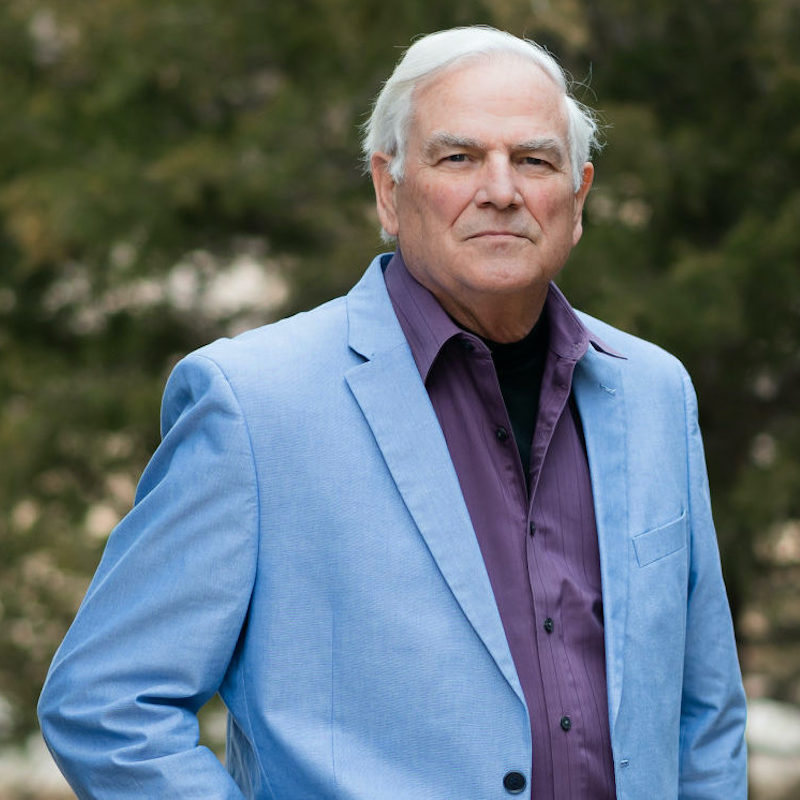 Robert M. Traynor, Ed.D., is a hearing industry consultant, trainer, professor, conference speaker, practice manager and author. He has decades of experience teaching courses and training clinicians within the field of audiology with specific emphasis in hearing and tinnitus rehabilitation. He serves as Adjunct Faculty in Audiology at the University of Florida, University of Northern Colorado, University of Colorado and The University of Arkansas for Medical Sciences.