

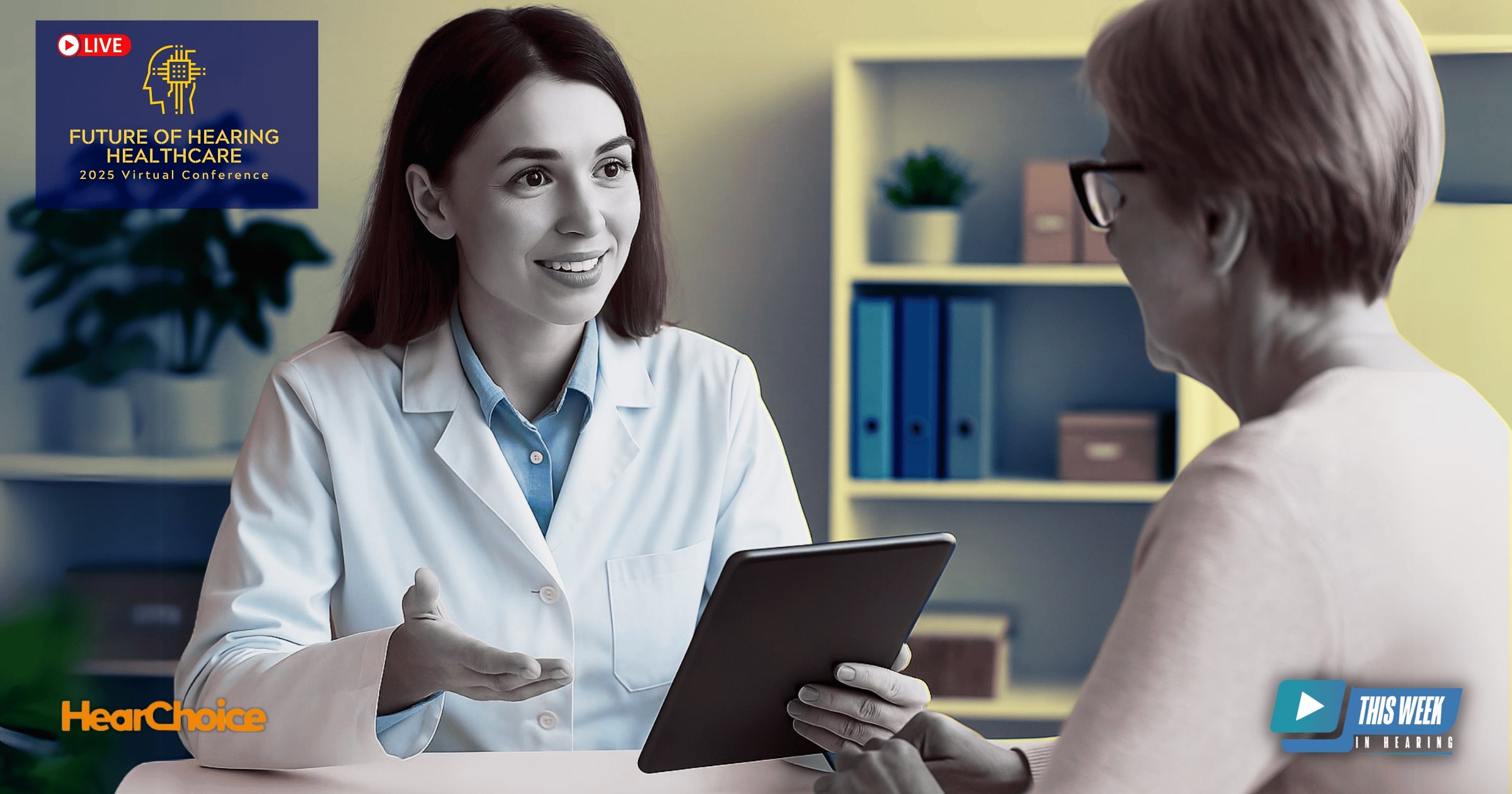
What if a digital tool could help bridge the gap between hearing loss and informed action?
In this session from the 2025 Future of Hearing Healthcare Conference, Dr. Mel Ferguson of Curtin University introduces the HearChoice project—a co-designed, evidence-based decision aid developed to empower adults with hearing loss. Backed by Australia’s National Health and Medical Research Council, HearChoice is designed to address long-standing barriers in the hearing care pathway, from lack of knowledge and stigma to limited care options.
Dr. Ferguson outlines how the tool was developed through stakeholder engagement, usability testing, and ongoing clinical evaluation. Early feedback from users and clinicians suggests that HearChoice not only improves understanding but may also prompt meaningful behavior change.

Full Episode Transcript
Hello, I’m Mel Ferguson, I work at Curtin University in Perth in Australia. And I just want to start off by saying what an absolute pleasure it is to be giving this presentation at the Future of Hearing Healthcare conference. And I’m absolutely delighted to be talking about a project that’s very close to my heart, the Hear Choice project. And this is a project which is, has developed a digital decision aid to educate, engage and empower adults with hearing loss. I work with a number of really excellent researchers in Australia and these are the organisations that they work for. This research is funded by the Australian National Health and Medical Research Council. So good hearing does not last forever. As many of you in the audience will know that people start to notice hearing difficulties and have in challenging situations such as shown on the left at family parties or in restaurants where it’s noisy and people just can’t hear what is said and hearing loss affects 1 in 6 of the population and so that is 4 million Australians. And what we’re asking with this particular project is can Hear Choice help with some of the challenges that we see with the current hearing healthcare system? And these are shown here. So for example it takes nine years from when people first notice that they have hearing difficulties to doing something about it. On average about two out of three people who have hearing loss don’t do anything about it. And even those who go and see a hearing care professional at an audiology centre are often only offered a limited range of hearing options. So that’s usually simply hearing aids or do nothing. And in fact in Australia about 40% of people who do go to see, see a hearing care professional leave the clinics empty handed. And there’s a number of reasons for this. One is that there’s generally poor knowledge and misinformation about hearing loss and hearing health care and hearing aids and in particular people have unrealistic expectations around what hearing aids can and cannot do. Now this research was informed by research priorities and this isn’t just an idea that I thought was kind of good to do. This was taken from the idea was taken from research priorities that had been identified by key stakeholders including adults with hearing loss. So this was the roadmap for hearing health from Australia and the report of the independent review of the hearing services program. So this is the subsidised hearing care program that’s offered by the Australian government. And then finally Research priorities were identified in the UK’s national Institute for Health and Care Excellence guidelines on hearing loss that were published in 2018. And all three of these guidelines recommended that there be development and evaluation of the clinical effectiveness of decision aids. And the reason being is that adults with hearing loss are to feel empowered to make safe and informed choices on their hearing health care options. So the aims of Hear Choice is shown on this slide here. So they are to develop and evaluate an online decision aid support tool to increase informed decision making and to increase earlier access and uptake of hearing health care. Now importantly, when we do research projects it’s important I think to try and get our research findings into clinical practice. So we also have a name which is to establish how to scale up Hear Choice and make it sustainable if indeed it was shown to be useful. So on the bottom we’ve got the schematic and we can see that people seek help they make an informed choice about hearing care and finally make a decision. And all of these can be helped with the Hear Choice app. Now ultimately, as I said the aim is to see an increase in uptake of hearing health care. But at the end of the day we’ve got to realise that hearChoice is simp. And so what we’re really wanting to see is that people who use Hear Choice take some kind of action for their hearing difficulties. It might be to go and see a healthcare professional which would be the ideal option but it may be that they go and get a TV streamer from their local store. So Hear Choice has been co designed, I’ll say a bit more about that later. Weve identified it being unbiased and trusted because we don’t mention at any point in here Choice, any manufacturers or any brand. So it’s brand agnostic and what we do is we bring all the information that people need to make a decision about their hearing health care and have it in one place. It’s evidence based, based on research from our research but also from research from others and we follow all the guidelines or all the requirements of the international standards, the IPDAs guidelines. So the international Personal Decision Aid Standard guidelines. So in Hear Choice we talk about some of the impacts of hearing loss, what it is, what all the available hearing health care options are with the aim being to give Peter people better hearing health. So we’re looking to educate, engage and empower adults with hearing loss. The Study design is shown here. We have four work packages. The first is needs analysis followed by the co development of hear choice. The third package is the evaluation with a randomised control trial. And again as I’ve mentioned before the fourth we’re very interested in implementation and this is our fourth Work package. Importantly stakeholders voice is embedded all across the study in every single Work package. Where we’re at at the moment is we’re just about to start the randomised control trial next week in fact. And we’ve already started work on some of the implementation aspects that I’ll talk a bit about. So the first work package was to understand the early hearing journey because we really don’t know an awful lot about that and we wanted to find out and identify what the barriers enable us to help seeking and informed decision making are and to identify features that are important to include in hear choice. And we did this with semi structured interviews with 16 adults with hearing loss, nine who had sought help and seven who had not. We then held two focus groups with a total of nine hearing care professionals. And then we carried out some online surveys with adults with hearing loss and hcps. And what we saw from the semi structured interviews and to really sort of show what the issue is is something that this lady said here. She she was a lady in her early 60s and she’d been having difficulties with her hearing for some time. And she said I feel a little bit clueless about going forward and I think that’s a barrier that a lot of people feel in my position because you don’t have that information, you just, you just feel a bit defeated. And then she went on to say I just want basic information about what it might cost me, what I might be able to get from the government, what I might be able to do those types of things. So this is our sort of typical target audience for hear choice and these are the issues we want to address. So we did the Interviews and the Survey We planned it based on the COM-B model which is a health behavior change model. And this Has three separate Path capability, motivation and opportunity. And all three impact on the target behaviour which in our study was help seeking and informed decision making. So I’m going to talk about the results from the Interviews We identified 28 barriers and enablers to help seeking and 14 barriers enablers to decision making. And on the left hand side you can see the kind of factors that influence these and on the right hand side the features of Hear Choice which will address these issues. So for knowledge what came out as being important was to include signs and symptoms of hearing loss to ensure people had realistic expectations and to talk about the benefits of hearing health care. Importantly and this was number one in both the interviews and the surveys. People wanted to know about the costs of hearing health care and how it was funded. And the features of Hear Choice that we’ve built in Included being a trusted go to For clear and accessible information and advice. In terms of motivation the Factors that were most important here were factors to do with the Hearing practitioner. So those are factors that we can’t direct influence but we can indirectly help the client. So people said they wanted their HCP to offer clear explanations and to address their individual needs. So what we aim to do with Hear Choice is to empower users to self advocate for themselves either to do something with or without an HCP. And then finally in terms of opportunity the big factor was feelings of trust in hearing Care So what people were saying to us was that they didn’t want to feel like they were being flogged hearing aids. So what we do with Hear Choice is provide unbiased information about hearing care. And people have said the very lack of the fact that we’re not trying to flog hearing aids or we’re not trying to push particular manufacturers or brands make them feel as though that Hear Choice is trustworthy. So moving onto the survey we asked our Adults with hearing loss what options they had been offered if they’d gone to see a hearing care professional. And as you can see here along the top we’ve got the percentage of participants who were offered an intervention and the interventions down on the left hand side here. So hearing aids were the most sort of prevalent information around about 60% of people were offered hearing Aids And this fits with what I was talking about in the introduction. But of all these other options less than or around 10% or less than 10% of people were offered these options. Now what happens in this slide really addresses this and shows that there are missed opportunities because this slide shows the percentage of participants who were interested in intervention but weren’t offered it. So if we look at these Interventions here we can see between 60 and just over 90% of people were interested in options but weren’t offered them so there are missed opportunities that we aim to address in hear choice. We asked about hear choice and what people thought about and support for hear choice was high. So we gave a brief explanation of hear choice to both our adults with hearing loss and the HCPS. So 3/4 of the adults with hearing loss said they were interested in using a tool like HearChoice. And of our HCPS, 85% said they thought hear choice would be useful, 75% said they would be glad if a client had used hear choice and 68% said they would recommend hear choice to their clients. Now since then we have developed hear choices and shown it to quite a few hcps. And I would guess that if we did or I would anticipate that if we did this survey again in people who knew what heard was these figures would be much higher and same for the adults with hearing loss. And in fact I want to share with you an email that I received spontaneously unsolicited from one of our CCI people, one of our consumers who was helping us develop Hear Choice and she, @ the middle of last year she, she emailed me and she said gosh, hear choice progress looks really really good. As a consumer consumer needing to make assistance choices, the tool felt like I had a personal coach assisting me to navigate the website. Moreover it breed non judgmental, no hard sell, no, no pontificating, no bias with simple empathic language. And the reason I’m sharing this with you is that this email really encapsulates the ethos of what Hear Choice is now for work Package two. When we developed hearChoice we took an iterative consumer participatory co design approach. So we spent all of last year developing HearChoice. We had multiple workshops with our CCR, our consumer and community involvement panel who were involved every step of the way. We also had a community advisory group and towards the end of the year we tested Hear choice on a group of naive people with hearing loss. So we got their views and we had the input from someone who, someone who many of you will know, Andy Bolivia who was really instrumental in helping us address some of the UX issues. What we have done. Done with this approach we’ve been able to embed the perspective and views on our adults with hearing loss in terms of the specification and the minimal viable products we produced. And these included things like helping us make decisions about the decision making flow how we present the options, what the wording should be. The readability is that of around a 12 year old and for them to talk about their own experiences. And I’m a big believer in the saying down at the bottom. No research about us without us because I think we get much better products. So I’m just going to say a little bit about the hearChoice app. So there are a number of different tabs along the top that you can see here in the laptop version. And I’ve got here the first tab here which is called Learn. So this is where we just get people to think about their hearing loss and we provide information around various aspects of hearing loss. So for example with signs of hearing loss they just click on this button and a box will appear and they can say what their own personal experience of hearing loss are so they can tick those. And throughout hear choice we have videos you can see on the top right of adults with hearing loss talking about their own experiences. We talk about the impacts and benefits of getting help and we have a section on Mythbusters. We then move on to services so people can check to see if they’re eligible over here with a quiz to see if they’re eligible for Australian government support. We provide information on different types of hearing care professionals, the pathways, what the hearing tests are. And people can test their own hearing with a Gitripla test that’s available on an Australian government website. And they can assess their own social and emotional impact of their own hearing loss with the social isolation measure. And then we get to the choose section. So really this is the meat of what Hear Choice is. And here we provide all the options that are available including non device and technology options including do nothing. So for each of these sort of umbrella options we provide, provide a little brief summary and then if people are interested they can click on the button here and they can find out more about what’s available. So for learning to listen better we provide information around communication skills and auditory training for wellbeing and connection. We provide information around hearing support and wellbeing support. So we’ve got an app that’s been developed in Australia that people can go to for technology to support hearing. We provide information around TV streamers and remote mics for sound enhancing devices. We talk about PSAPs and amplification apps and of course we talk about hearing aids. So what we do at this stage, if people click on any of these options, we say provide a little bit more about what each of these options is and we say where they can get it from for example online or an HCP and how much it will cost them. We then move on to people can say what they’re interested in and then we move on to MyPlan. So whatever they’re interested in goes into this sort of little basket at the top here. And people can view more information. And here this is where we talk about the pros and cons of each of the interventions which is essential to meet the IBDAS guidelines. Interestingly in terms of hearing aids, we had a few people when we were trialing the mvp and the paper copies, they were saying that for hearing aids they really liked the pros that were offered. They really felt as though this explained what hearing aids could do. But what was really interesting was that although they liked the pros, they liked the cons more. They felt as though because we were saying what was some of the limitations of hearing aids, it made them feel as though we provided, provided unbiased and balanced information that they can trust. At this stage people can then go on to say whether they want to take action or not and if they want to take action. We provide some options and we ask them to do it within a particular timeline and then they end up with this PDF that they can save to look at later or they can take it, print it off and take it along to their age to have a, a shared decision making conversation with the HCP. So what do adults with hearing loss say about hear choice? So these were people who’d not used been involved in the hear choice project. They were completely naive participants and they said the purpose of hear choice was clear and unbiased. And people said that it was easy to navigate. They also said it was well structured with great explanations. And one lady said the language was sympathetic, simpatico and in writing people said it was easy to understand. And one chap said I’m impressed. Everything you need is here. Now what was interesting with the user testing was that we were just looking to see whether people could use hear choice or not. But we found it actually prompted behavior change. So this lady, this 67 year old lady, she’d already seen an audiologist and she said I wish I’d known this before I saw the audiologist. She said she’s now going to see about getting a hearing aid. Now where she had been planning to wait another six months after she had gone on holiday. And in fact she went and got hearing aids and she’s on holiday right now. This chap said that he wasn’t aware that there were so many other options and he said I’m going to get a TV streamer later today. And indeed he did because he sent me the information a couple of days later. And then this lady, she’d already got hearing aids and she said what she really liked about Hear Choice was that it normalized hearing loss and reduced the stigma. So you know, you don’t feel like you’re alone. And she said I’m going to start wearing my hearing aids again because of this. And in fact she has, she is doing that. So our UX testers indicated with some questionnaires that Hear Choice is highly usable, useful and impactful. So the mobile app rating scale gave very high scores where five was the highest in terms of information, aesthetics and functionality. You can see the mean scores there. Engagement was a little bit lower because people weren’t able to customise Hear choice and certainly not in version one. They also, they would highly recommend hear choice to others and the average star rating out of 5 was 4.5 in total. In terms of the perceived impact with some questions that we asked people said that they felt much more aware of hearing loss how to seek help. They had better knowledge and this Hear Choice increased their intention to take hearing care. We used a generic system usability scale and this gave a score of 93.4% and anything above 80% is considered excellent. So I’m now going to show you a video about one of our testers after he used Hear Choice and he kindly agreed to be videoed. I’ve been reading Hear Choice and all the different technologies that are now available which I didn’t know anything about. There’s some very, very useful information included in hear choice. There’s a lot to take in but you take out what is applicable to yourself. It’s just helped me maybe make better decisions on where to go and what to do. So quietly confident really that there will be something out there that will suit my needs. Start my journey on making a big difference. So that was Glenn and he went on to get hearing aids and he’s really happy with the outcome and I’m really delighted to have been able to show you that video. So moving on to the evaluation, the RCT work Package three. We’re starting an RCT next week where people will either get hear choice or an active control which is an option grid that’s been developed in the UK but we’ve australianised it and we’ll measure outcomes before seven weeks, seven days after they’ve used hear choice and at three months and I just want to go and say a little bit about what I think is going to be really, really useful information from the RCT. We were able to go measure all the clicks so we can see how people navigate through here choice and we’ll be able to sort of get a better understanding of how people make decisions because right now we really don’t have much idea. We’ll also be able to identify client profiles and on the, on the right hand side here you can see this is sort of a summary of what we think we’ll be able to get from the work looking at this and by using machine learning best get a better understanding by looking to see where people go what the pathways where they’ll go from one page to the next, which we see by the different lines. So I think this is going to be a really important output from the RCT. Now moving on to the implementation work package. The aim is to scale up hear choice across Australia and make it sustainable. So we’re going to do this with some market research. We want to trial hear choice in clinics and get clients to compare people who’ve got hear choice with those who don’t and look at clinic outcomes because at the end of the day we think if we really want hear choice to be taken up it’s got to also be of value to audiology clinics. Now our value proposition is shown here. So what we’re looking at with hearChoice is that it will improve the businesses of audiology clinics. So hear choice is more likely to direct people to their HCP. People who use hearchoice will be better informed as a result of shared decision making with the HCP. This will lead to better quality of care. We anticipate this will lead to higher take up of hearing health care because people have a better experience this is more likely to lead to high retention of clients and that is really important because it costs an average in Australia 1500 dollars to get somebody into a clinic and to get them to take up hearing healthcare. We’re going to be taking a commercialization approach to make hear choice sustainable and we’ve been talking to lots of people in professional and business bodies, hcps and hearing aid manufacturers and we’ve had a very positive feedback about taking this approach. So where does hearChoice fit in the workflow? It could fit in before the initial assessment. So when the client books an appointment with the HCP hear choice can be sent out so they’ve already got that knowledge and feel empowered when they come in or else hear choice can be offered after people have already had their initial assessment so are more empowered when they come in. Add the follower. And we’re currently looking at this with a number of clinics and we’re asking questions do we see higher uptake of hearing care? Does the client feel better connected and have more of a trusting relationship with the HCP? Is workplace morale improved? That is people or HCPs have a better experience also. And to look at other takeaways from these appointments so to summarise the work that we’ve done so far with some early conclusions there are many barriers to help seeking and decision making in hearing health care leading to a huge unmet need and we’re looking to address these with hear choice. There are many missed opportunities in hearing health and we provide a whole range of different hearing health options and I think it’s important to say here that we see these non hearing aid options as likely being gateway products to eventually hearing aids which at the end of the day is probably the better option for many people and it could also warm people up to be thinking about what they need for their hearing health and we saw this with some of our MVP testing hear choice being co developed with users voice at his core and we think because of this we’ve got very high support for hear choice. Hear Choice is rated as highly usable, useful and impactful and as I’ve explained earlier we’ve seen it prompt a behaviour change. Were in the process of evaluating hear choice with an RCT and market research and we just starting to the process of commercialising hear choice to implement into clinical practice, to assist with a scale up across Australia, making it sustainable. And of course we’re looking at taking hear choice to the UK, Europe and the USA. So if anybody wants to find more about hear choice, please do. Feel free to email me. I’d be delighted to show you the hear choice product and talk it through with you. So, finally, I’d like to thank everybody who’s been involved in the project. There’s been a large number of people, some names that you’ll almost certainly recognise, in particular, Ellen Bothe. I’d like to thank Kat Penno. who’s been working with me on the commercialization. So if you’ve got any questions, please do email me and thank you for listening.
Be sure to subscribe to the TWIH YouTube channel for the latest episodes each week, and follow This Week in Hearing on LinkedIn and on X (formerly Twitter).
Prefer to listen on the go? Tune into the TWIH Podcast on your favorite podcast streaming service, including Apple, Spotify, Google and more.
About the Panel
 Dr Melanie Ferguson is Associate Professor at Curtin University, leads the HearChoice project, and is co-founder of HearTech Solutions. Her translational hearing research focuses on remote digital healthcare tools, hearing devices, listening and cognition, and outcome measures. She has held leadership roles in research, UK professional audiology, and been involved in hearing healthcare policy-making.