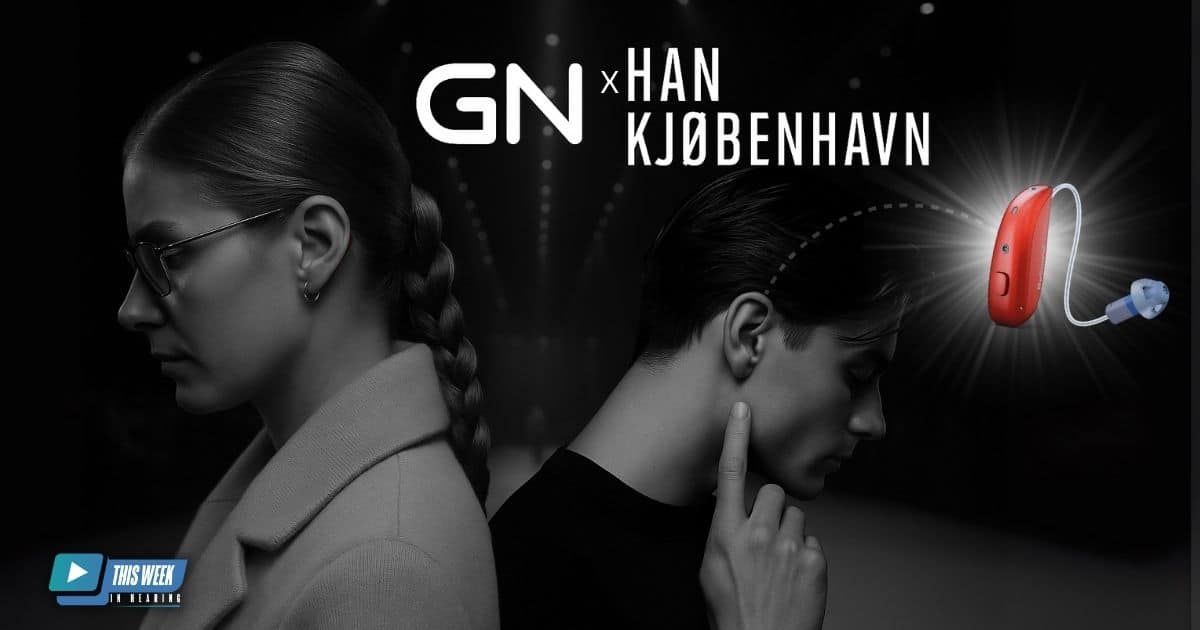
What happens when a global hearing aid manufacturer and a fashion house join forces to challenge stigma? In this episode, host Andrew Bellavia speaks with Marie Schleimann Nordlund, Director of Communication and Community at GN Hearing, and Kristian Rye, CEO of Han Kjøbenhavn, about their recent collaboration showcased at Copenhagen Fashion Week.
Together, the two companies brought hearing health to the runway, featuring models with hearing loss and integrating hearing devices into the show’s visual and auditory design. The project supports GN’s “New Norm” initiative, which promotes inclusive and authentic representation of hearing aid users in media. The conversation explores how the collaboration came about, why representation matters—especially for invisible disabilities—and how both brands hope to influence cultural perceptions of hearing loss going forward. It’s a thoughtful look at how fashion and hearing care can intersect to drive meaningful change.
- For more information on ‘The New Norm’ initiative, visit: https://www.gn.com/the-new-norm
Full Episode Transcript
Hello, everyone, and welcome to This Week in Hearing. A number of factors have driven increased conversations about hearing loss stigma, including greater awareness of the negative consequences of untreated hearing loss and the recent release of invisible hearing solutions, which include form factors that don’t look like hearing aids, as well as truly invisible in the canal devices. Invisible solutions have drawn controversy over whether they perpetuate stigma. My own opinion remains that for a person who is stigmatized right now, if an invisible solution gets them hearing care sooner, it’s all for the best. In other words, meet people where they are. And yet the question remains how to break down stigma so in future, the visibility of devices doesn’t mean a lot or it’s seen as a fashion accessory like eyeglasses. One company who’s been leaning into this is GN Resound, especially after the launch of their ‘New Norm’ initiative more than a year ago, providing royalty-free suite of photographs for real hearing aid users wearing modern devices to combat the use by media of those ancient photos of very old people wearing the big beige bananas that you’ve all seen far too often. Now, GN, in collaboration with the Danish fashion brand Han Kjøbenhavn, took it to the next level during in Copenhagen Fashion Week’s Autumn and Winter Event back in February. I’m sure you’re asking why we’re talking about this now and not then. We’ll get to that and more with my two guests, Marie Schleimann Nordlund, Director of Communication and Community at GN, and Kristian Rye, CEO of Han Kjøbenhavn. Thank you both for joining me today. Kristian please tell everyone a bit about yourself and Han Kjøbenhavn Yes, it’s a pleasure to join this podcast. First of all, I’m the CEO of Han Kjøbenhavn. We’ve been around since 2008. Started out as a small local brand in Copenhagen, which is a part of our brand name. Kjøbenhavn means Copenhagen Since then we went global and now you can find us in retailers all around the world, in the US as well. Thank you. and Marie? So you just introduced me. I’m overseeing communications and external relations in the hearing division of GN. GN is one of the, one of the important hearing aid manufacturers in the world. And we are very proud of, of the technology and of the collaboration we have with a lot of hearing care professionals around the world. We have been, we’ve been around for many, many years. We are nearing our 160th anniversary. So back in the days, we actually also had a mission to connect the world via communications cables and so on. And we’re still doing the same thing today. We are really uniting around a purpose of bringing people closer to each other and to the things that they love. And that’s also very much at the core of this collaboration that we’re talking. About today, which is really an interesting way of putting it. When you think about it. Bringing people closer together can be a transatlantic cable or it can be a hearing device so that one can talk with somebody across the table in a loud restaurant. It’s all the same thing in a way. And that’s a very long history. So thank you for that. Kristian In a joint press release which was released just last month in June, it described that during the Autumn and Winter Fashion Week event, there were two models with hearing loss who walked the Runway wearing their hearing aids. But given that modern hearing devices are so tiny, how would people in attendance even notice? Yeah, to be honest, I don’t think that nobody actually noticed during the show. Which is also kind of a point around nowadays hearing aids that they’re so discreet, almost invisible. But then again, the good thing about having a show is that in the, the aftermath there’s going to be a lot of attention and press coverage around the show where we get to tell all the small stories that we, that, that goes along with the, not just the clothing, but everything around the show, the, the brand. So so it’s, it’s kind of a, a stage, a setting to, to tell different stories. Okay. And, and I’ll tell you, when I saw the Han version of the press release, you have a short video showing two models walking down the Runway. In the second one, just as that person walks past the profile view and before it fades to black, I could swear I caught a glimpse of the red ones just like those. And so that’s what made me wonder. Right, because that was kind of an up close camera shot. So then, so then I want to talk about how this is publicized and discussed afterwards. But first describe the event itself and how the hearing portion of it was structured. The event itself, it’s for us as a brand, it’s a huge production. It’s like a biannual thing where we get to show the next collection that will drop in stores half a year later. Some brands do it as a, as a really commercial presentation for our brand. It’s more like a theater. It’s in a way we can express the brand and our emotions and also the small stories. That we want to tell again, including this collaboration. So when we got to. In dialogue with with Marie and GN, we. We deep dive into this and and we’re quite surprised around all the facts around hearing loss. So we, we really decided that this was a, this was a brilliant option for us to. To try to make a difference. But how. How we did it in a more practical way. Is that what you’re asking? Yes, yes. In other words, what was the experience like? Since you can’t see the devices? How was the experience structured so that even afterward you could discuss it? How. How were people made aware of it even during the event, as a setup for all the things that happened after? First of all, we. We had to. To cast some models for the Runway who was actually wearing hearing aids. And in the beginning, our casting director, who has the responsibility for that, she was like, oh, that’s going to be difficult. But no, surprisingly not. It was quite easy. Again lots, lots of people are wearing hearing aids. So we got those two models and elderly person and the younger person. So in that way we represented everyone, I would say. And then we had a backstage photographer dedicated to only focusing on those two models during the day, in the hours before the show, during the show and afterwards. And yeah, even the soundtrack for the runway show was. Was also designed to. To you know, put some focus on this statement. There was kind of There’s some effects around the sound trying to imitate tinnitus sound. And were people made aware of that during the event so they knew what the soundtrack represented? No, they were not. Not until afterwards, but then suddenly made it made sense to them. Okay. Okay, interesting. And. And I, I think the key thing you really said there was that you cast models who really wear hearing devices. And, and of course, there’s a lot of debate about, you know, representation in the arts, and I would include this as well. So the fact that you actually looked for people who had hearing loss and wore devices, genuinely, I think, very positive message in itself. And the fact that they were not that hard to find, you know, which. Which says a lot. Including the fact is that if you want to genuinely represent the kinds of people you’re portraying in your art form, go look for them. They will be there. So I really love that. I love that. And then you kind of intimated it. Why was the PR released in June when the event itself was in February? Yeah, basically, it’s, It’s. It’s because of this. This really stupid cycles around the fashion industry that you know we. We show something, and then half a year later, it’s it’s gonna be for everyone to, To. To buy if they’d like to. Okay, so understand. So you’re. You’re now. Now the. What we showed back then is being released. Right, Right. So you, you show in February, and then you release the autumn and winter collection this time of year. Okay, Makes perfect sense. So the PR is timed with the release of the clothing line. Even, Even the fact we call it Autumn Winter now it’s in July, but. I know that from the catalogs that come to my house. So we. Yeah, we just have to go with the flow. Right, right. Understood. So, Marie, how actually did this collaboration come about? And then once the idea of doing so happened how did GN work with Han to structure what became really a multimedia expression of the experience of hearing loss and representing people with hearing loss in a positive way? How did that come about? So I think we united around a joint purpose of saying, okay, let’s try to take representation. Let’s try to talk about accessibility also for some of the things that are probably not visual but some of the things that people have challenges with. So let’s try to make that a part of the show. Lets try to take hearing aids that are probably not known for fashion into that world and see, can we actually change some of the cultural narratives we have around hearing loss? Can we try to change the perception and also challenge some of the misperceptions that are around. You mentioned the beige bananas that people think hearing aids are? So we thought, okay, we are really proud of our devices, we are really proud of our design, the discreetness, the beauty of them. So why not try to make something that can be thought provoking, that can make people stop and think about it? So that’s, That’s a whole kind of a starting point of where we could unite around a common idea and purpose for this. Okay, how did, how did the two companies actually get together? How did you even conceive of this collaboration being from, you know, two completely different industries? What initiated this discussion that led to the collaboration? I think there are some interpersonal relationships between the agency that we use for some of our work and Han. And they actually said, why don’t you get together and see if if this first date goes well, then maybe there should be a next one. So I guess that’s it, right, Kristian? Completely right. Yeah. Our creative director, Jannik Wikkelsø Davidsen who founded the company. He used to work in in advertising. Actually at the very same agency. So it’s a personal connection. And then of course, to. To them, we, we were the perfect match. Because us as a brand yeah, it’s a, It’s a thing that we do. Can I just add, it’s. It’s hard for me to comment on your creative direction and style, but I think in terms of like, your expressions, your models, you have a lot of diversity already. I think you’re one of the brands that is very inspiring in terms of it and you know, self expression. I think you have some really, really cool models and some really cool imagery and expressions as a part of your brand. Well, in fact, Kristian, that’s a question I wanted to ask you because I’m not in the fashion industry and I don’t follow the industry very closely, but I still see a greater emphasis on representing a wider range of people, including those with disabilities. So what is Han Kjøbenhavn’s philosophy and approach to this? How have you addressed this and worked on, you know, worked with. In this concept, you know, leading up to the collaboration with GN. Yeah. A matter of fact, … has always represented diversity and inclusion in our brand. But even before inclusion and diversity became a big buzzword in the fashion industry, and to be honest, in the, in any commercial industry but. But so far we believe it’s still like a visual thing in fashion. It’s about the body shape, size age, color it’s not about the more invisible differences that the people might have. So for us, it’s natural to still try and push the boundaries on how to, how to cast models for campaigns and shows. And that’s what we also try to do here. We actually feel we have a responsibility because we are you know we are an important voice in, especially towards the younger crowd in how you should look and express yourself. So if we can make a difference, that’s. That’s what we try to do. I love it. And I think that really makes. The collaboration with GN makes a lot of sense in that context. Or how to, how to, how to speak to the people. Ultimately, if you want to be pragmatic about it, how do you speak to the people you’re trying to sell to? Right. To To represent them genuinely makes a lot of sense as well as being a good thing to do for the greater image and message that that creates. In, in the very beginning, in the 2008. When we did our first, very first campaign, we used we streetcasting elderly models at that point. To be honest, it was maybe more like an anti fashion statement, trying to, to go against this polished fashion marketing at that time. But then throughout the years we’ve been more How do you say it? Yeah, we’ve been more responsible about it, like, or feeling the responsibility about about it. And even some years ago we, we had another Runway show where we put some rather direct focus on mental disorder and that kind of split the waters because what did that have to do with fashion? But for us that was perfect because we, we put some some focus on, on a very important issue. And that was the point for us. And, and as a brand, as Marie also said, a bit like our, our cast and our brand in general is a bit gritty and imperfect. And that’s also what we try to express. Kind of like all of us, right? We actually try to, to express that imperfection can be better than perfection. Yeah, we ambassadors for that. Okay, okay. So, so yes, I really can see how this collaboration fits in totally with your ethos. So. And, and yeah, hats off to creative director for thinking of this in the first place. Now Marie, from your point of view, how then will you continue to leverage this like the new norm? The photographs are there and hopefully more and more media are using them. How will you use this in the same way to spread the positive message about successful people with hearing loss who look like you and I out there in the real world? How will you use that going forward? So the way we will use it going forward it is to work with people like you. We want to spread the word out wide and loud to everyone, to see, to know, to feel inspired by. You mentioned that we have a photo library that is publicly available and free of use for any journalist, any media, anyone who wants to use it. It features incredibly beautiful people that are wearing hearing aids. So we want people to use this and put it when they’re writing an article, when they’re doing something, take it and use it. It’s here to show that it’s not a beige banana you have behind your head. It’s something that is small, discreet, beautiful. We want to show how beautiful people look at these devices with their perfections and imperfections. And we hope that people will use the ‘New Norm’ in the same way to find inspiration and say this is cool. The Han Kjøbenhavn is a continuation of this. And I don’t Know what lies ahead. I’m open for ideas. So anyone who has an idea, come to us and let us know. What would be a great way of showing that hearing aids are cool, they’re part of life take care of your hearing and have a better life than you maybe had before. So that’s our, that’s our ambition, our purpose. But I cannot tell you exactly what, what will come after this. But for sure something creative, fun, engaging will come. And Kristian, you had said that the show was really just the start. You had an on site photographer taking photos throughout the event in preparation for the Runway and everything. So how actually are you using it? Where are people seeing it and just how, how is it being portrayed? You know, from February until now and beyond. Since the show and beyond, we as a fashion brand are quite a visual visual business. So, so it’s, it’s been on Instagram, it’s been on Facebook, what have you, our newsletters. So, so for us it’s, it’s, it’s a story to tell. And we, we will continue doing that and hopefully we can do more creative projects highlighting this, this topic. And then was going to ask you the question, are there other plans to carry on this collaboration going forward? We, we always love to design physical stuff, but I guess for this one it’s, it’s going to be a bit more difficult. But there’s other creative ways to do it. You never know. Maybe we need to, to create some kind of beautiful accessory that could go with a hearing aid. You don’t know what the future brings. Right, right. Exactly. At least for us, it’s important to, to, to show that you should express yourself and, and and your hearing, your hearing aids. So, so far so good. Well, and I for one, and Marie knows where I come from. Right. I for one am very excited by this and really glad that the two of you got together to do this. And thank you very much for that and also for spending some time with me. You have any final thoughts, Marie? Before we end this podcast. Just wanted to reiterate that I hope people will enjoy these pictures these videos, these messages. I think they are really important and I know that a little action of going and taking a hearing test or taking a loved one to go and have a hearing test to see if you need support, that can have a tremendous effect on the person’s life. So I want to encourage everyone to go and get tested and see. Do you need Support. Or maybe if you don’t have a hearing loss, why don’t you try asking questions to someone who has a hearing loss to know more about it? We know that people wait too long. We know that one out of only one out of five person who has a hearing loss actually treated. And it’s such a shame because it has an impact on cognition, it has an impact on physical well being, on mental well being. So really don’t wait. Go and get tested. Go and get the help you need and help the people around you to do it if they need your support. Okay, thanks. You know, it’s funny, you reminded me of an incident I’ve had multiple people because I wear my hair so short. It’s pretty obvious I wear hearing devices, especially from the back. I actually had a person I never met before in my life come up to me in a parking lot, ask me if I was willing to talk about the hearing aids in the process and so on. And we had like a 15 minute conversation in the parking lot. And so far from being a negative to be seen wearing nice looking devices, I think it actually has a very positive effect. Just what you said, you know, if you’re concerned about your hearing or have questions, find somebody and ask them. So I love that. And Kristian, final thoughts? Yeah, I just wanted to, to elaborate on your experience because we, we’ve had the same since, since the show. Just, just the, the two models walking the show, they’ve been, they were so happy because they felt that suddenly, you know, they, they actually fell insecure, you know walking down the, the Runway wearing the hearing aids. But afterwards they were so heavy and hopefully they’ll take take that forward and, and just on, on our social media and LinkedIn, I, I noticed that it’s one of the most how do you say it? Yeah. Most liked post we’ve ever done. So, so you can tell it, people really feel this collaboration. Thats that’s terrific. And these are the ways we’re going to break down hearing stigma once and for all so that people of all ages and walks of life are comfortable wearing devices and get hearing care sooner. So thank you both for this and thank you both for joining me today. And thanks to everyone for watching or listening to this episode of This Week in Hearing.
Be sure to subscribe to the TWIH YouTube channel for the latest episodes each week, and follow This Week in Hearing on LinkedIn, Instagram and X.
Prefer to listen on the go? Tune into the TWIH Podcast on your favorite podcast streaming service, including Apple, Spotify, Google and more.
About the Panel
Marie Schleimann Nordlund serves as the Director of Communication and Community for GN Hearing, one of the world’s leading hearing aid manufacturers. With a focus on global external relations and strategic communications, Marie plays a key role in GN’s mission to connect people through innovative hearing technology. She leads initiatives that promote hearing accessibility and combat stigma, including GN’s “New Norm” campaign, which highlights real hearing aid users in modern media imagery. Marie’s work centers on fostering dialogue, representation, and awareness across the hearing health landscape.
Kristian Rye is the CEO of Han Kjøbenhavn, a Danish fashion brand known for its bold aesthetic and commitment to inclusion and storytelling. Since its founding in 2008, Han Kjøbenhavn has grown from a local Copenhagen label into a globally recognized brand. Under Kristian’s leadership, the company has pushed boundaries in casting and creative direction—highlighting underrepresented voices and perspectives on the runway. Through recent collaborations, including a partnership with GN Hearing, Kristian has helped bring awareness to topics such as hearing loss and accessibility within the context of fashion and culture.
Andrew Bellavia is the Founder of AuraFuturity. He has experience in international sales, marketing, product management, and general management. Audio has been both of abiding interest and a market he served professionally in these roles. Andrew has been deeply embedded in the hearables space since the beginning and is recognized as a thought leader in the convergence of hearables and hearing health. He has been a strong advocate for hearing care innovation and accessibility, work made more personal when he faced his own hearing loss and sought treatment All these skills and experiences are brought to bear at AuraFuturity, providing go-to-market, branding, and content services to the dynamic and growing hearables and hearing health spaces.