

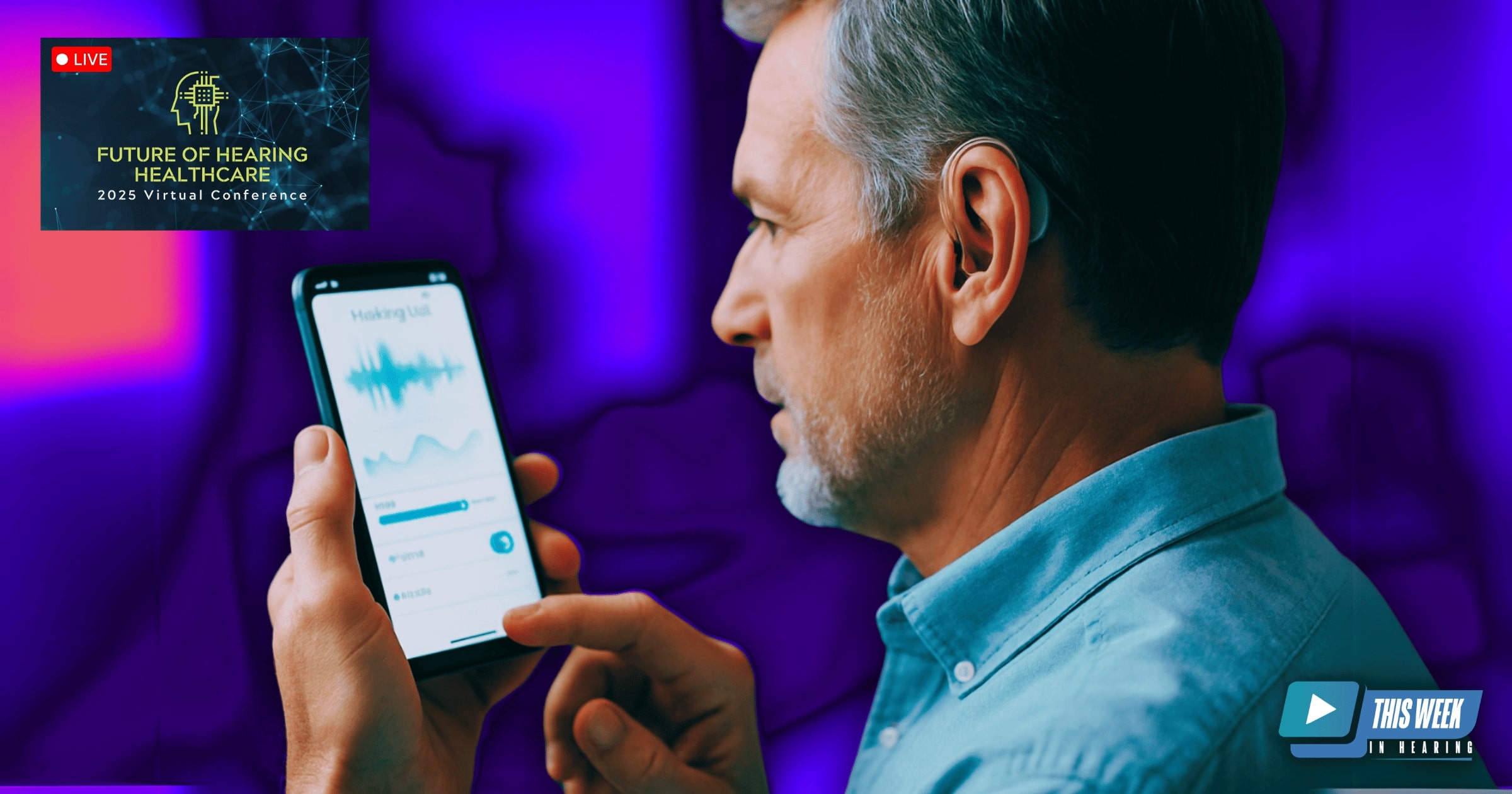
Hearing care is evolving rapidly—are we ready for what’s next? In this conversation from the 2025 Future of Hearing Healthcare Conference, Andy Bellavia and Dave Kemp explore the trends reshaping hearing healthcare. From the growing influence of AI and consumer tech to the mainstreaming of OTC hearing aids, they discuss how new technologies are expanding access and improving outcomes for people with hearing loss.
Dave shares insights on the convergence of consumer and clinical devices, the rise of new treatments for tinnitus, and how automation and assistive roles are enabling hearing professionals to serve more patients effectively.
They also examine global dynamics, like how countries without established care systems may leapfrog traditional models entirely. Whether you’re a clinician, tech developer, or simply curious about where hearing care is headed, this discussion offers a timely and optimistic look at the innovations, business models, and mindset shifts needed to meet growing global demand.
Full Episode Transcript
Hello everyone, and welcome to the Future of Hearing Healthcare 2025 with a panel discussion with Dave Kemp. I think in this environment he probably needs very little introduction and I’m not even sure who’s the moderator or who’s the guest here as we explore innovations in hearing care and what’s exciting to see these days. So, Dave, why don’t you tell me, say a few words about yourself or the three people left who don’t know who you are and what’s exciting you to these. These hearing care. Well, it’s good to be back with you, Andy. I am David Kemp. I’m the director of business development at Oak Tree Products, which is a small family owned business that my parents started out of the basement of our home back in 1993. So I’ve kind of been seeped in this industry my whole life, initially as the janitor of the office, but now on the sales side of the business. And anyway, it’s given me the opportunity to meet a lot of people within the industry, providers, industry professionals at the various vendors and companies that sort of exist within this space. In addition to sort of my Oak Tree hat, I’m also a podcaster. Do a lot of these with you. I think you’re one of the first people that I ever podcasted with, Andy, back in probably 2017 or 18. So, you know, a lot of what we initially were talking about was the future of, you know, kind of the innovation in this space. My blog was Future Ear. And you know, that’s kind of morphed into my podcast today where it allows for me to kind of continue to interview people in this industry around the innovation that’s transpiring sort of segues into this week in Hearing, which you’re a co host of as well, which is another just sort of way to tell stories of what’s going on within the industry, the news that’s happening, all the innovation that’s transpiring. So a quick rundown there for, from. Me, yeah, it’s wild to look back when we did the. I remember when we did the first video podcast together, how, if I may say, how crude it was the two of us and how funny how time flies. It’s all come since then, right? And yes, I will plug your Future Ear podcast as well as of course this week in Hearing, where we’re both co hosts. So, you know, when you, because you’re, you’re embedded in several different places, right? You work with the audiology profession and you’re also following the trends in the hearing space Overall, what’s really exciting you right now, what’s new that’s happening that’s exciting you right now? Yeah, I was kind of thinking about this when you, you pitched this panel, this huge panel that I’m part of right now. And you know, I was thinking about it though, like what, what is really sort of, I guess, worth noting that’s happening here in the middle of 2025 and I kind of was seg. Segmenting it out in my mind. So first of all, I feel like, you know, going back to a lot of what you and I have originally really discussed is the product innovation and how the micro, microtization of, you know, kind of Moore’s Law, more or less of the devices get smaller, they get more powerful, you know, so you can, we’ve, we’ve been on this journey since as long as I’ve known you of this progression. And I think that now, you know, you’re really seeing this convergence around, you know, these consumer devices that can basically operate like a full fledged medical device. And you know, I guess it’s significant that the line of demarcation is really just what constitutes a clinical hearing aid, you know, regulation wise, not as much technologically wise because I guess the two really are so, so similar. So I feel like, you know, you always need to be aware of where we sort of are on that journey. And I feel like we’re, we’ve really kind of entered into a new, the beginning phases of this next step change with these AI powered devices. And it’s one of those things that it starts out as a buzzword, but we all know that that is sort of going to be the, probably the foundation of all the innovation to come here over the next, you know, decade and plus is going to be automation and computers just being embedded into everything. So, you know, for me, I feel like that’s really worth pointing out is that, you know, you now have this sort of, I guess you would call it the proliferation of these devices and the pervasiveness of these ever increasing sophisticated consumer devices that can do more and more things. So, you know, that I feel like sort of is this one pillar and then I feel like from there you have kind of, well, what about all the people that are in this ecosystem? And I feel like that’s sort of under a renaissance of itself, sort of by necessity because I think that, you know, it’s no secret that the, the cash cow or I guess the bellwether of the revenue for your average hearing healthcare professional is going to be dispensing hearing aids. And I feel like that’s been under siege for a while now for from big box retail to managed care. You know, you can go down the line of all the different things that have kind of come gone still exist. But the thing that I guess kind of feels more obvious now more than ever is the, the real I think need for that, the audiologist in particular to sort of skew more medical. Because I think that what we’re, what we’re kind of like moving faster and faster toward is this future where I think that the initial entryway into hearing healthcare is, is a self service device. I mean you can kind of see it with like look at NAL3, you know, that’s kind of talking about how your first fit clinical prescription hearing aid is going to get more and more, I guess personalized and finely tuned which sort of, you know, makes it so that the, you know, if you’re just doing speech mapping and real ear measurement, that’s not like a full blown differentiator because the automation is catching up to that too. So I guess what I’m getting at is like you’re seeing this, the, the tide that lifts all boats with, from a technological standpoint, you know, these devices are getting less expensive, more capable. Right. And, and so therefore I feel like it’s just going to expand the market because I think it’s going to become. So the accessibility of this is just going to continue to increase. It’s going to be something that you can just do as a consumer device initially with some of those like initial sort of features that are kind of in the hearing health care world. But I feel like where I’m not worried as somebody that you know, my business caters to the hearing healthcare professional. I want them to succeed because I feel like what doesn’t change is the fact that your, your hearing loss and you can attest to this, Andy, is for a lot of people it is a sort of diminish thing. It’s an age related sort of diminishing thing that you live with. And so I feel like at a certain point people want to really understand that it’s not about the technology, it’s not about I need to go get fit with the hearing aid. Because for all we know hearing aids by all intents and purposes will be ubiquitous. But what won’t be will be the, the care. Right. And being able to seek the professional and have the guidance that comes along with that. So I see that the profession just kind of continuing to evolve like that finding in it sort of Coincides with you now have entirely new treatments for sort of sister symptoms, if you will, in this space with tinnitus and being able to treat that with some of these neuromodulation type technology devices. Again, the common denominator with all this is like the technology just kind of keeps enabling all of these different things. So I’m, I’m very much half glass, half full person. I look at this with a lot of optimism because I don’t think that this is a scarcity thing. I think it’s an abundance thing. I think it’s just a matter of figuring out how do you actually treat all of the demand because there’s such a finite amount of supply. You’re going to need to offload a lot of that to automation. And I think that’s the early rungs of the, the onset of the hearing loss, right when it’s real mild. It’s not something that you’ve really gotten to the point where you need to go and schedule the appointment and go see the medical professional, but you really are at the point where you probably should be doing something. And that’s the whole thing where that, that sort of market, I mean, I’ve seen a lot of charts that show sort of the representation of what that looks like. And it’s like that’s the big piece of the, of the pyramid. You know, that’s the foundational piece is that’s the biggest part of the market. There are the people that have that sort of early onset hearing loss that aren’t really ready to take the plunge yet. So that’s where I see this notion of these consumer OTC type devices that kind of blend the two. I think they’re going to be really successful as time goes on. There’s an inevitability about them with the technology just continuing to maturate, get better. But I don’t perceive that as being a threat. I see that as being an expansion to the market that’s largely tapping into an unserved portion. Today that ultimately my sort of take is I, I continue to think that’s just going to grow the prescription and the clinical market because more people are going to be exposed to this. More people are going to have an appetite for, you know, basically going and seeking a professional to help guide them throughout this lifelong journey of. Let’s make sure we preserve as much as possible here and use all the different technology available to you because these are just, these are just tools. Right. So that’s how I kind of am seeing things right now. Is this sort of, we’re at a really interesting time right now of like the technology is, is really making leaps and bounds. It feels like in terms of the capabilities with parsing out speech and noise, you know, kind of solving the like age old things which again, I think it increases the patient satisfaction rate. So, so you just have more people that are talking positively about this. We know that word of mouth marketing tends to be the number one driver into a prescription hearing aid appointment. So again, I just see this all being a virtuous flywheel of compounding positive effects that are taking place or are kind of in the midst of percolating and will become more pronounced as time goes on. Yeah, and it’s interesting, I agree with everything you said and it’s interesting because. And you’ve talked to a lot more audiologists than I have, but all the ones I’ve talked to actually see these things as a positive. So I had a lot of conversations around Apple hearing aids and luxottica Nuance audio hearing glasses. And they all see this as generating conversations that are bringing people into their clinics, whether they’ve tried them or not. But the trends are real. Right? We’ve been talking for 10 years about the convergence between hearing devices and hearables and now you actually start to write. I mean it’s always coming, but never here. Yeah, but the last CES and afterwards was really illuminating. For example, I visited, I actually did a short video with Rehear Audiology. You know, when you do a real ear measurement on your hearing aid, you have to put a microphone in the ear canal. Well, every earbud in the world already has a microphone in the ear canal. It’s used for ANC noise cancellation. Well, they took advantage of that and they’ve done a fully automated real ear measurement. And I tried it at CES and it really works. And so now if you take an earbud style hearing device, you can run real ear as well as your normal fitting. That’s the sort of convergence that’s going to have an impact. And even, you know, one step above that actually is the fact that earbud style hearing aids are going to gain greater acceptance thanks to Apple and the AirPods. They’ll start changing that story. AirPods aren’t for isolating yourself. AirPods are for hearing better. And that’s gonna open up everybody who wants to do a situational earbud or that sort of thing. At the same time, the chip technology is really racing forward and the possibility of doing really good AI based noise reduction is starting to come about. You see people approaching this like Absolute Audio Labs for example, has hearing aid software that you can put in any earbud with a capable enough chip in it. So aside from generating all the knowledge, you know, or like increasing knowledge in the, in the general public of hearing loss and the comorbidities and all that, you also have the globalization of over the counter hearing aids. Apple has been scooping up countries all over the world and getting approval for AirPods Pro 2 hearing devices. And Nuance Audio, Essel or Luxottica has been rolling up different countries and getting approvals for the hearing aid glasses. So you now have taken what was a U.S. phenomenon and globalized it. At the same time the technology is moving forward. So you’re right. Base level delivery of hearing care for mild to moderate people I think is fantastic. That’s been an underserved population globally and that then as you say will then also create increasing demand for clinicians for people with hearing losses beyond this sort of mild and situational use. So I think it’s, it’s actually a great place to be wildly underserved overall number of people getting hearing care who need it. And now all together we’re going to start to carve into that. Well, it’s a, it’s an interesting point too about the, the kind of, the global market and you know, the fact that you’re going to kind of now have this red tape lifted in various countries that they can proceed, you know, that’s probably where we’re going to see a lot of the most innovative things take place are these markets that do not have the legacy incumbent sort of networks. So they’re not saddled with that. In a way. Markets don’t even have audiologists or very few. Exactly. So you know, those are going to be the ones that have the most incentive to make the OTC models work. So you know, there’s not, I just, I find that to be very interesting is, that’s kind of where I would look to in terms of where you might kind of see things is that it might actually emerge in these non US markets, you know, just because I think that the, the conditions of those markets are such that they encourage the OTC model maybe a little bit more than, than this one here in the US that always is going to be sort of having to walk that line between the prescription model and the OTC model. And there’s obviously a much larger infrastructure here that can support the existing model. Not to, you know, dwell on this too much, but I always think about like the analogy of, you know, you, you know, as like you have some of these countries that have like real long institutional banks and stuff like that. Other countries kind of maybe like skipped that phase within their, you know, they, they were such a immature country and then they leapfrogged it because they didn’t have to spend all the money that was associated with that. So they went like directly into digital payments would be a good example of that without having the legacy banking infrastructure. So again, I just, I find that to be an interesting element of this to keep an eye on is that the global market is going to be where we’ll probably see some very, very interesting things happen here in the coming, I would say like two to three years. Yeah, completely agree. In some respects it might be the tail that wags the dog when you start to serve global needs and underserved areas that, that will come back into western countries too with mature infrastructures like banking. I think of mobile phones. I had done some traveling in the past in South America where the landline phone network was a mess. There were long wait times to get phone. Well that everybody adopted mobile phones the minute they could. Exactly. Landline phones died much more quickly in some of those places than they did here in the United States. Now aside from the otc, how do you see in terms of diagnostics and practice and in those areas, how do you see innovations driving adoption of hearing care? How do you see the consumer being supported by innovations to adopt hearing care sooner? I guess the narrative is going to be doing more with less. Right? Because I just continue to think of this as a supply and demand equation. And I can’t shake the feeling that the baby boomer generation is so much bigger than most people I think can, can grasp without looking at a chart. It’s, it’s like three times the size of the next biggest generation. So you have this whole huge wave like people have described as like the silver tsunami and all that. And it’s just one of those things. The narrative of I just think we’re in the process. We talk a lot about stigma and how do you get past these sort of what feel like, you know, percentages that are like, locked in place. A 15% adoption rate of hearing healthcare treatment, or 12%, 10%, whatever. And I just keep thinking that, you know, there’s got to be a force function to. First of all, I think the catalyst is the OTC market really coming into its own. And I feel like that that’s going to just drive a lot more people to pursue that next step. And I think that’s what we are. I think, like, if I were an audiologist, that’s what I would be thinking about is how do I ensure that I capture that local demand in my local market. And I think there’s enough to go around because I think the market’s huge. And I think that we are so conditioned thinking that this market is, is, again, it’s a scarcity mindset. It’s like if only 15 of the people are being treated, how do you, how do you get the other 85 people, 85% of people to potentially take action here rather than squabble over the 15? And so I just think that that’s going to be. It’s a. It’s a market dynamics thing of, like, how do you connect the supply and the demand? And so I think that, you know, what’s going to be very, very interesting is, like, when you start to see business models emerge at these clinics where they can truly service more demand than previously. And I think that’s through, you know, like, I’ll continue to think that it’s going to be. Virtual conferencing. It’s going to be having, you know, people that are basically trying to facilitate the patient interactions in ways that are maybe non traditional. You’ll have that too. I think that’s going to be an existing thing. But it just seems to me that as more time goes on, a lot of this is going to be, you know, sort of rehabilitation, guidance, coaching. I kind of think that’s at the root of what the value is, you know, is again to have that person who knows this better than anybody. You know, it’s a dedicated medical professional for this very specific part of your body and in having that doctor throughout your life, more or less. And I think that, you know, there’s more ways that they can now I think that providers can service their local markets. You know, I think again with the whole these neuromodulation tinnitus treatment therapies, you know, these are. We haven’t had this before. I think like that’s really worth pointing out is that there’s never really been good treatments for tinnitus. It’s been one of those things you’ve just kind of had to live with. And you know, there’s been attempts and there’s been some stuff that I guess would that you could argue that has been moderately effective maskers and so on. But not now. You. I feel like again, it’s like that’s what’s so exciting is like here we are and the, this medical professional has truly become enabled to provide relief to so many people, thousands, millions of people within their markets that are suffering from this. And like that’s where for me this, this doesn’t give me any sort of pause or concern is like if you can give people that, that type of relief, there’s going to be a lot of sort of secondary effects that come from that. You know, people are just going to default to. This is the person I see for these sorts of issues and word gets around in the market that you’re the expert with this stuff. So I see that. I don’t really see the workforce like growing per se. I think that you’ll have, you’ll have. The dispensing market will probably continue to grow, but the AUD market I feel like is probably somewhat fixed. But I feel, I feel like what, what could really change is how do you enable those few but mighty people to play an outsized role? Like how do you basically take that, Whether it’s having them in, in some way triaging their expertise, training others. You know, I, there’s some really Interesting things I’ve heard about, you know, the role that audiologists are playing to help facilitate, you know, like occupational hope, health therapists, trainings with regards to the hearing screenings. You know, so it’s just thinking about the, the total ecosystem and all the other medical professionals that are sort of adjacent to this. It’s not just an ear thing, it’s a brain thing, you know. So it seems like there’s so much potential with the, you know, trend of better diagnostics, a better understanding of what’s really going on and the need for somebody to really help to interpret, interpret and communicate back to the other broader medical community. And I feel like a lot of that is just going to kind of increasingly be enabled by better technology and tools in the clinic. You know, maybe that’s just wishful thinking, but it seems to me that that’s kind of, you know, also inevitable is that technology marches on in that direction too is to just more efficient ways to screen people, you know, mass screenings, getting. I mean you think about like all of the sort of. There’s so much opportunity to do better if, if we had the resources. So if you had diagnostic equipment that was really capable of facilitating mass screenings and really easy to use, lay people can use them or you can have the audiologist train, you know, the types of the school nurses and stuff like that that would be able to administer those. So anyway, I just think that, you know, there’s some of this stuff feels like it’s like it’s not changing at a super rapid pace, but at times other stuff just kind of comes out of left field. Like the neuromodulation, tinnitus therapies. You know, I knew those had been being sort of clinically trialed, but you see all these different devices that are sort of pending FDA registration. You’re not sure what’s really going to pan out, what’s not. And so that to me is a really big win I think kind of in the, that’s going to be up there with like cochlear and the cochlear implementation and that really unlocks a huge portion of this market I think for the, for the professional. So you know, what, what, what are we going to see in the next, in the coming years that will be again unlocked by some sort of big breakthrough. Yeah, and mentioning tinnitus treatment I think is a good one because it’s a little bit under sung. But just as you said, I mean there have been traditional methods of dealing with tinnitus, like cognitive behavior therapy, for example, which are effective for some people and even that hasn’t been around forever and now you have a variety of treatments so that there’s something almost for everyone and that, that is really huge in terms of being able to treat tinnitus, you know, being so under treated for so long. But you also mentioned, and I think you know, when we talk about the shortage of audiologists, that can only be getting worse because as you mentioned, how do we do more effective screeners and how do we do more effective education getting people to address their hearing care? And I’m seeing some of those things. For example screeners, there’s Clementine out of Europe who’s got a kiosk based screening system that you can even partner up with local hearing clinics. So you go to a pharmacy, for example, there’s the blood pressure cuff over here and you can put a hearing screening kiosk over there. You’ve got sound scouts in Australia doing very similar. They’re focusing more on children but they have adult screeners as well that are automated, tablet based sort of thing or computer based. And also more education. I’ll mention that Melanie Ferguson, she presented earlier in the future hearing health care on the HearChoice app, which is a project I’m working on as well, to educate people on the whole range of options and demystify hearing care. Encouraging to get hearing care sooner by educating them and arming them to make an informed decision. And all these things are going to drive more people. And as they found in their studies so far with hear choices, a lot of the outcomes result in people committing to going to see a hearing care professional. Well, if you’re driving more people to seeing hearing care professionals, but the profession’s not growing, then you need other tools so that the audiologist is always practicing at the top of their scope and the ancillary things are being handled by somebody else. And of course it’s tricky to change your business model because you have to make investments up front in people and system changes and so on. But you know, if we’re going to serve the other 4/5 of the people and half of those 4/5 of the people who are not served today are going to go see a hearing care professional, we need either much more efficiency in the system or we need a lot more hearing care professionals, no question about it. Yeah, I completely agree. And you know, you’ll have. I think one of the interesting things with like AAA this year was there was a, I think there was like almost 100 audiology assistants there this year and that was A first it was up from like seven the year prior. So you have, you do have I think opportunity with kind of building out subclasses to help do, you know, all the way down to the administrative tasks up to as close as you can get. Right. And I think that kind of ties into the whole notion of doing more with less is I think there it’s like again, how do you, how do you just sort of extend that scarce resource? And that to me is like that seems obvious is that you’re gonna have to do that. You can’t get around to your point. Like as soon as a certain market were to take off, it’s like eventually they’re going to just get overwhelmed with the amount of demand. So it’s, it’s like that what I was saying, like the market dynamics of like how, how do you properly square this so that you know you can adequately supply the demand? And that to me is like a obvious sort of, you have to use some layer of technology, I think way to triage, you know, and use as much of these administrative or associate level type workers within your clinic. But you’re right, I mean it’s like way easier to you know, armchair quarterback this and say these are all the things that you need to do when in reality you’re right. Like there’s price tags associated with all these things. There’s opportunity costs of like maybe you’re focusing on one element of your business right now that you really don’t want to deviate from because you have a really good opportunity in front of you. So I, I think that it’s more of just note like recognizing that these are kind of the macro trends. I feel like a lot of people have already been kind of moving in this direction in the market kind of moving in this direction. I mean you think about just the way that the managed care space and like how. You know, insurance and the role that that’s taking and you know, with people coming in and that’s driving people in is because they have a benefit or a perceived benefit. And anyway, it’s just all of these things are, it’s trying to tap into this latent demand that so many kind of know is there. But it’s like how do you sort of properly marshal that into whichever funnel you, you know, I guess you’re associated with? So I, I don’t necessarily like know how this will materialize, but for me it seems obvious that there will have to be innovations that take place. And I think like this will, this will legitimately spur entirely new business models to cater to that. I think we’ve seen, you know, over the first five years of the 2000 and twenties, interesting early iterations of what those might look like. I’m not sure I’ve seen any that have truly stood out as like, this is a, a new game changing way to do this. A lot of it is, I still think very much in that sort of incubation, early phases of almost startup mode. And but I, I think that the mentality is there. I think you have a lot of, I mean that, that probably seems to be one of the most reoccurring themes when I’m talking to people at conferences and stuff like that is that a lot of people are actively looking to do new things, right? Like trying to figure out ways to broaden their, their customer base, if you will, or their patient base, tap into new technologies, whether it’s, you know, getting more involved in the CI space, doing more of a tinnitus, you know, getting into the vestibular stuff. The concussion protocol space is really interesting. So it seems like there’s lots of avenues that are kind of yielding some pretty good opportunities that have legs. But I, yeah, I don’t know, I don’t know how ultimately you are like this. The market will cater to what I believe to be the demand. And again, I kind of think then therefore it means that a lot of that will probably just be self serve initially because I kind of think that’s where the bulk of this growth market is, is that 40 year old, 45 year old, 50 year old, whatever, that’s just sort of getting into this and they’ve gotten exposed somewhere or another. Right? Was it a commercial? Is it through their phone now, is sort of giving them nudges in that direction. Do you want to test your hearing through, through AirPods? You know that like, think of how, how big that would be, right? And we’ve talked a lot about this before of like that’s kind of the magnitude of Apple that is also one of those things that’s hard for us to kind of wrap our heads around of like the size of influence that they have with one push notification or something like that would reach more people than any marketing campaign that’s done throughout this industry combined across every manufacturer for the last 10 years. You know what I mean? Like it just dwarfs it. It’s a totally different scale. So I’ll continue to come back to that too of like because it goes, it harkens back to some of our earliest conversations. Andy was just what it means to have Apple sort of right there almost just straddling the fence in your industry. It’s kind of been, it’s been a really interesting experience I feel like for this here in healthcare industry is you’re sitting adjacent to AirPods which are next to the iPhone. Like you know the, probably the highest selling consumer technology product at least in the US market. Certainly the highest selling audio device. Audio device, right. So it’s, I just find this to be, it’s. We’re in really, really interesting times right now because again you like we as a hearing healthcare market get to benefit so much from having one of a, you know, a multi trillion dollar company just sort of as a side business, you know, It’s a Fortune 50 company that they have inside of itself. That’s you know that’s one, that’s about two steps removed from what we all exist around in our industry. Yeah, no, that’s a, that’s a really, really good point. Is the, the effect that that adjacent company called Apple could potentially have if they, if they really push on this. Right. One push notification million people are you know, being urged to address their hearing loss or at least test for their hearing. So and then when it says you. Should seek a, a local provider, you know, again it’s like that’s, that sort of is the scenario of like how it, how it becomes an avalanche is like whoa, are you prepared for that? Are you prepared for you know, five times the amount of patient visits? I’m sure a lot of people be like oh my God, that would be the best thing ever. But it’s like no, truly, like what if that were to happen? Because that’s, that is kind of the power of a company of that magnitude. Yeah. If they get it right. I think this is still very immature as well. I’ll use my own example, right. My, my hearing is good up to about a kilohertz and then at 2 and 4 I’m down around minus 70. And I did the AirPods test and it said one ear is mild and one ear is moderate. Well, all the audiologists, you know, out there listening to this right now raise your hand if you think that’s mild or moderate. I don’t see any hands. Right? Yeah, right. And so the messaging has to be refined and appropriate and that’s really a difficult thing to do on such a kind of a quick burst. But at least it’s getting people testing their hearing and being made aware of their hearing and I think that sort of thing increases. It’s going to be good all the way around. And that’s, that’s probably what I’m most looking forward to is more consumer oriented messages that get more people. Now I’m talking Western countries, right? How to get more people interested in their hearing and thinking about their hearing. Like they think about so much, you know, of their health and different aspects of their health to get hearing added to that same thing. That’s, I see the infrastructure being in place to make that happen and that’s what I’m most excited about. So what would be the one thing you’re most excited to see happen going forward? Well, before I do that I was going to ask you, I, I had a question all teed up in my mind. So two way panel here, let’s, let’s. Ask you a question. You know, I was gonna say, okay, so given I could, I love your whole journey as somebody that like you know, you basically you’re in the pro audio space with your, you know, roll at, at Knowles and you know, very, very familiar with this and then you go through your own sort of process of getting fit with hearing aids and, and now you’re kind of in the hearing healthcare space as a consultant and so you’ve, you know every, all of this kind of intimately down to, as a patient but also as an industry expert. So I’m curious of like here we are in 2025, you know what, what do you think stands out in terms of what’s different now? If you’re starting your journey versus when you started your journey. When was that? Was that five years ago? Seven, 2018 was when I was fitted. So that’s now seven years ago. So what, what do you kind of observe changed, improved, whatever now versus if you had done it or you know what I’m saying, if you were just getting started now. Yeah, I mean in terms of my experience as a patient hasn’t really changed much. If I go see an audiologist today, it’s the same as when I saw it in 2018. And I’ll say with my hearing loss I just described, I’m 100% glad I went the professional route. I probably would have if this had happened, started happening now. I would have tried an OTC device at first, because, I mean, I was in on the very beginnings of true wireless earbuds. I worked with all the early people, all that I was very familiar with, that I would have tried them. But ultimately the professional route was what worked for me with that level of hearing loss. That experience hasn’t changed much, actually, the devices, though, like I wrote, Abram Bailey asked me to write a couple of articles. One when I first started on my journey, and another after I got fitted. And I. And I told them how, like, I got my hearing aids on a Thursday. I said to my wife, tomorrow, let’s go to Place X, our favorite loud restaurant or one of them. And, like, she asked me how my hearing aids were working. And then without even giving me a chance to answer, she said, apparently pretty well, because you look pretty relaxed, you know. And I realized I was sitting back like this. I wasn’t leaning in. I was sitting back relaxed, and made a tear come to my eye. And that’s how much better they sounded than nothing. I can’t wear those hearing aids today. Yeah, the new ones are so much better in noise, in overall performance than the ones I was fitted with in 2018. It is absolutely amazing what has happened in the device itself. Even, like simple things like those hearing aids. I had to create custom modes and was switching more often, you know, in different situations. Now, 98% of the time, I let it run in automatic, and the other 2% of the time is either putting it in music mode, which is, you know, special mode with all the compression turned off, or music listening. And or kicking in all the noise modes when it’s really tough. But most of the time automatic mode works great. Noise modes are amazing. And of course the best is yet to come with increasing use of AI with NL3, which I got to try in person, and how much more comfortable the noise experience was with NL3. So the devices have really raced along and I’ve told people you have three or four year old devices if you have the wherewithal. I would very much consider upgrading if you’re not having a satisfactory experience. That’s the key thing. I would say from my own experience, the audiology experience hasn’t changed any, but the devices have raced along and gotten a lot better. Yeah, that’s so interesting. I feel like the, you know, the whole point there around just, I just can’t get over that. You know, when we first started to do these things, you know, it was all about the battery life, right? You know, how do you make sure that you can preserve enough battery life to be able to do these different functionalities and stuff like that. And I just feel like it’s been that whole notion of like where the innovation’s really taking place is underneath the tiny little hood of that device. It’s all of those chips and the systems on the chips and it’s these, these things that I don’t even fully understand, but they’re the, the way that these things are designed and that’s where so much of this innovation’s just sort of invisibly been taking place. And here we are. And I feel like that’s such a good sort of visceral telling of it is like, you know, you couldn’t even, it brought tears to your eyes of how much of an improvement that those hearing aids did for you. And then today it’s like you can’t even use them because of how much they pale in comparison to the today. But, but it’s interesting, right, because my hearing hasn’t changed any in all that time. Like if I Whip out my 8 year old audiogram, it’s virtually the same as today. And so I also will describe it in the reverse and that is if you’re a first time hearing aid user, you don’t know what you want yet. So like, don’t drive yourself crazy trying to decide exactly the right model for you. Because if you go from zero to my eight year old hearing aids, it’s still so much better than it was. You will also be amazed and then you’re gonna find out exactly what works for you and you can Start to think about it. The most important thing is get that hearing care. Yeah, right. I took, if I took a brand new user with hearing loss like mine and put those eight year old hearing aids in, they’d still be amazed. Right. It’s only the fact that I have all that experience in different situations that I don’t that I find a new one so much better. But like that’s going from 0 to 80% and then from 80% to 95%. Like don’t let that stop you from getting hearing care because even if you got a lower or mid grade technology model as your first hearing aid, the most important thing is to get that done first. Yeah, I’m with you on that. I think it’s, yeah, it’s just hard not to feel that there’s just going to be, I just think there’s going to be a lot of people that are interested in pursuing this as they age and I, I see it as the patient experience is getting better because the technology is getting better. Like you said, all of the negative feedback was always associated around these sort of main objections from speech and noise to, you know, the various well cited things that are like the reasons people put them in the drawer. And it just feels like each one of those are just being systematically broken down by these new things. You know, sort of system architectures that are, these chip architectures that are being implemented, multiple chips, you know, chips like the Phonak one that’s like specifically dedicated as a deep neural net to filter speech from noise. And I know that’s just one method. They’re all going to have these kinds of things. But that’s like the trend is these things are just going to be amazing, it feels like, and, and they’re going to become, you know, there’s probably just going to be more competition in all facets from the clinical side to the prescription or to the OTC side to the consumer world. And I feel like that competition will probably inevitably drive prices down, increasing accessibility. So it’s like how do you, I just keep coming back to this of like what, what seems sort of certain, at least in my eyes or as certain as can be, is that demand goes up. And I think that that’s going to kind of be the nature of the profession in particular is like how do you, how do you now kind of capture whether it’s like brand new demand because a lot of the existing demand has become commoditized in some fashion because hearing aids just aren’t as lucrative as they used to be or that’s just not the business model anymore, you know, and again, this, hypothetically in five, ten years from now, whatever. But I, I don’t think that that necessarily negates the demand for the profession. Right. Is the expertise. That’s what is so valuable, the provision of knowledgeable expertise. And so for me, it’s just like bring on all the new technology. I mean, we haven’t even gotten into, I know we’re running out of time, but you know, like our cast and how that’s going to just open up the way people think about this stuff too. Brand new use cases, you know, and taking old existing things and making them brand new. So anyway, I just think we’re on the cusp of some very interesting things that are like, largely derived from a lot of this kind of wireless connectivity innovation that’s been being built out over the last decade plus. Yeah, and that’s, I mean, I’ll close my, you know, commentary out by really agreeing with what you said. This is not a one size fits all kind of market. The people are in a different emotional place. Their hearing aids are different, the things they do throughout life are different. And the fact that you now have a range of different solutions addressing different needs, I think has to draw more people into it. And I’m really excited by that, that there’s a solution for everybody. And above all that you’ve got professional expertise to help people guided through the journey. You have apps like HearChoice to help guide people through the journey. So that this whole thing is going to become much more mainstream, that hearing care and thinking about your hearing is going to become more mainstream. But I’m very excited for that. Well, and you said too, like, you know, the way that this sort of materializes in the real world, like it could be that, you know, I know it’s, it would be no surprise if you, like you said, you have the blood cuff monitor in the CVS and then you have a hearing kiosk that maybe that shows up in Best Buy, you know, maybe that shows up in Walmart, who knows, you know, but it just probably is like it’s probably going to start to pop up in retail. You’re probably going to start to, because again, the underlying technology is going to enable that. It’s going to become probably just better technology that you can put into a kiosk to, to at least screen and triage people. And again, it’s like a lot of this is incentivized by the likes of Apple who are at the top of the funnel that are really generating the basis of a lot of this demand by, you know, exposing people to the hearing healthcare features in the iPhone and all of these things. It’s just. It’s a big, big funnel. And so that, to me is like, I would not be surprised at all in the next few years of, like you said, the mainstreaming of what I would say is like kind of the gateway into hearing Healthcare, you know, is, will it be like an AirPods Pro Model 3 or whatever that is? Or, you know, it’s like AirPods Med Pro, you know, or something like that. So I. Who knows what’s going to be the catalyst for a lot of this stuff? But it just seems like the convergence of all of these sort of, you know, I guess there are standalone things, but they’re all very, very intertwined. And again, I feel like hearing health care has been this really interesting thing that’s like right in the middle of where so much innovation is taking place right now. Macro, like from AI and the chips and the microtization of everything and being able to preserve energy through these really sophisticated algorithms. You know what I mean? It’s just a lot of this stuff is actually, it’s like a test box for. It feels like broader applications, you know, in the. In the, you know, in the. In the broader consumer world. And that’s a really interesting place to be in. I feel like for this industry that I don’t think it is. I feel like it’s just one of those things that gets lost on us. It’s like we’re kind of right in the crosshairs of where so much of the innovation, you know, is being targeted right now. Absolutely. And, you know, you mentioned it’ll be interesting to see how this all plays out. I’ll wrap up this episode by suggesting that everybody book the future of Hearing Healthcare 2027 where we see where we’re at compared to this conversation right now. So thanks a lot, Dave, for being a part of this and thanks, everyone for watching.
Be sure to subscribe to the TWIH YouTube channel for the latest episodes each week, and follow This Week in Hearing on LinkedIn and on X (formerly Twitter).
Prefer to listen on the go? Tune into the TWIH Podcast on your favorite podcast streaming service, including Apple, Spotify, Google and more.
About the Panel
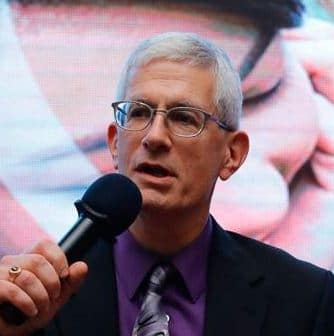 Andrew Bellavia is the Founder of AuraFuturity. He has experience in international sales, marketing, product management, and general management. Audio has been both of abiding interest and a market he served professionally in these roles. Andrew has been deeply embedded in the hearables space since the beginning and is recognized as a thought leader in the convergence of hearables and hearing health. He has been a strong advocate for hearing care innovation and accessibility, work made more personal when he faced his own hearing loss and sought treatment All these skills and experiences are brought to bear at AuraFuturity, providing go-to-market, branding, and content services to the dynamic and growing hearables and hearing health spaces.
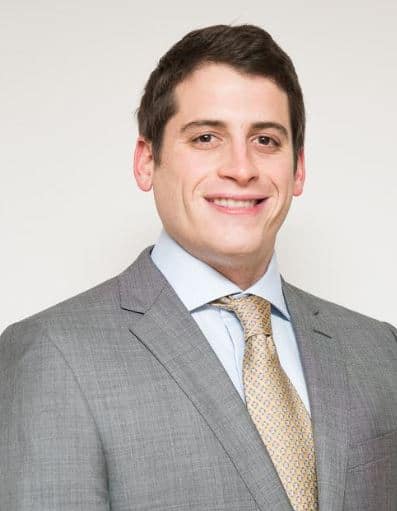 Dave Kemp is the Director of Business Development & Marketing at Oaktree Products and the Founder & Editor of Future Ear. In 2017, Dave launched his blog, FutureEar.co, where he writes about what’s happening at the intersection of voice technology, wearables and hearing healthcare. In 2019, Dave started the Future Ear Radio podcast, where he and his guests discuss emerging technology pertaining to hearing aids and consumer hearables. He has been published in the Harvard Business Review, co-authored the book, “Voice Technology in Healthcare,” writes frequently for the prominent voice technology website, Voicebot.ai, and has been featured on NPR’s Marketplace.