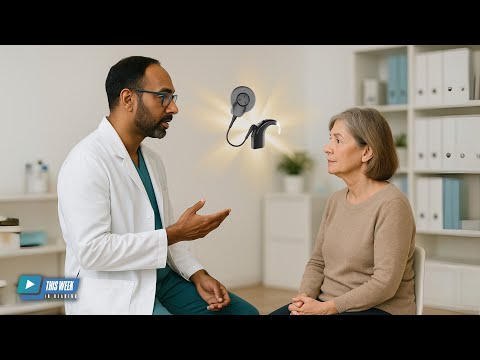
Cochlear implants remain vastly underutilized despite decades of evidence showing their ability to restore hearing and improve quality of life. In this episode, neurotologist Dr. Varun Varadarajan joins host Brian Taylor to explore the clinical, logistical, and cultural barriers that continue to limit access to cochlear implant care.
Drawing on his background in music and neuroscience, Dr. Varadarajan shares his journey into hearing restoration surgery and offers insights into early intervention, the 60/60 referral guideline, and why timing matters for long-term outcomes. The discussion highlights several misconceptions that often delay or prevent patients from seeking cochlear implant evaluation—from concerns about age, surgery, and cost to misunderstandings about candidacy and device function. Dr. Varadarajan stresses the importance of individualized counseling, collaborative decision-making, and helping patients understand that cochlear implantation is a process, not a one-size-fits-all solution.
He also addresses myths within the professional community, including hesitancy around residual hearing loss and outdated assumptions about surgical complexity. Beyond clinical considerations, Dr. Varadarajan shares practical strategies for building and expanding cochlear implant programs, including the importance of audiology partnerships, reimbursement planning, and aligning institutional goals. He also explains the value of the Cochlear Provider Network in connecting rural or underserved patients to implant services, and discusses how remote care and virtual follow-up are reshaping postoperative management.
Hello and welcome to another episode of This Week in Hearing. I’m your host, Brian Taylor. And this week we’re going to be talking about cochlear implants and some of the barriers to care. And with us to discuss this topic is Dr. Varun Varadarajan, who’s an otologist from Sacramento, Ear, nose and throat, which of course is in Sacramento, California. So without further ado, Dr. Varadarajan welcome to our broadcast. Thanks so much for having me. And you know, I’m really excited to be on the podcast and I really enjoy talking about cochlear implant and building cochlear implant programs like you mentioned. You know, my specialty is an otologist. I’m actually a neurotologist. And so, you know, after medical school I did my residency in otolaryngology or ear, nose and throat, and then ACGME accredited fellowship in neurotology and skull based surgery. So care of the ear, the inner ear and skull base, really the temporal bone. And my biggest passion is hearing restoration and cochlear implants. So tell us a little bit more about your path towards being a cochlear implant surgeon. Where does your interest in that come from? Yeah, exactly. So like, my interest in cochlear implants and hearing rehabilitation surgery in general started with my background in music. So I actually grew up playing several musical instruments. I still perform music. I did a music major as an undergraduate in addition to my biology major. And when I wasn’t, you know, studying music theory and playing music, I was fascinated by neuroscience and neurotology. Sort of tied in all of those academic interests in one, including, you know, physics of sound, the physiology of hearing, auditory perception, and the neuroscience aspects too. And once I discovered that as a career path, I was like, well, this, this includes everything and fits. And so that, that’s where I went for. That’s awesome. And I think you recently started or got involved in this practice in Sacramento. Can you tell us a little bit about your path to, to Sacramento ENT. Yeah, so when I finished fellowship, I actually first moved to Denver, Colorado. I practiced there for a little over a couple of years. And then there’s a really good opportunity here in Sacramento in a large private practice, a big cochlear implant program where there’s also a lot of more potential for growth as well. And you know, my, my wife is also a physician and she’s an allergist. And so there are opportunities for both of us here. And so we took it. Yeah. Okay, that’s great. Can’t beat the California weather. That’s part of it. Yeah. You can beat the taxes, but you can’t beat the weather. Well, can’t have everything right. Yeah. Well, anyway, you’re actually. We’ve kind of started an expert series around cochlear implants and some of the barriers to care. And in previous episodes, we’ve talked about the 60/60 referral recommendations. And I was wondering if you can maybe give us a little insight from your experience around early implantation and maybe some of the barriers that you’re seeing in your clinic. Yeah, so it’s. It’s interesting. You know, it’s really good that 60/60 has been disseminated as a good rule of thumb for referring providers, not only audiologists and, you know, hearing instrument specialists, but also other ENTs and otolaryngologists. We still see quite a mix of where patients are, what path in their hearing loss journey that they end up presenting to the office. Part of that is because we have a wide. A wide source of where the patients are coming from. You know, if they’re, you know, it’s very common for our patients to be caught very early in their path to a cochlear implant where they’re barely meeting the 60/60 criteria. Those patients are typically coming from audiologists who are familiar with cochlear implants or program and activate cochlear implants themselves or other ENTs. But there’s also patients who, you know, may have been seen at Costco or, you know, that, you know, they have been using hearing aids for much longer than they probably should have been getting benefit from. And then we see them severe to profound bilateral with 0%, you know, 10, 0 to 10% word recognition score. And so we see them at that full spectrum part of it, you know, the. Part of the hesitancy, I think, for a lot of these patients who come in who are considered borderline is, you know, we’re implanting patients earlier. That includes patients with a lot of residual hearing. And so they’re. They’re nervous about losing residual hearing. There’s a misconception that if you have residual hearing that you should not get a cochlear implant, which, you know, we can talk about more and more detail soon, that also there’s a greater trust in the technology, in the community, that the technology will improve speech discrimination, will improve their communication ability, and that’s improved. And that’s why we’re seeing patients earlier on in that hearing loss curve. However, despite all that cochlear Implants still have a very low penetration for those who could actually benefit. We still need to do a better job of getting the word out there that we have this as an option. Right. I’m guessing that one of the things you hear some people say, some patients, they have the mindset that they want to wait till they really need it. So could you. What do you tell a patient that might qualify for a CI why they should be implanted now rather than put it off? Yeah, this is a good question. And it’s a very common scenario. This is, you know, it’s most relevant in these borderline candidates. So someone who just meets 60, 60. And, you know, for those of, those of us who are listening who do cochlear implant evaluations, these are the patients that, you know, need some background noise to qualify. They aren’t the classic, you do your sentences in quiet and they qualify patients, they, you’re requiring plus 10 or plus 5 decibels SNR to get them to qualify. Or there’s CNCs, you know, hovering around 50ish to 40ish. And, you know, you’re like, you’re about. Just about ready. The ear is the way I like to say this, it’s almost ripe enough to switch over to a cochlear implant. These are the patients we don’t want to push them into necessarily getting a cochlear implant. And that philosophy, that philosophy may vary depending on the surgeon you talk to, but it may sound cliche, but, you know, we have to objectively ask ourselves, what’s the best thing for the patient? And not all patients who qualify for a cochlear implant should be getting a cochlear implant. And it’s a hard truth that we have to tell ourselves because we go into it being like, I’m going to go put in as many implants as we can. Let’s do it, you know, and we’re improving implant penetration where, you know, people who are needing it and qualify are going to get it, but not everybody who qualifies should be getting it. And that’s a. We always do remember that. And one of the factors for candidacy is that a patient needs to be dissatisfied with hearing aids, too. That’s. It’s not just an indication that they meet the numbers, but they also need to be dissatisfied with hearing aids and not functioning well. And if, you know, they’re doing well with hearing aids and getting by, the right answer is to stick with that unless they really want an implant. You know, they have to want it even if they technically qualify for an implant. You know, you and your actually getting good function with your hearing aid, then keep using the hearing aid. But the patients who are dissatisfied with hearing aids and who qualify, these are the people that, you know, it’s not that hard to convince them. You know, our job is not to convince or sell the product. But these are the patients who are being putting themselves in a position to have a better overall outcome, better overall speech perception with the implant compared to the patients who are going to wait until the hearing is well beyond, you know, the candidacy threshold. You know, I tell all patients about the bell curve of performance. You know, we can’t always predict where we’re going to land on that bell curve. We want all of our patients to land on the far right side of the bell curve and be outliers with 90 plus percent scores. You know, but we can control some things and we can’t control them all. We know that patients with greater durations of deafness tend to do worse in patients with shorter durations of deafness. And neuroplasticity is gonna play a role there. We know that patient motivation, oral rehabilitation afterwards, cognitive status, you know, these are all factors. Obviously we know that patients with greater degrees of residual hearing, you know, they’re afraid to lose it. But the silver lining there is, you know, we can save it in a lot of cases. And two, even if you do lose it, the more you had going in, the better you’re gonna do with the implant. And that’s one thing, that’s you, you don’t just march into a patient encounter with the arguments. But this is where the conversation evolves as you get to know the patient, you meet them the first time and you don’t just sign em up for a surgery if they’re just borderline type of patient. I encourage them, learn about it, you know, use you look into resources, connect them with the manufacturers. If it’s from another audiologist, I, we, we say, well, why don’t we circle back, you know, really think about what you want to do because they’re going to think of more questions. Because there are a lot of implications of implanting somebody who’s borderline. Right. Well and from I, what I gather from what you say is it’s a process, education’s a big part of it. That’s all. I, speaking of barriers, there was an article, I think it was published in seminars and hearing maybe in 2021. Dr. Nassiri, Ashley Nassiri, I think, I think is at University of Colorado Medical School now. She was one of the authors on it that I recall. She talked about barriers, and one of the barriers that was listed was unhelpful and unclear patient counseling around CIs. And I’m kind of curious, when patients come to you, what are some of the things that they might commonly ask or maybe what you overhear them say that is completely off base? Yeah, that’s a good question. That’s a great article. And it’s a hot topic in our specialty as well. You know, patients come in with a wide variety of misconceptions and, you know, part of it we can blame on the counseling, which, you know, if their referring provider is well versed in cochlear implant technology, has kept up with the candidacy criteria. We’re not going to see bad counseling from them. But it’s people who don’t really understand how an implant works or who it’s for. That’s where we see a patient coming in sometimes not even realizing it’s a surgery, you know, that we, we see that end of the spectrum where they don’t even know it’s a, it’s a surgery. Or some of them think, oh, aren’t I getting it today? I’m go ahead and put it in. You know, that’s complete, complete misconceptions. But, you know, the common things are, you know, they think it’s a brain implant. You know, it’s like Neuralink, you know, Elon Musk style brain implant. A lot of them say, I’m too old for that, you know, and they’re like in their 60s, you know, or 70s, that there’s good literature supporting geriatric population, cochlear implants, that they do very well with it. A lot of them, with the surgery itself, they think it’s like a big inpatient hospitalization where half their head is shaved, like a craniotomy. That’s a big, that’s a big one. They don’t understand the surgery. And the referring provider often doesn’t understand the surgery either. And they’re getting inaccurate counseling that way. Some of them aren’t being told that there’s, there’s, at least at the time of recording this podcast, there’s still an external device that you have to wear. You know, we are, you know, there’s an internally implanted device and then there’s a speech processor externally, which I tell them is analogous to their hearing aid. You’re going to have to, you’re going to have to wear something until it’s fully developed. Where we have a totally implantable device. And, you know, and another one is, I heard from a friend, it doesn’t work. You know, I know somebody who got it done down the road and it doesn’t work for them. You know, and it’s. If we’re counseling patients appropriately, we’re implanting the right patients and they’re motivated to work with it afterwards, do the hearing rehab afterwards. It’s really the outliers that it does not work. It. You know, it’s very few patients that aren’t getting benefit and satisfaction from it. Right. Well, it sounds like there’s a lot of misconceptions and myths. Are there any other ones that come to mind? Yeah, I think another one I just heard recently is, you know, a patient walks in and they’re like, well, I qualify on both sides. Why can’t you just. I’m assuming I have to do both. And it’s actually, that’s a little more nuanced misconception because there are many patients who do end up with two cochlear implants, these traditional candidates, but the second, the decision on the second side is really about patient choice and, you know, when the patient’s ready to decide on a second one. But the majority of traditional candidates are in the bimodal condition. They have a cochlear implant on one side and a hearing aid on the other side. That’s the. I tell them that’s what most people do until they really feel that cochlear implant side’s performing better than their hearing aid side. And it’s up to them when they feel that already. And I tell them I’m on standby, you know, we’re ready when you are. And we shouldn’t have to convince you to do this because you should usually convinced yourself with how you’re doing with your first implant. Another one is MRI compatibility. And this is an easy one. And you can completely understand why this is an issue, you know, because for the longest time they weren’t MRI compatible and they’re afraid that they can’t get an MRI if they get injured or they get an orthopedic injury. And we know now that, you know, all currently FDA approved implants are MRI compatible. The caveat is, you know, with head imaging, there is a magnetic artifact, a magnet artifact that shows up on the MRI. So you can’t see all aspects of the brain which you have a cochlear implant in, but it is safe to get the implant. So if you bust your knee skiing, you know, in Colorado, you can. Or in Lake Tahoe here, you can get an MRI to get it further evaluated. You don’t have to worry about that. Another one is cost. You know, a lot of patients, you know, they say, oh, I hear it’s $30k to $60k thousand dollars in price. There’s no way we’re going to pay for that. You know, we. It will take us forever to save for that. You know, we’re retired and majority of insurances will cover this. Especially traditional candidates. I’ve never seen a not approved for a traditional candidate who we they meet audiometric criteria. Now a lot of commercial plans will require a few extra hoops you may need to jump through. For example, they may require particular imaging, they may require like for example for this would be a non traditional candidate but single sided deafness, asymmetric sensory neural hearing loss. They need to do a CROS trial, a CROS hearing aid trial in a lot of cases. And so you do what the insurance wants you to do so you meet their criteria. And beyond the patient’s deductible, which varies depending on the plan, it’s paid for and the patient doesn’t have to worry about it. Yeah, I think that I’ve heard that misconception myself quite often. So thank you for clearing that up. You mentioned earlier we talked a little bit about you relocating from Denver to Sacramento and I would imagine when you relocate that and get involved in a new practice, there’s a lot of time needed to establish relationships with other professionals. So especially hearing care professionals who would be good referral sources for CIs. So can you tell us a little bit about how you’ve gone about building relationships, trying to connect with some of these referring hearing care professionals? Yes, and I’ve actually had a lot of practice because even in Denver, Colorado, my audiology team and I there, we started the cochlear implant program from scratch at our practice. Previously never offered cochlear implants. And then we built it and then it grew very quickly. In our first, I think 10 or 11 months we ended up doing 40 cochlear implants, you know, and not only organic identified patients who are traditional candidates in our clinic, but also patients from other audiologists and other ENTs. And we do get that question a lot is how did you do that? I also get why did you leave that? You know, why did you move to Sacramento? And it’s even it was a good opportunity there and it’s an even better personal opportunity for me here. The short answer is, you know, it’s not easy but it involves a lot of networking, connecting with audiologists and otolaryngologists, ents as well, connecting with hearing aid dispensers, providing education to the community. So not just the people who are hearing healthcare providers and the, you know, first line responders for healthcare, but also primary care doctors, the identifying the patient’s sudden sensorineural hearing loss and the urgent cares and ERs. But really I gotta give a shout out having excellent audiologists who are on board with offering the full spectrum of hearing healthcare. You know, I have to give a big shout out to my audiologist in Denver, well, my old audiologist in Denver, that if they’re listening to this, we couldn’t have done it without them. Everyone has to be on board with the mission. And after that, there’s, I guess, the long answer. It takes a lot of steps. And you know, this is also true for my current position here in Sacramento and putting in that work here, you know, we. Our implant volume here, this is already a busy big ENT practice with a couple other neurotologists, but our implant volume went up 50% in my first year of doing surgery here. And so it works. Putting in the work actually pays off. But to start a program from scratch, you know, there are a few key areas, you know, and you can feel free to stop me. And we can dive deeper into any of these if you’d like or if there’s anything you think the audience would want to hear more about. Sure. But the first ingredient, let’s say you’re not in a big practice where you have a, you know, other, you have an existing implant program. You need a surgeon and an audiology team in a, in a practice or institution that know believes in the mission supports the development of a cochlear implant program, which is easier said than done because the administration may want to see a proforma to see if your vision for doing these cochlear implants is actually financially viable. Because, you know, it’s expensive to do it. It’s expensive for the hospital. And your practice may not own the hospital. The hospital may be a third party in the mix or the surgery center, for example, raw. Assuming you have those elements, the clinic then needs to have the infrastructure and the space to accommodate candidacy, testing, implant activation, implant programming. And you got to make sure that the audiology booths and rooms are being used, that the ones that are being used for cochlear implant patients are not conflicting with or interfering with the routine audiology services that your other non implant surgeons are simultaneously using or using to support their clinic. And also, you know, there’s an employed model for audiologists and they’re employed by the practice or the institution. The administration and audiology leadership has to make sure that the audiologist compensation model is not purely incentivized on hearing aid sales. You can see how that can get messy because you’re trying to start doing more implants and the volume grows. There may be one or two audiologists who is into it they like doing implants, they would get real job satisfaction from doing it. But that if their comp plan is such that you sold 10 less hearing aids that month because you got into cochlear implants and you get paid less, where’s the incentive to run the cochlear implant program? That’s a complex, nuanced thing you have to go over with the, the. The practice leadership. But, you know, once everyone, once you figure that out, you know, everyone eventually comes to agreement about candidacy testing, you know, utilization of background noise in candidacy testing. So some people are very aggressive. You know, they’ll go, they’ll just test in +5dB SNR. And that’s their candidacy testing. Most people, I think, you know, a lot of us start in quiet for sentences, for sentence testing. Then we add plus 10 decibel if they don’t qualify. And then we use plus 5dB sort of as a tool for these asymmetric patients to get them to qualify as traditional candidates or, you know, unique situations. That’s also another. It’s another baseline study. Testing in plus five. It totally varies. The philosophy will change. Will be different depending on the institution you look at. And everyone in your practice and your, your hearing health team that you have has to be in agreement for that, agreement with that. And that’s true for you as a surgeon or you as an audiologist and the surgeon you’re working with, if you’re in different practices too. And you know, that’s an ongoing conversation. The manufacturers help a lot with this. So, you know, they have a, they have a really good recipe to get your clinic set up, the resources for your audiologist, they help get the room set up. They tell you where to put the speakers, how far away to put the speakers. They install the software, for example, Cochlear America’s a custom sound. You know, they’ll get it installed and they’ll obviously provide ongoing support once the program’s up and running. That’s just the clinic. Beyond that, you know, you have to have a surgery facility where you can do the surgery. They need to have the OR equipment. And then this one can be tricky. They need to have contracts with the manufacturers that you’re going to offer that don’t result in the facility itself losing money on the implants because if you start doing them and they start looking at it and they’re losing money, they’re not going to let you do implants anymore. And that’s a, that happens more often than you think. You have to go back into negotiations. That can take time. And you know, even now we’re dealing with that locally or our surgery for centers are constantly in negotiations with the manufacturers to make it make it. So everyone feels that they’re getting a fair bargain, you know, and ultimately all we care about is patients getting the hearing healthcare they need. But there’s the business of medicine looming over us that we have to play with the. Play within the rules. Yeah, you have to be able to cover your costs, of course. And it sounds like there’s a fair amount of business planning that’s involved. Do you, do you know, manufacturers like Cochlear Americas, do they offer services around that to help, you know, get the numbers right? You can make projections and things like that for the people admitted students. Good question. They can help a bit with that. They, they really do. What they really help a lot is with the billing strategies and ways of taking non billable time away from the audiologists. A lot of the patient counseling that audiology has to do, which is considered non billable time. Like Cochlear America’s, for example, has an engagement manager that, you know, works with patients and does a lot of that counseling. And after the patient’s implanted, you know, they work with them to work with the technology. But yeah, they definitely help. And they tell the audiologist the best way to maximize their time, which CPTs to use. And with the surgical standpoint, we kind of just have our set CPTs that we can use from, but they give us surgical support in the or. They help, really help the techs and the OR staff get comfortable with the instrument and how to set up for your case and everything. But yeah, back to that. You know, once you’re set up and ready to do your implant, let’s say your clinic is ready, the OR is ready, the next step is all about candidacy, education, and networking. And so I personally see this step as the most fun because b. More about that. Yeah. And so as someone who exclusively treats ear and hearing disorders, I. This is sort of my chance to shine and meet audiologists, talk about hearing disorders and really get nerdy with them and talk about complex cases and, you know, how they manage certain conditions when they decide to refer versus not, you know, controversies. We love talking about those. But I get that, you know, a lot of surgeons have various personalities and, you know, I understand that this step may not come naturally to everybody. And ultimately my goal, when I work with audiologists and hearing instrument specialists outside of my own practice, you know, I want to create a relationship where they feel like I am a natural extension of their practice, where, or in some cases, it actually feels like we’re in the same practice, even though we’re across town, you know, or four or five hours away. In some cases, you know, you know, they should be. They should feel comfortable calling me, texting me, emailing me for anything, even a simple question, or curbside consult me on something because that’s what I’m there for, and that’s what they’re there for. And on the flip side, I will consult them on a patient that we’re making a decision on what to do. You know, I don’t want to make a unilateral decision on what to do with a patient. It’s. We are a healthcare team and. And everyone should be on board with how we decide to treat a patient collectively. You know, it’s easy in a big institution to have a big hearing health, a big hearing team meeting where all the audiologists and surgeons meet together and go over patients. But in the private practice world, you don’t often get that. You know, it’s up to us as individuals to, you know, advocate for patients and make sure that we’re collectively making the best decision for them and making the best recommendation for them. And, you know, also, you know, a lot of audiologists, they. A lot of audiologists who sell hearing aids, you know, they. It may feel strange to refer off a patient who you’ve been following for like half their life. You know, you follow someone, you prescribe them their hearing aid and you wait, 20 years later, their hearing is to the point where they’re ready for a cochlear implant. It can feel very strange to be like, all right, well, we’re all down here, we can’t help you anymore. It’s time for you to see this surgeon. That can feel weird and it’s scary for patients. It’s awkward for the audiologist. My goal is for it to not feel that way because most patients remember, are bimodal and, you know, cochlear implant on one side, hearing aid on the other. I want the patient to keep seeing who they know and trust for their contralateral hearing aid. In a lot of cases, they’ll do the implant programming themselves too, depending on the audiologist, and that relationship should not have to end. And, you know, even for audiologists who don’t do cochlear implants and who aren’t sending cochlear implant referrals, but maybe another medical clearance type referral. As surgeons, we have to know where these patients are coming from and we have to send them back to their hearing health professional they came from so they know that there’s a degree of trust there and collaboration. Well, I’m thinking there’s probably a lot of professionals listening to this and saying it’d be great if they could have the same thing. They could work with you, but they’re probably in a different state, so it’s not feasible. So I guess my question is, what would you suggest that they do to try to develop a referring relationship with their area surgeon? Yeah, good question. It’s. Well, there are going to be a couple of scenarios. One is they have a surgeon in the area and that’s probably the easiest way to do it. You know, the second scenario is if you do live hours away or in another state where it ends up being closer. In that case, it’s very common to work with an out of state surgeon. And we do that right now like our neighboring states. We often see patients from them. Now, let’s say the simpler scenario is you’re an audiologist in a sort of metropolitan area or a suburban area and you have these patients that need a Cochlear implant that would benefit from a cochlear implant. The first place that, the easiest place you, you can go to is leaning on the reps, the manufacturer reps. They have a catalog of all their, the surgeons that they work with in the area closest, and they can make a direct connection for you. And if they, if they’re not comfortable doing that, they can tell you where to reach out to. And you, you reach out to the office and say, hey, we have, we want to collaborate on patients. They should be responsive to that, you know, and because it helps their business, first of all. And two, they want to work with providers in the community too. But, you know, if it’s a good fit, if you feel that both parties are comfortable with the open line of communication, you can find out the best method of contact that they prefer, whether it be email, phone call, you know, who they want you to communicate with them through. Develop a process for referral pathway. After that, you know, how do you like referrals? Do you want them faxed, you know, et cetera? And then who do we contact if we have issues sending, sending over the information? What insurances do you take? The conversation ends going, goes down that pathway until it’s solidified. And then once you start sending three, four or five patients, it becomes a routine smooth thing, and then they should end. As an audiologist, you have to advocate. I want the notes back from you. I want to see your reports. You know, once you see the patient and write a little clinic note, have your office fax it back to us so we know that you saw them because that goes back to communication. The surgeon. We’re doing 70 things at one time. You know, we’re dealing with surgery of half of our patients are really, really like routine, mindless decisions. The other half of them are complicated patients that, you know, we’re dealing with issues. And on top of that, we’re trying to juggle referral networks and maintaining referral relationships. It’s easy to forget. So it, you have to remind us sometimes, hey, let me know how this guy’s doing, you know how this gal’s doing, and let me know what you think, hey, they’re coming to see you next week. Let me know what you think of their ear. You know, advocate for your patients the same way you would for your family member. That’s really good advice. I think we talked about myths and misconceptions that persons with hearing loss might have. I’m guessing that there’s some of those same kinds of myths and misconceptions with audiologists and hearing instrument specialists. What are some of the common ones that you might hear? Yeah, that’s a good question. A lot of them who don’t fully understand the surgery think it’s a, it’s extremely invasive. Yes, it’s an it’s a considered a you know elective big procedure but a lot of them still think it’s a you know it’s an all day affair where the patient stays overnight. It’s an outpatient surgery. It can take anywhere from you know, 35 to 40 minutes to a couple hours if someone who does a lot of them and they’re going home the same day unless there’s some medical, medical condition that makes them need to stay overnight in the hospital. You know and some there are other cases where it’s even quicker than that. You know some patients anatomy is so favorable and it’s, it’s one of the easiest surgeries that we do as someone who only. Only does ear surgery because the other ear surgeries we’re doing are these complex infected ears or tumors and stuff. It’s nice for us to do a cochlear implant and have a clean ear to work it. A lot of providers are also not clear on how to describe the benefits of a cochlear implant or articulate it. Yeah. How to describe the difference between what this is going to be and what you have now as a hearing aid. How the differences between acoustic stimulation versus electric stimulation. And there’s good data out there on how the bimodal condition is, what the most common condition is, and that they can highlight that there’s objective data showing improvement in speech, understanding hearing satisfaction, even day to day things. Understanding the television. You’re talking on the phone with two hearing aids alone versus the bimodal condition. In traditional candidates, they, you know, greater than a 90% satisfaction increase. Another one is the residual hearing component. Everyone assumes that they’re going to lose all of their residual hearing going in. And we know that with modern surgical techniques and the majority of patients, if we really try, we can save it. Now, it’s not a guarantee that anything can happen after surgery. Inflammation in the inner ear can happen. That destroys whatever hair cells that you work so hard to preserve. You know, a lot of people do end up with hybrid kits afterwards where we have a full length electrode, not a hybrid cochlear implant where it’s a short electrode. We put a full length electrode in. We’re saving residual hearing. They’re wearing the processor that also has a hearing aid piece and they’re getting hybrid stimulation still. So the low frequencies are getting acoustic stimulation, high frequencies, they’re getting electric stimulation. And there’s still a lot of referring hearing healthcare providers who don’t know that’s an option or that’s even a thing. I. Well, same caveat. If you lose all the residual hearing, residual hearing, the nice thing is you have a full length electrode, then you can just activate those electrodes and get full spectrum electric stimulation. Another one is single sided deafness. It’s still, there’s a lot of providers who don’t know. That’s, that’s a big indication for this. For those of you in the audience who are thinking, oh yeah, I forgot about that one. The caveat there is duration of deafness. FDA approval is for 10 years. And I’m sure you guys have talked about this in a previous podcast about candidacy. This is a nuanced decision again, because 10 years duration of deafness, what does that mean? Does that mean that duration of hearing loss or duration of profound sensorineural hearing loss? Because if someone started losing hearing 10 years ago and it’s gradually declined where it’s really not serviceable only for the last five years, you would, you would definitely would consider them within that 10 year FDA approval, the FDA, FDA approval guideline. Whereas if you didn’t ask that question specifically and you ask the patient, how long have you have you been deaf? They’ll say 20 years. You know, it’s 10 years, 20 years. And you’ll say, nope, cochlear implants, not an option. You have to. It’s part of the art of the getting the history of, okay, well, what Was it like 10 years ago? What was it like 8 years ago? Do you have any hearing tests from then? How long have you been using the hearing aid? When do you think the hearing aid stopped working? It’s sort of our job to ask those probing little questions to see, you know, is it possible you could actually get benefit from a cochlear implant even. Even with a prolonged duration of deafness. And there are many patients with a duration of deafness greater than 10 years, which we will implant. We just consider it off label and their insurance will still approve it because they meet criteria. We just sort of warn them, hey, you know, you may not. You’re not going to land necessarily on the right side of the bell curve. Even, even though some of them do. Another one is, I’ve heard this one a lot, is, this guy’s too old. He’s not going to come in for an implant. Like, I’ll go and visit an audiologist or a hearing instrument specialist. And I’ll say, they’ll be like, oh, check out this audiogram. It’s like, you know, severe to profound, speech discrim. 30 both sides, where word recognition scores 30% both right and left. And I was like, oh, here we go. It’s a great textbook candidate. And they’ll be like, oh, he ain’t doing it. He’s too old. He’s 72. And I’ll say, come on, that’s the perfect. As a perfect 72 candidate. Yeah. And he’s like, oh, yeah, he just, he goes golfing every day and he’s stubborn. He’s not going to do it. So it’s like, that’s a situation where, you know, that’s the perfect person that would benefit from this. And they need to advocate for the patient’s ear. They don’t need to tell them to get the surgery. We don’t need to Tell them to get the surgery. They just need to get the CI eval, get screened to see if you’d qualify. Because if they’re struggling with hearing aids, this is the next step. Yeah, no, I’ve heard that a lot. Audiologists that think their patient is too old and they’re in their mid-70s or, you know, sometimes even older, and they like, they’re really healthy. Otherwise, you can see they’re probably an excellent candidate. To your point, I’m curious, what would you say to an audiologist or a hearing aid dispenser who feels like they’re being too pushy with their patient, who’s maybe, you know, a little bit reluctant, apprehensive? What would you say to an audiologist that has a patient that’s needs a little bit of encouragement? That’s a really good question. And I think this situation is more common than it’s the, than the other way around, actually, where they’re extremely comfortable just saying, go ahead and get the eval. But the biggest thing to remember is the evaluation is just the first step. It’s just a screening tool. Right. It’s just to see if you’ll qualify. Referring. A patient’s not going to sign a patient up for surgery. It’s just a see if they’re, if they won’t even, even want it and they shouldn’t make a decision on if they want it or not without seeing if they qualify for it. And then even after that, they can take as long as they want to decide if they want to make this step. Because then there’s the education piece of it, connecting with the manufacturer, maybe volunteers who have an implant. It’s just about getting more information and knowing your options. And I hear it all the time. Audiologists say the best way they get a patient in who is reluctant is just saying you don’t have to get the surgery. Just go meet, just get the consult for us. And that way, if you change your mind in the future, you’re plugged in, you know, and that patients do respond to that a little better than go meet the surgeon for possible surgery on your critical structure in your head. If in doubt, get it checked out. Go through the evaluation process. Yeah, a lot of times you’d be surprised is there’s patients who will tease out other symptoms that actually do require additional medical workup beyond a cochlear implant. Like I’ve found cochlear, I found acoustic neuromas that way. I’ve found a patient with a deep retraction pocket of the eardrum that was becoming a cholesteatoma because their hearing instrument specialist or audiologist may not have a microscope in their clinic otoscope. And so sometimes we are looking in their ear and we find strange things and it’s, it’s a good, this is a good way to get our eyes on it, you know, get a microscopic set of eyes on the eardrum and get a different set of eyes of the situation as a whole. Cause we’ll order an MRI and we’ll find something else, you know, and it’s, it’s just a way to get in, get the consult and if you decide against it, cool. That’s good to know. You know, we already kind of mentioned this, but I wanted to get some feedback from you on the cochlear provider network and how you might use that to expand your ability to help patients. So tell us a little bit about your role inside the cochlear provider network and how that all works. Yeah, so the cochlear provider network or the acronym CPN, this is, it’s a great way that Cochlear America’s the implant manufacturer has improved access for patients. I think that was the original prime goal. Primary goal for it is especially patients in rural areas or areas that don’t have easy access to an implanting surgeon for them to be able to get access to this technology. The CPN program allows audiologists who do not have an in house surgeon to be connected to surgical practices who can do the procedure. Then the patient follows up with the audiologist again to activate the implant and they can program it long term. It does require coordination, you know, between both offices about, you know, the surgeon and the audiologist. Had that same conversation we talked about before and what do you like for your CI eval? Like what’s your thoughts on use of background noise? You know, now with new mstb everyone’s, you know, encouraging CNCs as well. So that the, we have those conversations. But this is the best thing for the patient who is in an area where they don’t live down the street from a cochlear implant surgeon. It’s a little, it can be slightly inconvenient because they still need to go somewhere for the surgery. But you know, the majority of the time the surgery is extremely straightforward and they just have like a couple of times they have to go down there maybe for the initial consult, the surgery and then usually a post op visit. But if they’re really far away, we’ll sometimes do that virtually too. And we often trust the audiologist to look at the incision for us. I have a patient who their primary doctor is six hours away agreed to do it. So they saved the patient a trip but that’s how these patients are getting hearing who otherwise would not be able to. Yeah. So tell us coordination of care is kind of a hot topic these days. Remote consults, those kinds of things. What role does remote consults play in your practice? What role do they play as part of the cochlear provider network? Could you tell us a little bit about that? Yeah. So there, there’s sort of two avenues to look at it. One of it’s from the surgeon’s perspective and one of them, you know, is from the audiologist perspective. For us, you know, the initial consult, we want it to be, you know, ideally at some point before we agree to do a surgery on someone, we want to look at their ears in person. For those reasons I mentioned before, we sometimes find funny looking eardrums or other medical issues that need to be. Be addressed. Occasionally I will do a new patient consult virtually and I won’t decide to do a surgery until I, you know, until they actually come in for an in person evaluation. But this is really good for far away patients who aren’t sure if they want to do this, but just want to meet the surgeon, see if they jive and see if this is, learn about the surgery to be like, is this even a path I want to go down? Right. And then after the surgery, obviously the follow up visits from a surgeon standpoint we can do virtually. They can they try to put their phone or their camera behind their ear to let me look at the incision. It’s not as good as in person because I can’t feel it and touch it. But a lot of people it’s, it’s, it’s a straightforward healing process and it’s not a concern for audiologists. You know, the technology is advancing rapidly and remote care, remote programming is going to become huge. It’s the initial activation. You know, it’s nice to be in person and ask about symptoms and look at the sites and check the magnet strength. But once you know that the implant magnet strength is status quo and stable, they don’t need to necessarily keep getting it evaluated. And periodically they can just do touch up appointments virtually and remotely and you know, depending on the manufacturer, they’re making, you know, huge, huge strides in this. Yeah. And I think overall patients don’t want to travel, people don’t even want to leave their road to go to a grocery store that’s farther than two blocks away. So imagine going there for like seeing a surgeon or audiologist for a surgery you’ve already had done. Yeah, no, I can see the benefits, definitely. I’m curious, you know, in the hearing aid world, remote programming, virtual visits, I don’t think have gotten the traction that people anticipated. I mean, it’s still early, of course, but you know, there was a big upswing during COVID and then over the last couple years it’s almost non existent in many clinics. I’m as, what’s your take on that? Is that what you experience in your practice? Is there a certain kind of patient that really likes virtual kind of visits? Yeah, good question. I think it, it’s definitely patient dependent. There are some patients who just really want to be in person because they hate dealing with technology because it requires good wi fi signal, it requires their camera to work and their microphone to work. And a lot of our patients in the geriatric age group, they’re stressed out about that. They don’t, they don’t even want to use their phone. They have their son or daughter, you know, with them to help facilitate the appointment. And they’re hard of hearing, so it’s like they need to depend on their speaker and they’re turning it up and I’m trying to like put my mouth next to the camera so they can read my lips, you know. Luckily, with our virtual telemedicine platform, I often chat them too. I can like put stuff in the chat and they read it and then they see, tell me what, they answer the questions that way. But other patients are obsessed with it. They hate coming into the office and they only want to do virtual. So they’ll like be in a parking lot in their car just to like go over imaging results, you know, virtually. And a lot of them are like, why can’t I just do the first post op virtually for a huge surgery? Not, not, not a cochlear implant for like big surgeries, a big cholesteatoma we took out. And they’re like, can’t you just look at it virtually? And it’s like, no, sir, I need to clean your ear. I need to. Well, I guess the bottom line is it’s good to be able to offer a choice. Yeah, oh, absolutely. It depends on the patient. Well, I’m curious, from your perspective with the hearing aid front, what have you heard are the barriers for virtual care for hearing aids? You know, obviously it’s different because they need servicing and cerumen management and that. I think it’s the same thing. I think when you’re dealing with an older population that’s not as comfortable with all the gadgets that we use today, that’s just another barrier. They’re already, you know, because of their hearing loss, it’s already a struggle to talk on the phone or to use their computer speaker. So like you said, I think sometimes the added stress isn’t worth it and then would rather just come into the office. Plus often that population, they do, you know, they’re not, they’re retired. And so they do have the time. Yeah. And again, it’s a, it’s a choice. Some people love it. That are older. Yeah. And I mean, driving is dangerous. You know, driving long distances in the winter, it’s, it’s a problem. And it can certainly. Yeah, it can be, can be. So that, that leads me to another question around the future of cochlear implants when it comes to care. You know, we talked about virtual and remote. What are some of the things we can anticipate in the near future. Yeah, I think if anything, remote care from the audiologist perspective is only going to get better. I think there’s going to be more and more programming that’s done remotely. I think initially it’s still going to be important to the initial activations. It’s nice to just be there and explain how to use the actual device, how to use the charger, get set up with Bluetooth connectivity, all those sort of things. But then once they’re cruising, you know, very. A lot of our audiology colleagues are like, you know, this could totally be done, you know, remotely. And, you know, I think that’s only going to be happening more. And I think it’s, I’m still in the camp of reluctance for the first post op visit being virtual because I really like to palpate for, you know, hematoma. I want to put my finger on the incision and look at it. But many of my colleagues are, you know, already on board. They’re like, forget it. I don’t even need to see them. I just let audiologists look at their incision and they call me if there’s a problem. Now, I’m sure I may change at some point in the future, but I still like to see them back and see how their experience was. There’s pros and cons of each one. Because think about it from a surgeon standpoint, it doesn’t make financial sense to keep seeing every patient back for a post op, even in the beginning because it’s in the global period for payment. And so we’re, it’s a free visit for the patient. So my colleagues who aren’t seeing those patients post op, they’re looking at, they’re looking at it from a financial viability standpoint. You’d rather see a billable encounter in that time than someone who is just seeing you for a wound check that the audiologist is going to, you know. Right, yeah, exactly. If we’re looking at, from a time standpoint. Exactly. But, but I will say for, I don’t think there’s researchers listening to this, but if you’re building a new program and you’re out there, you know, it is nice early on for patients to know that we’re here hands on with our post op care too. They really do appreciate it. They like seeing the surgeon after surgery. They like, you know, that hands on care. And I think I’ve, I’ve received positive feedback about that. So until I have to, I’ll keep doing it until I have to stop I’ll keep doing it. So, speaking of the future, what are some other technology innovations, other areas of care that you might be excited about as we move into the future? Yeah, I think one exciting one. At some point in the future, you know, there’s going to be clinical trials on this soon. Our totally implantable cochlear implant devices where we don’t have to wear a processor externally. There obviously will be pros and cons to that, but, you know, everybody stay tuned and, you know, for what we’re going to. We’re going to hear about that. Another big one is that, you know, cochlear implants, one of the barriers for patients is the fact that, you know, majority of them are done under general anesthesia with a breathing tube put in, completely knocked out. And some people who have other medical conditions are scared to undergo anesthesia, and we have to get medical clearance to do that, especially if they have heart or lung issues. Cochlear implants are being increasingly done around the country under sedation, whether it be local, you know, injection, IV injection medications with a combination of IV meds or moderate, you know, moderate sort of sedation protocols. And we work. We can work with our anesthesia colleagues. That’s in certain areas of the country that, you know, it was well published, by the way, and it’s right now in our practice, it’s more so the very select patient that we’re trying. We try to offer that to if we. If we want to do that at all. Most people don’t want that. You know, most patients are scared, but depending on how you pitch it to them, you know, you could easily convince a patient to do it if it’s the right patient. To not be falling asleep for the cochlear implant surgery, it’s sort of scary. It’s like, oh, someone’s drilling on your head. But, you know, believe it or not, that’s not the part that’s, you know, bothering them the most. You know, it’s really, you know, the incisional soft tissue pain. They can feel pain from the. The drilling of the bone. They all can feel dizzy because the irrigation solutions during surgery can have a caloric effect. There There’s a lot of factors like that, and we’re constantly trying to improve the protocols for that. But eventually, I think it’s going to be more commonly done that way, unless that totally implantable device totally takes over by then. But I, I think that’s something that we’re all excited about. Wow, that’s. That’s really interesting. So my final question to you. If viewers are interested in learning more about your practice, your, you know, your experience with cochlear implants, anything like that, how can they contact you or how can they learn more about your practice? Oh, absolutely. Shoot me an email. It’s first initial and first name V and then my entire last name, vvaradaragjan@sacent for a short for Sacramento ear, nose and throat, it’s vvaradarajan t.com shoot me a message. Like I mentioned, I’d love to get nerdy with audiologists about this stuff, so don’t be shy. Well, Dr. Varadarajan, we’re really happy that you were able to take time out of your busy schedule to spend some of it with us. Thank you. Absolutely. It’s an honor to be on the honor to be on the podcast. Thanks so much. Great discussion. Yeah, no, yeah, it was a great, very informative. And this is a great addition to our expert series on cochlear implants. Thank you. Thank you.
- Research article mentioned in the discussion: Nassiri, A. M., Marinelli, J. P., Sorkin, D. L., & Carlson, M. L. (2021). Barriers to Adult Cochlear Implant Care in the United States: An Analysis of Health Care Delivery. Seminars in Hearing, 42(4), 311–320. https://pubmed.ncbi.nlm.nih.gov/34912159/
Be sure to subscribe to the TWIH YouTube channel for the latest episodes each week, and follow This Week in Hearing on LinkedIn and on X (formerly Twitter).
Prefer to listen on the go? Tune into the TWIH Podcast on your favorite podcast streaming service, including Apple, Spotify, Google and more.
About the Panel
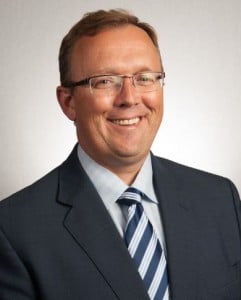
 Varun Varadarajan, M.D., is a dual board-certified neurotologist and otolaryngologist specializing in ear, hearing, and skull base disorders, including cochlear implantation and acoustic neuroma management. A lifelong musician, he holds degrees in both Music and Biology from Washington University in St. Louis and completed medical training at the Medical College of Wisconsin, followed by residency at the University of Florida and a neurotology fellowship at The Ohio State University. Originally from Milwaukee, Dr. Varadarajan integrates his passion for auditory perception with advanced surgical care and is active in education, research, and leadership within the American Academy of Otolaryngology.

Brian Taylor, AuD, is the senior director of audiology for Signia. He is also the editor of Audiology Practices, a quarterly journal of the Academy of Doctors of Audiology, editor-at-large for Hearing Health & Technology Matters and adjunct instructor at the University of Wisconsin.




 Varun Varadarajan, M.D., is a dual board-certified neurotologist and otolaryngologist specializing in ear, hearing, and skull base disorders, including cochlear implantation and acoustic neuroma management. A lifelong musician, he holds degrees in both Music and Biology from Washington University in St. Louis and completed medical training at the Medical College of Wisconsin, followed by residency at the University of Florida and a neurotology fellowship at The Ohio State University. Originally from Milwaukee, Dr. Varadarajan integrates his passion for auditory perception with advanced surgical care and is active in education, research, and leadership within the American Academy of Otolaryngology.