

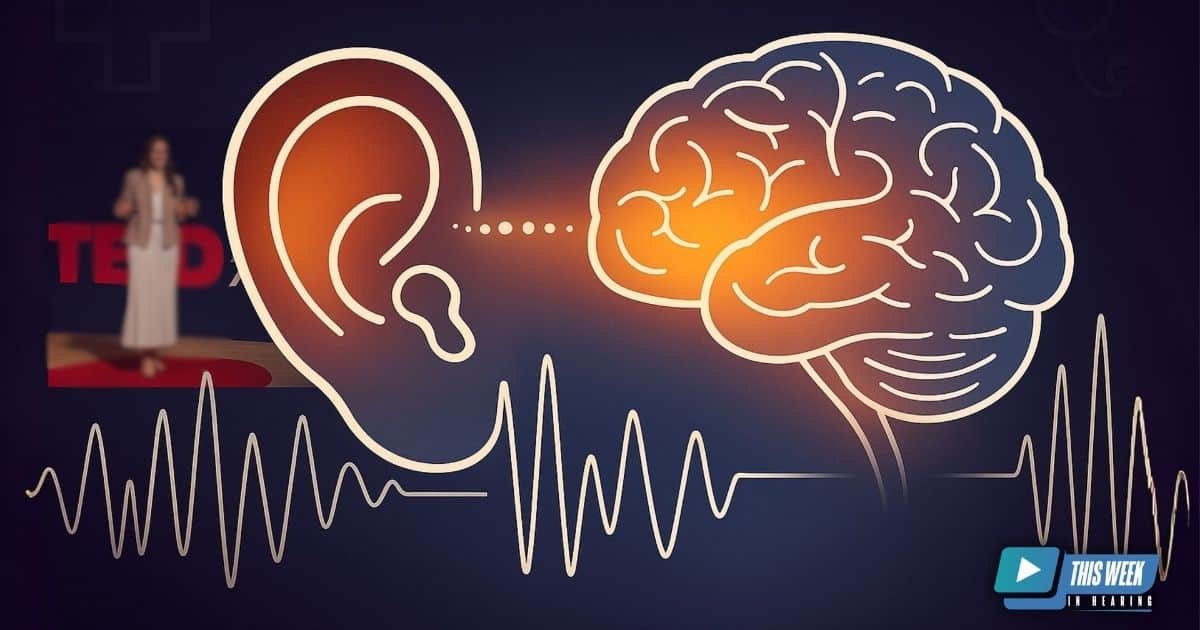
Madison Levine sits down with Dave Kemp to share her journey from founding a private practice to shaping it into a clinic that bridges hearing care with the wider healthcare system, emphasizing the role of hearing in cognition and aging well. She discusses her recent TEDx talk, the importance of physician and patient education, and how hearing care professionals can strike the right balance between raising awareness and avoiding alarmist messaging.
From building referral networks to motivating patients with research-based conversations about cognition, Madison underscores the need for audiology to address one of the public’s greatest fears: dementia.
She also reflects on overcoming imposter syndrome, the experience of giving a TEDx talk, and the lessons learned in growing her clinic into a thriving, medically focused practice.
Full Episode Transcript
All right, everybody, and welcome to another episode of This Week in Hearing. I am excited to be joined today by Madison Levine. Thanks so much, Madison, for coming on today. You wanna give a quick background about who you are and the TED Talk that you recently did the Sugar Creek Women TED Talk. We wanna get into that today and talk all about that, so let’s start with a little bit of background on you.
Cool. Thank you for having me. I’m really happy to be back. I started my private practice 10 years ago, and my mother had a practice down in Georgia so I grew up in her office, but I started mine from scratch, by myself, and over the years had babies, needed to hire more providers, and kept growing our services. From what really started as truly a more retail model as a hearing instrument specialist and moved into a more medical model, and we now do vestibular services and tinnitus treatment, and we keep winning Charlotte’s ‘Best of the Best’ and just trying to be a leader for what can be in private practice.
I love that, yeah. You really you are a poster child of starting a clinic from scratch and scaling it up. And it’s been so cool to watch, you know, your journey as a clinic owner and how you’ve sort of iterated with, you know, the changes of, of sort of the environment of the industry and the patients. And and it’s just like to hear how those decisions, the impact has positively benefited your practice and helped grow it. So do you wanna talk a little bit about the TEDx and then, you know, how that all sort of… The inner dynamics, I guess, of that in your clinic and your first hand experience that you see with all this of, you know, what you presented on.
You know, I got really into physician marketing a few years ago where I realized that they were letting drug reps in to give them lunches anytime, and so I decided to start signing up like a drug rep and bring them lunch. And that worked really well, and the thing that the physicians were most interested in was this connection with cognition. And so that was kind of ringing bells for me that that was a trigger for them, and then I’ve always been really interested in marketing. And so I got heavy into radio marketing a few years ago, and I have used all kinds of current research in the educational content that I put out. But the feedback I hear in the clinic is really interesting. I’m always listening to see what was it that triggered that patient to wanna come in. Cognition. Every day of the week, somebody’s coming in because of that message. And I keep testing. I’m normally running or We all seem like we’re really concerned about is not just aging, but aging well. We’re all terrified of losing our minds, and I try to be really careful with the words that use and the studies that I reference ’cause I do not want to be alarmist but I’ve just found that when I talk about it, it is the thing that’s motivating people to really seek treatment.
Yeah, for sure. I, I, well, I was gonna say I, I, that when you were saying that I very vividly remember this presentation that I think Dave Fabry was giving and he showed, you know, sort of the the number one fear of I think it’s like 50-year-olds today or 60-year-olds today, and in the past it was like heart disease, it was cancer, and now it’s dementia is the number one sort of fear that I guess the general public has as they age.
How I was talking to doctors and speaking to patients and seeing what is it that they were most interested in, when I got the opportunity to apply to do this TEDx in Charlotte, that was the idea that was top of mind ’cause we talk about it in the industry all the time. The profession is very aware of these studies, and you’ll occasionally see CNN or somebody pop one of them up there, you know, once or twice a year, but I didn’t feel like there Well first of all, there were no TED Talks on the subject. I really wanted to create something that could live and breathe as a very short, very concise summary that people in our profession could share and use in their clinics and that people in my life, in my circles, could share and send to their parents as a, you know, not aggressive, “Hey, you should check this out. I just watched this TED Talk,” and it has been so motivational for people, which is what I wanted. So I’m so happy about that.
Yeah, no, I think the, the message is, and, and you’re alluding to it, is like you know, around sort of how do you do this in a way that’s not alarmist. I know that there’s obviously fear that, you know, you, you don’t wanna fearmonger more less, but at the same time you have to balance that with the severity that is sort of like in your TED Talk, pandemic I think there’s like a lot of like really concrete evidence of this, is like when people, you know, the isolation, all these things sort of compound on one another, and, you know, all of it does sort of lead to that atrophying of the muscle of the brain and all that. And so I think that it’s interesting to kind of hear like clearly that’s a motivator.
Mm-hmm.
but how do you do it in a way that’s, I guess, not alarmist and, you know, still communicates that message of the severity of it both to the general public but also to the allied medical professionals, right?
Yes. Those…. That’s a really good point. Those professionals who are allied who can make those referrals to us be-You know, they say that medicine, it’s changing by the minute, so by the time they’ve graduated with their MD or DO, it’s already changed. And for them to stay up-to-date on everything is really challenging. And so I think it’s our responsibility to, since we are staying up-to-date on our own stuff and they are on theirs, for us to share with them and help them catch up. Because It… Your reference to, you know, how do we do this and not be alarmist, but carry the weight of how serious it is. I don’t know if you’ve heard this, so many primary care doctors will say You just have a mild loss. It’s just high-frequency, you don’t need to do anything.” And even some audiologists and hearing instrument specialists might say that. But we know that a lot of this research is even looking at just mild losses. I feel like if we take the research seriously and we really look at it and say, “What if? What if we address this when actually is a problem and not wait? What else can we… What else can we help them prevent?” And that’s really my point, is that I want
It’s a really interesting, like, way to sort of position it you know, ’cause like you said, you have some of these things that might be an indication of something that’s sort of gradually wearing down, but you also have… You know, I’m thinking about a presentation I saw Victor Bray do, that, you know, he talked about sort of the check engine light system that can be your hearing, right? So if you have a sudden sensorineural hearing loss, that might be an indication that you have something going on with, like, your kidneys, you know? And so I think it actually really ties into this idea that it is a… It’s part of this whole… It’s on the forefront of understanding this ear-to-brain connection and all that, and I think… Of everybody’s… That everybody has, and the early warning sign… Allied medical professionals to understand that connection and be that champion.
Absolutely. I tested a woman this morning who was 71. She’s in the best shape you’ve ever seen. She takes great care of herself. And she had some concerns and immediately wanted to get tested as soon as she noticed them, and she was actually doing great. She was just very sensitive to the fact that there had been any change, but her hearing was 100% normal. And I was just looking at her as somebody with an incredibly healthy diet, incredible exercise routine, and she’s on no medications and she has no blood pressure issues. She’s not diabetic. And then you’ve got patients who are also 71 who have all these other things that have been building up for decades, and then they show up in our office with hearing loss. And, yeah, it’s all connected. That blood flow to the ear matters, and unfortunately, it can play such a huge role later in life when hearing loss isn’t treated, and we start seeing people become lonelier, and they’re retracting from conversations and… Oh, my gosh, like, a host of things happen.
Can you speak to you know, within your clinic, and, like you mentioned, you know, as you’ve kind of become more medical you said you were obsessed with, you know physician marketing and stuff like that. I know, you know, outside of word of mouth marketing from your patients themselves, usually the number one referral source for a clinic is physicians. And so can you just speak to this idea of, like, what almost kind of sounds like grabbing a seat at the table and kind of elevating yourself into this broader conversation, and what the benefits of that have been and… You know what I mean? Can you just kind of speak to that?
Yeah. I’ll be totally honest that when I started out, I had such a complex about talking to physicians that I felt were more educated and elite. You know, I just… I was really terrified, and so I would drop cookies at the front office and just kind of, you know, whisper away and hope that they got them.
Yeah.
and being an HIS too, I had a whole complex about it, and I very seriously… Considered if I should go back and become an audiologist. Over the years, as I was able to move into this more medical model and move from a hearing care clinic to an audiology clinic and hire multiple audiologists and add vestibular to the clinic, I went out on a limb and I joined my independent physician network locally, and I was terrified that they were gonna call me out and
What do
“You’re not an MD. You can’t join our group.” And that didn’t happen. They said, “Oh, we don’t have anybody in audiology in this group. We would love to learn from you.” Like, “Okay, well, then I’m gonna keep coming until you really realize you should kick me out, I guess.” And then, you know, reaching out to especially all the concierge and the high-touch clinics in my area to get to come in and to have a lunch with them and to offer them my cell phone number and get theirs back. You know, I’ve been doing this, I’ve owned my clinic for 10 years. It took me six to get to the point of doing any of that, of really viewing myself as a peer to these physicians. Were just treating different issues for patients. But it’s hard.
Yeah. I mean, that’s so cool, though. And I feel like that’s probably been a massive game-changer for for your clinic and all that. But what… I guess, like, the question is like, what in the absence of somebody like you that’s kind of taking the initiative to, you know, join and, and basically raise your hand and be like, “I can, I can be the champion for this, you know, part of the anatomy,” more or less what were they using, what were they doing previously? Like, I guess that kinda speaks to this whole thing, which is, are you doing your patient a disservice, I guess by not championing this on their behalf? Because if you don’t, then, I guess, what does the system look like? Where are these people going? Are they… I guess that’s the question.
What is the alternative? So in our area, we have a huge ENT system, and I think the norm was that every physician in town simply referred into the huge ENT system. And I’m sure that that took care of lots of people and that worked, but there really wasn’t a good alternative. So if, if independent clinics in Charlotte were to gain patients, it wasn’t from, from physician referrals. It was simply only from marketing, I really think, until I started making these relationships and building them, and they they really have to test it out because they don’t really believe you that you can handle it at first. Can speak to that part? Like, how did you sort of legitimize yourself in the eyes of these people? The professional reporting was so important, and I will be the first to admit, my background and my training in how to chart and to write professional reports was pretty minimal, coming from a more retail type of environment. So I had to learn how to more appropriately write what does a physician actually wanna see. I’m more than capable of doing it. I just had to learn it. So sending those reports with every patient and then following up, that’s what they don’t get from a lot of retail centers, is they’ll get, you know, a blurb and no follow-up. And then they don’t view that as a respectable medical clinic that they’re partnered with, right? You have to rise to the same level of professionalism that you see in those medical clinics.
Was that process of rising to that level, was that a, was that a real process? Or, I mean, how did that go where I guess you got acclimated to operating in a fashion that met their standards?
Probably the turning point was she came from such a great background of so much experience in ENT. I started seeing what she was already capable of and what she was doing and realized that was the standard at which the whole clinic needed to operate, and so I was very lucky to have had somebody who had such a high caliber of work come to me and get to learn from them. I think that’s important as a business owner, everything you can actually learn from even the people that you’ve hired and pick from their skill sets in order to build a better organization.
Totally. Yes, I think that’s a huge secret to success for a lot of people is you can, you can hire people that know side of it. How has, you know, I guess this, like, mindset shift that you’ve undergone in the way that you message the market, the way that you communicate to patients when they’re in clinic what’s that been like, I guess? That sort of transition into where you are now? What, are these patient conversations a whole lot different than what they were in the past or how does that look?
A lot has changed over these 10 years. I would say patients are getting much better medical care from my clinic on the back end of this as they did on the front end just because we’re getting better and we’ve learned a lot.
Right.
like, not that, not that I wasn’t trying to give my, the best care possible and had deep relationships with patients, but now the nature of how we record things in the office, how we track things-… our medical relationships for referrals, even when we’re sending them out. They’re getting better care because we have learned so much. But the other thing is, when I look back at some of the hearing aids that I was using in those first years, I was really letting the patient drive what they wanted to pick, at what price point, rather than being the driver as the professional that could predict what kind of outcome they were gonna get. And I think that confidence just came over the years. And now, we’ve gone from where I used to have five or even six levels of products, I only have three. I actually used MVP, My Vitals Pro over the last couple years, and I saw that my lower end products had triple the rate of returns as my higher end products did. And once I saw that and I explained it to my other professionals, nobody wanted to use them. Everybody could just blatantly They would just say to the patient, “We could get you a lower end product. We have triple the returns from those.” And they said, “Well, I don’t want that.”
Right. Yeah.
It’s foundation that I never, I never would have thought to piecemeal out my returns by product level, not just by manufacturer.
Thats interesting.
It’s
cool. Yeah So I guess with when you said earlier that, you know, you were kind of A/B testing all these different messages, and you said that the one that pertained to cognition, I guess, was the, the most compelling, or that was the one that led to the most referrals do you, do you get a sense of what those conversations look like between the patient and the physician? I mean, do you think that you know, kind of going off this whole topic of like, I guess at the top of the funnel now, you know, going off the idea that the number one fear is dementia, you know, do you think that that’s how this kind of whole thing transpires is they come in and they say, “I’m losing it.” Or they have a loved one that says, “I think this person might be losing it.” And now, through your efforts, you’ve kind of become one of the … sticks. And we know that that’s one of the most modifiable risk factors, is to do some sort of you know, treatment like hearing aids or something like that. You know what I mean? I guess, like, that, is, is that how you see this funnel working right now?
Yes. Yes. Isn’t it fascinating that people could suspect mild cognitive decline and they could get referred straight to a neurologist, and they could be tracked by a neurologist and their primary care for years, and they might never get a hearing referral? That absolutely blows my mind.
Right.
Like, we have, you know, ages where you’re supposed to get a mammogram,
Totally.
… that are so important to catch things. But the fact that mild cognitive decline and mild untreated hearing loss mimic each other, shouldn’t we at least get somebody cleared? So, these are the conversations I’m having with physicians. And yes, it is working for them to say, “Oh, I need to refer you to neurology and you need to go to audiology, too.”
Totally.
I just wanna see it everywhere. I want it to actually become, like, a national conversation
Right.
it
And that’s the, and that’s, like, what we were talking about before, which is you know, before we started recording, which is like the glass half full, glass half empty mentality of like, on one hand, this is really discouraging that these things, like, to your point, you have, you get, you get your colonoscopy starting at 40, right? And like, we have standards for all these different preventative screenings and stuff like that. But like, hearing is so absent, and yet this is potentially linked to the number one fear that entire generations of people have. And it’s like, so it’s discouraging, but at the same time, what an opportunity, right? Like, I feel, you know, that I feel like really does lead into this whole, “We’re already in it,” of, of at least people wanting to seek some sort of, they wanna engage in this model, right? And I think that for as much challenges that audiologists are facing, I think that there’s still so much opportunity simply because of the role that, you … is, it seems, is so, so lacking, right? Like, it’s just absent from the total conversation. And good on you for in your, you know, in your market for becoming one of those champions. And I think there’s obviously a lot of commercial material benefit for your clinic and stuff like that. But I guess, more importantly, is like, that’s where audiology and hearing healthcare needs to, I think, meet the moment, is like again, doing it in a way that’s not blatant fearmongering but is still communicating the severity of this, and, and the the way that the ear, you know, is this early point of vindication of what’s going on, maybe, more broadly speaking.
Absolutely. And, and it’s the, it’s the spark. It’s the beginning of something that can spark a whole fire of issues down the road. And yeah. I do, I think a lot about being very careful with the language and not fearmongering. And still, I’m kind of jumping up and down because it’s, it’s important to me. I don’t know how and why I’ve gotten that they believe it, because the research is there. And and the fact is, once you’ve seen tens of thousands of patients, like I have at this point, who are going through the process of aging, and you get to see them go through a decade of it and they’re losing their faculties, you see with your own eyes, even before you’ve read the research, what happens when they’re delaying treatment and they’re not getting it when they should have. And truly, one of the most heartbreaking, frustrating parts of my job is when I’m finally fitting somebody with hearing aids who should’ve done it years earlier, and I can only get them so much help, and I’m managing their expectations.
Totally.
And it’s like, God, if I’d gotten her five-year early
right
How much better would your entire long-term outcome have been?
And the, the thing is, is like, I think your TED Talk touched on it. It’s like, intuitively, this all really makes sense, right? Like, if you, if you start to lose your hearing and you start to socially withdraw, you’re right, it’s a muscle, it’s gonna atrophy. And that has a lot of really nasty sort of secondary order effects kind of thing, and, I feel like we can all viscerally relate to this from the pandemic. And so it is, like, I, you know, with, in the absence of outright being like, it’s gonna ward off dementia or something like that, you can at least say, to your point, it, it, it could help to at least slow things, right? Because you’re gonna give people the ability to continue to use that muscle and try to prolong the ability to the, to not atrophy, right? For the muscle to not decay. So it, I feel like all of that is like, it’s very intuitive. And now we have a lot of research and science that backs it up. So I think, like, this is, like, as you are a really good representation of is like, this is what you can do with that information now. You can arm yourselves in a capacity that you deserve a seat at the table. And, and it sounds to me like you, like, they’re like, “Yeah, we, we didn’t have anybody like you and thanks for coming by ’cause we need this.”
Shockingly.
Yeah.
I personally just have a problem where I’m very afraid of someone telling me I’m where I’m not supposed to be. Like, I’m not the kind of person who will, like, cross the caution tape if I’m not supposed to be over there. My husband’s the opposite.
Huh.
Which causes all kinds of funny issues. But I really felt that I was gonna get caught. Like, “Ugh, you’re not an MD, you shouldn’t-”
It’s like imposter syndrome.
Total. And, you know, I don’t know where I read about this, that the people who experience the most imposter syndrome, apparently are… It’s like the more you learn about a topic, the more you realize how much you don’t know about it.
Right.
So when you actually don’t know much of anything, you’re way less likely to have imposter syndrome.
Think you’re a genius.
Confidence.
ignorance is bliss.
So that tells me, okay, I must know a lot if I feel this much …
Cool that you’ve just persevered and pushed through it. So as we come to the close, tell me about the, the TEDx experience. I think you’re, I can think of a few other, you know, people within the industry that have done a TEDx. Its always cool to hear the actual, sort of like, how the sausage is made type of thing. Like, what, what was that process like?
Well I talked to all of them. Angela Alexander, Juliet Sterkens.
Those were who I was thinking of, yes.
Raël. I talked to everybody. And we all have been so encouraging to each other. You know, it was an experience like nothing I’ve ever had. I got very interested in public speaking a few years ago. I just kind of discovered that I enjoyed it. I really liked teaching. And so when the opportunity came up, I applied. Not sure if I was gonna get it. I did not realize the entire speech is 100% memorized. There are
No, no cues, really?
… no cues at all. And it’s done in one take, live. They won’t post it on YouTube.
Oh, no kidding. You’re one and done. So you have to just be on.
The pressure was wild. Like, I’ve never sweat through my hands before.
Mm-hmm. Palms are sweaty.
But literally, yeah, like Eminem. the talk, to practice it, to perform it over and over, and then the day of to nail it. And I’m so critical. I could, I could tell you every moment where I thought I was about to completely lose the script while I was talking.
Uh-huh.
But I’m really proud of it.
You nailed it. You totally nailed it.
Like doing a marathon
It was a flawless seven-and-a-half minutes.
I was like, “Oh, I did it. I created something.” And the biggest compliment that I’ve gotten is I have a few colleagues who are using it when they have a patient who’s in denial. Theyre having them watch it in the office, and they’re reporting to me their conversions. That patients see it and they’re feeling motivated. And I’m just so happy that that is having the impact I wanted it to have.
It’s so cool. It really is. Yeah That’s, that’s a very neat sort of getting to that point. Did you, did you enjoy public speaking before or was this a, was this a fear of yours that you overcame and now you like it?
Yeah, I was definitely afraid of public speaking when I was younger. But once I started doing little healthcare talks, hearing healthcare talks in different senior living facilities over the years, you know, the crowds starting getting a little bigger, little bigger conferences, kind of got my feet wet, and I’m speaking AuD Boss this year.
There you go.
That might be the biggest, so that’ll be fun in a couple months.
That’ll be really cool. Are you expanding on the presentation? Is it gonna be an expanded version?
It’s actually is people want to see you and they want to know you as a brand in order to trust your brand. And so that’s what my talk is on.
Well, you’re an expert in that. I mean, you’ve built your brand up across the last 10 years in a way that you’ve leaned into social media, yeah, I feel like you’ve iterated in a bunch of different things. You’re a, you’re just like a chronic iterator. It seems like you’re just constantly iterating and coming up with new, you know, there’s a better way to do this kind of thing. So it’s really cool to see ’cause it’s just, like, every time I check in with you, it seems like you’re, you’re kind of onto the next thing and you just keep leveling up. So it’s really, it’s really neat to see somebody that started where you did and you know, starting a clinic from scratch and then graduating up into what it is today. It’s like, I think just it’s a really cool motivational thing for other aspiring young professionals or whoever in this industry that might want to take their cues from somebody like you.
Thank you. I appreciate that.
And with that, this has been another great conversation. Thanks, Madison, for joining me today. Thanks for everybody who tuned in here to the end. We will chat with you next time. Cheers.
Be sure to subscribe to the TWIH YouTube channel for the latest episodes each week, and follow This Week in Hearing on LinkedIn, Instagram and X.
Prefer to listen on the go? Tune into the TWIH Podcast on your favorite podcast streaming service, including Apple, Spotify, Google and more.
About the Panel
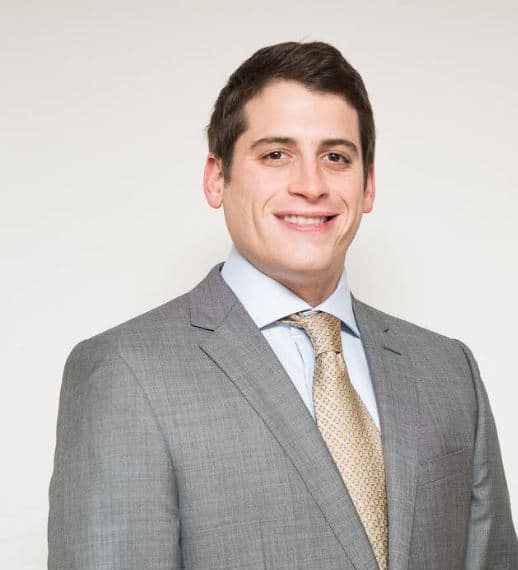 Dave Kemp is the Director of Business Development & Marketing at Oaktree Products and the Founder & Editor of Future Ear. He writes and speaks widely on the convergence of hearing healthcare and emerging technologies, and has been featured in outlets including Harvard Business Review, Voicebot.ai, and NPR.
 Madison Levine, BC-HIS, is the owner of Levine Hearing and is nationally Board Certified Hearing Instrument Specialist. She is a second-generation professional in hearing healthcare. She holds a Bachelor of Science degree from the University of Georgia.