

Hearing care professionals often face challenges when trying to evaluate and compare performance claims across hearing aid brands. Andrew Bellavia speaks with Michael Preuss, Audiology Manager at Sonova, about Phonak’s approach to validating its claims through objective, lab-based methods designed to better reflect real-world listening environments.
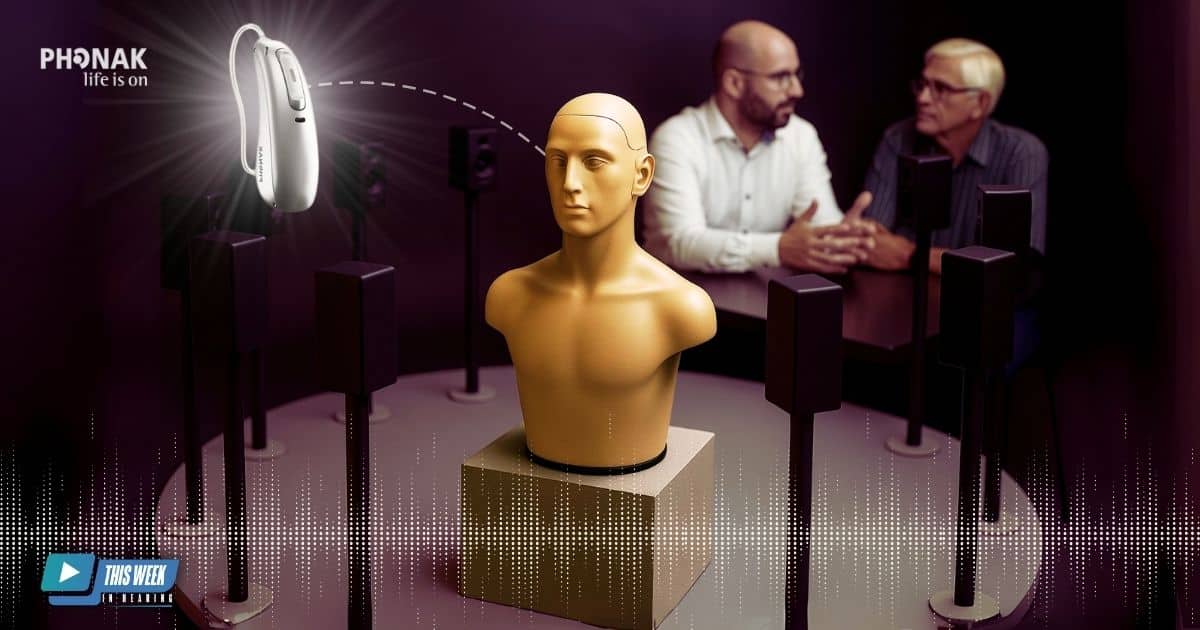
Preuss explains how Phonak uses a 12-speaker array and ambisonic sound recordings to simulate complex acoustic settings like cafés and dinner parties—scenarios where traditional test setups fall short. He also outlines the development of Sphere mode, powered by a deep neural network (DNN), and how it differs from directional microphone technology.
The conversation underscores a broader call for industry-wide standardization to support more informed clinical decision-making.

Full Episode Transcript
Andrew: Hello everyone, and welcome to This Week in Hearing. I’ve heard people say often that it’s impossible to compare performance claims from one hearing aid company to another. It may never be 100% possible because everyone’s hearing loss is different and everybody’s results may therefore be different. But there’s one area that can be accounted for, and that’s the way hearing aid performance is measured when it’s done objectively in a lab. Everybody does it a little bit differently, and Phonak contends that the system they use creates the most realistic simulation of the auditory environment for real users, and therefore their performance is very objectively and properly measured.
To explore that a little bit more, I have with me Michael Preuss, who I was fortunate enough to catch at Sonova’s US headquarters about 90 minutes from my office. Welcome to the show and thank you. Tell everybody a little bit about yourself.
Michael: Yeah, thank you, Andy, for having me today. So I’m Michael Preuss. I am audiology manager from Sonova headquarters in Switzerland. And I am living with hearing aids myself, Andy, since I’m three years old. And this is kind of how my way into audiology was paved. So I got the interest growing up with hearing aids, learning from my pediatric audiologist how to fine-tune and manage hearing aids, that I decided to become an audiologist one day.
So fast forward to today, I’m living with hearing aids for over 34 years now, and I’m working in the hearing aid industry as an audiology manager, contributing to our research of the products and also into the development of the products.
Andrew: Okay, thanks. It’s interesting. I’ve talked to a lot of people who had hearing loss and that brought them into the industry, which is a little bit different than my story because I was in the industry five or six years before I got fitted for the first time. But in the end, we both have the “advantage” of the lived experience, which helps inform what we do in the industry. How does that help you in your daily work?
Michael: Yeah. So it helps me on multiple levels. So on one term, I’m kind of ending up often as the guinea pig. So when there’s something new to develop or to evaluate or to test. I’m often asked alongside our other colleagues with hearing loss to maybe just give a quick sanity check of that new innovation, of the new idea, is there something that we should explore further and move into future products. So that’s one big aspect thinking about the future innovation of our hearing aids.
Then one part or key part of my role is also explaining the technology. And I find it much easier to explain technology and to talk to the benefits if there’s also a personal touch to it. So it’s really not only saying, hey, we are innovating on X, Y, Z, we are improving the listening effort, cognitive load, we are improving speech intelligibility, but it’s really about Hey, and this is how I experience that in the real world.
Andrew: Okay, which is really interesting. in so many different ways in accessibility, you need people with that experience to help guide what you do, and you actually have it from inside Sonova. And now you were the lead author on a report that was written late last year. Describing the measurement methods you used to validate the Sphere’s speech performance in noise, and you had really two key things in there that you said were important: one was the speaker setup, and the second one was the sound files you use, the noise files you use.
So let’s break that down. First, the speaker setup. How is your speaker array arranged? How does that differ from others you’ve seen? And what’s important about the way you do it?
Michael: Yeah, so it kind of started as an internal exercise first. So we really wanted to understand how our new innovation performs in the most realistic listening environments. So with that in mind, and we knew that our chip was designed to separate speech from background speech, we thought about what can we do in terms of a speaker setup to make this the most realistic and challenging setup possible. So we were using a 12 loudspeaker setup around a manikin. We were using ARTE database, so ambisonic recordings of the sound environment to also play the background noise, so that really at head level we have this, yeah, ambient noise level being present that creates the realistic listening environment.
Andrew: Okay, so we have 12 speakers surrounding a manikin in the middle with Spheres loaded, and you’re now taking the microphone output. And to break that down for people in the audience, Why do you need 12 speakers, first off? Why can’t you do it with, say, three?
Michael: Okay, yeah, that is a good question. So think about being in a restaurant. Think about being at those environments where it’s the most challenging to understand. It could be, as I mentioned, a restaurant. It could be a wedding. It could be really where a lot of people gather. The background noise is coming from any direction. There’s reverberation coming from windows, from the walls. So it’s not that two noise sources placed in the back hemisphere is really enough to represent a realistic listening environment. So it needs noise coming from all around, including also the direction of speech. So we are also making sure that speech and noise is co-located from the front.
Andrew: Okay, so in the front there would be speech and noise, and all the way around otherwise is noise. So you’re getting noise from all different directions. So how do you correlate the results then? If you have 12 speakers versus 3 speakers, what would be the difference in the measurement results?
Michael: In terms of what we measure in those realistic environments is often the SNR benefit. So we want to assess in those technical measurements what’s the difference between the signal and the noise. So that’s the SNR and what it stands for. When you think about having only speech coming from the front and having two noise sources on the back, you can actually generate very high SNR benefit in this lab setup simply by using, for example, directional microphone technologies that are focusing at the front hemisphere. So with that, I’m focusing on you as my conversation partner, and I’m easily able to reduce the noise that’s coming from the back through the microphone setting.
However, when we translate this setup into a real listening environment, this SNR benefit falls flat. And our goal and our ambition is that our technical measurements are designed in a way that what we measure in the lab is very, very close to what the person wearing hearing aids is going to experience in the real world.
Andrew: So let me make sure I understand this correctly. A directional microphone, typically, you have a zone in the front where you’re picking up audio. It’s going to be reduced around, but directly back it’s often worse. So in other words, if I’m talking to you with a hearing aid directional microphone running, I might not be disturbed by somebody over here, but somebody directly behind me might be louder. Because that’s how the directional microphone tends to be not as good directly in the back. Right, the front is the best, the back is letting some leak through, and off the sides, less is leaking through.
Michael: Yes.
Andrew: So you want to have speakers in all the directions to make sure you account for noise where the directional microphones are not performing so well. Is that why you do that?
Michael: Yes. So if you look at the polar plot basing, that describes where sound is best picked up with directional microphones, exactly what you said. In the front, it is the best. It can still pick up something from like 180 degree from the back. But in the null of the beam former is what we call 120 and 240 degree is where the attenuation of the signal is really the best. But this is what never happens in a real world. So we really want to make sure that also noise is coming from the angles that the directionality of the microphone is positioned at.
Andrew: Okay. And so by going all the way around with 12 speakers, you’ll get a more realistic soundscape.
Michael: Yes.
Andrew: Now you also mentioned Ambisonic recordings. Explain Ambisonic for everyone, please.
Michael: Yeah, so for Ambisonic recordings we are using what’s called the ARTE database. So that’s a publicly accessible database of realistic listening environments that is accessible for everyone for research purposes. And those recordings are Ambisonic. And this means that if we are playing those to the 12 loudspeaker away, they not only create noise coming from each loudspeaker individually, but at head level, they create like a 360 sound and listening environment. So it’s as close to reality as we can get with that setup.
Andrew: Right. So the sound from the 12 speakers converging on the head at the place where the manikin head is, It’s a very realistic 3D soundscape.
Michael: Yes. And to add to that, we are also using this realistic recordings because they are not just any type of background noise.
Andrew: I was just going to ask you, what are you using actually?
Michael: Yeah, so the ARTE database consists of different recordings of realistic listening environments. We focus on three different background noise scenes, which is the cafe scene, the food court scene, and the dinner party scene. Because those are the scenes we are developing our products or have developed this product and feature for. to really separate speech from noise in those listening environments where clients struggle the most.
Andrew: Okay.
Michael: So it’s not any sort of background noise. Think about static noise, for example, that could also be used to measure an SNR benefit. But very similar to the loudspeaker setup, also the measured SNR benefit there would fall short in a real world because we don’t encounter static noise so much on a wedding or in a restaurant visit.
Andrew: Right. So using realistic sound scenes as your noise is also important. And then the primary measurement you are doing is speech to noise ratio. Right. That’s what you’re that’s the primary goal, at least in the study that the paper was describing was you’re measuring the speech to noise ratio unaided and the speech to noise ratio aided.
Michael: Yes.
Andrew: And then how do you actually translate that to real auditory improvement by real people, right? Because the auditory system, as you well know, is more complex, right? So how do you translate real benefits? Like how do you measure real benefit that goes with an improvement in the speech to noise ratio?
Michael: Yeah. So basically, spoken, we already know from Killion 1997 that clients that have a hearing loss need a better SNR. to understand speech the same way. So this is kind of the theory or the foundation where we are building on. So this is also why the SNR benefit as a measurement is so interesting for us, and it is a technical measurement. So we can do this alongside the development process of our hearing instruments. And when we have assessed certain SNR benefit, and based on the knowledge we have also from that paper, we know, okay, it’s going to provide a benefit to the client’s listening needs.
And then the next step after those technical measurements would be to conduct a clinical study with the same feature on real people. And then it’s not only about the SNR benefit, but then we can start looking into speech intelligibility improvements, into listening effort reduction, cognitive load. So we can then really expand the research field further.
Andrew: Okay, so then you start with an SNR benefit. You already have data that can correlate the improvement in SNR to improvement in speech intelligibility, but then you actually do real-world testing on real people and assess their speech in noise capability?
Michael: Correct.
Andrew: And that more or less is all explained in the paper so that people can understand exactly what you’re doing and therefore the basis on which…
Michael: So this paper was basically a paper about our technical measurements. So we wanted to really understand how does our new feature compare to the features that we’ve launched in previous technology levels or previous hearing aids. Because when we are launching a hearing aid, we often get asked the questions, well, how or what’s the benefit? of this feature compared to something you’ve had in the hearing aids before? Why should I be interested in fitting this device to my clients to address their listening needs?
So this is where we then ended up doing this SNR measurement comparison amongst different feature sets. And the second analysis that we then done was how well does it also compare to other devices currently on the market? So this was was in the technical white paper. We then conducted additional studies at our other research centers, but they are framed in a different white paper. So the white paper you’ve mentioned only covers the technical approach to those measurements.
Andrew: Okay, and so then for clinicians, you’re really answering two questions. And one is, what’s the benefit of Infinio versus previous generations? Why would I want to recommend Infinio for somebody? And then the second question would be, why would I want Why would I want to recommend a Sphere versus a non-Sphere Infinio?
Michael: Yes. So this is basically what we are really interested in. Understand our technology. how it performs against previous generations. And thinking about the Infinio, we are utilizing Stereo Zoom 2.0. So we are using directional microphones.
Andrew: Is Stereo Zoom 2.0 binaural directionality so you can get a quite focused beam?
Michael: Correct. It’s utilizing all the four microphones from both hearing aids. It creates that network for an even narrower focus towards the front. So it’s not saying that, hey, directional microphone technology is out or outdated. So there is really a place for this technology, especially for one-to-one conversations in the noisy environment. But really what we then developed, a DNN approach to separating speech from noise, including the direction of speech. So that’s a key difference compared to directional microphones. That kind of led us in the way of, okay, this is something completely new. This is groundbreaking, it’s utilizing a DNN in real time to analyze sound and to do something with it.
Andrew: And that came out when I did the launch podcast, which I’ll put in the show notes along with the paper itself. But let me ask you a question because I’m not quite sure I was smart enough to ask it just so. if I’m running a narrow directional microphone, one-on-oneing with you, Why do I need the DNN running all the way around and not just reducing noise this way because the directional microphones are already doing it? How do they work in combination with each other?
Michael: Yes. So within the DNN, we are not using stereo zoom in combination. This is simply because we do not need this narrow beam former anymore or this narrow microphone towards the front anymore. So how we’ve implemented our deep neural network is that we are using what we call a fixed directional microphone. So think about the front 180 degree being within the range and the back hemisphere is a little bit attenuated. The main benefit is if I’m using a directional microphone, I need to pay attention to my conversation partner. If we are having a conversation but someone else on the table is making a joke, I may miss it because this person is not part of my current focus. And as soon as I’m going to ask a person Can you repeat that joke?
Andrew: You’ve defeated the purpose, right?
Michael: Yes, correct. And having that DNN run in real time and also opening up the directionality to basically the group conversation is a true game changer. Because then we can have a conversation, but as soon as a person is talking next to me, and chimes in the conversation, I can get it and understand it with my hearing aids. And then I can answer to that person saying, oh, I totally agree and I have the same plans for the weekend. So it’s really like a natural conversation or if a waiter is joining from the side asking if I would have something else to drink. Previously, my experience was that I had to… look at the waiter and ask him to repeat the question. And now it feels much more seamless engaging with the other.
Andrew: Okay, so it’s one or the other. You’re not using high directionality and sphere mode at the same time.
Michael: Yes, correct.
Andrew: How does it, if I’m running in automatic mode, like in mine, I can force sphere mode. If I’m not forcing sphere mode, what’s the logic for choosing one or the other? How does it work for a person who’s in automatic mode?
Michael: So within the Audéo Sphere hearing instruments, there’s in the automatic mode, there’s no accessibility of StereoZoom anymore. However, the benefits of the DNN outweigh Stereo Zoom 2.0. So we really recommend if you stick to the Automat, use this spheric speech and loud noise program, the DNN program, or create a manual spheric speech and loud noise.
Andrew: So in automatic mode, people will never see a high amount of directionality.
Michael: Absolutely. That is still part of the Infinio R.
Andrew: But I’m also thinking about all the times I used it because I been paying very close attention to how it performs in different scenarios, and I could see it working in a way like you described. Then, and I asked this question for a reason, and that is, when you do the technical measurements, do you actually simulate hearing loss in the mannequin, or does it even matter? Like, I would say that my experience as a person with hearing loss if I give somebody a neutrally tuned hearing aid and using the directional microphones and they have, audiometrically normal hearing, they actually get a different experience. And I’ve seen this where some companies will measure and compare hearing aid performance with somebody with mild to moderate hearing loss. And I question whether that’s just as valid for somebody with severe hearing loss. And so is that really true or am I wrong there? And Do you simulate hearing loss when you do these technical measurements to correlate it to real experience?
Michael: Yes. So we usually simulate an N3 hearing loss. So think about the different grades of the hearing loss. The N3 is most commonly used for those moderate degrees of hearing losses. It has a little bit of a high frequency loss, basically. So we are focusing on this degree of hearing loss because it gives us the most insights also into our main hearing aid wearer space, understanding how does this help the majority of our clients. But definitely we are also looking into our technical measurements, how does it perform on a more severe level, even looking into can even profound benefits. profound hearing losses benefit from their technology. So we are assessing, depending on the research need, different degrees of hearing losses, but certainly most common is the N3 level of hearing loss.
Andrew: Okay. And are you actually measuring benefits for people without audiometric hearing loss? And in here, I’ll go to the NAL’s paper, Brent Edwards’ paper, where he says just in the United States, there’s 25 million people without audiometric hearing loss who have trouble hearing speech in noise, And there’s a couple of other studies giving similar numbers. Well, if you take that 25 million and go global basis, that’s like half a billion people. So are you also studying that as part of this work, and when you do the measurements and then correlate it?
Michael: Yes, not directly related at the moment to spheric speech clarity. And I can’t obviously give too many insights into our research, but we are having also this client population on our radar. So we call them also the hidden hearing loss. So you can’t see something within the audiogram, but they report having challenges in those environments. So we are also looking into this. Yeah. So it’s an exciting space also for us.
Andrew: And that’s baked into some of the research you’re doing here and over in Switzerland.
Michael: Yeah.
Andrew: Okay. Well, thank you. I really appreciate you taking the time with me to explain the paper, and how you measure devices. I think it’s important for clinicians and others to understand the measurement methods involved and even more knowledgeable patients so that they can have some objective basis to understand one device versus another.
Michael: Yes.
Andrew: And it was great to be able to have a tour of the labs at no extra charge as well. Anything you want to add before we finish?
Michael: Yes, first of all, thank you also for inviting me and having me in the podcast. One thing I wanted to add is We’re not just doing that for understanding our own technology, but it’s really for a broader sense. For us, really, this kind of realistic listening environment means that also a hearing care professional can make an informed and purchased or an informed purchase decision for the hearing aid. So it’s having this, we need this broader alignment within the industry also and transparency for the hearing care professional that those measurements in the future need to be performed more equally. You mentioned that in the intro, that the comparability is not yet given, and each and every manufacturer is using some sort of a different marketing message. And I think it’s difficult for a hearing care professional, I’m a trained hearing care professional myself, to really make sense of what does the marketing message now mean for my clients’ listening needs. And if we can solve that in the future, that would tremendously support the hearing care professional in making an informed decision for the client’s listening needs, because ultimately it’s the reputation also of the hearing care professional by choosing and selecting a device that fits best for the client. So that’s really our approach and also intention behind these measurement setups.
Andrew: And that’s a terrific explanation. Thank you. And I should add that The sort of testing I learned about in the lab tour encompasses all different venues. For example, you’ve got the listening room with the eight speaker raise, but you’ve also created realistic environments like this one, which is like an apartment or a flat somewhere, like an apartment or a flat somewhere, so that you’re going everywhere from the objective technical measures to real experience with real people and real rooms in different environments. So that’s a terrific set of measurements and correlations and appreciate the explanation that goes with it.
Michael: Thank you. Thank you for having me. Andy, thanks.
Andrew: You’re welcome. And thanks everyone for watching or listening to This Week in Hearing.
Resources:
- What is behind the numbers? Understanding how quality, robust evidence is achieved through realistic technical assessments. (Article)
- Background on how manikins are used in hearing aid performance assessments
- Exploring Phonak Audeo Sphere Infinio launch
Be sure to subscribe to the TWIH YouTube channel for the latest episodes each week, and follow This Week in Hearing on LinkedIn and on X (formerly Twitter).
Prefer to listen on the go? Tune into the TWIH Podcast on your favorite podcast streaming service, including Apple, Spotify, Google and more.
About the Panel
 Michael Preuss, PhD, has served as Audiology Manager at Phonak HQ since 2020. He brings a unique perspective to his role, drawing on his personal experience living with hearing loss and his background as a lecturer at the Academy of Hearing Acoustics in Lübeck. Michael is responsible for delivering expert training sessions and providing audiological input during product development. He earned his degree in Hearing Acoustics from the University of Applied Sciences in Lübeck, Germany.
 Andrew Bellavia is the Founder of AuraFuturity. He has experience in international sales, marketing, product management, and general management. Audio has been both of abiding interest and a market he served professionally in these roles. Andrew has been deeply embedded in the hearables space since the beginning and is recognized as a thought leader in the convergence of hearables and hearing health. He has been a strong advocate for hearing care innovation and accessibility, work made more personal when he faced his own hearing loss and sought treatment All these skills and experiences are brought to bear at AuraFuturity, providing go-to-market, branding, and content services to the dynamic and growing hearables and hearing health spaces.