

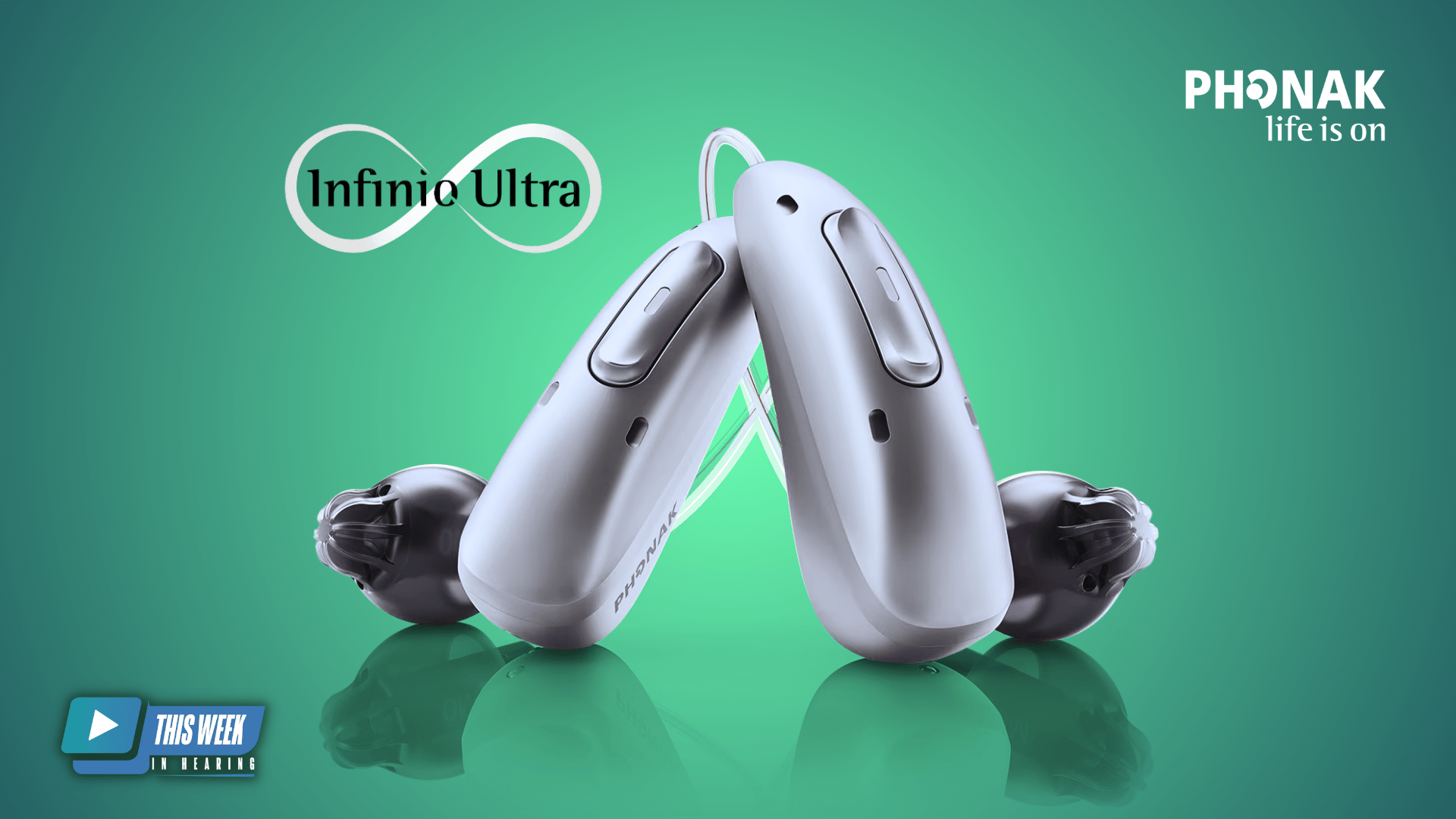
At EUHA 2025, Phonak highlighted the technology behind Infinio Ultra, including insights into the platform’s upgraded AI sound processing, energy efficiency, and new maintenance design. In a discussion at the Phonak booth, Gareth Griffiths, Director of Campaign Management, shared how the updates strengthen Phonak’s focus on real-world hearing performance—delivering clearer speech, simplified care, and longer-lasting reliability for everyday users.
 The newest version of AutoSense OS—version 7.0—was trained on 18 times more environmental data than before, allowing for more accurate sound classification and smoother transitions between listening environments. Griffiths explained that the upgrades deliver improved speech understanding in noise and a more natural listening experience for users in complex soundscapes.
Another key focus of the update is ease of use and reliability. Phonak introduced its new EasyGuard ear tip, designed to simplify wax management and provide greater durability, particularly for users with dexterity challenges.
Enhancements in battery performance have extended listening time in Sphere mode, while Bluetooth connectivity has been refined for faster pairing and more efficient streaming across devices.
Full Episode Transcript
Speaker 1: Oh, hello. There we go. I get my, I get my upgraded Spheres on They
Speaker 2: haven’t even started the interview yet. Oh, I’m
Speaker 1: thank you very much.
Speaker 2: Sorry for interrupting. Perfect No, it was perfect timing.
Speaker 1: Oh, okay.
Speaker 2: Just shows how quickly the upgrade was. Five minutes. Thank you. Yes.
Speaker 1: There are my upgraded Spheres. It took about five minutes, and it’s exactly the same time as somebody does it at their audiologist back home, correct?
Speaker 2: Absolutely, yes. Yeah. It’ll take anything between four and seven minutes depending on how their target is set up and what they’re doing, but we’ve found five minutes is the average.
Speaker 1: Thank you. Hello, everyone, and welcome to This Week in Hearing, live from the Phonak booth at EUHA. I have with me here Gareth Griffiths, who just assumed a new role.
Speaker 2: Yeah.
Speaker 1: Please tell everybody about yourself.
Speaker 2: Thank you very much, Andrew. Gareth Griffiths, and I’m the Director of Campaign Management. So, as of the 1st of August, myself and my team will be looking after every campaign for Phonak. So whether that’s a launch campaign or a commercial campaign, it’ll come from us.
Speaker 1: Appreciate you spending some time with me to talk about two exciting announcements. Congratulations on the European launch of the Virto Infinio.
Speaker 2: Oh, cool. Thank you. Yes.
Speaker 1: And on the upgrades to the Infinio Sphere and to the Infinio in general with the new AutoSense 7.0.
Speaker 2: Yes. It’s an… The Ultra upgrade is really, really exciting, and we’ve managed to put a huge amount into effectively 12 months. So, we are very excited for what the consumers and the customers are gonna experience.
Speaker 1: And I actually wanna start with something that’s a little bit prosaic, and the new ear tip.
Speaker 2: Okay. Yes.
Speaker 1: So, tell me about the new ear tip, and I’ll tell you why I think it’s important.
Speaker 2: I, I am really excited that you’ve started at that. So many people have underestimated it in the months building up to this launch. I can’t think of a better way to explain it than talking about when I was an HCP. So, I’d go into clinic, and my clinics were either… well, they were very busy. And often, they were busy with service appointments. And I have to say, a lot of the service appointments were wax. And that wax, I mean, for me, it was change the white tip, hand it back. It was so simple, but I have pretty good dexterity, and my customers, they relied on me to do that for them. I had a guy who didn’t book appointments anymore. I’d turn up at 8:00 in the morning, he’d be waiting, and he’d just have his hearing aids out like this, waiting for me. I’d take them from him. I’d do it. I’d give them back. Wax management is so crucial to hearing aid users, and yet it’s so difficult to change something so tiny. EasyGuard should remove that completely. It, it’s… The, the membrane is, is… It’s very special. Sound can get out, but no physical wax moisture can get in.
Speaker 1: Well, and I’ll tell you why I actually tried it, because I got shipped a set the day before I left to come here.
Speaker 2: Yeah.
Speaker 1: And I put them on the Spheres, and off I go to Europe. So my first day, which was Tuesday morning, I decided to try a test. ‘Cause with the normal tips, if I put the hearing aids in right after I shower, they get clogged up, so I would always have to wait for the ears to dry out. So I put, with these tips on, I got out of the shower, got myself cleaned up, put the hearing aids in right away. No problem. And the first person I thought of was, until very recently, I had a neighbor across the street, in her 90s, limited dexterity, and she generated a lot of wax but she could not handle the wax guards. And so, either myself or a family member were always changing the wax guards. And it would go down that she would say to me, “My hearing aids aren’t working.” “Oh, let me see ’em.” And they were always clogged with wax. And I’m sure she would be able to clean those tips with a cloth and keep them going. So, I think that’s actually the population that’s really gonna benefit from those.
Speaker 2: And this is the beauty of EasyGuard. Every… I say every. The vast majority of users who wear RICs can take the RIC out of their ear and put it back in again. If you can take it out your ear, you can wipe it on a cloth. That’s EasyGuard. That is your maintenance. And I am so in love with this product. It might be the smallest thing that’s gonna make the biggest difference for the next, I don’t know, maybe 10, 20 years. Audiologists are gonna love it, and I cannot see a future where somebody has to start retraining somebody on how to do a wax trap. That’s gonna be like… I talk to some of my students about the old days with the trim and they go, “That’s not a real thing.” And I go, “It, it was, yes.”
Speaker 1: Yeah.
Speaker 2: Now it’ll be the same with wax traps. That’s what I wanted to get to.
Speaker 1: That’s terrific. So, let’s talk about Infinio in general.
Speaker 2: Okay.
Speaker 1: I’m a little bit ahead of the game from a European
Speaker 2: Yeah.
Speaker 1: … because I’ve been wearing the Virtos for a couple months. I’ve got the experience of AutoSense 7.0.
Speaker 2: Yes, okay.
Speaker 1: But now you’ve backfilled that into the Sphere as well.
Speaker 2: Yes.
Speaker 1: Talk a little bit about AutoSense 7 and what it does compared to 6.
Speaker 2: Okay. So, a huge amount of work went into making sure that we could fit AutoSense 7 into our RIC products. And you’re right. We did have it in the, in the ITEs first but the planning was always to come in this direction. The biggest difference that we took with AutoSense 6 to AutoSense 7 was the training of the classifier. So, our classifier uses AI and machine learning to make sure it can be as accurate as possible.And what is always important to remember is accuracy output depends on the input. So we took 18 times as many samples as we had in AutoSense 6 to train AutoSense 7. And we used all sorts of different samples, different clips, different… It’s, it’s a huge number. And this has meant that AutoSense 7 is 24% more accurate. And when I say 24% more accurate, I often get, “Does that mean the other one wasn’t accurate?” And it, it is a really, really difficult conversation because everything we’re doing, we need to make incremental gains. It means that people will be in the right classification more often. And because AutoSense blends, we’re able to have a difference for every situation you’re in, blended uniquely to their hearing loss and their situation.
Speaker 1: Well, and it’s interesting because I started with Marvels. That was my very first hearing aid, Marvels, and it had, I don’t know, AutoSense 3? I don’t remember, right? And it worked. Like, I remember being amazed when I walked from a quiet street with my wife into a noisy restaurant. It took a few seconds. The first second I was bombarded with noise, and then it just went whoop, like that, right?
Speaker 2: Yeah.
Speaker 1: But at the same time, as I got used to them, I found myself manually changing modes and creating custom.
Speaker 2: Yeah.
Speaker 1: And then I went to Paradise, and it was better. I found myself more infrequently changing things. But I still had to.
Speaker 2: Yeah.
Speaker 1: By the time I got to the Spheres with AutoSense 6, it was working very, very well. And now I haven’t, I haven’t enough experience with AutoSense 7 to say like… And it’s getting more subtle, right? It’s getting more subtle. How much better is it in daily life versus 6?
Speaker 2: Yep.
Speaker 1: But of course, when you think about what you can do acoustically to make it a better experience for people, you’re really nibbling around the margins now, right? That’s where we get to the DNN, but we’ll discuss that separately.
Speaker 2: Absolutely.
Speaker 1: You’re making it slightly better in more circumstances for people, which is a win.
Speaker 2: Yes.
Speaker 1: But already in AutoSense 6, I was almost never changing modes. The only time I would change modes with AutoSense 6 is to go to music mode.
Speaker 2: Yep.
Speaker 1: Right? Because AutoSense will, will make music more like
Speaker 2: Yep.
Speaker 1: so that I can talk in a restaurant when there’s background music going on. But if, but if I’m using music, listening to music or mixing at our church, which I do, I’ve gotta put it in music mode. So we use music mode, and I would use forced Sphere mode. But other than that, I would leave it alone. And even forced Sphere mode very rarely.
Speaker 2: And I’m gonna, I’m gonna give you two stories now about exactly that, music and Sphere mode. So we’ll start with music because one of the other things AutoSense 7 is, is more accurate at classifying different genres of music. So this includes electronic music. Look, everybody’s music is eclectic depending on who the person is. But understanding when music is important in music mode and when there’s speech in music, not rap versus conversation, it’s super important when you’re in a restaurant with music that you wanna have the conversation. So the first story. One of our audiologists he was talking about going to a concert and… This audiologist is somebody you’ve spoken to, Michael Preus. The story he told me is he goes to the concert, it’s it’s dinosaurs who play rock. It, it’s hilarious. But he was able to have a conversation with his wife comfortably, even with the music playing. Then when the conversation stopped, it moved into music mode. So he noticed AutoSense 7 adapting on the fly to the music. The other thing is about Sphere mode, and you were talking about the subtleties and the change. Another person who has been upgraded to Ultra internally a few months back, her comment to me at first was, “I’m not sure if it’s working right.” And of course immediately go, “What happened?” We worked out what had happened was with AutoSense 6, when her particular hearing loss and her setup moved into Sphere mode, she heard it. She heard the change, and she liked it ’cause she, she went I’m in Sphere.” But it was more psychosomatic. She’d heard it. With AutoSense 7, she then realized she wasn’t noticing the change as much because it was blending in and happening more gradually and staying in for a bit longer. So because she was used to it changing and she wasn’t used to the subtlety, she thought it’s not… Now she’s had them for a few months and she says it’s great and she loves it. But it’s really interesting when you talk about that subtlety and how it moves more gradually. It’s exactly what we wanted to get across.
Speaker 1: Well, now I’m gonna have to pay attention to that because when I was at the launch event yesterday I could tell that they went to Sphere mode, and this is still AutoSense 6.
Speaker 2: Yes.
Speaker 1: I could tell they went to Sphere mode. And and I was listening carefully while talking to somebody, and I could just tell the level of the background noise
Speaker 2: Yeah.
Speaker 1: … reduced. It was there.
Speaker 2: Yes.
Speaker 1: But, yeah, it’s… I mean, I’ve always liked Sphere mode. In a lot of circumstances where Sphere mode works really well.
Speaker 2: Absolutely
Speaker 1: But now you’ve improved it. So tell me about the improvement. Like, what is the upgrade and what does it mean to the average user?
Speaker 2: So the upgrades to Sphere… Look, we have to start with Deep Sonic and what we managed to achieve in the first place, and that is… It’s, it’s still unbelievable, and I struggle to put into words how much they did to get what they did onto that chip.
Speaker 1: And here’s a shameless plug for my launch podcast from Las Vegas where I actually interject a few minutes describing the evolution of AI. … leading to the DeepSonic.
Speaker 2: It’s so important. Now, how do you go from what we did in Vegas to getting better? I mean, it takes a long time to get R&D stuffing, right? What they did is they… When you train a DNN, it takes thousands of hours to train a DNN. And, it’s, often, as I said, with auto sense, the output is only as good as the input. And DeepSonic is incredibly, incredibly strong and powerful. Sorry, somebody walked in. We can start that again.
Speaker 1: That’s all right.
Speaker 2: So, DeepSonic is incredibly powerful. One of the biggest gains we found we could do immediately is to retrain it for efficiency. So, we had a goal: how do we get the same output, the same brilliant sound quality, the extract-enhance-integrate without the same amount of battery drain? And that was crucial. When we first launched Sphere, we had this let’s call it a safety net within target. And that safety net was: if you’re gonna hit Sphere for three hours a day, maybe you wanna think about your battery life. Maybe… We were really nervous. And, in hindsight we shouldn’t have been, because everybody I know that wears Sphere doesn’t have battery life problems. But it just goes to show how we were a bit nervous about it. Now, we’ve taken that tick box out of target, because you can be in Sphere mode, dedicated Sphere mode, for 11 hours.
Speaker 1: I’m gonna test you on that, by the way,
Speaker 2: Do it.
Speaker 1: … I did it with the old ones, just sat ’em in a quiet situation on the
Speaker 2: Yeah.
Speaker 1: … my office and forced Sphere mode, and I got seven and a half hours out of it.
Speaker 2: Seven and a half? Okay. I have found, in my testing, that I got five and a half in a, not in a quiet environment. In a really noisy environment, in Sphere mode, I got five and a half. I thought, “Okay, five and half.” But, we’re… Look at this, right?
Speaker 1: So, that’s exactly it. I wore the Spheres to CES last year.
Speaker 2: Yep.
Speaker 1: Mid-day, I look at the battery. I’m like, “I’m not gonna make it.” Because it’s… CES is louder than … especially if you go down in a basement to Eureka Park. It’s very loud down there, and it was cooking through the battery. So, it’s rare, but there are those circumstances. You put in some hours with Sphere mode, you do some streaming, you make some phone calls.
Speaker 2: Absolutely.
Speaker 1: So this is, I think, a really valuable addition. So now, in terms of noise reduction it’s the same, but you’ve now extended the battery life.
Speaker 2: Absolutely. And a battery life story for you. Somebody who was flying across to Chicago. So the flight is what, nine-ish hours? He was next to a colleague. In his words, she had a lot to say. They were talking for five hours, in Sphere mode.
Speaker 1: naming names
Speaker 2: I will not be naming names, no. She was very excitable about what was coming up and talking about the training. Five hours of conversation in Sphere mode. He then watched and streamed music or the TV for another three and a half hours. Because of the time zone change, he still got 30-something hours out of his Spheres, including that five hours, plus the three hours streaming, plus then other nonsense going on. But, he also has a severe profound hearing loss. That then made me go, “Yeah. We’re okay. If he can get through that kind of a day, we’re doing something really right.”
Speaker 1: Yeah, that’s terrific. So have we, have we not covered any ground on the Infinio? the RIC Infinio?
Speaker 2: Connectivity. So, we have taken the connectivity… So, easy connectivity from the ITEs. We have taken that across into the RICs as well. I remember launching Marvel, and I remember standing on stage and saying, “Connectivity is the future.” And I remember audiologists saying, “What are you talking about?” “I am a hearing aid audiologist. I’m not a Bluetooth technician.” And I thought at the time, “Things are gonna change.” But ironically, they did and they didn’t. I don’t want audiologists to have to be Bluetooth troubleshooters. So, as amazing as having Bluetooth Classic is, the challenge is in the pairing and it’s in the three connections in your Bluetooth settings. So, the bigger challenge is, how do we resolve that and keep Bluetooth Classic? We’ve done it. So now you go through the app, you pair up in one process, and it’ll be streaming as well. And I did a test and got it paired and streaming music from a standing start in about 33 seconds. And you told me earlier you did something similar.
Speaker 1: So, yes, I had a very similar experience with the Virtos. I, when I did it the very first time, I did it at a deliberate pace on camera for the Virtos podcast, and it took me a minute.
Speaker 2: Okay.
Speaker 1: Now, I had to switch because I brought the Spheres here for upgrading.
Speaker 2: Okay, yeah.
Speaker 1: And I’m wearing the Virtos now. So I put the Virtos on a second phone while the Spheres were on my first phone, and I did it quickly in my room before coming here, and I also hit 30 seconds. It’s just like boom, boom, boom. It’s an amazing pairing process.
Speaker 2: Really cool. And there’s actually one thing in the RICs that the Virtos don’t yet have. And it seems like such a small thing, but it’s, it’s the little things that can sometimes make that difference. The feedback test has been upgraded in the RICs. So the feedback test is different. It is a much faster to start with and subtler sound. It takes approximately 13 seconds.
Speaker 1: So you’re speeding up the workflow for the audiologist.
Speaker 2: Absolutely. Dis-… And, the comfort…… for the consumer. So, we’ve made it a much more comfortable sound and made it faster for the audiologist.
Speaker 1: Okay, excellent. Now, you talk about connectivity, so I want to touch on one aspect of connectivity. Because yes, connectivity’s very important. I live my life online, I have lots of internet meetings, I stream podcasts, you know, music, this sort of thing. And so, the Phonak version of Bluetooth Classic with two-device connectivity and so on, all very excellent. Really, really good. But connectivity’s also in live situations, and so let’s talk assistive listening.
Speaker 2: Okay.
Speaker 1: Okay?
Speaker 2: Let’s do that.
Speaker 1: So, share with me your assistive listening roadmap, because right now, the Infinio does not support loops and it does not support Auracast, so where are you at going forward?
Speaker 2: Okay. So, I can’t share the roadmap with you because I can’t talk about future products. I can say it is high on our minds, and I can say that we are working on a solution to ensure that consumers get the benefit from Auracast at the right time and appropriately. What we don’t want it to do is to have a situation where some consumers are left out depending on the device they’ve got, how it connects, how it streams. So, it’s extremely complex, as I know that you know and what we don’t want to do is have a situation that’s not quite baked and not quite working.
Speaker 1: And so you did say one thing, doing it in a way that some people are not left out. Now, I’m gonna make a private assumption about what that means and hope I’m
Speaker 2: Okay.
Speaker 1: because not everybody uses an app. So, the Eurotrac data shows that anywhere from half, depending on the country, half to two thirds of the people are not using their apps today. And in the MarkeTrak 2020 5data just released, it was about half in the United States.
Speaker 2: Yep.
Speaker 1: And
Speaker 2: And, and I’ll take it a step further. There’s many assumptions around who may or may not use Auracast. I, look, I grew up, I talked about trim pots and audiology days have moved on, right? Telecoil used to be flick a switch and, and maybe it worked depending on where you were. Even with people who use an app, not every phone that uses the app is gonna be compatible with the Auracast streaming and the protocol and how they connect to the protocol currently.
Speaker 1: Well, let’s, well, let’s, let’s break that apart, right? Because there’s LE Audio and there’s Auracast.
Speaker 2: Yes.
Speaker 1: Right? So, Apple does not support LE Audio. However, my iPhone 11 works great with the Sennheiser app and will Auracast my Sennheiser earbuds.
Speaker 2: Yes.
Speaker 1: So, you can have it both ways, even on an older phone.
Speaker 2: I agree, and that’s what we wanna make sure, is that you can have it both ways. Because there are some manufacturers currently where you can’t, and we are aiming to make sure that the solution we provide is possible and accessible.
Speaker 1: So, you gonna drop any hints as to timeline?
Speaker 2: No.
Speaker 1: I, didn’t expect … answer than that one. But I’m very much looking forward to it because it’s an important part of many people’s lives.
Speaker 2: It really is. I mean, we need people to be able to access audio. We need people to be able to access what they want to access in the environment that makes the most sense to them. Auracast has got a wonderful vision. I want to make sure that that implementation is not fragmented and I want to make sure that users and audiologists can follow the simplest route to that access as possible. And I know we’re not there, and yes, I know that it’s disappointing. I wanna make sure we get there as fast as we can, and you will know, much sooner than it happens, where we’re going.
Speaker 1: Excellent. I’m really looking forward to seeing how you actually do it because it’s clear you’re being very thoughtful about it.
Speaker 2: Thank you. Yeah.
Speaker 1: Anything else you wanna add before we close?
Speaker 2: Let me think. So, we’ve covered Ultra Adaptive with AutoZen, we’ve covered Ultra Connected, we’ve covered Ultra Easy, we’ve covered Ultra Clear. I wanna end on one thing.
Speaker 1: Yes.
Speaker 2: I wanna end on EasyGuard today. And it’s, it’s a bit of a
Speaker 1: Speaker Speak, speak into the music.
Speaker 2: … because wax is just our life.
Speaker 1: Speaker 1: Super.
Speaker 2: And you raised such a good point about water. Showering and not being able to put your hearing aids in, it’s a nonsense. Just put your hearing aids in and live your life. This membrane is so special. And we’ve got a, we’ve got a reliability team at the office, and they’ve got this robot that literally takes the donor, dips it in cleaner just a liquid, wipes it on a tissue, then an arm comes and brushes it with a brush. That is not what we recommend, by the way. We recommend just wipe it with a tissue, but we thought, “Let’s over test it. Let’s see how we go.” And I tell you what, these nylon brushes that it uses, they are breaking before the EasyGuard. The EasyGuard is just going on and on and on. So, we’re gonna make sure that people, if, if they have to change it, they change it once every three months and there’s no more wax traps. They just hear on their terms. And I think it’s the unsung hero. All the other upgrades are amazing and Ultra’s super cool, but that’s the one that’s gonna change workflow and lives now.
Speaker 1: Yeah, I agree. For me, it’s a convenience. I don’t have to clean them, I can put them in when I want. But for others, it’s gonna be a real
Speaker 2: Yeah.
Speaker 1: because of the dexterity issue, because of the awareness about wax and when their hearing aids are clogged with wax. So yeah, very nice job. Thank you very much for spending some time with me.
Speaker 2: Absolute pleasure. Thank you for having me today.
Speaker 1: You’re quite welcome. And thanks to everyone for watching or listening to this episode of This Week in Hearing.
Be sure to subscribe to the TWIH YouTube channel for the latest episodes each week, and follow This Week in Hearing on LinkedIn, Instagram and X.
Prefer to listen on the go? Tune into the TWIH Podcast on your favorite podcast streaming service, including Apple, Spotify, Google and more.
About
Gareth Griffiths is the Director of Campaign Management at Phonak, overseeing global launch and commercial campaigns across the company’s hearing solutions portfolio. A former hearing care professional, he brings hands-on clinical experience to his work, helping shape campaigns that reflect both the audiologist and consumer perspective.
Andrew Bellavia is the Founder of AuraFuturity. He has experience in international sales, marketing, product management, and general management. Audio has been both of abiding interest and a market he served professionally in these roles. Andrew has been deeply embedded in the hearables space since the beginning and is recognized as a thought leader in the convergence of hearables and hearing health. He has been a strong advocate for hearing care innovation and accessibility, work made more personal when he faced his own hearing loss and sought treatment All these skills and experiences are brought to bear at AuraFuturity, providing go-to-market, branding, and content services to the dynamic and growing hearables and hearing health spaces.