

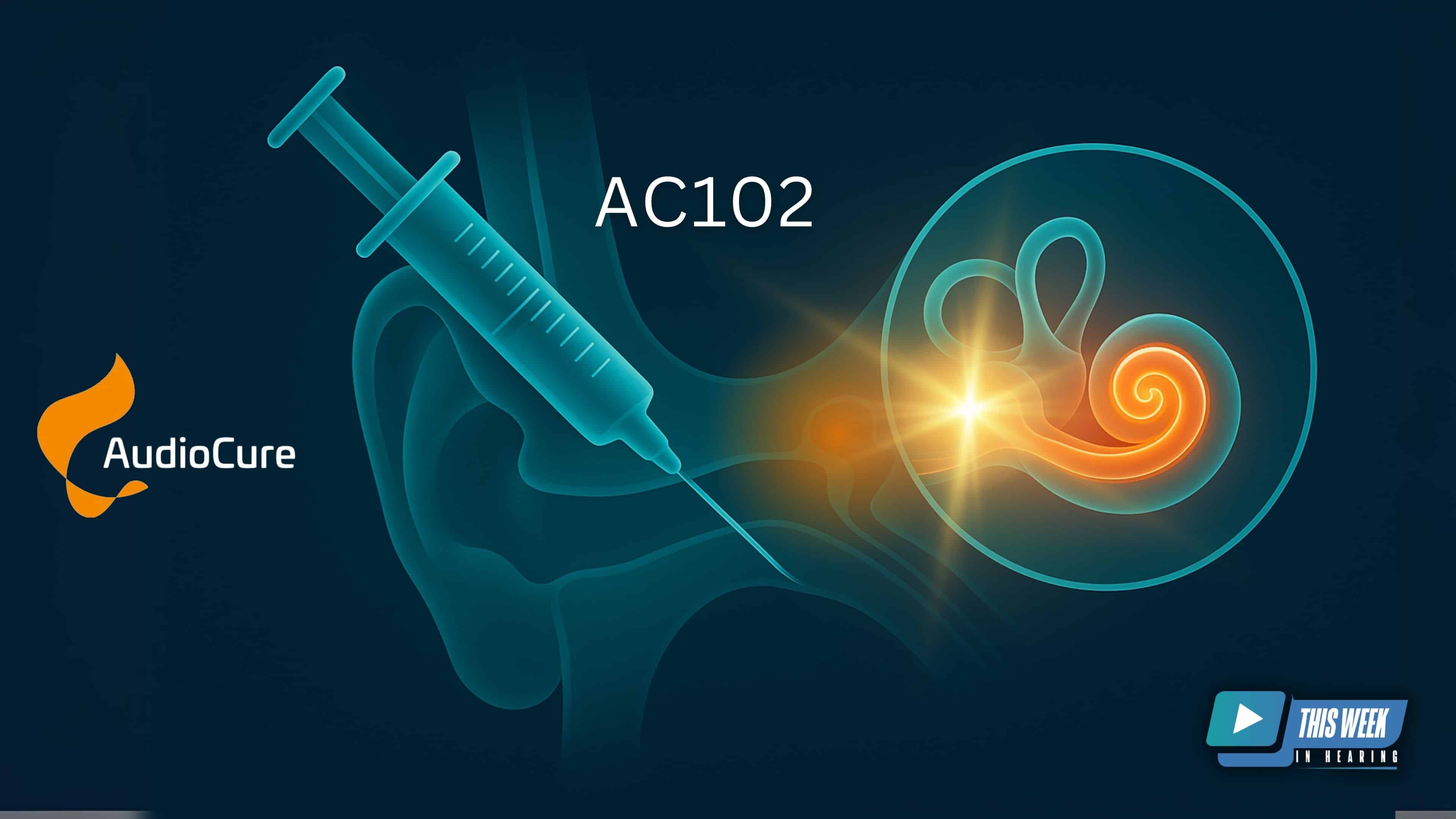
What if a regenerative therapy could not only halt sudden hearing loss but also help the inner ear repair itself? Dr. Reimar Schlingensiepen, CEO of Berlin-based biotech AudioCure, joins Brian Taylor to discuss AC102, the company’s lead compound now in Phase 2 clinical trials for sudden sensorineural hearing loss. With limited treatment options available today, the drug is being closely watched as a potential breakthrough in hearing healthcare.
Dr. Schlingensiepen explains why sudden hearing loss should be treated as a medical emergency, the shortcomings of current steroid-based approaches, and how AC102 works at the cellular level to prevent programmed cell death and restore critical connections in the auditory system. He also highlights the progress of ongoing clinical trials and discusses how AC102 could potentially improve outcomes for patients undergoing cochlear implant surgery by reducing insertion-related trauma.
The discussion further touches on broader applications, including recent preclinical findings published in the International Journal of Molecular Sciences. In that study, AC102 nearly eliminated tinnitus symptoms in an animal model of acoustic trauma while supporting repair of damaged synaptic connections in the inner ear. These results point to the potential for regenerative medicine to reshape treatment of auditory disorders that remain poorly served today.
Full Episode Transcript
Hello, and welcome to another episode of This Week in Hearing. I’m your host this week, Brian Taylor, and our topic is regenerative therapies for sudden hearing loss. And today, I have the pleasure of interviewing Reimar Schlingensiepen who’s the CEO of the biotech company AudioCure. Reimar, thank you so much for taking time out of your busy day to join us today.
That’s really my pleasure, and many thanks for pronouncing my name so very well, because it is a challenge. I know that, so… My name is, as you said, Reimar Schlingensiepen I’m a medical doctor by training. I did not start in ENT. I started in hematology oncology, and from there, with some colleagues, founded a, a startup for cancer drugs. And I joined the industry in ’96, so almost 30 years in the industry. In 2015, I bumped into a young entrepreneur called Hans Rommelspacher who worked on neuroregenerative drugs. Now, this young entrepreneur founded AudioCure in his early 70s, so after his retirement.
Wow.
And, you know, with his decades of university work and my decades of working in different positions in the industry we found out very quickly that we could form a wonderful team and gather some real the most refined experts around us to develop a pipeline of, of drugs with AC102 being our lead candidate.
Yeah. We’ll talk a little bit more about AC102.
Sure.
I’m kind of curious tell us a little bit more about AudioCure. You mentioned this partnership. How long has the company been in existence? Where you located?
Right. Yeah So AudioCure is, is a Berlin, Germany, Berlin company. Were in the very heart of of, old Berlin, which is really very inspiring for us. And Hans founded the company in in 2010, but then, you know, he had to get the money, and we really became operational in 2012. And, and that’s when everything started. And we had to, you know, look into the compounds we had in mind and test them and, you know, from step to step, from candidate to candidate. We then developed drugs and, and, you know, what we’ll talk later about AC-102. But that was, you know, not from the outset, but really step-by-step process.
Right. So let’s, let’s talk a little bit about sudden hearing loss. I think a lot of our viewers are probably familiar with it, but it helps, I think, to remind folks. Could you maybe tell us a little bit about the prevalence of the condition, how a patient might typically arrive in the clinic with it the challenge in diagnosis? If you could kind of review some of those things for us.
Yeah, sure. Yeah I mean, one of the challenges certainly is it doesn’t hurt. So you work wake up in the morning and you, you think, “Okay, there’s something wrong with my ear. Is that, is that ear wax? Is, is something wrong? Do I have an effusion?” And it takes you probably a while before you really get worried that, you know, there’s something serious going on, because you don’t hear it. Then you know, you go see your GP and you know, they, they may wash your ear and so on, and, and, you know, from what we’ll probably talk about later, you lose a lot of valuable time because this is a serious emergency in a way, and it, it takes time and, and yeah. One of the points is, how often is it? I, I mean, one of the issues is it’s not that common that every neighbor and friend knows what to do like with a heart attack, for example. So luckily, their education, I think, is, is very high and people know what to do. Hearing loss is pretty common in a way, sudden sensorineural hearing loss, so acute hearing loss, that in the US alone, you have between 50,000 and 100,000 new cases per year. So it’s, so it’s not like age related, but still a, very important
Mm-hmm.
with a with a lot of consequences if you suffer of it. And so you have these, these important numbers and the awareness is not that high. And as I said, you know, it, it, the processes are not very speedy. And one of the reasons, of course, is there’s very little to do. There are very few treatment options for the patients.
Well, let’s talk a little bit about traditionally, what are some of the strategies used to treat the condition?
Yeah. So in, in the ’70s, there had been the attempt to, to apply steroids, and in the ’70s, practically every condition, whatever disease, they tried steroids for good measure because you know, they have a lot of also beneficial effects. So also, physicians tried it in sudden sensorineural hearing loss. Now, over the past five to six decades, it, it was never possible to prove their efficacy, but also not to disprove the efficacy. So people just carried on, and it became just a standard because there’s no alternative. Because for the doctor, there is a desperate patient who doesn’t hear and you want to do something and not send them home and say, “I don’t have any therapy for you.” And in this condition, there is also a, a significant portion of people who have a spontaneous recovery. Now, was it spontaneous or was it my therapy? That still hasn’t been found out. So treatment options basically still is steroids. The proof is still outstanding. And there are some other options. There have been many, many real logics which have been abandoned because they seem to, not to do any good. Hyperbaric oxygen where, again, a bit like steroids, it’s unclear. They may be beneficial or they may not. That’s still to be proven. So overall, it has to be said, treatment options are not great.
Right. Well, but I guess that leads us then to your compound AC102. How does that fit in?
How does that fit in? Basically there are, there are two approaches. I mean, steroids, what they hope is to be anti-inflammatory, but it’s not clear whether inflammation is really always a, a key player. If you want to go more specific, you have basically two approaches. To prevent the cell death of your sensory cells or to regenerate them. And if we look into sudden sensorineural hearing loss that is actually a time lapse what happens in age-related hearing loss. Presbycusis just, you know, what happens over hours or days is what happens in most of us over decades when we grow old. So what happens is that we have these outer sensory hair cells which are amplifiers. They amplify our sound up to 10,000-fold, which is enormous. And those may die. They may switch on a program, unfortunately, under stress, which, drives them into programmed cell death. And the others, the, the, the receivers of the sound, the inner hair cells, they, under stress, may detach from the brain from the auditory nerve. So you have a complex pathology and as I said, you know, there have been compounds that address the programmed cell death. There have been compounds that that try to regenerate auditory nerve and these receivers, the inner hair cells, and we are in the lucky position, and this may be the only compound that covers both. So it does revert programmed cell death. We can see that in vivo and in vitro so that these cells get this program, “Okay, you kill yourself,” and that can progress very much and, you know, we, we add AC102, that command is stopped and reverts into, “No, go back to normal.” That’s one point, and the other one of the, the connection between the auditory nerve and the, these receivers, the inner hair cells of them detaching in the presence of AC102, they, the auditory nerve fibers, they grow back and the, the inner hair cells are willing to reconnect. So you can really see in histology how they all come back. And that makes it a very comprehensive approach where I don’t think there is so much parallel evidence.
I see. So I understand you’re involved in clinical trials. Could you tell
Yes.
and share with us some of the clinical trial data that you’ve collected so far? Some of your findings or some of the studies that you’re embarking on right now?
Right. Well, unfortunately, it is a double-blinded study, so we are blinded as are the study doctors though you know, we, we are still eagerly awaiting, of course, the results. We have we compare ourselves to steroid standard treatment as it is given by the guidelines with AC102, and we have around 100 patients per group, so two groups, 210 patients overall. And with the recruitment, we are pretty well advanced. We hope to finish it by end of the year and then it goes into the evaluation. But you know, as of now, we, we, we don’t have any insight of how AC102 compares to standard treatment for good measure, because, you know, it has to be double-blinded to be meaningful.
Right. But the fact that you’ve gotten this far, I think, says a lot.
Yeah. I mean, we ran AC102 in different animal models, not only in models for sudden hearing loss, but also for tinnitus and for electrode insertion trauma, so when, when patients get a, a cochlear implant even with, you know, the best surgeon in the world cannot avoid that that they destroy during insertion certain structures in the inner ear. And this compound has shown in, in, in tinnitus, in cochlear insertion trauma, in, in sudden hearing loss model that it can stop and revert these processes. Now based on that, we felt confident that we can go into humans. I mean, with all the toxicology and safety all being very in, in favor of starting such clinical study, but we ran a phase one in healthy volunteers. Why did we choose patients? Because that’s often done or normally done. The point is if you have already moderate, severe or profound hearing loss, you cannot detect subtle disadvantages of your compound and we wanted to be absolutely sure that this compound doesn’t do any harm. We didn’t expect it because it is regenerative, but you never know. Though we chose healthy volunteers and even, you know, you would have detected the subtle, subtle implications on the inner ear and hearing and what we saw, of course, is this, this compound resides for up to four days in the middle ear. During that time, of course, you have a slightly muffled noise, but that’s because you have something, a gel in your middle ear. But when that is cleared hearing goes back to normal, of course, and it’s only a healthy volunteer can hear that because it’s a few decibels. Other than that, it was like, of course, the injection may hurt, it may be a little bleeding at the injection site and so on, so what you would expect. But nothing adverse concerning AC102. So that was very good and based on that, we felt confident that in the next step, we can really do a clear control with patients and SSNHL.
Well that’s that’s great. You mentioned tinnitus and cochlear implants. Could you talk a little bit about each and how AC102, you know, like for example, how might AC102 be used in the management of bothersome tinnitus?
Yeah. So basically we, we tested this compound in animals for the treatment of the acute onset of tinnitus. And okay normally people ask themselves, how do you ask a rodent whether they have not? They might not, they might be somewhat reluctant to answer that question. You do that actually by, by giving them a certain sound. Let’s say, you know, we have a tinnitus at a certain frequency, beep. And, you know, that animal has it. And like for us humans, there may be a loud speaker that has such a humming noise and everybody says, “That’s so annoying.” And that person who has a tinnitus in that frequency says, “What is annoying? I don’t hear anything.” Because that sound in your ear is masking the loud speaker. Now that same is true for such a rodent. What they do so they have like, say, this beep. And if it’s a healthy animal, you can warn them of a very loud, very discomforting noise, like a loud clap or anything, and the animal startles. So you measure the startle reaction. So let’s say you do beep, short gap, then again beep, and the animal knows when this gap comes, okay very shortly thereafter there is this very discomforting startling noise and they get bored and , you know, because they know, okay, I’ve been warned there will be this annoying startling noise. But the, the animal with tinnitus cannot hear this warning gap because it’s covered with the tinnitus. So the beep of the loud speaker and the beep that the animal hears, they cannot hear this short interruption. So they do have a full startle reaction. Then we know they have tinnitus. Now with AC102, what we could see was that those treated with placebo practically all the animals had tinnitus and that even increased. Now on day three, both AC102 and placebo treated animals had tinnitus, and then it diverged. The AC-102 animals went down to almost zero tinnitus, and the others remained over the five weeks period, of having more or at least, you know, stable tinnitus. And that is something that, you know, we want to bring into the clinic. We don’t have the funds yet, so that is something, you know, I would start tomorrow if we had the funds. But we will have a readout most likely from our sudden sensory neural hearing loss study because 80% of patients undergoing SSNHL do have tinnitus and very importantly, they may, you know, recover from the hearing or they may not suffer of, of what is left as a hearing loss. But what does vex them is the tinnitus they have. So they may say, “Doctor, you know, everything is, I’m hearing well, but this humming noise drives me crazy.” So we do hope that in our SSNHL study, the AC102 group, we see a benefit towards tinnitus perception and suffering of tinnitus.
Well, I know there’s a lot of our viewers out there that suffer from bothersome tinnitus that come on our channel just to see if there’s anything new happening in that area. So we look forward to learning more about it.
Yeah, and unfortunately I a caveat I have to say, you know, this, this is the compound, I mean, authorities are rightfully very restrictive with it. You know, it can only be used in this SSNHL trial and, you know, we need to get the results. We need to get new funding and we need to start a, a separate tinnitus trial before it can be given to any patient.
Right.
that’s the law, that’s the regulations, and that is that is for good measure.
Yeah, thank you for that. You also mentioned cochlear implants. Can you tell us how AudioCure is using, the compound to improve electrode insertion trauma?
Yeah, absolutely. While the tinnitus trials were run in Erlangen, Germany the, the cochlear implant studies are, run in Vienna very known group from Professor Arnoldner and his team. And what they do is they insert cochlear implants in, in rodents much, much more harshfully than you would do it in humans because you want to see a significant damage which you would avoid in humans. But here, you know, you want to see what AC102 does. So it’s, it’s done you know, quite robustly inserted and you can see that the animals have quite a loss of hearing after this, this insertion. And if they treat these animals with the AC102 gel what you can see is that those getting the placebo treatment, they have a constant high hearing loss among all frequencies, while those that get AC102, which is surprising and we don’t have a full explanation for that, it’s given only once. It will only reside for a certain time, a few days at max in the inner ear, but it seems that it turns a switch because what you can see is that over three months hearing improves gradually, even from day 60 to day 90 where AC102 is long gone, there is still some self-repair. So it’s, as I said, it seems to be like a switch telling the inner ear, you know, go ahead and repair yourself. We hope that and we want to run rather sooner a clinical trial in, in cochlear implant insertion trauma where we hope that the cochlear implant outcomes they are great anyway, but there is another improvement of, of avoiding, you know, any operation related hearing loss….
It sounds like AC102 is a, a multipurpose drug.
Yeah, as it is regenerative. And, and we are lucky because, you know, if we look at the mode of action what it does, it, it increases the performance of the mitochondria of the respiratory chain. So in the presence of AC102 this powerhouse the mitochondria produce more ATP, which is, you know, the energy supplier. And at the same time when you increase the ATP, you don’t lose as many electrons which form oxygen radicals. And it has been known that the ear is very sensitive to oxygen radicals. So the less you have the less you force the cells into, for example, programmed cell death and so on. So this is, this is why it has, you know, as you say, maybe multiple purposes because the inner ear very easily undergoes this, this oxygen stress. And, and to cut that to, to very, very low levels … seems to be very beneficial.
That’s good. My final question for you before I let you go, and that is what’s your take … what’s your outlook on the future of regenerative medicine inside of the hearing and ENT space?
Maybe, you know, before we come to, to the, to the end with … of this conversation, before we before you know, I, I went into this discussion, I just had some thoughts of, you know, what our ear has to do. And, and may, may I share that with you?
Yes, please.
You know, and I just looked into some figures. We have like our brain has billions of cells, neural cells. Our eye has more than 100 million cones and rods helping us to see a wonderful landscape. Our ear can hear, and I think that is, you know, if you look at landscape or you look at, you hear it, Beethoven’s Ninth Symphony, that may be somewhat comparable in complexity, beauty, whatever. Now, if you have 100 million rods and cones, okay, easy to, to imagine that you can see that. Your ear has to listen to Beethoven’s Ninth Symphony with 12,000 amplifiers and outer hair cells and only 3,500 inner hair cells. Mother Nature, are you kidding us? 3,500 cells compared to 100 million retinal cells to listen to a symphony? You know, and if we have a conversation, I can hear whether you are happy, angry, cynical, smug, whatever. So subtleties, everything is filtered out and we, we can hear with 3,500 receptors. That is unbelievable. And if, you think that through, your eye at night is at rest and can recover. Your ear is never at rest because, you know, our ancestors in the cave when the snake or the bear was approaching, they could not have their ears at rest. They had to be 100% there. And, you know, you, you, you and I we will remember when we sneaked in at four o’clock in the morning at the age of 16. Who did hear us despite the fact that we didn’t make any possible noise? Mom did. How did she do that? Because her ears were at 100%. So that just brings me back to why the mitochondria and the ATP and all that is so important, because our ears, they work 24/7. They work always at highest level, particularly when there is no sound. So when you have stress or anything, you have to ramp up the energy and it can’t, and instead you get the radicals that drive your cells into cell death. So, just thought I wanted to say because I just had thoughts about it before this conversation, how amazing this job is from this very, very low number of cells giving us this, this beauty of hearing. Unbelievable.
It
was just … Yeah, yeah.
Thank you for that. That was good.
Right.
So,
Your final question.
No, I guess the last question I have for you is with respect to AC102, could you talk a little bit about the timeline as far as the clinical trial is over, you release the study. What, what happens after that?
Right. Yeah. So as I said, recruitment most likely until end of this year. Then, you know, there’s a three-month observation period until the last patient is out, and then it goes in all to that database cleaning. And, you know, there may be … these are more than 40 study centers, there may be some, you know, entries that have to be, you know, revisited with a doctor. Is that a four or is that a seven or whatever? And that takes time. That’s a, that’s a very kind of tedious but very important process. And so we hope that in 2026, we have these results and, you know, fingers crossed for all the patients in the world, you know, good results. And based on that, we would like to start as soon as we can a phase three trial which then hopefully, you know, brings us to finally get that drug approved. But that is, you know, that is the future where now, of course, we have to get phase two done. As I said before, we are also preparing for a phase two study in cochlear implant insertion trauma. So that will be our second clinical trial. And provided that the funds are there you know, more than happy to start some … trial in acute onset of tinnitus. So that’s, that’s where we would like to go along.
Well, it’s We hope to have you back on our on our broadcast in the future and we can talk more in detail about some of those findings. So,
Yes, with pleasure.
Thank you. Reimer Schlingensiepen, who’s the CEO of the biotech company the German biotech company, AudioCure. Thank you so much for your time. I really appreciate it.
Thank you, Brian, for this fantastic interview.
Reference:
- Tziridis K, Rasheed J, Kwiatkowska M, Wright M, Schlingensiepen R. A Single Dose of AC102 Reverts Tinnitus by Restoring Ribbon Synapses in Noise-Exposed Mongolian Gerbils. International Journal of Molecular Sciences. 2025; 26(11):5124. https://doi.org/10.3390/ijms26115124
Be sure to subscribe to the TWIH YouTube channel for the latest episodes each week, and follow This Week in Hearing on LinkedIn, Instagram and X.
Prefer to listen on the go? Tune into the TWIH Podcast on your favorite podcast streaming service, including Apple, Spotify, Google and more.
About the Panel
 Reimar Schlingensiepen, MD, is the Chief Executive Officer of AudioCure. Dr. Schlingensiepen has more than 25 years of experience in the biotechnology industry. He studied medicine in Oxford, Paris and Göttingen and, as a clinician, has conducted a variety of clinical trials in oncology, immunology and neurology both as investigator and sponsor. He is co-founder of biotech and other companies. Dr. Schlingensiepen has worked as manager, consultant and coach for high-tech companies in the fields of biopharmaceutical development, medtech, diagnostics and regenerative energy. He joined AudioCure in 2015 as CEO.
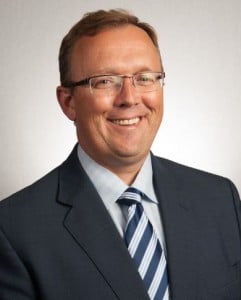
Brian Taylor, AuD, is the senior director of audiology for Signia. He is also the editor of Audiology Practices, a quarterly journal of the Academy of Doctors of Audiology, editor-at-large for Hearing Health & Technology Matters and adjunct instructor at the University of Wisconsin.