

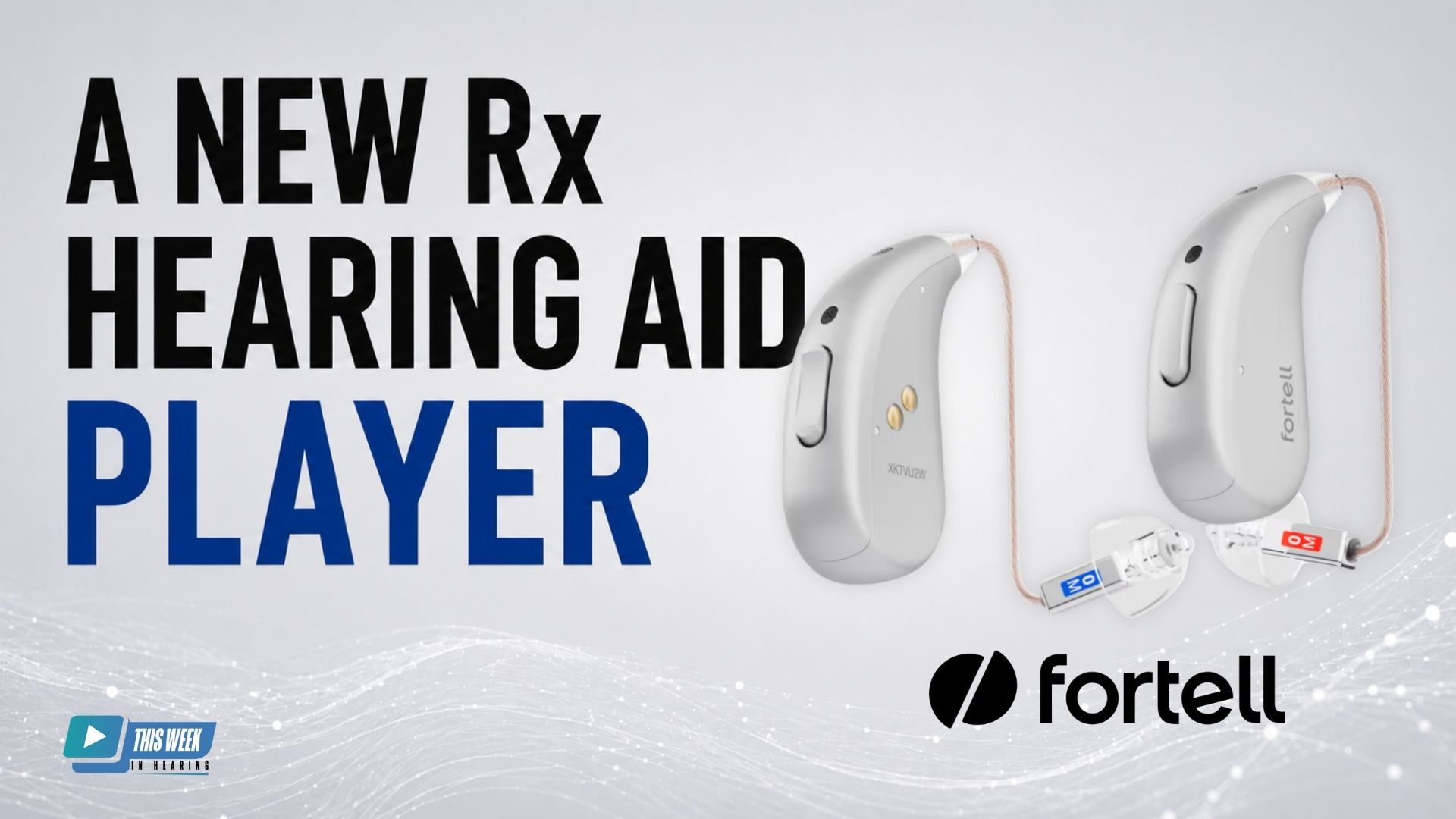
Fortell is taking an unusual path for a hearing aid startup: entering the prescription hearing aid market with proprietary AI technology, its own clinics, and a care model built around audiologists. Shari Eberts speaks with Fortell co-founders Matt de Jonge and Cole Morris about the company’s approach to one of the most persistent challenges in hearing care—understanding speech in environments with multiple competing talkers.
The conversation explores Fortell’s use of source separation and Spatial AI, including its Front Voices mode, which is designed to prioritize speakers in front of the wearer while reducing competing voices from other directions. De Jonge and Morris also discuss clinical studies evaluating speech intelligibility and listener preference in multi-talker noise, along with the limitations of the technology and why some of its more aggressive processing remains under manual control.
The discussion also explores Fortell’s decision to enter the prescription hearing aid market through company-operated clinics rather than a traditional manufacturer distribution model. The co-founders discuss the role of audiologists in fitting and optimizing the technology, the company’s approach to pricing and ongoing care, and the broader challenges of building and scaling a new hearing aid company in a market dominated by established manufacturers.
Looking ahead, Fortell plans to expand its clinical footprint while continuing to advance its AI-based hearing technology. Shortly after this conversation was recorded, the company introduced AI 2.0, a software update that Fortell says further improves speech-in-noise performance through expanded real-world training data and refinements to its signal-processing algorithms.
Full Episode Transcript
Welcome to This Week in Hearing. I’m Shari Eberts. If you’ve read Wired or Forbes or just about any hearing loss blog in the past 6 months, you’ve probably heard the name Fortell. It’s a new hearing aid company built around a bold claim that AI can finally crack the cocktail party problem. the ability to follow one voice in a room full of competing sounds. The company launched in December through its own flagship clinic in New York City and now has locations in Greenwich and Palm Beach as well. And I had the chance to try the product in May, and I liked what I heard. Joining me today are 2 of Fortell’s co-founders.
Matt de Jonge is Fortell’s CEO. And before Fortell, he worked on the AI team at Bridgewater Associates served as VP of Product at Butterfly Network, a company known for putting ultrasound onto a chip. Cole Morris is Matt’s college roommate and a fellow Bridgewater alum before leading data at Oscar Health Insurance. And he’s also the first author on Fortell’s 2 clinical studies evaluating speech intelligibility and user preference in noise. So Matt and Cole, welcome to This Week in Hearing. Thank you so much for having us. Yeah, thank you. My pleasure. Glad to have you. So you guys have a pretty personal origin story, I guess, especially Matt. You’ve talked about watching your grandparents withdraw from conversation, even though they had expensive hearing aids that should be helping.
So tell us how that experience led to the founding of your company. Yeah. You know, it was, it’s a painful memory. Yeah. My, all, all 4 of my grandparents struggled with age-related hearing loss, and I watched it gradually rob them of much more than their hearing. And I, I remember quite vividly there was a period of time where the hearing loss was new and there was a lot of effort on both sides to stay socially connected. Yeah. And eventually I saw them kind of give up on asking people to repeat themselves and sort of fall into smiling and nodding. Yeah. And I very painfully remember a moment where I caught myself talking at a volume where other people could hear me to my left and right, other family members.
But I knew deep down my My grandparents were not able to hear. And I, to be totally candid, it is guilt from that memory that has fueled, I think you could call it an obsession with this idea of making hearing aids more effective. Well, I love that obsession. As a person with hearing loss, I hear stories like that and have witnessed things like that all the time. And it is very disturbing and sad how Poor hearing or not being able to converse with family and friends can have such an isolating effect on people of all ages with hearing loss. So I love that that was very motivating for you and led you here.
So that’s wonderful. Thanks for sharing that. And Cole, what brought you into the company? Was there something specific that convinced you finally this hearing and noise problem could be solved? It’s a tough one. Yeah, it’s, it definitely is. I, you know, I came at it from a slightly different perspective. My background was as a macroeconomist and then as a health economist at the health insurance company called Oscar. And that was, you know, I, I basically spent all my time thinking about like how we could use technology to try to get better healthcare outcomes and lower healthcare costs. And, and so when Matt pitched me on the idea of building a better hearing aid, like I was, instantly in.
Like, there’s almost no place in healthcare where you can get a clearer line from better technology to not just better health, but better quality of life. And, you know, when you consider the downstream impacts, which people are very aware of around falls, lost income, depression, and cognitive decline, like there’s just so much, so much impact from being able to build a better hearing aid. And so I felt like, you know, if we actually had a shot at pulling this off, and Matt very much convinced me that we did there’s, there’s no way I wasn’t gonna take that shot with him. That’s wonderful. I love that. So, as you know, for people like me who live with hearing loss, the hearing in noise is really our number one complaint, right?
And a complaint about the hearing aids, because even if we have the fanciest ones or AI-powered devices, they don’t always separate the speech sounds that we want to hear from that backward background buzz or even, you know, other voices that we may not want to hear that are behind us or to the side or what have you. So why haven’t other hearing aids been able to solve this problem?
And what are you guys doing differently? Is there a fundamental change, you know, rather than just an incremental improvement that you have found for the hearing aids? Yeah, I do think it is quite fundamental. You know, it’s hard not to feel a little cynical if, you know, your audience, I think in particular, will have observed just the degree to which hearing aid companies have started using AI in their marketing. People, these companies have come to appreciate that it’s pretty easy to put AI into your marketing materials. But it’s very challenging to use AI to make a better hearing aid. And when we started the company, it was sort of a kind of a quiet acknowledgment in the industry that what we were doing at Fortell was impossible.
Huh. You know, the state of the art was that AI could reduce listening effort and kind of improve the convenience and the sort of kind of softer quality of life aspects of wearing a hearing aid, but it was considered elusive and intractable, this idea that hearing aids could actually fundamentally make you a better listener. But, you know, when you think about it, it’s like, that is, at least as we see it, the fundamental role of a hearing aid and an audiologist is to help someone hear in an environment where they struggle. And so, you know, we took a clean sheet approach to this problem I had spent 15 years wanting to attack the problem of better hearing aids, but it just was too hard.
It just felt like science fiction. Unique experience that we gained at our previous companies developing real-time AI algorithms and custom chips finally gave us this like narrow glimmer of possibility that, you know, it might actually be possible to do something better. And so what we do is we use a technique called source separation. So in real time, we use AI to separate incoming audio into channels of important and unimportant. And so if we can do that quickly and accurately, that gives the audiologist the opportunity to remix important and unimportant back together for the wearer at a preferential signal-to-noise ratio. at an easier signal-to-noise ratio so that it feels like you’re having a conversation in quiet.
And, you know, anybody who’s checked out our clinical trials has seen that, you know, what’s particularly novel is this technique we call spatial AI that interprets sound not just on the basis of what it is, but also where it’s coming from. And that has given our hearing aid the ability, even in multi-talker noise, which is like, you know, kind of the most challenging environment in which, you know, know, people struggle to hear even in multi-speaker noise. We can remove distracting talkers and home in on the voices that are of interest to the wearer. I mean, that sounds amazing, right?
That, that’s what everybody always says they want. I always said, okay, I want to have somebody where I can hold up a microphone and have them read a sentence and say, okay, this is Matt, okay, this is Cole. These are the voices that I want to hear. Everyone else, you can mute them. You know, is it an experience like that, or is that, is that not really a good way to explain it?
I think that that’s, that’s absolutely a good way to explain it. When it, you know, when, when we, when we’re at our best, I like to say that it, it sounds like you have put a lapel microphone on the person you want to hear. Right now, when we do that, we have to be careful. It’s a it’s a highly interventional thing. To do to someone’s hearing is to explicitly knock out some voices and preference others. So that’s forced us also to think about, I would say, challenge some of the orthodoxy around how people interact with their hearing aids, right?
In a traditional hearing aid, getting the wrong mode, you know, accidentally being in restaurant mode instead of outdoor mode, the reality is the stakes are low because they all sound the same, right? But when you’re actively removing some talkers from the scene, We don’t ever want to do that at the wrong time for you. So we require the users to tell us, hey, lock into the places I’m, you know, to the speakers I’m looking at. Okay. So talk a little bit more about what the different modes are. And, you know, I guess Front Voices is sort of the one that I’ve heard most people talk about and sort of be wowed by.
So describe what the different modes would be, and then a little bit about how people would switch between them. Yeah, so, so there’s 4 basic modes of the device. One is dedicated to live music. So it’s just about restoring enjoyment of music. And, you know, I think that’s often underlooked. It’s really important. We spend a lot of time making sure music sounds great for people. So we call that live music mode. The next mode is called conventional mode, and that is our implementation of a traditional high-end hearing aid. The job of that hearing aid, the job of conventional mode is just to restore your audibility, make sure that the sounds in the world are loud enough for you to hear, but we don’t don’t mess with those sounds.
We just give it to you authentically, transparently adjusted for your hearing loss. And then you get to All Day AI mode and Front Voices mode. And those modes are where the AI kicks in and steps into the signal path and is actively working to improve and enrich the signal-to-noise ratio. And so most of our users spend their time— and again, you can see why we named it All Day AI mode— which is preserving your omnidirectional hearing looking for the talkers of interest and amplifying those while attenuating other distracting sounds, but while still preserving situational awareness and naturalness, right?
So that’s all the AI. And again, a lot of our users just set it and forget it, leave it there. And then this Front Voices mode we tap into with a button press or using our companion app on the iPhone. That’s, that’s for those noisiest environments where where, you know, talkers on your left and right are driving you nuts. Maybe it’s a cocktail party. That’s where we want to say, hey, just give me the talkers I’m looking at. And it is that mode where we see the most profound signal-to-noise ratio improvements, but also the most profound changes in intelligibility, right?
So this is where we get into like breakthrough world’s first performance on these studies. It’s like multi-talker noise is the noise source that is most damaging and deleterious to understanding. So for the first time ever in being able to knock out multi-talker distractors, we can fundamentally turn people into measurably better listeners. And as far as we know, this has just never been done in the industry and it’s a big deal. Well, it is a big deal. I mean, it sounds like a restaurant program, but like on steroids, right?
It’s like a restaurant program that’s going to make a big difference. You can use it at a cocktail party or a coffee shop or many, many of those different settings. And so I think that’s very interesting that that is a manual setting because there is sort of a trend in the industry to just have everything be automatic. So you want— because it’s such a fundamental change, that’s the reason you made it manual?
Exactly. So within this All Day AI mode, there’s a lot of active optimization, right, in our set it and forget it mode. Mm-hmm. So we’re doing a lot to make sure you don’t have to touch your hearing aids if you don’t want to, right? You could just have fun, enjoy your life, enjoy the people around you, you know, and hear. That’s really the goal is we don’t want people to have to think about their hearing aids or their hearing loss, right?
But when we’re going to do something very aggressive to the signal to make sure you can hear, We never want to do that by accident. And so we require you to tell us, okay, knock out the talkers behind me and my— into my sides. That’s what I want in this environment. One day— Yeah. One day perhaps we’ll have hearing aids that can, you know, literally read people’s minds. Yeah. And then we won’t need to ask them to press a button. But for now, we err permissive, we err omnidirectional, we preserve your situational awareness. But when you tell us you want to go into this sort of turbo mode, this Front Voices mode, that’s when we step in and we crank it to 11.
Okay. And then you turn it off as well. So now it’s like, okay, back to normal life. Let me turn that off. Exactly. Yeah. Okay. It’s also, it’s also worth noting that like, this is how each of these modes sound like how much we improve the signal-to-noise ratio is something that, that the audiologist has control over. And so it’s one of the, one of the things that we’re finding is that there are slight differences in preference between people based on their degree of hearing loss and how much situational awareness they want. And so there’s, that’s actually something that we found is really important is having, being able to work with your audiologist to set the modes up to work optimally for you.
Yeah, I love that because it’s great to have the autonomy, but you also need a partner in making sure that that autonomy is, is channeled in a proper way, right? So that you’re both working together to get that optimal result. So that makes a lot of sense. So do you have, you know, a story that you can share? I’m sure you’ve seen lots of people try the devices at this point. And so, you know, how do people react?
What, what’s sort of a good success story to share? Yeah, I mean, you know, that it never gets old. Like the last 7 months since we’ve launched, it’s, it’s been very emotional just to see the effect this technology can play on people’s lives. And just to give your audience, you know, a sense, like we spent 5 years heads down in the lab working on technology. We felt very strongly— it’s a little unorthodox. The conventional thinking is get your first product out as quickly as possible and then iterate. We felt very strongly that the world did not need another mediocre, incrementally better hearing aid. And frankly, we also thought that it would have been a bad business decision to launch something that was only slightly better.
So we spent 5 years heads down working on core technology, initially on the AI science and then on the custom chips required to bring all this AI power into the hearing aid. Wow. So, you know, when it’s easy to get lost of the impact that this will have on people, on real people’s lives, when you’re 5 years day in, day out just in the lab, it has been profoundly meaningful to us. Every time a patient comes to our clinic on the Upper East Side and now at all of our other clinics, we always demo for them outside In the real world, and you know my favorite stories are just like when we get tears and hugs.
Like we get a lot of tears and we get a lot of hugs, and I would say it’s particularly remarkable. You know some of the press has I would say overly fixated on this, but we’ve had the opportunity to to meet our heroes, and not just meet our heroes but help them hear their families. And so it’s just been incredibly meaningful, and I would say it’s. It has fostered this has become a true addiction for our team. We are just, this is what we’re going to do until we’re, until it’s time, you know, until they, until they escort us out of the building. Like, this is, this is— Throw you out.
We’re hooked. And what’s so interesting, you know, that the natural the the human auditory system is so majestically complicated that this is a problem we will never solve. We will never finish. We will always find opportunities to improve the hearing experience for people with hearing loss. So that’s interesting. So you feel like this is not done, right? This is the best version that you have now, but you’re going to continue to work on improving it. Is that right?
That’s 100% right. So, you know, I, I, we are, we are working in this industry because we saw what we, we actively felt the pain and the consequences of 30 years of by and large stagnation. If someone woke up from a coma, you know, after 30 years, the world would be completely unrecognizable to them. iPhones, televisions, you know, flat screens, I mean satellite internet, I mean electric cars, right?
The world has remarkably evolved over the last 30 years, but it would not be hard to— there would be no shock about conventional hearing aids. Oh yeah, I know what that is. Right? Okay. It’s like, it’s, it’s like the, the, the last major breakthrough in hearing aids was 30 years with when, when these devices went analog to digital and you had the advent of wide dynamic range compressive amplification. And then you had this little, little, little innovative spurts after that, the introduction of Bluetooth, anti-feedback algorithms, beamforming. There were these like kind of incremental improvements, but over a 20 to 30 year period, hearing aids have not gotten better at helping people hear where they struggle.
And so, you know, our small team, with a lot of help from some really sophisticated investors, has been able to make, I think, the breakthrough that patients have deserved but not gotten. And but absolutely, we’re just getting started, and we’re just so excited by the amount of work that there is left to do. Oh, that’s terrific. Awesome. So, Cole, I want to give you a little bit of time to talk about these studies that you did because you’re the first author on both of them. One’s on speech intelligibility, one on user preferences, and you conducted them with some pretty important people in the industry. Can you talk about that and also the headline findings so we understand sort of all the backup behind this new technology?
Definitely. I actually love talking about the studies. So Cut me off if you, if you need to. Yeah. Yeah. No, one of the things, one of the things that really struck us, you know, when we started, we read a lot of hearing aid white papers, was just like how thin the scientific evidence was for, you know, besides directional microphones, the ability of existing technology to really improve the number of words that people understood in noise. Like when it comes down to it, that’s the thing we, we, we felt like was a prerequisite, was like we wanted to, from very early days, like get to the place where in a well-designed study that was, you know, scientifically rigorous, we could show measurable improvements in people’s ability to understand in background noise.
And so, you know, we basically have these 2 studies. The first one is geared exactly at that question, at this question of intelligibility. And the, and then the other one is, is geared at, you know, what I would consider an equally important element, which is do people perceive that they’re hearing better? Do they perceive, do they subjectively prefer the experience of listening to one hearing aid to another hearing aid in noise?
And in both of these cases, we wanted to focus on the most challenging environment, which is that thing we’ve talked about of the environment of multi-talker noise where the noise is not just the, you know, the, the sort of hum, the rain outside my window. It’s the sound of other people talking at audible volumes right next to you, making it really hard for you to focus on the conversation. Mm-hmm. So our intelligibility study, that one was, you know, a speech and noise test. And that is, you know, pretty easy to imagine. It’s you’re sitting, you put, you have someone sitting in a chair wearing a hearing aid. With speech that they’re trying to understand coming from a speaker in front of them, and then really distracting loud talkers being played from competing speakers.
And in that, and then what we do is we basically measure how many words do they get correct in one scenario, and then how many words do they get correct wearing a different hearing aid? And in this case, we chose basically the best hearing aid we could find, which was another AI hearing aid available on the market. And You know, the most important, the way you quantify that is you basically say how much, what’s the relative volume of the speech and noise that they can tolerate, where they can still understand words. And participants wearing Fortell could understand words equally at a 9 dB more challenging SNR. So that may not make a lot of sense to, and to your average listener, cuz SNR isn’t a term that people throw around.
That’s signal-to-noise ratio. But to put it in perspective, directional microphones, which was the thing I described as being the other useful thing in background noise, give you about a 3 dB improvement, 3 decibel improvement in background noise. And obviously the hearing aid we were comparing to had directional microphones on. So getting a 9 decibel improvement beyond that is a pretty astonishing result. Yeah. We felt pretty, we were honestly like pretty proud to, to, to see that. And we felt like that was going to make a, that it was going to make a big difference for people. And, and that was the, I’d say the core finding of the intelligibility study.
The other study is one where we basically did a Pepsi challenge. And so that’s where we recorded the hearing aid, the Fortell hearing aid in, in multi-talker noise, and we recorded the latest technology from each of the big 5 in that same multi-talker noise. And then we blinded people and had them listen to track A, track B, and rate which one they found easier to understand. And, you know, in that case we had, I think it was 19 participants per sort of selected Fortell relative to all 5, and the last participant selected Fortell relative to 4 of them, and then there was one tie. So in both these cases, it was fairly decisive in the results, which we were both sort of like not surprised by, but also surprised by just ’cause of how overwhelming the data was.
And, and, and so we felt like it was also really important to put these studies through the peer review process and make sure that, you know, we were, we were getting outside scrutiny on them just because the size of the impact we were reporting was so high. And that was another reason that we felt like working with the outside academics that we worked with was an important element, having someone else looking at our data, looking at our methods, making sure that we, you know, weren’t grading our own homework in a way that tilted the results. That was a, that was kind of from the initial design, something we felt was going to be important.
Yeah, absolutely. Because I think people could discount it saying, oh, okay, well, this is a company that, you know, funded studies and it showed that their hearing aids perform better. So I think it’s very important to have that, that backstop and that something you feel comfortable is in place. Yeah, it was, it was both the people who, who we were working with. So, you know, Marco Svirsky and Bill Shapiro from NYU on the intelligibility study, and then Joe Montano and Barbara Weinstein on the subjective study, all, you know, people who we knew would not sign their names to something that was shoddy research. And then in addition, you know, the design of the experiments was like, very much in partnership with them was such that like we were, we were minimizing the amount of bias that could be introduced.
So the important elements there are blinding, basically making sure that at no point in the experiments do people know that they’re, that this is a Fortell hearing aid and this is an X hearing aid, you know, blinding. And then on the participant, I mean, on the researcher side, anyone who’s collecting data also can’t know which, which hearing aid they’re wearing. And then randomization. So making sure that there’s no bias in the actual construction of the test. So anyone who’s— there should be— patients are randomly assigned which one they get first, which questions are being answered with Fortell versus with the other hearing aid. So all those things, you know, are important to kind of making a rigorous study.
Absolutely. So, I mean, as I’m sure you guys know, for people with hearing loss, it’s not just about sort of understanding the words, right? It’s sort of making— how hard do we have to work to understand those words? So is there some measure of listening effort or cognitive fatigue that was part of those studies, or is that something that you are going to look at next? Yeah, it’s a great question. You know, we haven’t measured it directly. You know, I would certainly expect that improvements in intelligibility will be very correlated with decreased listening effort. And I would say anecdotally, it’s one of the things we hear like most frequently from patients is the feeling of, hey, I get to the end of the day and I’m not exhausted.
Yeah. Like I used to be. And that— I’ll just say that, you know, we, when we were reading, you know, we tried to become experts on all the white papers these manufacturers, these legacy manufacturers write to try to substantiate their marketing claims. My position was always like, listening effort, like, that’s weak coffee. Like, let’s turn them into better listeners, right? Like, let’s make people measurably better listeners. Like, if you can’t make someone a better, better listener, okay, like, survey them to see if, like, if it was more fun to listen, you know?
So, so we, we always felt like it was much more ambitious to try to tackle true movements in intelligibility. That said, I mean, I’m being a little, a little snide here. Cognitive effort, you know, is so important, and we are actively, you know, excited about, you know, some of the new neural imaging techniques and pupillometry. There are some techniques I think that will allow us to bring a similar level of rigor to measurement of listening effort. Yeah, I would say from just from interacting with patients in the clinic a lot, I I’m very excited to do this type of study just because I, I I sort of feel like I know from my like subjective experience that there’s something there that’s pretty meaningful.
And so I’d be very excited to try to measure it. And I think it’s that effort sometimes that leads to the isolation, right? Because it’s like, ugh, you know, is it worth it to actually even put myself in this situation because of the amount of effort that it’s going to take, even, you know, with my best hearing aids, right, to enjoy this party? And so, you know, maybe I just won’t go. So I do think the listening effort, is, is a critical piece for people in terms of really having that impact on their life, their relationships, their ability to communicate. And I know that’s, you know, that’s your goal. So I look forward to hearing more about that down the pike for sure.
Yeah. So let’s talk a little bit about limitations because every technology has them. Were there certain situations where Fortell did not work as well or they were not as preferred? Is there anything that you can talk about on that piece of it? Well, the, honestly, on the study, the studies themselves, like the, you know, in the intelligibility study, every participant heard better with Fortell than the control. And in the subjective study, it was 19 of 20 preferred Fortell to every of all 5. And then there was one tie with the, with like for one of the hearing aids and they preferred it to Fortell. quartile on the other 4. So if anything, like we were worried with the studies that people were going to dismiss them out of hand because the results were what they were.
The, I think if we were to zoom out though and say like, are there environments where you would prefer a different signal processing to the spatial AI that we tested in the, in those studies? The answer is definitively yes, because as we said, spatial AI is getting rid of those side talkers. So if you’re trying to have a conversation with someone who’s next to you at the bar, that’s not the mode you want to be in. And so there’s a, there’s a you know, there’s, there’s definitely importance and room for other types of signal processing. And that’s why we’ve tried to sort of give the user enough control to be able to navigate their world effectively.
And I’ll just add that, you know, the spatial AI is a breakthrough, but it’s not perfect. And so I’ll give you an example of an environment in which it could, you know, it could disappoint a wearer. You know, the, the fundamental heuristic we’re using when you tell us, hey, I’m in a, I’m in a challenging cocktail party or restaurant environment, I want you to tell, I wanna hear where I’m looking. It works profoundly well when you can put the voices of interest in this cone of vision. Right. And the distracting talkers outside of the cone of vision. But sometimes that’s not practical, right?
And so if, if you’re in a configuration where you, you have distracting talkers and and they’re loud, so the AI thinks, oh, that, that could plausibly be someone who’s talking to you, and you can’t get them out of the cone of your vision while still keeping your actual target in that cone, then you’re going to get an experience of, you know, overly permissive amplification of both a wanted and an unwanted talker, and you might be disappointed in that environment. So a big part of what we do, you know, is a core principle for us is treat patients like they’re smart. Right?
Like, this is why we— like, every product design decision we make, all of our marketing materials— like, people are smart, and we don’t think that it’s our responsibility to dumb it down for people. They’re smart, and so we need to tell them where the technology works well, how to get the most out of it, what the shortcomings are. And so this is another role that the audiologist plays with every patient, is we’re going to tell you what What did— how did we build this?
What is it designed to do? What is it not designed to do? So that you’re fully empowered to get the best value out of the technology. Yeah, that makes sense. Respect the user, right? And then they can make choices for themselves within the parameters of the device. So I love that. So let’s change gears a little bit. Let’s talk about the distribution because you’ve taken a pretty different path, right?
Most hearing aid companies sell through a variety of audiologists. But you’re selling through your own specific clinics. Why did you decide to do that? Why is that an important part of the process? And do you imagine that will change in the future? You know, when you spend 5 years in the lab on the technology, you have a lot of time to think about, okay, how are we actually going to launch this when it’s ready?
Like, probably more time than we wanted, right? right? At the end of the day, the North Star for us was we want the experience with Fortell to be the experience we wish had been available to our parents and grandparents. So we don’t do anything unless like we can, we could stay consistent with that, with that North Star. And the way we decompose that into like actionable things that we can work on and services and devices and technology we can offer patients with hearing loss is we want Fortell to, to combine the most sophisticated technology with the best and brightest audiologists and a concierge level of support for the patient and the technology.
So it’s those 3 pillars, right? The best hearing aids, the smartest and best and hardest working audiologists, and ultra high levels of customer support, the only way we felt we could deliver on all 3 of those dimensions was to control every detail ourselves. And so, you know, I would say that as long as we can guarantee that when you come to Fortell, you get all 3 of those things, then we’re open to a lot of different ways we could reach patients. We believe deeply in the role of the audiologist. We spent a ton of our time, you know, meeting audiologists, trying to figure out, okay, who really understands, you know, the technology that they’re fitting?
Who really cares? Who’s really listening to their patients? And who is still curious enough to learn? You know, and so, so I would say it’s, it’s equally important in our eyes to find the best doctors as it is to constantly be pushing the envelope on the hearing aid technology. So what does that model mean for affordability, right? I mean, you could sort of have to balance that long-term mission, but also price availability. How do you think through those parameters?
Yeah, I mean, this is something we think about and talk about a lot. You know, as a small company, we have to, We have to decide very carefully what we want to be. And we want to be the progress that this industry has lacked. We want to be the ones responsible for pushing the state of the art forwards. It’s really expensive to do that. We invest massively in new technologies so that the solutions we provide our patients truly reflect the limitations of science and technology. And that line is constantly moving, and chasing it is expensive. And so we are focused on being the best solution for hearing loss, and we’re focused on delivering that solution in a very high-value package.
So our hearing aids are about $6,800. That comes with 5 years of unlimited audiological care from your dedicated audiologist. It comes with 3 years of, you know, comprehensive warranty, including, you know, insurance against loss or damage. That package, it’s costly, but it is priced below top-spec offerings from legacy hearing aid manufacturers down the street at academic medical centers and in private practices. So our goal was let’s make sure what we’re offering patients is really high value, but also continues to fund aggressive investment at constantly making things better. Okay, fair enough. So last question this has been such a great discussion. What’s next for Fortell?
Like, if you look 5 years out, what does success look like for you guys? Yeah, I think that a big goal is we need to reach people outside of, you know, Florida, New York City, and Connecticut. So expanding the number of clinics where, you know, where we can deliver this amazing combination of technology, audiological service, and customer support. So we’re growing, and we hope to grow not just within the United States, but internationally as well. So we’re working a lot on that. And then of course, we’re constantly trying to push the envelope on just how helpful a hearing aid can be. My hope is that in a few years, Patients with hearing loss are spending a lot less time thinking about their hearing loss and a lot more time having fun, enjoying the people around them.
Yeah. And so that— there is just so much work to do to chase that. You know, we’ll, we’ll get asymptotically closer, but we’re not going to rest on our laurels just because, you know, our first hearing aid is the best in the world. Awesome. Well, thank you both so much, Matt and Cole, for being here. I mean, it’s not every day that a new company enters the hearing aid market, let alone ones taking on the problem that matters most to those of us living with hearing loss. So I wish you continued success as you grow the company. And for people who want to learn more, check out Fortell.com, F-O-R-T-E-L-L.com. And thanks so much for being here with us.
I just want to thank you again for having us and for the role you play in this ecosystem as an ambassador for people with hearing loss. It’s profoundly important. And, you know, we’ve watched a lot of your content, so it’s an honor to be here. Thank you so much. Appreciate that.
.
Be sure to subscribe to the TWIH YouTube channel for the latest episodes each week, and follow This Week in Hearing on LinkedIn, Instagram and X.
Prefer to listen on the go? Tune into the TWIH Podcast on your favorite podcast streaming service, including Apple, Spotify, Google and more.
About the Panel
Matt de Jonge is co-founder and CEO of Fortell, where he leads the company’s efforts to develop AI-powered hearing aids designed to improve speech understanding in complex listening environments. Before founding Fortell, de Jonge worked at Bridgewater Associates and later at Butterfly Network, where he helped develop and commercialize AI-enabled medical technology.
Cole Morris is co-founder and COO of Fortell, where his work spans company operations and the clinical research supporting its AI hearing technology. He served as principal investigator and co-author of Fortell’s first clinical studies and is lead author of a 2026 International Journal of Audiology study evaluating the company’s Spatial AI technology against leading premium hearing aids in multitalker noise.
Shari Eberts is a passionate hearing health advocate and internationally recognized author and speaker on hearing loss issues. She is the founder of Living with Hearing Loss, a popular blog and online community for people with hearing loss, and an executive producer of We Hear You, an award-winning documentary about the hearing loss experience. Her book, Hear & Beyond: Live Skillfully with Hearing Loss, (co-authored with Gael Hannan) is the ultimate survival guide to living well with hearing loss. Shari has an adult-onset genetic hearing loss and hopes that by sharing her story, she will help others to live more peacefully with their own hearing issues. Connect with Shari: Blog, Facebook, LinkedIn, Twitter.