

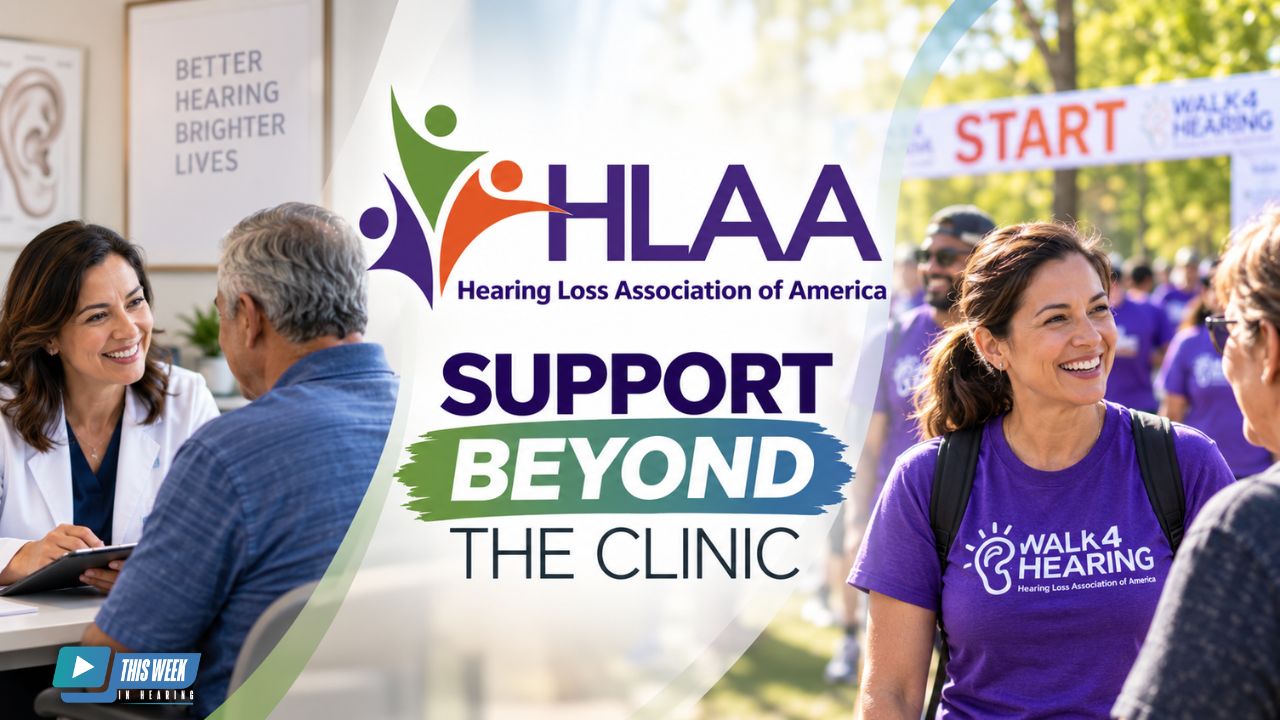
For people with hearing loss, many of the biggest challenges happen outside the clinic—from navigating difficult listening situations to managing the emotional and social impact of hearing loss.
Shari Eberts is joined by Dan Reiner, Director of Communications and Marketing at the Hearing Loss Association of America (HLAA), to explore how the organization can complement clinical hearing care and help support patients between appointments.
They discuss HLAA’s network of 125 chapters and state associations, Hearing Life magazine, peer support groups, educational webinars, practical toolkits, workplace resources, Walk4Hearing events, and other free materials that hearing care professionals can share with patients and families. Dan also offers practical suggestions for audiologists interested in incorporating HLAA resources into their everyday patient care.
The conversation highlights the role that community, education, peer support, and accessible resources can play in helping people live well with hearing loss—long after the clinical appointment ends.
- Resources Mentioned:
Full Episode Transcript
Welcome to This Week in Hearing. I’m Shari Eberts. Most audiologists have less than an hour with a patient, but the hardest part of hearing loss often begins after the appointment is over. That frustration at the dinner table or the exhaustion after a full day of Of straining to hear or just that creeping sense of isolation that we sometimes get with hearing loss. But today we’re talking about a resource that can help bridge that gap, Hearing Loss Association of America. Many of you know HLAA is the nation’s leading consumer organization representing people with hearing loss. But what you might not know is just how many ready-made shareable resources they have, resources you can use to support your patients between appointments. when that emotional and practical questions of living with hearing loss really kick in.
So my guest today is Dan Reiner, HLAA’s Director of Communications and Marketing. He joined in October 2025, and he brings nearly 2 decades of nonprofit experience in communications, including 10 at the National Council on Aging. And his work centers on making complex health topics accessible and on building communities where people feel supported rather than alone. And at HLAA, he oversees the organization’s communication strategies, including the magazine Hearing Life, the webinar series, and a growing library of toolkits that he’s designed to make them very easy for sharing. So thank you, Dan, for joining us today. Thank you so much for having me. My pleasure. So you came to HLAA from the aging and nonprofit world, like I mentioned, rather than from hearing care.
So can you talk a little bit about what drew you to HLAA? And for audiologists who maybe just know the organization through convention or the Walk4Hearing, you know, what’s your sense of how to describe what HLAA offers today? Honestly, I’m a sucker for a good cause. As you mentioned, I’ve worked in nonprofits pretty much my entire career. I actually went to college to be a teacher. So being in communications has always let me kind of indulge my love of working with people and, you know, my penchant for explaining things. So, you know, HLAA kind of lives at the intersection. Of all the players who contribute to someone’s hearing health story.
We bring together people with hearing loss. Of course, we are primarily an organization that engages people who themselves have hearing loss. But of course, we also kind of, we convene healthcare providers, researchers, students, device manufacturers, policymakers, and anyone else interested in improving accessibility in hearing health across the board. Awesome. It’s so— I mean, it seems like it’s just there was not a particularly personal relationship with hearing loss or anything like that that drew you. How much did hearing loss come up when you were working in the aging space? Quite a bit. And I will say, I mean, every— I’m apparently actually rather lucky in that every man in my family older than me has had hearing aids.
You know, sensorineural hearing loss is almost certainly going to come my way by the time I’m about 55, 60 years old. So I’m grateful to have learned, you know, plenty about the issue in my short time at HLAA already. But, you know, having— growing up with You know, 2 grandfathers who both always had their hearing aids and were always using them. I gather that’s actually not particularly common, so especially for their generation. So, you know, having that unknowingly, having that kind of positive example, it was beneficial as a younger— as a youngster for me. Well, that’s very lucky to have that, that good role model. Yeah. Excellent. So let’s talk about audiologists a little bit, right?
Because they’re really the experts in the technical side of hearing care, the device, the devices and all of that. But the emotional adjustment to hearing loss is equally important. But sometimes because the appointment time’s so limited, that happens outside the clinic. So why should audiologists think of HLAA as an opportunity to extend the care that they provide? And, and how does HLAA How does HLAA fill in that emotional gap? I like to describe HLAA as the organization primed to strengthen the continuum of care that experts provide. A primary care physician and an audiologist may have different roles to play, but they are working towards the same goal with the same patient, right?
Improved health outcomes and a better life. And that’s what we are able to contribute to by providing support for the social and emotional facets of living with hearing loss. We, you know, for 47 years have understood the range of questions and feelings that people may face as they learn about their changes in hearing, whether sudden or gradual. But also, we know the importance of saying to people that, you know, you’re not alone. And, you know, we have a community ready and waiting in the form of 125 different chapters and state associations across the country who are ready and willing to take in newcomers, remind them that, you know, this isn’t someplace new.
People have been where you are before, and we can help you through it. Yeah, I love the way you describe that. And I mean, I’m a member of the New York City chapter, and yeah, Coming to HLAA really changed, you know, how I felt about my hearing loss. And like you said, I no longer felt so alone with it, right? I was part of this community and I could learn so much from them, just practical kind of information as well as that emotional support. So I always say, you know, if every audiologist in America referred their patients to HLAA, like think about what the impact could be for that. Do you have any thoughts about that?
Yeah. First off, I would love that. I wish it was that easy. And I think, you know, maybe the most immediate change, though, would be the ease with which people could learn from others who have lived the same experiences. The internet has done a lot of things, but one thing it has not managed to do is replace the quality and degree of reassurance that comes from talking to someone in person and knowing that they are there to help you and not judge you. You know, people have many, many, many different feelings and questions depending on the circumstances, right? And, but there is always someone who has been where you are.
And I can’t think of a better way to give people the confidence and the wisdom to make decisions for themselves than connecting them with someone or a group of people who can accept the process and help them through the process that they’re going through. Absolutely. And we have a lot of fun too. You know, while we’re supporting each other, we’re finding out that we have so many other things in common in addition to the hearing loss. And so there’s— it creates this really vibrant community for people, which is a fairly special thing. So let’s talk a little bit about the specific resources that audiologists can share. So let’s start with the magazine, Hearing Life magazine.
What does it cover? And then how, you know, do audiologists get it and how do patients get access to it? Well, I’m happy to say that, you know, folks who are interested will enjoy a recently redesigned magazine. Our May issue was the first published with a new designer who joined our team earlier this year. The look and feel is great. And, you know, to answer your question a little more directly, I think the word life does a lot of work for us in the title of that magazine. We do cover a little of everything. Sometimes it’s a 4-page spread about genetic hearing loss and the research behind that. Sometimes it is, as in the most recent issue, a fanciful interview. with fictional characters.
For those who don’t know, Peppa Pig, the cartoon for kids, had a storyline earlier this year in which her younger brother George was diagnosed with what we would call moderate hearing loss in the US. And he was fitted with a hearing aid. And we partnered with Hasbro. And Mummy and Daddy Pig, George and Peppa’s parents, actually did an interview with Barbara Kelley, the executive director of HLAA. And that was featured in the magazine. Just a really— I’ve always enjoyed magazines. I know it’s a struggling medium these days, but we, you know, there’s something to be said for being able to hold something in your hands, especially, you know, in the age of AI.
You can’t fake a good magazine, you know? And again, we cover a little of everything in it. And, you know, for someone who is either just starting their story with hearing loss or trying to learn more about it on behalf of someone they care about, it’s a fantastic resource as an entry point on many, many topics. And then, of course, we have a digital version that meets the highest of accessibility standards from, you know, very carefully managed screen reader components to, you know, font and contrast and other things. But people can subscribe by becoming an HLAA member on our website, hearingloss.org. And, you know, for those who are able to, I really recommend having a copy or 2 available in your waiting room or in a place where someone who may not realize that that’s something they need can just see it and be like, oh, this is different than the copy of Vanity Fair or People magazine, right?
Maybe the feelings that you’re having in that office are not the same as what you might have when you’re excited about the latest celebrity gossip. And all of a sudden you see a colorful, bright packet of paper that shows you something familiar. Right? And all of a sudden you’re engaging and learning more again about, you know, how there are people that have been where you are. Look at the people with hearing loss doing these incredible things. Again, going back to this past issue, we interviewed a young woman who was on the Team USA Olympic ski jumping team and had hearing loss. She actually reached out to us, and it’s just fantastic.
Like, I’m really, you know, humbled to be able to put out stories like that and make them available to people who will benefit from them. Yeah, I love that because sometimes people with hearing loss, we just need a little bit of encouragement, right? We need to be able to see that, yes, there is hope. We can live well. And some reading about others who are doing that is always very helpful. So the magazine is great for that. So tell us a little bit about the webinar series that HLAA has. What are some of the best topics? And obviously they’re captioned and archived, but are there any specific ones that you might point out for audiologists to recommend to their patients?
So we have several that are simply designed as peer support groups. We have one for veterans, one for parents of children with hearing loss. And of course, all our webinars are led by experts so that there’s no question about like who’s, who’s getting this and who’s giving us this information and things like that. But we also have, you know, more almost kind of lecture structured series. We have a workplace task force that does webinars periodically about how to advocate for yourself and how to ask for accommodations and strategies for succeeding in the modern workplace if you have hearing loss. And of course, we also have one-offs. We’re planning one right now for this fall related to advocacy efforts, as well as a new peer support group specifically aimed at parents of children with genetic hearing loss, for whom hearing loss may be just one of many things that are the result of a particular condition or come with a diagnosis.
So, you know, as much as the in-person aspect of our community is important, we know that there’s also value, strong value, in having research and support groups and discussions about the latest topics and trends online. There’s no point in ignoring that as a tool. Yeah, no, absolutely. One of the things that I really noticed when I was at the convention this last time is it seems like there are a lot more toolkits that are available. both maybe on the website, but the printed materials at the HLAA table were really impressive to me. So can you talk a little bit about what’s available, the different topics, who they’re designed for, and, you know, how do audiologists get their hands on these so that they can share them?
Yeah, I’m so glad you like them. The latest addition to our kind of gallery of toolkits was a small 20-minute activity, guided activity for parents who have children with hearing loss. This was part of our partnership with Hasbro that made it possible. But the goal is to give parents simple instructions, positive guidance on how to have a conversation with their child who has hearing loss about what the child wants. The parent-child relationship is obviously not always equal, right? And for good reason. But the activity is designed to have a low-stakes, calm, and positive conversation about the child’s direct experiences, what they— what makes them scared, what do they love to do, and kind of use that as a way to inform the support that parents advocate for, whether it be from an audiologist or a pediatrician or a teacher or a coach or even friends.
And you’ll see we’re working on some— a video from the world of Peppa Pig where cooperative play is going to be part of what is discussed. And I think that’s another great example of you know, the huge range of considerations that parents in particular have to take when they’re thinking about their— what their child with hearing loss needs. Absolutely. Are there any toolkits that are more adult-focused that you want to highlight for audiologists as well? Sure. We have many. And just like all the other resources on our site, you can find them and print them or download them or view them for free. And a lot of them are, again, great entry-level introductions to what hearing loss feels like, how to, you know, evaluate yourself or a loved one for hearing loss, and recommendations for how to navigate the questions that come with that.
That’s terrific. And I love that they’re all printable because, like you said, you know, sometimes if you’re sitting there waiting to go into the audiologist’s office, if there’s something that you can physically look at whether it’s the magazine or sort of a toolkit or something that you can even take away with you from the appointment to review or share with your family and friends. It’s a really powerful, you know, we’re trying to minimize paper, I guess, in general, but sometimes having that hard copy is really helpful because you can reference it and share it with other people very easily. Absolutely. So, I mean, let’s talk a little bit about how audiologists can use some of these tools.
So I really didn’t hear about HLAA at the start of my journey. Now, this was many, many years ago, and I’m sure audiologists are much more familiar with HLAA today than back then. But I really wish that I had had more access to some of these resources. So if an audiologist today is listening to this and they want to add HLAA into their care workflow, you know, tomorrow, what is the best way that they can start to do that? I really think, first off, just mentioning HLAA, it’s very easy for people to take a mere mention of something and run with it in, you know, in the age of the modern internet.
But I also think that, you know, having 50 copies of one of our simple handouts, a chart about, you know, a simple sheet about What kind of assistive devices work with different assistive listening systems and that kind of thing? Anything that you as a practitioner and as a healthcare provider are hearing and seeing as a need for your patients, we have a resource that you can have for free to fill that gap. And, you know, we try not to be prescriptive about how an expert should incorporate us into their as you called it, workflow. But we appreciate that you are busy. And if you are not sure what you might be able to use from us, feel free to reach out.
We have an inbox for questions in case you just want some easy recommendations from us. We’re happy to give you those too. That’s terrific. And I would mention HLAA also is pretty active on social media. And so sometimes patients, maybe they’re not joiners or they just want to step, you know, step a little toe into the waters as another way to mention HLA as well, right? It’s like there’s the website, there’s the walks, there’s the convention, there’s the chapters, but there’s also these social media outlets where, you know, you can sort of take a little browse around and see what it’s all about. So I always recommend that as well.
Absolutely. We are on Instagram, X, Facebook, and LinkedIn. We also have a YouTube channel. But the— I mean, social media is a great place where we can share success stories and profiles of volunteers and advocacy wins and resources. And, you know, it’s a nice departure from what a lot of us find when we log on to social media these days. That’s right. Absolutely. So last question, just in terms of patients or family members or people with hearing loss that are listening, You know, what do you want them to know about HLAA, and where can they learn more, and how can they get involved as well? So whatever your interest level or availability, we have something for you.
We are the force behind the Walk4Hearing, which is a fundraising event held in cities across the country, both in the spring and the fall. that raise money for local hearing health programs. They are kid-friendly events. They are family-friendly events. We have a special guest coming to the New York City Walk, Cheri, that I can’t share any more about, but I strongly encourage folks in the area to swing by September 19th. So there’s, you know, there’s that. We are advocates who are in touch with, you know, lawmakers and standards makers and regulators and partners at other disability rights and accessibility and communications organizations. We are available to help you. If you just want a resource, you want to go explore our website and find a resource for yourself, go for it.
If you want a conversation with someone in person, we have 125 chapters across the country that can help you out. And they all have volunteers and events of their own. And of course, as you mentioned, we have our annual convention. which is a really phenomenal opportunity for people to get hands-on with some of the latest assistive devices and technology, as well as hear about cutting-edge topics at our annual research symposium. This year’s topic, the conference was, the convention rather, was this past June. And the topic of this year’s research symposium was the role of AI both in healthcare and in device manufacturing, which was a fascinating panel. And, you know, we typically make even that available online about a month or 2 after an event.
So like I said, no matter your availability, we’ve got you covered. I love that. You’re just meeting people where they are, right? Wherever they are in their journey, there’s a way that HLAA can be, you know, a support and provide information. Yes. So awesome. So thank you so much, Dan, for joining me and for laying this all out so clearly. And to our audience of audiologists, I’ll just repeat that most of these resources are free. They’re easy to share, they’re ready to share, and they can make a real difference for how your patients are living with their hearing loss between visits and just in general. So thank you so much for explaining, and you can find everything we discussed at hearingloss.org.
Thanks so much. Thank you.
.
Be sure to subscribe to the TWIH YouTube channel for the latest episodes each week, and follow This Week in Hearing on LinkedIn, Instagram and X.
Prefer to listen on the go? Tune into the TWIH Podcast on your favorite podcast streaming service, including Apple, Spotify, Google and more.
About the Panel
Dan Reiner is Director of Communications and Marketing at the Hearing Loss Association of America (HLAA), where he leads communications and marketing strategy supporting the organization’s nationwide hearing health community. He joined HLAA in October 2025 after nearly two decades working in nonprofit communications, including 10 years at the National Council on Aging, and brings extensive experience translating complex health topics into accessible, engaging information.
Shari Eberts is a passionate hearing health advocate and internationally recognized author and speaker on hearing loss issues. She is the founder of Living with Hearing Loss, a popular blog and online community for people with hearing loss, and an executive producer of We Hear You, an award-winning documentary about the hearing loss experience. Her book, Hear & Beyond: Live Skillfully with Hearing Loss, (co-authored with Gael Hannan) is the ultimate survival guide to living well with hearing loss. Shari has an adult-onset genetic hearing loss and hopes that by sharing her story, she will help others to live more peacefully with their own hearing issues. Connect with Shari: Blog, Facebook, LinkedIn, Twitter.