
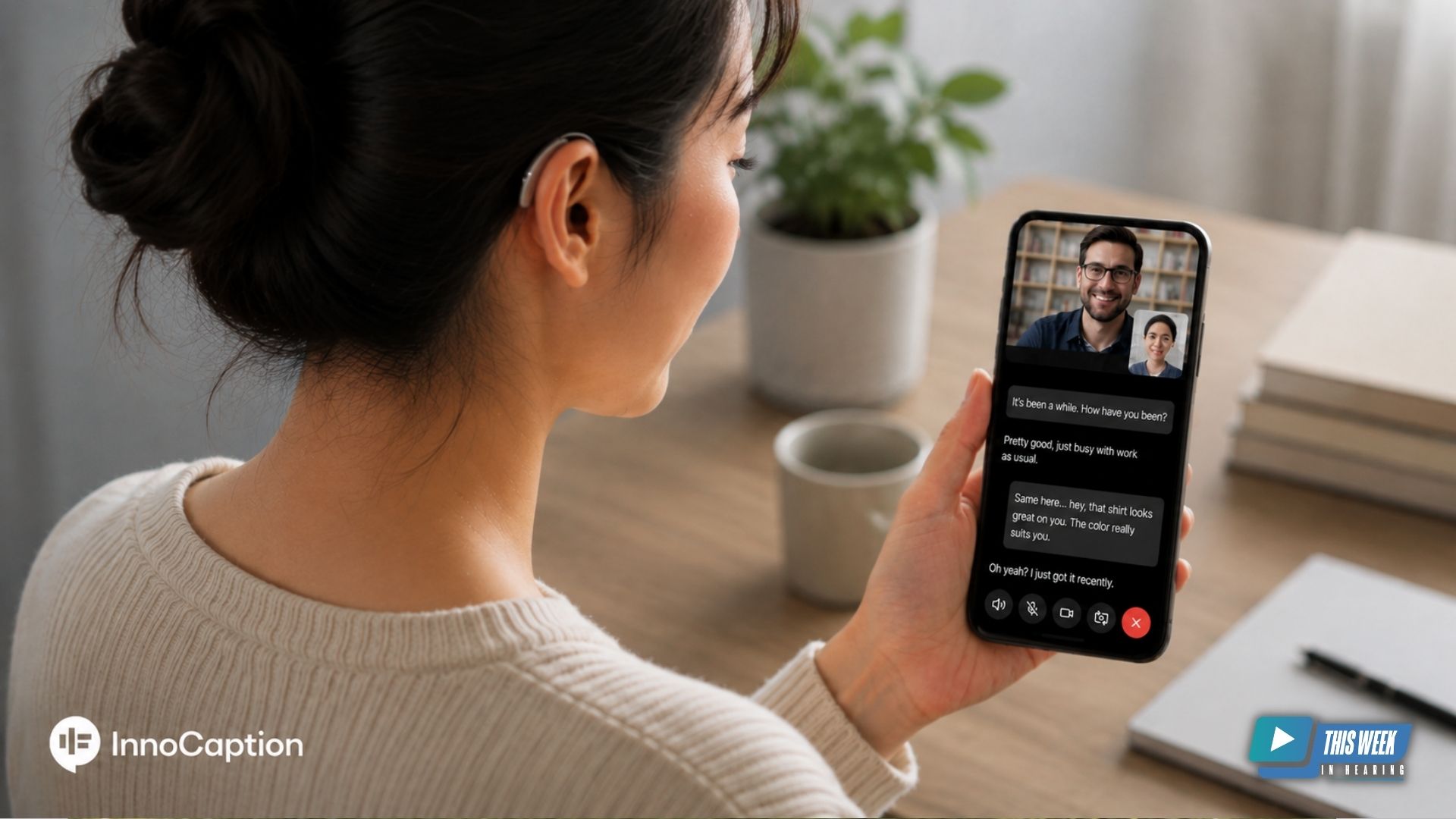
Accessible communication technology is advancing rapidly, but building tools that people can truly depend on requires more than simply adding artificial intelligence. Brian Taylor speaks with InnoCaption CEO Paul Lee about the evolution of captioned communication, the company’s milestone of supporting more than 30 million captioned calls, and the importance of keeping users at the center of accessibility technology. Lee also shares the personal story behind his move from finance to InnoCaption and his recent transition into the CEO role as his father, who founded the company, steps back from day-to-day operations.
The conversation examines InnoCaption’s approach to responsible AI, including why users can choose between automated captions and live stenographers and how human support teams continue to train and refine the company’s AI tools. Lee discusses the challenge of designing AI-assisted text-to-speech technology that can make communication faster without taking control away from the person using it.
They also explore lessons from InnoCaption’s acquisition of CaptionMate, the growing role of accessible video calling, and why visual cues such as facial expressions and lipreading remain important alongside captions.
Looking ahead, Lee discusses the broader shift toward captions as a mainstream communication tool and the potential for technologies such as Auracast to expand access to audio in public spaces. Together, these developments point toward a future in which accessibility features are increasingly integrated into everyday communication rather than treated as specialized add-ons.
Full Episode Transcript
Hello and welcome to another episode of This Week in Hearing. I’m your host this week, Brian Taylor, and our topic this week is accessible communication. And joining me to discuss that topic is Paul Lee,
who’s the CEO of InnoCaption. Paul, welcome to This Week in Hearing. It’s great to have you with us. Thank you for having me here, Bryan.
Yeah, so I thought maybe to get things started and to kick things off, I’d like to ask you and maybe tell our audience a little bit about yourself and your company,
Innocaption. Sounds good. So I’m Paul Lee, CEO of Innocaption. I’ve been with the team for 6 years now, and before joining the Innocaption team, I spent over a decade working in the finance and investment industry across New York, San Francisco, Hong Kong, and London. And now I’m based here in sunny Southern California with my wife and two young boys. And at Innocaption, we are an accessibility technology company focused on breaking down barriers to communication. And our main Innocaption app delivers fast and accurate real-time captions for phone calls, as well as advanced text-to-speech features to help people who are deaf, hard of hearing,
or have a speech disability. And we’re certified and funded by the FCC, so our service is free for eligible users in the US. Well, that’s great. And I know that a lot of providers out there rely heavily on Innocaption with their patients. So that’s— thanks for that introduction. I wanted to dive into the questions
I have for you. I know that you stepped into your role as CEO about 10 years ago, and you’ve passed the 30 million mark with captioned calls. Can you tell us why that milestone, what that means to you personally, given your own path into the company? Sure. Oh, and I just wanted to clarify, I’ve been with the company for 6 years, but we’ve marked our 10-year anniversary
for the InnoFaction app launching. Thanks for the clarification. Yeah, yeah, no worries. So yeah, it is a really meaningful milestone for us and for me personally. As I said, I joined the team in 2020 after more than a decade in the finance investment industry. And when I joined the team here, my wife and I both quit our jobs took a pretty big pay cut to join what was then a
bit of a bootstrap startup. But I did it to help carry my father’s legacy forward because he had actually built the company over a decade. And it was something that I wanted to do also because I wanted to find a career path that would let me help people in a real tangible way. And so I wanted to make sure that the technology that my father had spent all of that time building and putting his own savings on the line for would actually be able to help millions of people who are deaf and hard of hearing.
And I wanted to see it reach its full potential. And so the numbers around, you know, 30, over 30 million captioned calls that we’ve been able to service over the last 10 years, it really represents the impact that I believed was possible when I joined the team. And it’s really thrilling to know that what my father has started is actually reaching
people at this scale now. And another big milestone for me personally was that by joining the company, I wanted to provide my father with a path to stepping back from all of the day-to-day, time-consuming operational roles that he had had to, to lead all of these, these years. And so this year, with— by stepping up into the CEO role and my father becoming chairman of the board, it means that I’ve been able to deliver on that goal as well. So again, all in all, a really big personal milestone for us.
That’s great. That’s quite a legacy. I didn’t know it. I didn’t know that. Given your background, I guess I’m curious to know what building accessibility technology has taught you and how does staying close to your users shape the way that you make decisions? Yeah, great question. And for me, the biggest thing that I think it’s taught me is that you can’t build good accessibility technology from a distance. You have to really go in deep,
stay close to users. And I think that’s how I was able to get up to speed on the needs and challenges that our users face every day and help build better technology that can, that can help improve their lives. When I first joined the team 6 years ago, one of the first things I actually did was worked on improving our customer support experience. And so I hired a few interns that summer that I joined, and together we wrote over 50 articles in our new online help center that,
that wasn’t existing before. And I got personally involved in a lot of the complicated support tickets, especially the ones that needed a lot of back and forth with the engineering team, and I think that hands-on work and really getting to engage with our users really helped build the expertise that I needed to then be able to lead the development of our app and products and services and helped me be able to take
a leadership position over time. Excellent. I’d like to ask— get your take on AI. You’ve described InnoCaption as a responsible implementer of artificial intelligence with the human in the loop whenever that’s needed. What does that look like in practice, and what are others getting wrong
about AI and accessibility?
Sure, so we use AI where it really helps our users, and we kind of try to keep that focus. Is this something that’s actually helping our users rather than is it just a short-term
cost-cutting tool or mechanism? And I think two ways that I can illustrate that is one is how we deliver our captioning, our auto— especially our automated captioning. And how we’ve built our customer support function. So when we first launched the InnerCaption app 10 years ago, all of our captioning was done
by live human stenographers. So these are like trained court reporters. And then in 2019 is when we actually introduced fully automated AI captioning. And that sounds obvious now where we sit with all of the proliferation of automated captions. But at the time, a lot of people were actually very skeptical whether the technology could even work for this use case, because a lot of the years prior to that, it really did not perform well in these types of very diverse call settings. And it was really only around between 2020 to 2022, kind of in that time frame, that the speech recognition technology got better and better at a very rapid pace.
And that also then coincided with our users actually adopting it more. So when we first launched the service, and even today, it’s an optional service whether you choose now between fully automated captioning
or a human captioner. And we think that that’s really important because automated captions will always have some weaknesses as well. And that’s where our users can actually hop over and request a live captioner to jump on at any point in the middle of their call or even at the start of the call if they know they want a human captioner for that call. And so we’ve tried to be responsible adopters of new technology in that way where we actually give user’s choice, and we are very upfront around the strengths as well as limitations of new technologies as we roll it out and try to do, as you know, provide the best user experience possible.
And then on the customer support side, what we’ve actually done was we’ve trained the AI agent that we also have available for support for users to be able to chat with in our support channel with as much information as possible. And our support team, our human support team acts as directly as a trainer for that AI agent AI agent as well. And what they’re actually just doing is monitoring and making sure that whenever there’s an issue or a question that they, the human support agents are getting very frequently, they actually then build new responses and knowledge base into the AI agent so that it can actually just deliver faster responses because that AI agent is available 24/7, just, you know, within a few seconds.
And so for a lot of the things that are simpler and more repetitive and very standard, the AI agent is actually able to answer those questions very quickly and very well, leading to a better user experience. And that actually frees up our human support agents to actually tackle the more complicated tickets. And overall, that elevates our overall user experience. And now we’ve gotten to a point where when an AI agent gets involved in a customer support ticket, they’re able to— it’s able to resolve over 80% of the tickets that it’s involved in and actually has a really, really high satisfaction rating amongst our users.
And that’s because it’s not just a one and done, flip the switch on and let it and see what it does. It’s a very proactive approach where our support team, all of our human agents are deeply involved in continuous improvement and refinement of how the AI agent works and then also taking on a lot of the more difficult things that we know
that that AI cannot do. So again, this is another good example of how we are very much user experience focused and making sure we understand both the strengths and the weaknesses of the technology as we roll these out.
Yeah, it sounds like a really smart way to combine human intelligence with artificial intelligence. Next question is about your AI text-to-speech features, including AI Refine. It helps users type less while they’re staying in control of their own words. What was the— can you tell us a little bit about what the design challenge was in building AI that assists
without taking over the conversation?
Sure. So the whole challenge here was building an AI that speeds you up in that conversational flow without putting words in your mouth, where the user remains the author and
the one driving the conversation. And so our text-to-speech features help users who don’t voice or have a speech disability. And AI Refine, the point of that, that feature is so that the human user can actually type a few words and it helps convert those few words into a fully formed sentence that actually fits the conversational context of what’s being said back and forth. And it took a lot of experimentation to get that right because it’s really about trying to make sure that the AI is helpful without just kind of going off and generating its own ideas and really sticking to what the user is guiding.
And what the user’s intent is and where we feel like we’ve landed at a spot that strikes a really good balance where people have said, you know, we’ve had deaf users say, oh, I can actually now type like I might
want to communicate in ASL. And actually it helps put it into English-spoken grammar much more quickly and makes it easier for me as well. We’ve had other cases of people being able to just quickly guide with a few words pretty complicated, complicated flows of conversation because it actually is using the context of what was already spoken or, or typed in the, in the past in that conversation as well. And so in a lot of ways, you know, it took a lot of engineering to get there in terms of testing different language models to see what performed best, to see what outputs felt most natural, as well as which ones were actually, you know, fast and efficient too, because you don’t want people to get held
up in that conversation either. So it was a lot of experimentation, but one that we think is making a real impact for people that need text-to-speech services to be in
the flow of the conversation.
Yeah, it sounds like a lot of thought and energy went into that. One thing I didn’t know was that about a year and a half ago, you acquired— Innocaption, that is— acquired Captionmate,
which is another FCC-certified provider. I’m curious to know, what did that acquisition and integration teach you about protecting continuity of service for the community that depends on it? Yeah, and I think from our perspective, that acquisition was a big success in terms of being able to continue to offer that service and making sure that everything went smoothly through that process of integrating another
provider into our organization. But it was really about not just buying a customer list, but rather protecting a communication lifeline. So CaptionMate was another FCC-certified call captioning provider that was mobile app-based, and the founder was ready to move on at that point when she reached out to us in middle of 2024. And the real risk there was that she didn’t want her users that she had been servicing for and building up the service towards— she didn’t want her users to lose service because they relied on it every day, just like our intercaption users did as well.
And so continuity and keeping that that seamless experience was really important for the founder. And so, you know, and we actually got tested on that right away. The night before we actually completed the deal and actually closed on the acquisition, there was a bug that came up in one of, not in Captionmate’s software, but in one of their vendors. And overnight we actually had to work with their external vendor to not only discover the bug, but actually replicate it and run tests ourselves to help that vendor get through that process.
So we basically pull an all-nighter with our engineering team to make sure that that service didn’t have impact. Luckily it happened at night and so there wasn’t much use and a huge amount of impact, but it was one that if we hadn’t helped stepped in there, it could have led to a lot more
issues down the road. And so we actually ended up resolving that overnight and closing the deal at 6:00 AM the next day on my birthday, actually a coincidence, But it was an experience that really taught us, when we’re acquiring another service like this, we need to go all in as well and make sure that their users don’t lose service and continue to have an excellent experience. And since then, we’ve been able to take over the team and the engineers that were supporting that application and the support function where we’ve rolled out our best practices from the intercaption
experience as well. And you know, what meant a lot to me personally later on was that, you know, the founder who sold the business,
she saw all of that. She saw everything that we did and the effort that we put in as well. And she could tell that we were being a responsible steward of what she had built. And she definitely made a point of telling us how grateful she was that she was able to partner with us and work with us through that experience. And so, you know, I think that whole acquisition also reaffirmed our values of putting our users first, and doing whatever we need to do to make sure that they’re serviced and they have
that communication lifeline.
Yeah, that’s a stressful situation that it sounds like it had a happy ending.
Yeah, luckily,
yes. I know that video is kind of a hot topic these days around these kinds of services, and I know that you have something called InnoCaption Video, I think it’s called. It sounds like a service where you’re trying to extend real-time captioning into video calls. And so I guess I’m curious about that service, if you could tell us about the importance of visual cues, why they’re as important as much as audio, and what gap we might be trying
to close with that service.
Yeah, so many of our deaf and hard-of-hearing users have told us for years, can you help provide captioning for FaceTime calls and video calls like that? Because they prefer video calls, especially with friends and family, because they can see the facial expressions. Read lips, and all of those cues really help
make that conversation easier. That was what was always so challenging about a regular phone call where you have none of that visual cue. But I think a lot of times what we found is that a lot of mainstream video calling platforms don’t really put accessibility at the core of what they do. And so it’s not an experience that’s really
optimized for our user demographic. And so, you know, we’ve heard of issues where the captions were hard to turn on or where they would disappear mid-call. They wouldn’t be as accurate as they would want it to be. And sometimes it would just be an overlaid caption where it was actually covering the
other person’s face or lips. And that kind of defeats the whole purpose of why they really like being able to see the other party, right? To be able to read the lips and see their cues. And so those were the gaps that we wanted to address. And so in May of this year, we launched a new app called InnerCaption Video. It’s a standalone app from our main
InnerCaption phone call app. And what’s nice about this app is it allows you to do that familiar one-on-one video calling experience with friends and family, but it has a built-in fast, accurate caption screen right on the bottom of that screen where it starts off with kind of like a half-screen video and half-screen caption, and you can actually adjust it live in the call to make the captions bigger or smaller and adjust it as you need it. But it’s got that dedicated space, and there’s no toggling. It’s always on.
And so it makes sure that you’re having the most accessible experience possible. And both parties actually see the same captions as well of both sides. And so what’s unique about that is if I’m speaking with someone and I see that my speech is not being captioned correctly because I’m speaking too fast or slurring or not articulating well, I can catch myself and say, “Actually, what I meant to say was this.” And so that way, by self-correcting the captions, it actually de-risks an environment where, you know, people aren’t going to miss important details.
And I think that’s really important as well. And so all of those things really are about solving accessibility for these video calls. And I think that it’s really going to be impactful for our deaf and hard of hearing users. And a lot of the early feedback has
been tremendously positive. And when we demo this live at conferences and stuff, people are really excited to give it a try. And it’s— what’s also nice about it, it works across iPhone and Android devices. So no one is left out in terms
of having that communication. Yeah, that’s really great. I mean I think it’s important for our listeners, our audience, to appreciate just how much work on the technical end, you know, kind of behind the scenes, goes into all this. I think it’s tremendous.
So I wanted to acknowledge all of your technical people and their expertise. I think that sometimes they we forget about all the stuff that goes into this
so that it works seamlessly. That’s right. Thank you. Thank you for calling that out. For my last question, Paul, I’d like you to get out your crystal ball, and I guess I’m curious to know where you think captioning, accessibility, AI, hearing technology, you know, what’s next and what should the industry
be paying attention to? Yeah, and I think great question in terms of just, you know, we’re always thinking about what’s in the future as well. And, you know, when we go to conferences and see different technologies and things too, we’re always trying trying to keep up the speed and also gauge where we think there could be real value for our user community. I think, first of all, from an overarching perspective, I think captions are definitely going mainstream. And I was just reading that over 80% of adults 18 to 24, so younger adults, watch TV with subtitles on, even though only a small percentage of them
actually have difficulty hearing. And so a lot of young folks are getting used to having captions on videos on their phone, on Netflix, wherever it may be. But I think through that, accessibility is becoming a
mainstream expectation. And it’s not something that is going to be as difficult to be able to get accessible in different places through captioning. And so, you know, a lot of studies show that captions improve comprehension, attention, and recall for people that don’t
have hearing loss as well. And so I think a tool that was really built for and hyper-optimized for accessibility can actually now end up helping a lot more people. And I think, I love seeing that accessibility features
appreciated more broadly. And my hope is that it means that it becomes easier to convince more environments, businesses, venues to make things more accessible as well. And I think that second, another kind of along the same lines, but a slightly different take would be, I think Bluetooth technology, there’s going to be a lot of advancements. I think I’ve actually heard some of the other podcast episodes from This Week in Hearing talking about Auracast, And so I’m sure you’re very familiar with it, but I think as that technology matures and gets ingrained into a lot of different devices, whether it’s TVs or audio systems or hearing aids and cochlear implants, as it gets broadly deployed, I think that’s going to be really, really impactful from an accessibility perspective, as well as for broader audience as well.
In our own office, we installed a hearing loop in our main conference room, in our boardroom. And our former co-CEO and now Vice Chairman, Joe Duarte, he actually spent decades having his own business where he was actually installing hearing loop
systems and other accessibility systems. So he actually rolled up his own sleeves, brought some of the gear that he had from those days, and we helped him rip up the carpet and put all the wires
in for the loop system. And, you know, it was really a cool experience to see and see how impactful that can be and how it works behind the scenes. But, you know, it also gave me a great understanding of how difficult and challenging it is actually to roll out these hearing loop systems in all the venues that really need that type of accessibility. And so I think that’s really what makes Auracast so promising, where you can have venues in a much more easy-to-deploy way put in systems that can actually broadcast audio straight to hearing devices, whether that’s even an AirPod, frankly, in the future, as well as, hearing aids and cochlear implants so that more people can actually get that assistance that they need when they’re in noisy environments or if they need that accessibility.
So I think that that’s gonna be a game changer as it gets rolled out. And I think that even for people where English is a second language, it could be really helpful as well. And if we combine these kinds of audio accessibility features with captioning being more broadly available as well, I think it’s gonna make for a
much more accessible world.
Well said. Very insightful, Paul. And my guest today on This Week in Hearing is Paul Lee, who’s the CEO of Innocaption.
Paul, if someone wants to learn more about Innocaption and all the great services that you offer, how can they find that out?
Yeah, so please visit our website at innocaption.com, where you can find all about our services as well. And, you know, if you want to hear more about some of the things that we’re excited about from a technology perspective and things, you can follow our LinkedIn page at InnoCaption or myself, Paul Lee. You can look me up, Paul Lee,
InnoCaption. We’re trying to be more proactive about sharing some of our thoughts and views, especially around AI and what the future holds for accessibility.
Well, look for that.
Paul, thanks again for taking time out of your busy schedule to be with us. Really appreciate it. It’s been a pleasure. Thank you so much, Brian.
.
Be sure to subscribe to the TWIH YouTube channel for the latest episodes each week, and follow This Week in Hearing on LinkedIn, Instagram and X.
Prefer to listen on the go? Tune into the TWIH Podcast on your favorite podcast streaming service, including Apple, Spotify, Google and more.
About the Panel
 Brian Taylor, AuD, is Vice President of Clinical Research & Professional Relations at Neurotone AI and a recognized thought leader with more than 35 years of experience in audiology and hearing healthcare. In addition to his leadership role, he serves as editor of Audiology Practices, is an adjunct instructor at the University of Wisconsin, and contributes regularly to HHTM, where he shares insights on amplification, clinical best practices, and practice management.
 Paul Lee, Chief Executive Officer at InnoCaption. Paul spent the first 12 years of his career in the finance and investment industry, working across New York, San Francisco, Hong Kong and London. Throughout that time, Paul acted as a financial advisor to an exciting accessibility startup founded by his father. Eventually, drawn to this startup’s incredible mission and impressive technological development, Paul joined InnoCaption in 2020 to help grow the team and achieve the vision that Joseph and Joe had laid out for the company.