Welcome to This Week in Hearing. I’m Shari Eberts. Our guest today is Dr. Alison Richard, a senior research scientist in the Yale Anthropology Department, the Crosby Professor of the Environment Emerita, and former Provost of Yale. She studied the ecology and social behavior of wild primates in Africa, Central America, and the Himalayan foothills, but she is most widely known for her research on lemurs in Madagascar, which is oddly what brought us together for the first time. I have always personally been fascinated by lemurs, so when a bucket list trip to the Seychelles and Madagascar became available, I jumped at it—and Alison was one of the study leaders. But on the first day, when she and her daughter sat down at my lunch table, I didn’t know she was the study leader or that we had something other than our fascination with lemurs in common. We both have hearing loss. So thank you, Alison, so much for being on the podcast today. It’s a pleasure, and thank you for inviting me.
Everyone with hearing loss has a story, so I was hoping you could share your journey—when it developed and how it progressed. Around 1991, I started getting tinnitus, and that developed into clear hearing loss. By then I was Provost, so I saw an audiologist and got hearing aids. But they were quite primitive—big, uncomfortable, like galoshes for the ears—and I didn’t wear them. I felt guilty, but in my role people tended to speak very clearly, so it didn’t feel necessary. Years went by, and those hearing aids stayed unused. Later, when I was Vice-Chancellor of Cambridge University, my late husband pointed out that sometimes I didn’t respond to him, and he couldn’t tell if I hadn’t heard him or was ignoring him. That pushed me back to the audiologist, and by then the technology had improved dramatically. I got new hearing aids, and now I wear them all day—I couldn’t live without them.
It’s interesting how often hearing loss is first noticed by someone close to us. Another moment that stood out was when my husband told me I was guessing what people were saying. He said I guessed brilliantly most of the time, but occasionally I was wrong and sounded foolish. That honesty made it clear there was a real issue. It’s true—we often rely on guessing and get good enough at it that we don’t realize when it fails. Now, I can even recognize when others are bluffing in the same way. That ties into a broader issue: people often hide hearing loss out of fear of seeming less capable, but that can backfire. When we don’t acknowledge it, misunderstandings can make us appear exactly how we fear—confused or disengaged. Culturally, hearing loss has carried stigma, unlike something like wearing glasses, but that is beginning to change as technology improves and awareness grows.
In terms of work, hearing loss did have an impact. In the field, studying lemurs, I couldn’t hear their vocalizations or the calls of my colleagues in the forest. Looking back, I realize how much I missed during the years I didn’t use hearing aids. In lectures, I still struggle to hear audience questions, even with microphones. So I address it directly: I tell the audience I won’t hear their questions clearly and have someone relay them to me. It works well, and it sets expectations. Over time, I’ve become more comfortable being open about it. In some contexts I didn’t explicitly disclose my hearing loss unless it was relevant, but I do feel strongly about helping reduce the stigma by being open and practical about it.
That openness really stood out during our Madagascar trip. You handled Q&A so seamlessly and with humor, which made it easier for everyone. Sometimes there isn’t really a choice—you adapt because you have to—but it becomes easier with experience and teamwork. One challenge is that people relaying questions have to summarize them clearly, which is a skill in itself, but overall it works well.
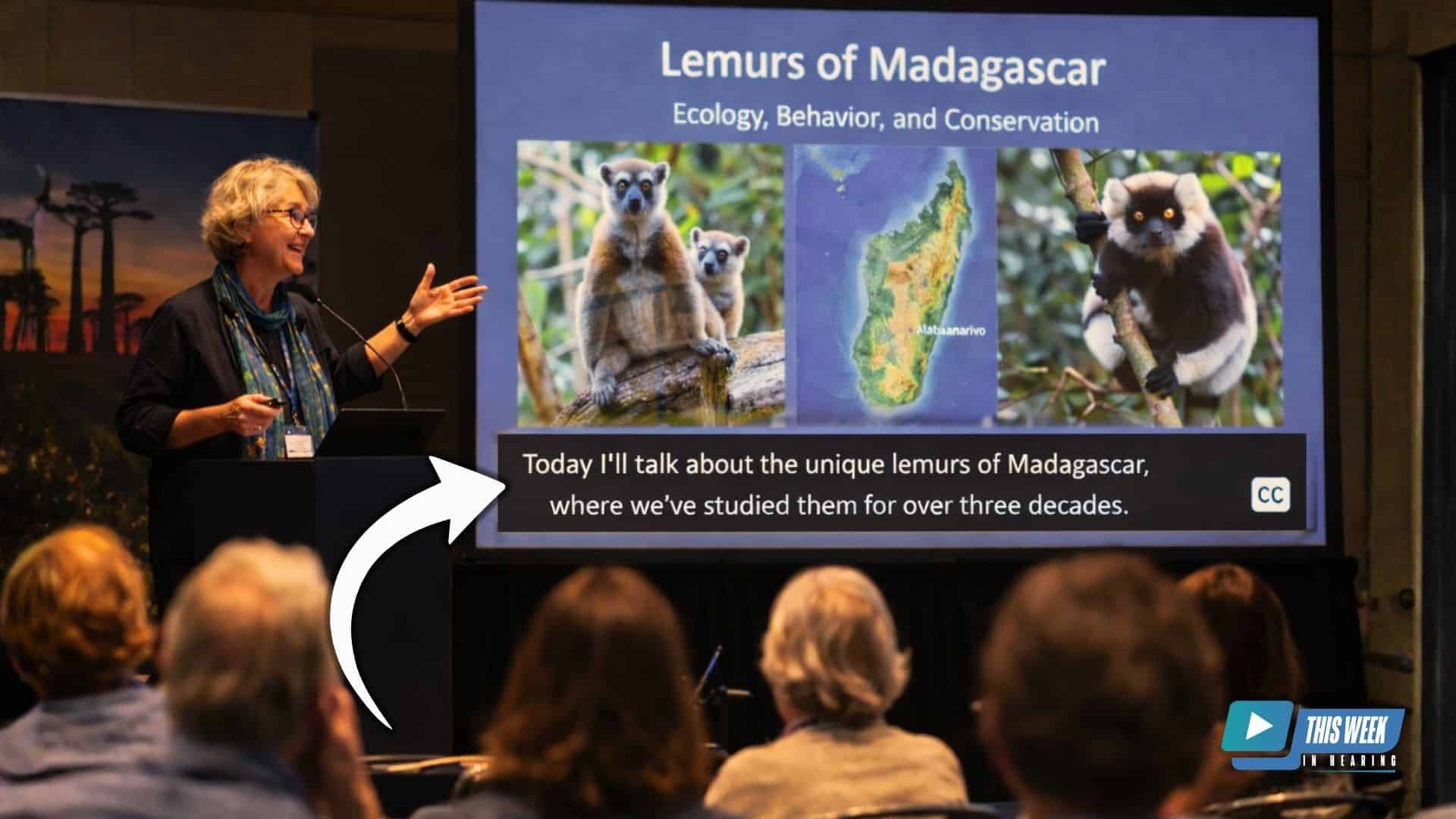
Before the trip, I had asked if presenters could enable PowerPoint captions, since following lectures can be difficult with hearing loss. Everyone agreed, though many were nervous about using the technology. For you, it turned out to be a revelation. It really was—completely transformational. I hadn’t known it was possible and worried it might be clunky or unreliable, but it worked smoothly and added enormous value. It didn’t require me to change much in how I spoke, and it felt like pure upside. Now I always request captions when giving lectures. It’s a simple, powerful tool that benefits everyone, not just people with hearing loss, because it improves comprehension and retention.
That idea of universal benefit reminds me of opera. When surtitles were introduced, I initially thought they would be distracting, but they completely enhanced the experience—even for operas in English. It’s the same principle: access tools often improve understanding for everyone. As for why professors were nervous about captions, it’s likely just unfamiliarity and general anxiety about technology failing during lectures. Still, it highlights how institutions could do more to normalize and implement these tools. There’s a real opportunity to make captions standard in educational settings.
You mentioned advocating for broader use of captions at Yale, and that kind of leadership can create meaningful change. Many students likely have some degree of hearing difficulty, even if it’s not visible, and captions could help a wide range of learners. Whether in live lectures or online settings like Zoom, the technology is there—it’s just a matter of awareness and implementation. Even small barriers, like not knowing how to turn captions on, can prevent people from using helpful tools, which shows how important it is to share knowledge and support one another.
On the Madagascar trip, captions worked well from both sides—as a lecturer and as a participant. They made it much easier to follow others’ talks without being distracting. Placement matters too; having captions above slides can make them more visible for everyone. And of course, the trip itself was filled with incredible experiences. One standout moment was seeing lemurs near Mahajanga. I had been nervous we wouldn’t see any, especially since we were staying near the coast, but then we encountered two white lemurs playing on the ground, completely at ease and close to us. It was magical—not just for the group, but for me personally, as it echoed my early research experiences in Madagascar decades ago. It also sparked reflections on how environmental conditions affect animal behavior, like how energy constraints might limit play in harsher regions.
That moment, along with many others, made the trip unforgettable—not just for the wildlife, but for the people. What could have been an isolating experience instead became inclusive and engaging, thanks to simple accommodations like captions and a supportive group dynamic. It’s a great example of how accessibility enhances experiences for everyone. In the end, the trip inspired two goals: to advocate for widespread caption use at Yale and to learn how to enable captions on Zoom. Small steps like these can have a big ripple effect. Thank you again for sharing your experiences—it’s been wonderful reconnecting and learning from each other.