

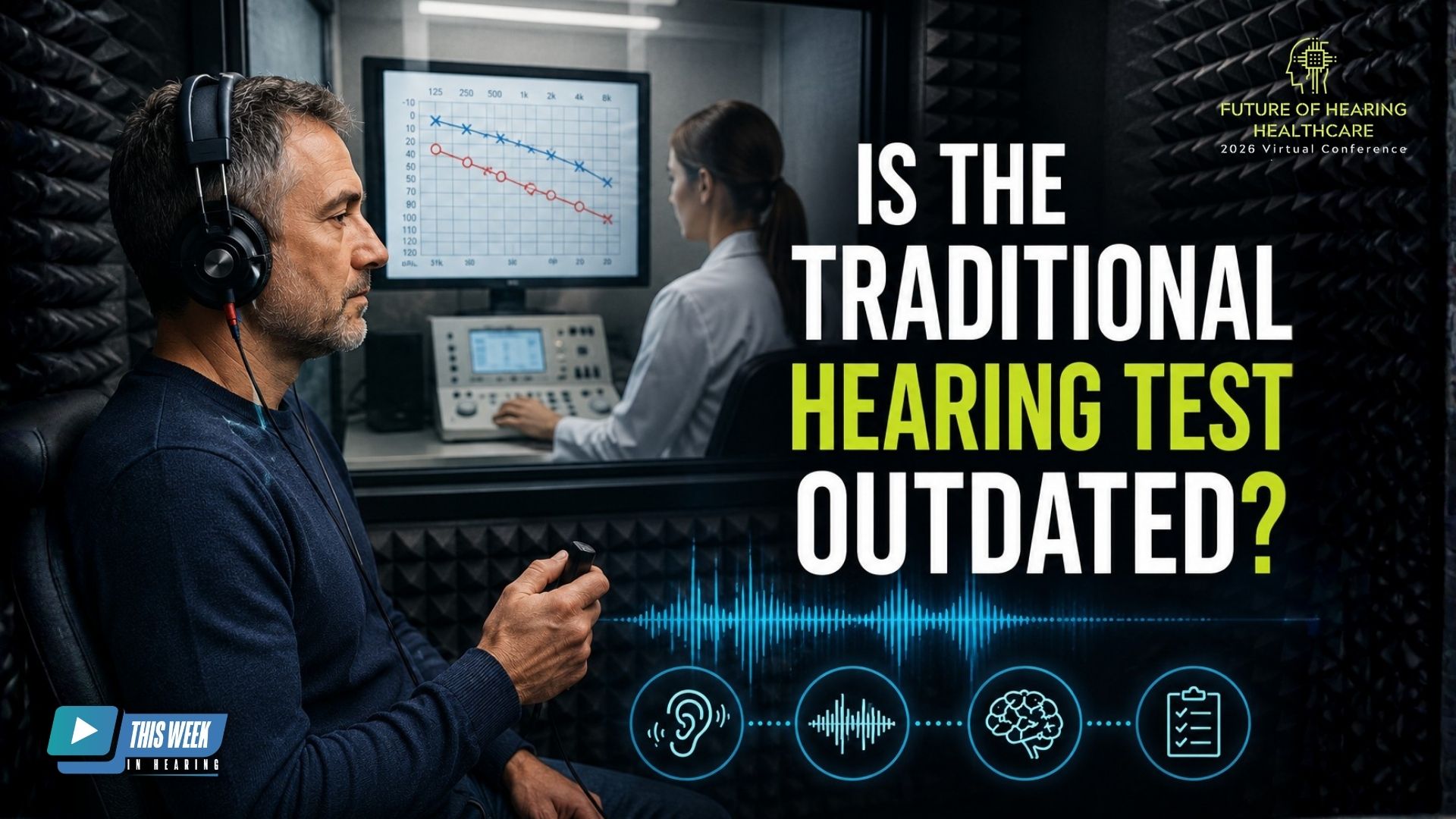
Are today’s routine audiologic evaluations keeping pace with the rapidly evolving landscape of hearing healthcare? In this panel discussion from the 2026 Future of Hearing Healthcare Conference, moderator Dr. Bob Traynor is joined by Dr. Jay Hall, Dr. Frank Musiek, and Dr. De Wet Swanepoel to examine whether the traditional audiologic test battery is still sufficient for today’s patients—or if it’s time to rethink how hearing is assessed.
The conversation explores the growing role of speech-in-noise testing, otoacoustic emissions (OAEs), central auditory screening, teleaudiology, and AI-driven diagnostic workflows, while discussing how these innovations could make hearing care more patient-centered, scalable, and globally accessible. The panel also challenges long-held clinical assumptions and considers how diagnostic evaluations may extend beyond the traditional sound booth to better reflect real-world listening needs.
Whether you’re an audiologist, hearing healthcare professional, student, or industry leader, this discussion offers valuable insights into the future of diagnostic hearing care.

Full Episode Transcript
Welcome to another presentation from the Future of Hearing Health Care. This is our 2026 virtual conference, and we were all asked to kind of put together some interesting topics that we felt very strongly about. And over the years, I’ve had some substantial concerns with how we go about doing our basic audiologic evaluation. And the more I got into the legal component, medical-legal assessments, I have found that we really do need to overhaul this particular type of evaluation, as it’s something we do every day. And it really needs some assessment. So, but you know, we owe a huge debt to the people that preceded us in the profession. People like Harvey Fletcher, who began some of these ideas, and Ira Hirsch from speech audiometry, and a number of others in that area. Probably one of the biggest debts we owe is to Dr. Raymond Carhart, who spearheaded a group of innovative young individuals during World War II to design the 20th century diagnostic testing that we would have all grown to know and love, probably better than we should. Now, you know, you have to think about this a little bit because there were certain needs that were, were necessary during World War II. We had nothing at that time, and the procedures that we continue to use were developed at that point in time. These were the things like the pure tone air conduction and the pure tone bone conduction and the speech recognition threshold, as well as the word recognition scores. And these are 80-year-old evaluations which were designed at the time of Buck Rogers, Space Cadet and Betty Boop cartoons, as well as the car that’s presented here is the type of vehicle that was being driven to the clinic by all of our forefathers that designed these clinics. So today I hope Hope that we can now move to a significant discussion of the outdated basic audiologic evaluation. My first guest is Dr. Jay Hall. Dr. Hall is a professor at Salus University, well known in the area of evoked potentials and otoacoustic emissions. My second guest is Dr. Frank Musiek, who is a professor emeritus from a whole bunch of places, from the University of Connecticut, Dartmouth Medical School, as well as the University of Arizona, and one of our main contributors in the area of central auditory processing disorders. Another panelist that we have today to present a world perspective on the use of an outdated audiologic evaluation is Dr. De Wet Swanepoel from the University of Pretoria in South Africa. So thanks so much for being with me today, guys, so we can talk about this a little bit and move into some perspective. So before we get going, let’s take just a couple minutes to throw out your perspective. We don’t say throw up your perspective, we just say throw out your perspective. So so Jay, can you give us just a couple minutes of where we’re going to talk, what we’re, where we’re going with our discussion today?
Sure, Bob. Well, thanks for inviting me. This is a topic which I’ve been thinking about for many years and acting on and publishing on and also presenting on, and that is the outdated test battery. It’s really quite amazing, and it’s kind of embarrassing if you tried to explain this to somebody in medicine or some other health profession that, that essentially the way most audiologists approach the assessment of a patient today isn’t any different than it was 80 years ago, literally. And I’m not sure why. But in any event, we— I think we need to start focusing on why a person is coming into the clinic and not think about dispensing a hearing aid right away, but first conduct a thorough diagnostic assessment using all the tools that we might need. We can’t say, “Well, this is the test battery you should use on every patient,” because every patient’s different. So the procedures we use and the type of test battery we put together really needs to be based on the patient’s chief complaint and their history. And then that leads us to the tests that are most sensitive and specific for evaluating the type of auditory problem they’re likely to have. I’ll make one point. I actually put this into a little Audiology Online 20Q article in January of 2026. And that is that if you go back to read Raymond Carhart’s original description of the test battery— you mentioned Raymond Carhart, Bob— back in 1946, which ironically was exactly 80 years ago, the whole focus was on finding out who needs a hearing aid. These were usually military personnel or veterans in World War II, as you said, and then determining what kind of hearing aid they might need. The focus was not diagnostic. And Dr. Carhart in some of his early papers said, if your purpose is to find out whether or not this hearing loss needs medical management or further evaluation, if it’s not just for hearing aid assessment, then you should use a totally different test battery. So people obviously haven’t read that article because they’re using this test battery, which is being described for the diagnosis of hearing loss. But in actuality, the test battery is a very simple one to determine whether a person needed a hearing loss with no attempt to differentiate types of auditory dysfunction. So this discussion is long overdue, and I know all of us would like to see this whole area progress so that all audiologists are using a more modern patient-centered approach for diagnosing hearing loss.
So, DeWitt, can you give us more of a world perspective as to where we are with the outdated basic audiologic evaluation?
It’s great to be part of this panel. Thanks, Bob, and thank you, Jay, for setting the stage. I totally agree with what Jay said. You know, we’ve been doing the basic test battery for, for decades now, and we live in an age where there’s so much new technology and advancement that will allow us greater flexibility in the way in which we do audiological assessments. And I think what Jay mentioned is, is really key. The whole idea of setting up a test battery based on the patient’s needs. So my perspective is a little bit more from a public health, maybe global perspective as well. And I think the flexibility of adjusting the test battery for individual patients also should take into account the fact that the rest of the world has very different needs than many of the high-income countries around the world. And here it’s maybe just good to remind ourselves that globally there’s 1.5 billion people who have hearing loss, but 80% of them live in low and middle income countries where the majority of them are not going to be able to get tested in a soundproof booth. The audiologists are far and few in between, and the current basic test battery is not only outdated, but it’s really unscalable into these areas of the world. It requires, you know, the traditional soundproof booths. It requires highly trained specialist personnel. And I think the newer advances in technologies and tests available to us allow us to really rethink the way in which audiological assessments can be done and to really take them maybe outside of booths, take them into communities where people really are at. So it’s really about how do— how can we also decouple the current model about, you know, who should be facilitating the testing, where it’s done, and also what kinds of tests needs to be done. And I think there’s a a lot of interesting things and variations and changes that we could kind of touch base on later on throughout this discussion.
Great. Thanks, De Wet. The last but not least here in our just orientation is Dr. Frank Musiekk, who has been quite vocal in the area of Central Auditory Processing Disorders and and maybe including that into our basic evaluation to some degree. So can you just give us a snippet here, Frank, as to what your comments are going to be?
Yeah, thank you, Bob. And I want to say that I’m most happy to be here today and to talk with Jay and De Wet about, I think, a very important aspect of advancing audiology from somewhat of a stalemate over many, many years And I wanted to pick up on, Bob, your comments at the outset in terms of kind of the history of audiology. And I want to mention, if I could have maybe just my first slide there, if you can put that up, Bob, is that possible? Sure. Because the first opportunity, or I should say the first situation which I see is rather interesting in expanding the basic audiological evaluation, actually came from back in 1954 when Ettore Boca and his people, colleagues, looked at the pure tone audiogram and they said, we have a group of patients here for which they have a normal pure tone audiogram, in their hospital, and yet they complain of considerable auditory deficits. And with that, Bokeh and his colleagues expanded what they were doing, which was at that time mostly some of them doing Bekeshe audiometry, but mostly, you know, pure tone thresholds. They expanded it into some other kinds of tests, better look at these individuals that seem to have not otologic problems, but neurological problems. And these people, patients, were the ones that had complaints, but interestingly, for the most part, had normal audiograms. So that’s kind of the route that I’m going to take in terms of expanding things. And there are two, two pivotal reports that I want to draw on before I stop here. One is, interestingly, back in 1956, Goldstein published a paper in Neurology, okay, in the journal Neurology, which is still around. And what he showed was a 21-year-old individual that had hemispherectomy. Now think about this for a second. The entire hemisphere of one of the brain was sectioned and hence no auditory cortex. And yet in his report, he showed this individual without one auditory cortex had normal pure tones, hence a glaring weakness of what we’re trying to do. And then later, another pivotal paper by DeBode in 2007 showed— tested 14 individuals with hemispherectomy, all of them having normal pure tone thresholds, all of them having considerable problems in communication. So that’s where I think I’m going to go and try to expand this basic audiological evaluation.
Well, let’s kind of get into this a little more in detail. Now, we’ll begin with Dr. Hall. Jay, you’ve been quite an advocate of a number of particular areas within within checking and cross-checking and all these kinds of things. And so can you give us an orientation to kind of some of your concerns relative to the outdated basic audiologic evaluation?
Thank you. I’m going to refer to a slide as well, and the slide shows a pedestal, and sitting up on top of the pedestal is nothing more than our favorite audiogram. And we have pure tone audiometry elevated to this level that it— where it is just almost sacred. And it’s really a weak test. And I know that Dr. Frank will agree with this. The limitations of pure tone audiometry, when you really look at them critically, are amazing. It’s probably not only a test that we shouldn’t rely on almost exclusively. It’s a procedure that is probably among the weakest of all audiological procedures. Even just starting with the stimulus, pure tones. We don’t listen to pure tones. Nobody comes in saying, “I’m having trouble hearing 3,000 Hz. Could you help me?” And it’s a very limited number of pure tones, and it has very little communication, very little relevance or relation to how a person communicates. So let me just really quickly comment, Bob, on all the progress we’ve made in hearing research and the development of test procedures in the last 80 years, really mostly since the last 50 years or so, since 1970, ’75. We have very, very sensitive, well-studied measures of middle ear function. So we could easily rule out middle ear dysfunction, which is almost unheard of in adults, very uncommon, quickly with that procedure. We have extremely sensitive measures of cochlear function in OAEs. And it’s well known you can have very clear cochlear dysfunction and a normal audiogram. And then of course we have multiple measures of neural function, including central auditory function, which of course can be, as Frank just said, very much abnormal in a person with a normal audiogram. So I think the hardest part of moving forward and making progress is to somehow break this sacred link. It’s almost sacrilegious to say don’t rely on the audiogram, but we can’t. We must move on and at least get beyond the audiogram. I’m not saying don’t throw out your pure tone audiometer, don’t ever perform pure tone audiometry, but look at the bigger picture. And again, I’m speaking from a high resource, high income perspective, but most everything that we’re doing in, say, the United States, now there is technology, there are very— there’s a lot of research on low-cost devices for OAEs, tympanometry, and of course, There’s automated audiometry. So much of what we’re talking about could be implemented in a culturally contextually sensitive way anywhere in the world.
Why, and even boothless audiometry as well.
I think—
I think De Wet’s going to talk about that just a little bit as well. But— and one of the things that you and I ran into as we were doing our medical legal things is is how do we validate an audiogram whenever somebody— when it’s used primarily for some of the compensation things? And how do we actually validate that and know that it’s the right kind of assessment? And of course, there we have to use one of your famous discussions on cross-check.
That’s right. And that’s another very old concept, 1976. So now we’re going back 50 years, which is simple, works. It’s not just for children, of course, for adults. And yet, if you ask most audiologists, practicing audiologists, they are not applying the cross-check principle in their evaluation of patients. And as you say, Bob, with not only forensic audiologic assessments, but really any assessment. There’s no way audiologists not validating the pure tone findings using some type of independent procedure that’s not influenced by cognition, motivation, and language, the factors that do influence a behavioral test.
So I think I’m going to disrupt our order here just a little bit and bring Dr. Musick in here to to tell us all about how we’re missing the boat by not doing any kind of central orientation for each and every patient that we do a basic evaluation on.
Okay, Bob. Well, I’m glad to do that. And again, for— we can throw up my slides. I think one of the big issues that audiologists run into in their basic evaluation that has received has actually quite a bit of attention in probably the last 5 or 6 years, but has been known about for a long, long time, dating back to the ’50s. But the point is, is that audiologists in their everyday practice will run into patients that have all kinds of complaints, okay, in terms of hearing, and yet have a normal audiogram. And there have been at least 6, 7, 8 studies that have documented anyplace between 5% and 15% of individuals that come in for audiograms that in fact have this type of complaint. They complain of difficulty hearing in various types of situations, but a normal audiogram. Now, if in fact— I think I have a next slide there too. The thing that is really kind of striking and gets to what Jay was talking talking about was that Meelings in 2020 presented a huge study. And what Meelings found out, looking at this whole idea of symptoms, auditory symptoms, but normal audiograms, that in 79% of the surveys that they took, these individuals that came in with this kind of profile were turned back out the door without any kind of recommendation. And that’s almost 4 out of 5 that came in and said, I’m having trouble hearing, had a normal audiogram, were sent out the door and said, you’re fine. And of course, and when they looked at these individuals, they were very dissatisfied. that I didn’t learn anything because the audiologist said I had normal hearing and I can’t hear. I have trouble hearing. So the audiogram, and I think Jay alluded to this, does not equate normal hearing. It only gives us information about detection, which is a very basic function in terms of psychoacoustic evaluation. So I think that’s one of the big things that is a factor in terms of what we’re looking at here. And I don’t know, maybe we should talk about this later, but I do have some ideas about how we could expand the basic audiological evaluation to include screening procedures for central types of involvement that we might see in head injury, degenerative disorders like MS, and a variety of other problems that we, that we see. There are some ways that we can be alerted to, you know, central auditory involvement, which is one very important to detect because it could be more than just a benign condition, although often it is, and that is critical. And I think that to ignore this is one of the really big deficits in audiology, and not just here, but as I would speak to De Wet, say, all over the world. The other thing I would talk about is that practically all of the central tests that are done are done suprathreshold. And in fact, you don’t really need to have a sound booth to do the overwhelming majority of these procedures, but rather at least a quiet room. And so maybe later I’ll come back and talk a little bit about these particular screening test procedures. But that’s what I have been trying to convince people about for, I guess, the last 40 years, is that we hear with our brains and not with our ears.
You know, and how many of us have done a routine evaluation in the old days before we knew any better and sent our patients right out the front door again, say, “Hey, you’re okay. Your wife just needs to speak up,” or whatever is going on. And I’ll challenge our audience that they have done that more times than they have really wanted to do so. De Wet, can you give us a little bit of a world perspective on the limitations of basic audiological assessment these days?
Yes, Bob, I can just maybe touch on a couple of points that was raised both by Frank and Jay. You know, I think the booth has come up several times. The booth is a wonderful tool, really important for detailed and in-depth diagnostic audiological testing. So it’s really important for those kinds of assessments. But we also need to think about for which patients is it essential to have a sound booth assessment because it’s also an obstacle. The sound booth means it’s difficult to scale hearing healthcare services because they’re stationary, they’re expensive, they’re not available everywhere in the world. So, so who can we provide services to and what kind of test battery do do we need when we’re providing services outside of an audiological booth? And I think here I like to think of it as a maybe an 80/20 kind of triage model. The vast majority of persons who have hearing loss are adults, first of all, and the majority of those who have hearing loss as adults, vast majority, are going to have sensorineural hearing loss, usually reasonably straightforward. And so that means almost at least 80% of adults with hearing loss are going to have sensorineural hearing loss that probably could be tested and receive diagnostic workups outside of a soundproof booth. They already have a loss. So supra— so you don’t really need to test down to 0 dB or -10 dB. They’re going to have a at least a mild loss in any case. So for that 80%, I think we can think about what does a test battery look like for them outside of a booth. But then of course, we need red flag triggers that can triage those 20% or less of patients that really do need a diagnostic workup that’s going to require a booth, that’s going to require specialist investigations, and also that may include a medical evaluation as well. So that just means, you know, that 20% should be triaged for the specialist services. But I think 80% of people, at least adults with hearing loss, could be serviced outside of traditional test setups with the right kind of test battery. And then maybe just to mention another thing here, as we think about being flexible with who needs what test battery, I think it’s also important to think about for which patients are audiologists absolutely essential to be involved, but for which cohorts of patients could we perhaps utilize automated types of technologies that can be facilitated by technicians or, or community health workers and then perhaps reviewed remotely by audiologists so that we can expand the services into areas where previously it was impossible just because there was no professional and there was no soundproof booth or other equipment available there.
And we’re seeing quite a, quite a rise in the use of audiology assistants also here in the US. And my understanding is that that will probably, once we, once we find that routine component of a practice, we’ll be seeing that expand substantially worldwide, which would support your, your orientation to how we can become a little more valuable to those who can’t get to the clinic and maybe with telehealth. I know Jay in particular is involved a lot with that and so on. So, well, you know, as we move through this, this is almost a rebirth of the audiology profession. We’re seeing ourselves being reborn into a whole new area of not only technology, but, but the, but the use of that technology to help our patients and give us more information about what to do with that patient. So, so, so what would a new evaluation be? So, Jay, could you tackle that first? And we’ll run through our order here and just kind of see what everybody wants to do in terms of a— what would your basic battery be?
Okay, well, I’m going to— I’m not going to just take on the United States. I’m going to take on the world here. Oh, look at you. Yeah, think big.
And that looks— by the way, I have to just say that you’re having a beautiful day there in Maine with that river kind of running
through it. I can’t get rid of this. It’s a nice virtual background, but I can’t get rid of it. I’ve tried. Somewhere I’ve got at least a picture of my bookshelves back here to make it to look a little more professional. But I could envision—
Yeah, the last thing I heard was raining in Maine.
It’s going to be raining in a few minutes, that’s for sure.
Isn’t there something called The Rain in Maine? And on and on and on.
Mostly on the plane. No, that was Spain.
That was Spain.
Oh, Spain.
That’s right. Okay. I’m going to build on what De Wet said. I mean, I can envision, and I’m sure there are some audiologists out there that will be unhappy with these comments, about Otter because they’ll say, oh, he’s trying to get rid of us as audiologists. But I could imagine where you could have a very inexpensive— you could have otoscopy that’s video otoscopy, no audiologist involved, some facilitator takes a picture of the ear, or start with tympanometry, just a very inexpensive $10 almost throwaway tympanometer, which are coming out, and say, okay, this person’s got normal tympanograms, Likely, and it’s adult, so likelihood of middle ear problem is almost zero. So now let’s move in right away to the next level of assessment. Quick OAEs. Take 30 seconds. Another inexpensive device. Oh, there are no OAEs. So there’s no middle ear problem and no OAEs. That must be a sensory problem. So as De Wet said, they’re pretty straightforward cases, most of them. So now most audiologists say, oh, well, we need the audiogram. I’d say nope. Don’t need the audiogram. You can use Speech Perception in Noise test. They can be done with a smartphone. You could have automatic scoring. And that’s what you really want to know. How well does the person perceive speech in a challenging environment the way most people are going to be— find themselves listening and then go from there in terms of of management. Now, we haven’t talked about AI. Maybe, maybe we shouldn’t, but when it comes to making diagnostic decisions and putting together test results, I’m sure that there are AI strategies that work just as well as the average audiologist. And I’m not saying let’s get rid of the audiologist in this sequence, but why should we be spending our valuable time— and we can’t reach all the patients anyway, as DeWitt will You’d probably be able to come up with statistics. The vast majority of people in the world who have hearing loss have no access to audiological services. So most of it could be automated, could be much more sensitive than a simple pure tone audiogram. It could be very, very quick. It could be analyzed with AI. And then now you’re narrowing down who really needs the care of an audiologist. But everyone else could be fit. Now we have self-fitting hearing aids. So if the speech perception and noise results suggest that the person does need amplification, there are ways to do that in a very adaptive strategy, very effective strategy that doesn’t involve an audiologist sitting with the patient and running the tests on the hearing aids. So to add real quickly, I’ll wrap up. The most important procedure that’s not being done in my mind in routine audiologic assessment is some measure of speech perception in noise. We all know the most common chief complaint in adults is not difficulty hearing faint sounds, it’s difficulty understanding what people are saying, and particularly in noisy settings. So that’s the one procedure that I would recommend be included in every assessment. And we have plenty of good research evidence in the last 4 to 5 years on the diagnostic value and the clinical value of speech perception in noise. And of course, we have plenty of tests available that could be used.
Well, you know, one of the big things is people will say, “Okay, I’m quiet and everything’s going to work well in quiet, but you know, when I get into a noisy situation, that’s where I really have the trouble.” And guess what we do? We assess them in quiet, correct?
The most quiet setting, an atypically quiet setting with single-syllable words that nobody ever has to listen
to. Ever uses.
Correct. It’s just totally illogical when you think of it.
And then we shorten the list to 25 instead of 50, which most of the standards were done.
So 10 words, Bob.
The 10 most difficult words. That’s my strategy, which exists. So the first word’s the hardest and down to 10. And if they score 90 or above on that, they don’t have a problem. And it takes you about 20 seconds, maybe 25.
Okay, Frank, let’s we’re going for your 2 cents worth now to see how it or maybe, maybe, maybe 95 cents worth or something like that, whatever’s necessary to give us some perspective on what you think might be the ideal test battery for the new basic audiological evaluation.
Well, yeah, thanks, Bob. And I think De Wet’s points are well taken, and Jay’s certainly are also. And I think Jay has kind of put the runway down for me a little bit here because, first of all, Again, I don’t want to belittle the pure tone audiogram. It’s a keystone. I think the problem I see with the pure tone audiogram is it’s just been overinterpreted far more than what it’s capable of telling us. And I think that really needs to sink into a lot of practicing audiologists’ minds. But in terms of the test battery, first, obviously I agree with that. And I think Jay’s comments about the OAEs are good and the acoustic reflex should be in there. And but I would add to all of that, of course, rather than doing speech in quiet— speech in noise, let me bring out a very important point here. And that is way back in 1959, speech in noise was first used as one of the central auditory tests and still can be used. If you see lateral, severe lateral deficits, chances are if you have essentially normal peripheral hearing that there’s something going on further upstream and that will be important. To know. But the thing that I think people need to really think about is some dichotic listening procedures to be added to the basic test battery. And again, I don’t want to toot my own horn, but I think the dichotic digits takes 3.5 minutes to administer. And I don’t know whether I have my last slide up or not, but the sensitivity and specificity to well-documented and proven central auditory deficits associated with symptoms hovers around 70, high 70s to 80%, which is pretty darn good for looking at auditory function of the brain. And again, that investment I think is minimal, and it tests a lot of higher auditory function capabilities of the central auditory nervous system. There also is another test called the dichotic word listening test, which actually came out of the field of psychology, which again is relatively quick to administer, published, originally published by Myers in 2002, that also can lead us, I think, in the right direction to at least maybe check on those people that, that do have problems, come in with a history of head injury, multiple sclerosis, Charcot-Marie-Tooth syndrome, or in these kids that just have problems hearing, like Michael Busse first reported in 1954 with normal audiograms. And then if I may, I want to tell you about some research that’s going on right now with one of my ex-doctoral students at Walter Reed and with Bangart and Ellis from Walter Reed Hospital. They have taken our gaps-to-noise test, which is used quite often around the world. In fact, I would mention to DeWitt, and they have shortened it from about a 15-minute procedure to a 2-minute procedure. And that paper is right now being reviewed. And they call it the QuickGIN. And the QuickGIN takes 2 minutes to administer. And what it does is it focuses on the gaps differentials that are most sensitive to central dysfunction. So I think if people really want to look at evaluating the entire auditory system, which, by the way, way back in 1959, Carhart wrote a paper on saying that if in fact the pure tone audiograms do not correlate with the symptoms of the patient, you need to do something more. And I think with that philosophy and some of these central screening procedures, we can maybe for the first time evaluate the entire auditory system, or at least get some indications whether that patient may be okay or needs to be referred for further evaluation. I think without those kinds of things, we will never quite fill the voids that people complain about in terms of, you know, audiological evaluations. I know when I go to my optometrist, which is interesting, my first evaluation that I get every year is not just for my retina, but also for central visual abilities. And interestingly, That’s just their basic evaluation. And I go through that every year. It’s not just peripheral, but it’s also central because, again, the entire system, we have to be sensitive to the fact that we as audiologists have to test hearing. And hearing does not just— is not just limited to the periphery. It’s limited. It should include the central auditory mechanisms, which we’re learning more and more about, you know, every day. So, you know, I would include some kind of dichotic listening test or possibly this gaps in noise abbreviated procedure called the QuickGIN. Look out for those and start implementing those into your battery. I’ll make one other point. In some research that was done by Hen Huggdahl and from I believe is Sweden or Norway. But, but Ken is a good friend of mine, and he has published a lot of data on central auditory evaluations, primarily dichotic listening. And what Ken did before he retired is he actually put together a dichotic listening test that could be done on your cell phone. And he actually administered that or had people administer it to over 10,000 people. This is not a difficult test to do, especially when you have it abbreviated and it doesn’t need to be done at threshold. And obviously, as Ken showed, it didn’t need to be done in a sound booth and yet can be done quite quickly. So these interpretations are, I will tell you, not easy. But in terms of actually getting basic test scores, Some of these dichotic procedures can be really pared down to be useful and helpful in doing a complete— and I emphasize complete— audiological evaluation. And I’ll be quiet for a while.
De Wet.
Yeah, thanks, Bob. And thanks, Frank, for that really, I mean, interesting additional perspective about the speech in noise. Certainly, really important part of hearing to get that ecologically valid view of how people are actually functioning with what we typically use our hearing for. From my perspective, maybe the best way to kind of end off the recommendation for thinking about adjusting a test battery for community-based testing outside of traditional booth audiometry for the 80% of adults who have straightforward sensorineural hearing loss. I should just maybe share a current model that we’re running in communities, in low-income communities. We work with a foundation where audiologists are critical to the model, but they don’t do the actual testing. So the audiologists are the program managers. They do the training and the supervision, but they also support remotely with telehealth and telemedicine means. But the people who are actually facilitating the services are trained community health workers. So they go into low-income communities to community centers where there’s elderly support groups. And they offer hearing testing with automated audiometry that runs off a tablet or a smartphone. There are many of these types of devices available. They’re simple to operate because they’re automated. So these— they don’t need to be mini audiologists, but they need to just know how to instruct, how to facilitate the testing. And that gives them a quick understanding of whether this person has a hearing loss and do they potentially qualify for, for a hearing aid. They also then do a video otoscopy on the mobile phone. So there are many of these really nifty little video otoscopes that can plug into a smartphone, get a really good image quality. So they use a video otoscope, get a picture of the ear canal and the tympanic membrane that gets uploaded, and the audiologist can then review the pure tone audiometry results and the video otoscopy. Ideally, it would be nice to have tympanometry there also, but at the moment, the model just doesn’t allow us to have a tympanometer there also. But based on that basic, basic test battery, The audiologist can then provide some recommendations back to the community health workers in terms of what next steps to take. If there is wax there, community health workers can be trained to actually remove the wax or provide a simple cerumenolytic for them to use. A speech-in-noise test would be great at this point to use also. Language can sometimes be a challenge for the language-based test. I really like the QuickGin, which is not a language-based test, which I think makes it really applicable across many more sectors. But it means a simple test battery facilitated by someone in the field can then actually either triage that patient to say, no, there’s complicating factors, they need to be sent onwards for more diagnostic testing, or if that’s not the case, they can receive hearing aids right there and then. And that’s actually a model that the World Health Organization has also been recommending. There was a guideline document for this exact model that came out a year ago, and we worked with them on the feasibility study. So the model works. We’ve published on it. The outcomes are really good for these patients as well. And it’s the only way in which they’re really going to be able to access hearing testing and to be able to receive intervention. So that’s just one example of how The basic test battery can be adjusted and used in alternative settings by alternative personnel supported by audiologists.
Thanks, De Wet. You guys are moving very rapidly into the telehealth and teleaudiology kinds of things, and many of our clinics have been moving that way also. Some people even have a day a week set up for their telehealth kinds of appointments. And so I’d like to just kind of open this up now a little bit for everybody to kind of throw things at each other as to maybe we could suggest a tele— not telehealth, a basic audiological evaluation that might be reasonable in time and get us the most information. And as all of you have suggested, I think it’s difficult. We can’t throw out the Pure Tone Assessment because it’s used a lot for hearing aid fittings and some other kinds of information that we, that we need. And often in medical legal situations, we have to have that because that’s the standard. But so So what would be a— so, so a clinic, somebody comes into the clinic and you’ve already done your history would— I mean, we may want to— what I’m hearing is we may want to fine-tune that a little bit around what the history tells us. We may want to do that a little bit around some of the things that are prospective treatments for that particular issue. But what would be a basic one that would that would confirm history, that would, would give us the capability to, to maybe look at where we need to go for further evaluation. Maybe we need to do a, a evoke potential. Maybe we need to do a full central auditory battery. Maybe we need to try to figure out how we would use, say, Boothless Audiometry in, in the telehealth program. So what would be kind of cool would be for some senior people and someone with a world perspective to come up with, how am I going to do my evaluations and I’m going to do them brand new now? So how would we do that? So let’s— who wants— somebody just wants to start.
We’ll just kind
of— let me start off. Jay wants to start.
I can’t resist.
Okay.
If I were if I were starting a practice nowadays, 2026 I would not necessarily have a sound booth but have a quiet room. I would want to look at the history. By the way, I’d want the patient to complete the history on my website and download a PDF. So, I mean, if I wanted to, the night before I saw the patient, or certainly that morning before I ever laid eyes on the patient, I I could be thinking about how I wanted to approach this patient. And I would put a lot of weight into the person’s chief complaint in history, not just audiological or hearing history, their health history. Do they have diabetes? They have cardiovascular disease, kidney disease, COPD, whatever it might be. And I would know, I’d have a pretty good idea of what their risk for different types of auditory dysfunction was from the middle ear all the way up to the, cortex. Then they come into the clinic. I would greet them. I would confirm the history, verify, maybe ask a few more questions. I would turn them over to an audiology assistant or technician, somebody who either I trained or somebody else had trained. And I’d say, okay, this patient looks pretty straightforward. I’m not expecting a middle ear problem. I’m expecting a sensory hearing loss. It may be age-related. It may be related to one of these comorbid conditions that we’ve identified. And I’d say to the assistant or technician, do tympanometry. I like Frank’s idea. I’m a big proponent of acoustic reflexes. Acoustic reflex, if it was a child, probably broadband noise stimulus. And then if the tympanogram’s normal, go straight into the quiet room and get them hooked up for automated audiometry. And That could be air only, air-bone. Meanwhile, I’m working with the next patient because I’ve got another audiology assistant ready to go. So that first patient started, and then I’m going to come back to that patient once we see what the results are and go from there. If they’ve got cardiovascular disease, if they’ve had a head injury, if somebody’s worried about their cognitive function, their memory, etc., I’m going to include probably dichotic digits. Because as Frank said, I’ve used it many times for screening even. And the nice thing about dichotic digits, if you’ve got somebody who’s not a native English speaker, what’s the first thing they’ve learned in English? The numbers. So I don’t, I think, I don’t know, maybe Frank, you know about this, but if you took people that spoke 10 different languages and had them all, maybe had 10 people in each language group, had them all participate in dichotic digits, listening test, my guess is you wouldn’t see much difference between the groups if they were all normal. So I would then, if there’s a risk for central, move toward dichotic digits. The QuickGens, perfect, as Frank and De Wet both have commented. It’s language independent. You can do it anywhere in the world or in the U.S. or a lot of places you have people with different native language speakers coming in, no problem. And now you’ve gone from the cochlea to the cortex And about time, I would say you could do all of this in half an hour or less. And one of the big complaints, Bob, is people say, well, how am I going to get reimbursed? Well, if you’re not doing all of the testing, instead you’ve got an assistant and it’s taking very little time, you know, you’re not wasting much time. So you can model your reimbursement on the true services that only an audiologist could provide. And it would be very important to get a CPT code in the United States or a way of billing where you’re getting paid for an audiologic assessment, period, not for different procedures. So if the more efficient you are, the more you’re getting paid per minute you’re spending with that patient. I could evaluate a patient in less than half an hour and get probably far more information than the average audiologist who’s doing air conduction. Bone conduction, SRT, word recognition quiet. I’m not even doing most of those tests, and I guarantee you at the end of it all, I’ll say, this is what the person’s problem is. They need to be referred here, or maybe we can take care of it. But it’s, it’s going to be a very good use of test time. That’s what I call value-added test, which part of one part of that one criteria of a value-added test. It’s very
very efficient. It gets you the information you need very, very quickly. So that’s my ideal world. My next audiology career, that’s what I’ll do.
Okay, well, let me know when you start that, will you? I want to walk through the same window that you walk through, Jay. So, Frank, what would be your ideal evaluation?
Okay, Bob. Well, I want to make a couple of comments first. Not directly addressing that, but I honestly believe, and I’d love to hear what Jay and De Wet have to say about this, but I, after listening this morning, I honestly believe that we have to have perhaps two different kinds of test batteries because I think De Wet’s goals are somewhat different than what mine might be in addressing individuals, I mean countries where we quote unquote are supposed to have advanced, advanced audiology. And I think to try to make one test battery fit DeWitt’s goals and our goals is going to be very difficult to do. But what I’d like to do is simply address, you know, the United States and England and some of these other places that really do have supposedly advanced audiology. But I I wanted to say that out front because I really, really believe we’re looking at two different gears of maybe the same, the same car. So anyway, Jay’s point, or maybe it was De Wet, I don’t know, about history is extremely important. And let me give you an actual case example of why history is so important and why I think audiologists are not well geared to take a neurological history. One, because they’re not trained very well in it. And two, a lot of them are not anchored in disorders and pathology of the central auditory nervous system. And I think we need to gear that up. But let me give you an example what actually happened. And I think it may give a good learning example. I was at AAA meeting. An old friend of mine, audiologist, came up to me, said, oh, by the way, Frank, I want to tell you that I have this patient that— and I get about 3 or 4 of these by email every week, I want to let you know. But he came to me and he said, you know, Frank, this patient, I said, he’s on his third set of hearing aids. And boy, he just— I can’t seem to find anything that works on him at all. And the first thing I said, well, you know, maybe has central involvement, you know, because that’s a distinct possibility. And I asked this audiologist, by the way, who had been practicing for a number of years, I said, did you take any history about any neurological background? And he kind of turned to me and he said, you know, Frank, I really don’t include that. And I mean, you don’t ask him if he’s had any head injuries or mini strokes or any kind of dysfunction that might affect the center? He said, no, he says, you know, I guess I really didn’t ask that. And so here we go. The first lesson is you have to be able to ask the right questions in the history. And it should include not just what we’re used to listening to in terms of peripheral types of involvement, but also any history of neurological disease. Neurological incidents, neurological damage, or learning disabilities that may have hung around for a year or two or for 20 or 30 years with an individual that may have compromised auditory cortex function. So the history is extremely important. And when you get the right history, then I think that’s where you go on. And if I see a relatively clean neurological history, you know, there may not be a need for doing more evaluations in regard to central, but I still think that it’s worthwhile to do a screening procedure. And hence, pure tone audiograms, acoustic reflexes that could be done in conjunction or essentially at the same time as the tympanogram, the OAEs, and then some type of a central screening procedure which I think is really important. But again, so much of this, and I agree with Jay 100%, is dependent on getting an incisive, insightful type of history from the patient. And I think once you get that history, then I think that should and does guide you a lot in terms of what you’re going to do. And I would give a yell out for Jay’s value-added test, I think everybody’s got to think along those lines based on the history. What are the best group of tests that you can do to better get to the actual problem that the patient has? And if you start weighing these tests, a person comes in to me and says, you know, I’ve had multiple sclerosis since I was 28 years old, and, and that started 10 years ago. And right out of the gate, I would say, well, okay, and you’ve noticed a change in your hearing? Well, probably the change in hearing is going to be related to a central dysfunction and not a peripheral dysfunction. So I would go full blast for sure, a screener, and then anticipate that that person is probably going to come back for a full evaluation. But again, I think the focus of taking a good history including peripheral type of questionnaires as well as central types of questionnaires, is the key to this test battery that, again, I would agree with: pure tones, speech in noise, TIMPS, TIMPS and reflexes, OAEs, and then some kind of central screening procedure.
That’s really interesting, Jay, because that’s almost what we came up with at one time or another on one of our blurbs that we were trying to do here and there. And so the other component here that no one’s really suggested yet, and maybe De Wet’s going to do that here shortly, but the high-frequency area, high-frequency audiometry, you know, when a lot of us were trained, that was like a figment of somebody’s imagination. Because we didn’t have transducers that would help us get to those auto-calibrated cents. And so with that added in here somewhere, probably more as a detail thing, once you see the speech in noise as an issue, then you may want to move in there. I think one of the things that we’re hearing from at least the first two colleagues here is that Instead of focusing on a hearing aid history, you focus on their medical history and you focus on the other disorders that they have had and the kinds of things that would fit into an audiological diagnosis. And DeWitt, can you clue us in a little bit how we would do an evaluation in maybe a world format?
Yeah, thanks, Bob. I mean, I think I can only support what Jay and Frank said. I mean, If you think of a more conventional audiological clinic, then I think there’s a lot of innovation there that we could bring about just by front-ending some of the test procedures we have at our disposal. The history is essential, I agree, and a broad history. It would be great to just do that ahead of an assessment. So early online, as Jay mentioned, in a format where you can get a quick summary. But then I think starting off with the objective test measures, right, starting with the tympanometry, maybe a single acoustic reflex, and then a quick otoacoustic emission in both ears. So you’ve done all the objective tests up front, you have an understanding of the middle ear, of the cochlea, but then also of the acoustic pathways in the brainstem. If you have that, and that, I mean, could be done in a couple of minutes, right? You’re off to a great start to make some decisions on which other value-based tests, as Jay mentioned, you want to include. Pure tone audiometry is certainly one of them, but if the tympanometry is totally normal, then bone conduction would be something you could probably just leave out and then proceed with air conduction audiometry and then hopefully a speech-in-noise measure that also gives you an indication of how they’re doing with speech understanding in a little bit more realistic kind of setting. You mentioned extended high-frequency audiometry, Bob, and I think that’s worth kind of throwing in here. That’s also probably speaking to the point of the fact that we can’t get away with a one-size-fits-all approach. If there’s a patient who shows us certain symptoms, maybe also history-wise, Extended high frequency may be a useful tool. We know from some of the more recent evidence as well that extended high frequency audiometry thresholds are actually contributing quite a bit to speech-in-noise understanding in real-world settings. So there’s probably additional information to be gleaned from those measures that could also help with the counseling for those individuals who are struggling particularly with speech in noise. So maybe I would say that about the kind of traditional clinical setting, but maybe just to come back to the public health global perspective, I think there’s also a question to be asked: what’s the minimum test battery that we could use in lower income settings that would still provide us with sufficient information to at least triage patients appropriately for more advanced diagnostic care? And what, uh, and, and those that could just get by with a more basic test battery and the provision of hearing aids to also add value in terms of saving costs from a healthcare perspective. And I think that’s an area where we certainly need more work to be done.
You know, and I think too that these days with many audiology practices rely on the sale of hearing aids to actually make a living. And part of what we’re talking about here, by modifying the evaluation according to history, doing some screening kinds of things for further testing, you know, and Jay, I think you mentioned, or one of you mentioned, that, boy, I’ve really never had a good, Patients say they really never had this good of an evaluation anywhere except for here, wherever that may have been. And I’ve switched to doing a new type of battery in my clinic towards the end of my— well, the last, say, 10 years of my practice. And the idea was that we started with PureTones, then we did bone conduction. This is the beginning of a modification now, guys. And then we went to admittance with IPSIs and contra reflexes, as well as the speech recognition in quiet. But then we also did the speech in noise with the QuickSIN. And then we went to the OAEs. And by the time I did that, I had a huge idea. It may have taken me 7, 8 minutes longer than a routine kind of an assessment where we see people doing pure tone, airborne speech, and that’s it. But the idea was I had a whole lot of information. And now, as technology has been refined, we can actually modify, rule out some of those tests, add in some others that would help us make a, a nice battery. Another day, another time, after some thinking, we could we could do a session where we say, okay, this is my battery and this is your battery and this is the abbreviated battery, and we put it all together into some sort of a, of a, of a screen. Because really the, the first test we do is a screening test anyway. So the idea would be what What would be the tests that we would absolutely, essentially do? I would also like to say that, that just because you don’t get paid for everything in a, in an audiology clinic, from a marketing standpoint, when someone sells you that your test is the most comprehensive, that’s— you get almost as much or more out of that statement and then walking around town telling everybody that than you would from getting paid the full fee for all those services. So do we have some final comments, guys, as we move to kind of our closing component here in our discussion of the outdated basic audiologic evaluation? So Jay, summarize a little bit, and then we’ll move to Frank, and then finally to David.
Okay, well, I would say for the listeners out there saying, oh my gosh, this is kind of really out there and, you know, I’m not sure we should do it, there’s not much evidence for this, I would say quite the contrary. There’s a bit— I’ve been doing this approach, as you, Frank, said, and all of you have said, I’ve started out with tympanometry and reflexes. I added OAEs in the early ’90s when they came along. And always do all of that, the objective tests up front with history. So by the time you get into the sound booth, you pretty much know what to expect. And this has been around, this is essentially the cross-check principle. So this is not new, it’s evidence-based. It’s actually perfectly tailored to this era where productivity is weighted very highly and where you have to be very efficient to make, make a go of it financially. You can’t be wasting time on procedures that aren’t going to pay back in any way. So I think it’s, it’s time to make the move in there. And it’s, and it’s a question of just convincing people that they, they need to, to make the change. However that might be done. Frank.
Well, I would go back to Carhart and some of his comments and say, as audiologists, we need to evaluate the entire auditory system. And I think to do that, we need to step up a lot in terms of looking at the central auditory function, what I’ve termed for years neuroaudiology, because the incidence and prevalence of a lot of those neurologically-based disorders is far more than most audiologists comprehend. And so I think that’s important. And I will mention one other thing is we did kind of an informal question and answer and survey. But I think what we found out, I want to relay, and that is most audiologists, if you confront them with what we’ve just talked about today, that is including what actually used to be an old test battery, OAEs, acoustic reflexes, everybody did them. When I graduated, everybody was doing acoustic reflexes. They didn’t have OAEs yet, but, you know, they were all doing that. And even including a central test. When I confront a lot of audiologists who are practicing and I say, you know, do you think that’s worthwhile? The overwhelming majority of them say, yeah, we should do it. But then they don’t really do it, whether it’s financial pressures or what it is, they all agree this is kind of the way to go, but yet we don’t get the penetrance in terms of, at least in the United States, of people really picking up on it, although it is changing. And I think that’s a good sign. So I think, again, we just have to think of the entire auditory system and the best way to help people with these various kinds of hearing losses realize what the problem is and then appropriate referrals or mechanisms to help them. And I just don’t believe that we can continue the field of audiology and say we are the experts without looking carefully at evaluating all of the parameters of the central auditory nervous system. And I’ll leave it at that.
DeWet?
Yeah, so not much else to say. I think we’ve made it clear that, you know, we can’t have a one one-size-fits-all approach. We need to look at each patient individually. But I think it’s an exciting time. There’s so much innovation around and there’s so much we can do differently, faster, quicker, tailored to individual patients that can really add value to those individuals. And I think that’s in our traditional kinds of settings. But as I’ve also made the case, I think, I think there’s also a massive reach for audiology and expanding the way in which we think, probably thinking outside of the booth to really see how do we take hearing healthcare to people in ways that make sense, that’s defensible, that’s evidence-based. And I think there’s such a lot of impact to be gained there to really make hearing healthcare an accessible health intervention and diagnostic field. So I think there’s a lot to be gained, and I’m excited for audiology in terms of what can be done.
Well, great stuff, guys. Thanks so much for being here. I just would like to say that to all of you out there, listening to us, hopefully you can make some changes in the way your practice operates. You can tell us what works and what doesn’t work, as well as, as we move here in the U.S. from just other diagnostic testing level to becoming practitioners These are the kinds of things that we have to contemplate. No longer should we just be the sophisticated hearing aid salesman. We need to become diagnosticians and really see our patients from, from, as, as Frank suggests, is testing the whole auditory system to know exactly what’s going on before we actually consider the treatment of those those issues. Today my guests have been Dr. Jay Hall, Dr. Frank Musiek, Dr. De Wet Swanepoel from South Africa, and I want to thank all of you for being with us today at the Future of Hearing Health Care, and we hope you enjoy your virtual conference.
Be sure to subscribe to the TWIH YouTube channel for the latest episodes each week, and follow This Week in Hearing on LinkedIn, Instagram and X.
Prefer to listen on the go? Tune into the TWIH Podcast on your favorite podcast streaming service, including Apple, Spotify, Google and more.
About the Panel
Robert M. Traynor, EdD, is a hearing industry consultant, educator, author, and conference speaker with decades of experience in audiology and hearing healthcare. He has taught and trained clinicians worldwide with a particular focus on hearing rehabilitation, tinnitus management, and clinical practice development. Dr. Traynor serves as Adjunct Faculty in Audiology at the University of Florida, the University of Northern Colorado, the University of Colorado, and the University of Arkansas for Medical Sciences.
James W. Hall III, PhD, is an internationally recognized audiologist with more than 40 years of clinical, teaching, research, and administrative experience. He currently serves as Professor (part-time) at Salus University and the University of Hawaii, holds numerous adjunct and visiting professorships, and is President of James W. Hall III Audiology Consulting LLC. Dr. Hall has authored more than 150 peer-reviewed publications and several leading textbooks, with expertise spanning electrophysiology, auditory processing disorders, tinnitus, hyperacusis, and tele-audiology.
Frank Musiek, PhD, is a renowned hearing researcher, scholar, educator, and clinical audiologist whose work has significantly advanced the understanding of central auditory processing and the neurophysiology of hearing. His research has led to the development of several widely used clinical tests for assessing the auditory brainstem and central auditory pathways, many of which remain foundational in clinical practice today. Dr. Musiek has authored more than 140 peer-reviewed publications, nine books, and dozens of book chapters, and is internationally recognized as a leading authority on the human auditory system.
De Wet Swanepoel, PhD, is Professor of Audiology at the University of Pretoria and Adjunct Professor in the Department of Otolaryngology–Head and Neck Surgery at the University of Colorado School of Medicine. His research focuses on digital technologies, innovative service delivery models, and expanding access to ear and hearing care through telehealth and scalable solutions. Dr. Swanepoel has published more than 280 peer-reviewed works, serves as Editor-in-Chief of the International Journal of Audiology, directs the WHO Collaborating Centre for Prevention of Deafness and Hearing Loss, and is Co-Founder of hearX Group.