



By Dr. Jennifer J. Gans
When tinnitus first appears, the brain often reacts automatically. A sound is noticed—ringing, buzzing, or humming—and within seconds the mind begins to interpret it.
What is that sound?
Is something wrong?
What if it gets worse?
These thoughts are not unusual. The brain is designed to detect potential threats, and anything unfamiliar in our sensory world naturally draws attention. But over time, many people discover that the real difficulty with tinnitus is not the sound itself—it is the habitual reaction to the sound.
Learning to shift from a tinnitus reaction to a tinnitus response can dramatically change how the sound is experienced.
The Difference Between Reaction and Response
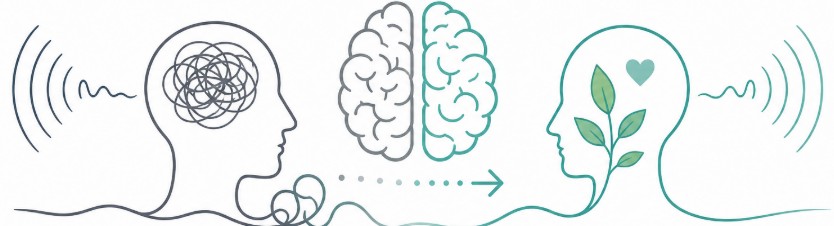
A reaction is automatic. It happens quickly and often without awareness. When the brain reacts to tinnitus, it can trigger a familiar loop:
- The sound is noticed
- Anxiety increases
- Attention locks onto the sound
- The brain monitors it more closely
This cycle can make tinnitus feel louder and more intrusive. The brain begins treating the signal as something important that must be watched.
A response, on the other hand, includes a moment of awareness. It creates space between the sound and what happens next.
Instead of automatically reacting with fear or frustration, a person can pause and ask:
“In this moment, how can I help myself?”
That small shift—from reacting to responding—creates choice.
Awareness: The First Step
The ability to respond rather than react begins with awareness.
Many tinnitus reactions are simply old neural habits. The brain has learned a pattern:
Sound → worry → monitoring → more distress
But habits cannot change unless they are first seen clearly.
When someone becomes aware of their automatic reactions—fearful thoughts, tightening in the body, constant checking of the sound—they begin to recognize that these responses are not inevitable. They are simply patterns the brain has learned.
Awareness opens the door to change.
Stress and the Tinnitus System
Stress plays an important role in how tinnitus is experienced.
When the nervous system is under stress:
- Attention becomes more vigilant
- Threat detection increases
- The brain monitors internal sensations more closely
In this state, tinnitus often feels louder and more bothersome.
When the nervous system is calmer, something very different happens. Attention softens, vigilance decreases, and the brain becomes less interested in monitoring the sound.
This is why many people notice that stress increases tinnitus bother, while relaxation decreases it.
Meditation: Tuning the Orchestra
Meditation can be a powerful tool in shifting from reaction to response.
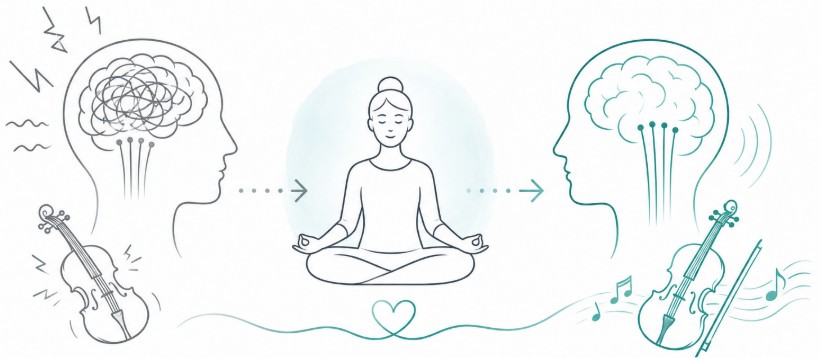
One way to think about meditation is as tuning the orchestra of the brain.
Imagine a violin whose strings have been tightened too much. When the strings are overly tight, the instrument plays sharp and tense. The music loses its richness.
A vigilant nervous system behaves in a similar way. When the brain is constantly on alert, its “strings” are pulled tight and the system becomes reactive.
Meditation helps gently loosen those strings.
Through practices that cultivate attention and relaxation, the nervous system begins to settle. The orchestra of the brain starts to tune itself. From that place of balance, something remarkable becomes possible:
choice.
Creating Space for a New Response
When the nervous system is calmer and awareness is present, the mind gains a small but powerful pause.
In that space, we are no longer trapped by old habits.
Instead of the familiar reaction—
“Oh no, the tinnitus is bad now. What if it keeps getting worse?”
—we can respond with curiosity and care:
“In this moment, how can I help myself?”
- Perhaps the answer is to take a slow breath.
- Perhaps it is to gently shift attention to another activity.
- Perhaps it is to remind ourselves what tinnitus actually is: a benign internal signal the brain has mistakenly tagged as important.
Over time, these responses begin to form new neural habits.
Making Response the New Normal
The brain is remarkably adaptable. With repeated practice, new patterns can replace old ones.
What once triggered anxiety can gradually become neutral—or even boring—to the brain.
Three elements are especially helpful in this process:
- Accurate education – understanding what tinnitus really is
- Reduction in anxiety – creating space, choice, and freedom to respond
- Consistent stress reduction – practices like meditation that help tune the nervous system
Together, these form a powerful foundation for change.
From Tension to Music
When the strings of a violin are tuned properly, the instrument can produce beautiful music. The same is true for the nervous system.
When the brain is overly tense and vigilant, tinnitus may dominate attention. But when the system becomes balanced—when awareness replaces reaction and calm replaces fear—the brain can return the sound to the background of awareness.
The goal is not to fight tinnitus, but to change our relationship with it.
And that change begins with something simple yet profound:
The moment we notice our reaction…
pause…
and choose a response instead.
About the Author
 Jennifer Gans, PsyD, is a clinical psychologist based in San Francisco and a leading international voice in tinnitus and hyperacusis care. She has spent decades helping individuals understand and change their relationship to tinnitus—transforming it from a distressing, intrusive experience into a neutral, manageable one.
Dr. Gans is the founder of MindfulTinnitusRelief.com course, home of the first comprehensive, self-guided 8-week program designed specifically to reduce tinnitus distress at its source: the brain’s interpretation and the nervous system’s response.
Her work integrates cognitive behavioral principles with mindfulness-based training to address what actually drives suffering—anxiety, vigilance, and physiological arousal. She teaches a clear, practical model: the sound is real, but it is not dangerous, and the brain can learn the difference.
Dr. Gans trains physicians, audiologists, and researchers worldwide, bringing a missing piece into tinnitus care: precise education combined with actionable skills. Her approach does not promise to eliminate the sound. It shows people how to stop being controlled by it.
More articles by Dr. Jennifer Gans:
Bothersome Tinnitus: When the Brain’s Natural Cancellation System Fails · The Importance of Tinnitus Education · When the Brain Turns Up the Volume: Understanding Hyperacusis and Predictive Failure · Making Tinnitus Boring to the Brain · Tinnitus: When Nothing Is Broken—but Everything Feels Wrong · Tinnitus, Caffeine, and Salt: Understanding What Really Changes Tinnitus · What Makes Tinnitus Unique in Medicine · Tinnitus Can Co-Exist with Other Disorders, but the Signal Itself Is Always Benign