



By Dr. Jennifer J. Gans
When the Brain’s Sound System Is Disrupted
Tinnitus—the perception of sound without an external source—is commonly described as ringing, buzzing, or humming in the ears. While tinnitus is often associated with hearing loss from aging or noise exposure, it is also frequently reported after traumatic brain injury (TBI). In fact, tinnitus is one of the most common sensory symptoms following concussion and other forms of head injury.
Understanding why tinnitus occurs after traumatic brain injury requires looking not only at the ear, but at how the brain processes sound.
The Brain Is Central to Hearing
Many people think of hearing as something that happens primarily in the ear. In reality, hearing is largely a brain process. The ear collects sound information and sends it to the brain, but it is the brain that interprets and gives meaning to those signals.
After a traumatic brain injury, several parts of this system can be disrupted. Even when the ear itself is structurally intact, the injury may affect:
- the auditory pathways that carry sound signals to the brain
- the auditory cortex, where sound is processed
- attention networks that determine what we notice
- limbic circuits that regulate emotional responses
When these systems are disrupted, the brain’s normal balance between incoming signals and internal neural activity can change.
Why Tinnitus Can Appear After Head Injury
The brain relies on steady sensory input from the ear. When that input changes—even slightly—the brain may attempt to compensate.
After traumatic brain injury, this compensation can occur in several ways:
- the brain may increase its sensitivity to auditory signals
- neural circuits may become more excitable
- communication between brain regions may become less efficient
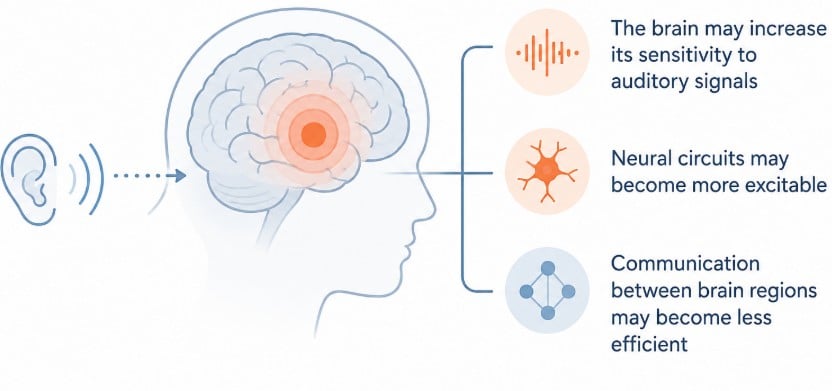
How the Brain Creates the Perception of Tinnitus
When the brain turns up its internal “gain” to search for missing or altered input, neural activity that would normally remain unnoticed can become perceptible. The brain essentially begins noticing its own internal auditory signals.
That perception is tinnitus.
Why Tinnitus After TBI Can Feel So Distressing
For some individuals, tinnitus after traumatic brain injury becomes more than just a sound. It can become a source of anxiety, frustration, or difficulty concentrating.
This often occurs because tinnitus interacts with brain systems that are already sensitive after injury.
Traumatic brain injury can affect:
- attention and concentration
- emotional regulation
- sleep patterns
- stress response systems
When the brain is already working harder to regulate these systems, an unfamiliar internal sound can be interpreted as something important or threatening. Once the brain labels the signal as a potential threat, attention naturally locks onto it.
The more the brain monitors the sound, the more noticeable it can become.
The Brain’s Ability to Adapt
Fortunately, the brain is highly adaptable. One of its most powerful abilities is neuroplasticity—the capacity to reorganize and adjust its activity over time.
In many cases, tinnitus after traumatic brain injury becomes less intrusive as the brain gradually recalibrates. This process often involves several important shifts:
- understanding what the sound represents
- reducing fear associated with the signal
- allowing attention to move away from the sound
- supporting healthy sleep and stress regulation
When the brain learns that the sound is not a threat, it can gradually move tinnitus back into the background of awareness.
Why Education Is So Important
One of the most powerful tools for people experiencing tinnitus after traumatic brain injury is accurate understanding.
Without clear explanations, the brain may interpret tinnitus as a sign of ongoing damage or danger. This interpretation can increase vigilance and anxiety, which in turn keeps attention locked onto the sound.
When individuals understand that tinnitus is a benign internal signal created by the brain’s auditory system, the nervous system often begins to relax. As fear decreases, attention naturally softens, allowing the brain’s normal filtering systems to return.
Over time, tinnitus may become far less noticeable.
Moving Forward
Tinnitus following traumatic brain injury can be unsettling, especially when it appears suddenly after a concussion or head injury. But it is important to remember that tinnitus reflects the brain’s response to changes in sensory input, not necessarily ongoing harm.
The brain is constantly learning and adapting. With time, support, and accurate understanding of what tinnitus represents, many people find that the sound gradually loses its importance and moves into the background of daily life.
In this way, tinnitus after traumatic brain injury is not only a challenge—it is also a reminder of the brain’s remarkable capacity to adjust, reinterpret, and heal.
About the Author
 Jennifer Gans, PsyD, is a clinical psychologist based in San Francisco and a leading international voice in tinnitus and hyperacusis care. She has spent decades helping individuals understand and change their relationship to tinnitus—transforming it from a distressing, intrusive experience into a neutral, manageable one.
Dr. Gans is the founder of MindfulTinnitusRelief.com course, home of the first comprehensive, self-guided 8-week program designed specifically to reduce tinnitus distress at its source: the brain’s interpretation and the nervous system’s response.
Her work integrates cognitive behavioral principles with mindfulness-based training to address what actually drives suffering—anxiety, vigilance, and physiological arousal. She teaches a clear, practical model: the sound is real, but it is not dangerous, and the brain can learn the difference.
Dr. Gans trains physicians, audiologists, and researchers worldwide, bringing a missing piece into tinnitus care: precise education combined with actionable skills. Her approach does not promise to eliminate the sound. It shows people how to stop being controlled by it.
More articles by Dr. Jennifer Gans:
Bothersome Tinnitus: When the Brain’s Natural Cancellation System Fails · The Importance of Tinnitus Education · When the Brain Turns Up the Volume: Understanding Hyperacusis and Predictive Failure · Making Tinnitus Boring to the Brain · Tinnitus: When Nothing Is Broken—but Everything Feels Wrong · Tinnitus, Caffeine, and Salt: Understanding What Really Changes Tinnitus · What Makes Tinnitus Unique in Medicine · Tinnitus Can Co-Exist with Other Disorders, but the Signal Itself Is Always Benign