

The Independent Hearing Aid Dispenser
 Last week’s post reported on the evolving hearing aid retail landscape, and specifically that of the independent dispenser. Most notably, the emergence of chain retail (such as Costco), the growth of hearing aid manufacturer company owned stores, and the VA has contributed to the 10% decline in independent hearing aid dispensers since 2004, with independents currently selling an estimated 39% of the market unit sales, down from 49% in 2004{{1}}[[1]]The long view: the future of the U.S. hearing aid market. Who gains, who loses, from the slow death of independents, Sanford C. Bernstein & Co., LLC, June 8, 2015[[1]].
The U.S. Hearing Aid Market
It is estimated that the U.S. unit hearing aid market is about 78%* private with the balance coming from the VA (Veterans’ Administration). The division would be slightly greater in favor of the private market if the wholesale value of the hearing aids sold were considered, rather than looking at unit sales (for example, the VA ASP – average selling price is lower than the private market).
Regardless, unit sales drives the market, not the wholesale cost. Hearing aid private unit sales has been growing at about 3-4% per year{{2}}[[2]]Hearing aid sales up 11% in first quarter 2015, The Hearing Review, April 15, 2015[[2]], but most believe it should be growing at a significantly higher rate if the needs of the hearing impaired to be helped by amplification is to occur.
But, where will the growth occur? If independents are decreasing, surely one of the other groups is taking up the slack. But who is gaining in the private hearing aid retail market?
Who is Included in the Private Hearing Aid Retail Market?
The private hearing aid market comprises the following entities:
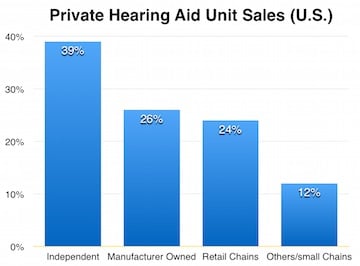
- Independent hearing aid dispensers (estimated at 39% of unit sales – Bernstein, 2015). These are businesses with a single store, or with few retail outlets, owner-operated, and usually run from the store, or from one of the stores if the owner has many. The retailer owns the business and runs it from the ground up, assessing all the store’s needs, including staffing, marketing, merchandising, sales, etc.
This category includes small chains of independents such as Sound Point, Hearing Unlimited, Pattillo Balance and Hearing, and others – with other small chains having generally eight stores or less.
- Hearing aid manufacturer-owned or supplied stores (primarily of the Big Six) and estimated at about 25%* of unit sales. These companies sell their product under the following names:
- Widex alone does not have company-owned stores
- GN ReSound – Beltone
- Starkey – Audibel (independently owned and operated)
- Sonova – Connect Hearing
- William Demant – Avada, Hearing Life
- Sivantos/Siemens – HearUSA
- Retail chains (Amplifon, Costco, store-within-store, etc.) – collectively estimated at 20%* of unit sales
- Buying groups are not percentage projected because their unit sales are generally included in the one of the other hearing aid purchasing categories.
- Direct online/mail order retail
- Pure play Internet retail (Lloyds, Hearing Help Express, etc.)
- Mixed Internet retailers (Audicus, America Hears, Hearsource, etc.)
- Referral Internet retailers (require significant interaction with audiologists).
 No estimate of unit sales is available for these categories, but whatever it is, it will take from the previous percentages. This percentage is thought to be low at this time, but it is anyone’s guess what it is, or its direction.
Projected Directions of Independent Retail Dispensers
Independent hearing aid retailers face pressures similar to other industries:
- Growth of large national chains, or other volume players that use aggressive and innovative marketing strategies to attract consumers to their venue
- Online purchasing resulting in increased consumer comfort related to product selection, free shipping, and ease of purchasing and returns.
- Focus on materials experience rather than on personal experience.
Independent retail is projected to continue to decline unless a way can be found to reverse the trend. Chain retail (store within store) is projected upward, but manufacturer-owned retail is projected to remain at about the same percentage as currently, primarily because many of the small retail chains have already been purchased.
The contribution of small chains to the independent retail market is welcome, but not without a caveat. For example, as small chains grow, they are likely to become the purchase target of larger businesses. In the case of hearing aids, of being a purchase target by a larger, non-independent company, such as one of the hearing aid manufacturers. It is a fact that many current hearing aid manufacturer-owned stores resulted from purchases of both large and small chains of independents.
So, the real losers, at this time, appear to be the independent hearing aid dispensers.
Problems Moving Forward for Independents
- Because of their small scale, independent hearing aid dispensers have little bargaining power with manufacturers who supply them with product, and as a result, find it difficult to negotiate large discounts. Because of this, they may find that competing in market changes is more difficult.
- The growth of independent dispensers is on the decline, regardless of the discipline of ownership (audiologist or dispenser), and shows no evidence of reversing the trend.
- ASP (average selling price) is highest with independents. This is because their operating costs tend to be higher, and must be covered. This can put independents at a disadvantage because of no bargaining power to discount hearing aid purchase price from manufacturers.
- Struggling offices most likely will not survive.
*Percentage estimates are from Bernstein, 2015, with permission.