


For the first time, the World Health Organization (WHO) has included hearing aids among the interventions that may be offered as part of strategies to reduce the risk of cognitive decline and dementia, marking a notable change from its previous guidance.
The recommendation appears in the WHO’s second edition of its guidelines on reducing the risk of cognitive decline and dementia, released in July 2026. The updated guidance reflects a considerably larger evidence base than was available when WHO issued its first dementia risk-reduction guidelines in 2019.
At that time, WHO concluded there was insufficient evidence to recommend hearing aids specifically for reducing the risk of cognitive decline or dementia, although it continued to recommend identifying and treating hearing loss for its established communication and quality-of-life benefits.
The new guidance takes a step further, stating that hearing aids may now be offered as part of dementia risk-reduction strategies.
The recommendation remains conditional, an important distinction at a time when the relationship between hearing loss, hearing treatment and cognitive health continues to be actively studied. Hearing loss has repeatedly been associated with increased dementia risk, but researchers are still working to determine the mechanisms underlying that relationship and the extent to which hearing intervention can alter long-term cognitive outcomes.
Still, the WHO’s decision places hearing care more explicitly within the broader discussion of healthy aging and dementia prevention.
Hearing Loss Joins a Broader Risk-Reduction Strategy
More than 57 million people worldwide are currently living with dementia, according to WHO, with nearly 10 million new cases occurring each year.
The updated WHO guidelines address a range of potentially modifiable factors across the life course, including physical inactivity, tobacco and harmful alcohol use, social isolation, high blood pressure, diabetes, high cholesterol and air pollution. Hearing loss is now included within that broader framework.

The shift follows the influential 2024 Lancet Commission on dementia prevention, intervention and care, which estimated that addressing 14 potentially modifiable risk factors across the life course could prevent or delay as many as 45% of dementia cases.
Hearing loss has received particular attention because it is both common and treatable.
Despite that, hearing aid adoption remains low. WHO has estimated that more than 400 million people worldwide could benefit from hearing aids, while only about 17% use them.
Dr. Jenn Schumacher, an audiologist at ReSound, said the new guidance adds to a growing recognition that hearing health should not be viewed in isolation from other aspects of healthy aging.
“Many people wrongly assume that hearing loss is simply an inevitable part of getting older. Although it becomes more common with age, hearing loss at any stage of life can have consequences that extend far beyond hearing itself.”
Schumacher emphasized, however, that hearing loss should not be described as a direct cause of dementia.
“While hearing loss does not directly cause dementia, the new WHO guidelines add to a growing body of research linking untreated hearing loss to an increased risk of cognitive decline and dementia later in life.”
Evidence of an Association Has Continued to Build
Numerous longitudinal studies now show that people with hearing loss are more likely to experience cognitive decline or develop dementia than people without hearing loss.
One large Norwegian study followed nearly 7,000 people over more than 20 years. Researchers found that poorer hearing measured earlier in life was associated with lower cognitive scores years later, with progressively greater hearing loss associated with poorer cognitive performance.

Another study using data from the Atherosclerosis Risk in Communities Neurocognitive Study offered a somewhat different perspective on the potential population-level impact.
Researchers followed nearly 3,000 adults between the ages of 66 and 90 and estimated that 32% of dementia cases in the cohort could be statistically attributable to audiometrically measured hearing loss.
Importantly, self-reported hearing difficulty did not show the same association. The finding suggested that many older adults may underestimate their own hearing loss and highlighted the potential value of objective hearing assessment.
Population-attributable estimates such as these do not mean that hearing loss causes that percentage of dementia cases or that treating hearing loss would necessarily prevent them. Rather, they estimate how much disease burden might theoretically be associated with a risk factor within a particular population if the observed relationship is causal.
That distinction has become increasingly important as the hearing and cognition field matures.
Why Might Hearing and Cognitive Health Be Connected?
Researchers have proposed several overlapping mechanisms that could help explain the association.
One is increased listening effort. With hearing loss, auditory information can become degraded, forcing the brain to devote additional resources to decoding speech.
Schumacher compares the experience to trying to read incomplete text.
“A good way to understand this is to imagine reading a sentence where the vowels are missing. You can still work out what is being said, but it takes much more effort from your brain. That is essentially what happens with hearing loss. Your brain is constantly working harder to piece together conversations.”
Another possible pathway involves reduced auditory stimulation and changes in the way the brain allocates resources after hearing deteriorates.
Social factors may also contribute. Difficulty following conversations can make social interaction tiring or frustrating, potentially leading some people to participate less frequently in gatherings and other activities.
“One of the most overlooked impacts of hearing loss is social isolation,” Schumacher said. “When conversations become difficult to follow, people can feel tired, frustrated, or embarrassed.”
Social isolation and depression are themselves among the factors associated with dementia risk, making it difficult to separate the different pathways involved.
Yet even these explanations may represent only part of the picture.
A 2026 review of the relationship between hearing loss and cognitive decline concluded that the association is biologically plausible but that no single mechanism adequately explains it.

Researchers have proposed sensory deprivation, increased cognitive load, vascular disease, neurodegenerative processes and shared biological or genetic factors. These mechanisms may also operate simultaneously.
Age may further complicate the relationship. Hearing loss beginning in midlife could contribute to long-term changes that increase vulnerability later in life. In some older adults, however, changes in auditory processing may instead emerge partly as an early manifestation of underlying brain disease.
In other words, hearing difficulty may sometimes act as a risk factor, sometimes as a marker of neurological change, and potentially as both.
Listening in Noise May Provide Another Clue
Recent research has also begun looking beyond the traditional audiogram.
A 2026 longitudinal study of 312 cognitively healthy older adults examined hearing, cognitive performance and MRI imaging over time.
Participants who had greater difficulty understanding speech in noise at the beginning of the study experienced faster cortical thinning over three years in several brain regions involved in speech processing, attention and higher-level cognitive functions.
Pure-tone hearing thresholds, in contrast, did not independently predict the same longitudinal brain changes.
The findings raise the possibility that speech-in-noise difficulty could sometimes reflect changes occurring within central auditory and cognitive networks that are not captured by a conventional hearing test.

Researchers cautioned that the study does not establish that difficulty hearing in noise causes brain atrophy. Instead, speech-in-noise performance may eventually prove useful as one behavioral marker of neurological vulnerability.
That distinction further illustrates why the relationship between hearing and cognition is unlikely to be explained solely by how many decibels of hearing loss appear on an audiogram.
Do Hearing Aids Actually Reduce Cognitive Decline?
This remains the most important—and most difficult—question.
Observational research has frequently found better cognitive outcomes among people with hearing loss who use hearing aids than among those who do not. But observational studies cannot completely account for differences between people who seek hearing care and those who do not, including education, socioeconomic status, access to healthcare, cardiovascular health and other lifestyle factors.
Randomized controlled trials provide stronger evidence but are considerably more difficult to conduct over the many years during which dementia develops.
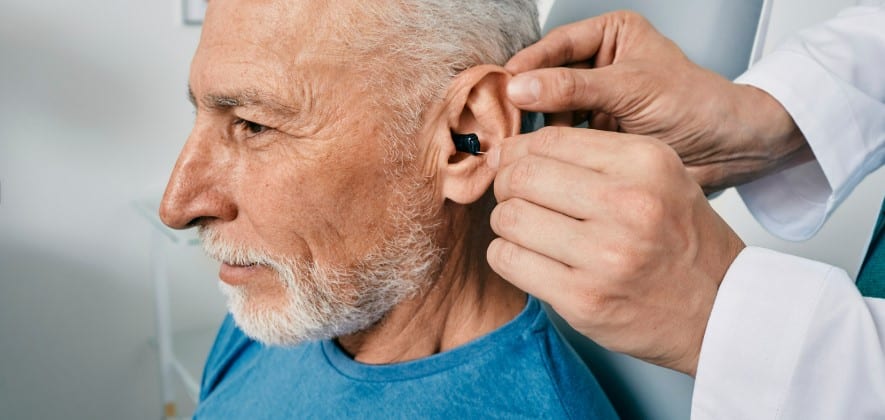
The ACHIEVE trial, one of the most closely watched studies in this area, found no significant difference in cognitive decline between hearing-intervention and health-education groups across its entire study population during the initial three-year follow-up.
However, among participants who entered the study with greater baseline risk for cognitive decline, hearing intervention was associated with a substantially slower rate of cognitive change.
Other smaller studies have continued to examine whether certain groups may benefit more than others. For example, the Treating Auditory Impairment and Cognition Trial (TACT) demonstrated that sustained hearing aid use could be successfully implemented in adults with mild cognitive impairment and found encouraging cognitive signals that researchers said warrant investigation in a larger randomized trial.
Taken together, the findings suggest that the effects of hearing intervention on cognition may not be uniform. Timing, baseline cognitive health, cardiovascular risk, severity and type of hearing difficulty, consistency of hearing aid use and other factors may all matter.
The current evidence therefore supports hearing loss as a meaningful and potentially modifiable dementia risk factor, but it does not establish that hearing aids prevent dementia in an individual patient.

The WHO’s conditional recommendation reflects that balance.
Hearing Care Has Benefits Regardless of Dementia Prevention
There is another important point that can become lost when hearing aids are discussed primarily through the lens of dementia.
The case for treating hearing loss does not depend upon proving that amplification prevents cognitive decline.
Hearing intervention can improve access to speech, communication with family and friends, participation in social activities and engagement with healthcare. For people already living with cognitive impairment or dementia, better access to communication may also help reduce avoidable barriers during medical care and everyday interactions.
“Well-managed hearing loss allows people to reconnect with family, friends and colleagues. This reduces feelings of isolation, which are known to negatively affect both mental wellbeing and cognitive health.”
–Jenn Schumacher, AuD
The increasing emphasis on hearing within dementia research therefore adds another reason to pay attention to hearing health, rather than replacing the reasons that have long supported intervention.

From Association Toward Action
The WHO’s new recommendation represents an important evolution in how hearing care is positioned within healthy aging.
In 2019, there was not enough evidence for WHO to recommend hearing aids specifically as a dementia risk-reduction intervention. Seven years later, the organization now concludes that hearing aids may be offered as one component of a broader strategy aimed at reducing cognitive decline and dementia risk.
That does not establish hearing aids as a dementia treatment, nor does it mean that hearing loss inevitably leads to cognitive decline.
Instead, it reflects how much the evidence base has changed.
Research increasingly supports a close relationship between auditory and cognitive health, while simultaneously revealing that the relationship is more complicated than a simple cause-and-effect model. The next phase of research will need to determine which individuals benefit most from hearing intervention, when intervention matters most, and how measures beyond the traditional audiogram might help identify people at greater risk.
For now, the practical message is considerably simpler: hearing loss is common, frequently underrecognized and treatable. Identifying and addressing it earlier can improve communication and quality of life today—and may prove increasingly important as part of protecting health and function later in life.
Editor’s Note: This article was developed with commentary and source material provided by ReSound and has been expanded with additional research and context.