

Note: “HoH” is a term that some people with hearing loss use occasionally to describe themselves – usually to other HoHs. It’s an acronym for ‘hard of hearing’, a term that ‘hearing people’ (how HoHs describe people without hearing loss) tend to understand. Sort of, sometimes.
(Are you still with me?)
I’ve had hearing loss my entire life. I became a hearing health advocate and a writer/speaker on hearing loss issues, so forgive me for believing that I’ve got an above average grasp on what it means to live with communication challenges. I’ve experienced the barriers and learned how to kick them down. I had, perhaps, become smug about my expertise at being a HoH.
Then, a recent aha moment made me realize there’s always new stuff to learn about, to try out, and to accept and adopt.
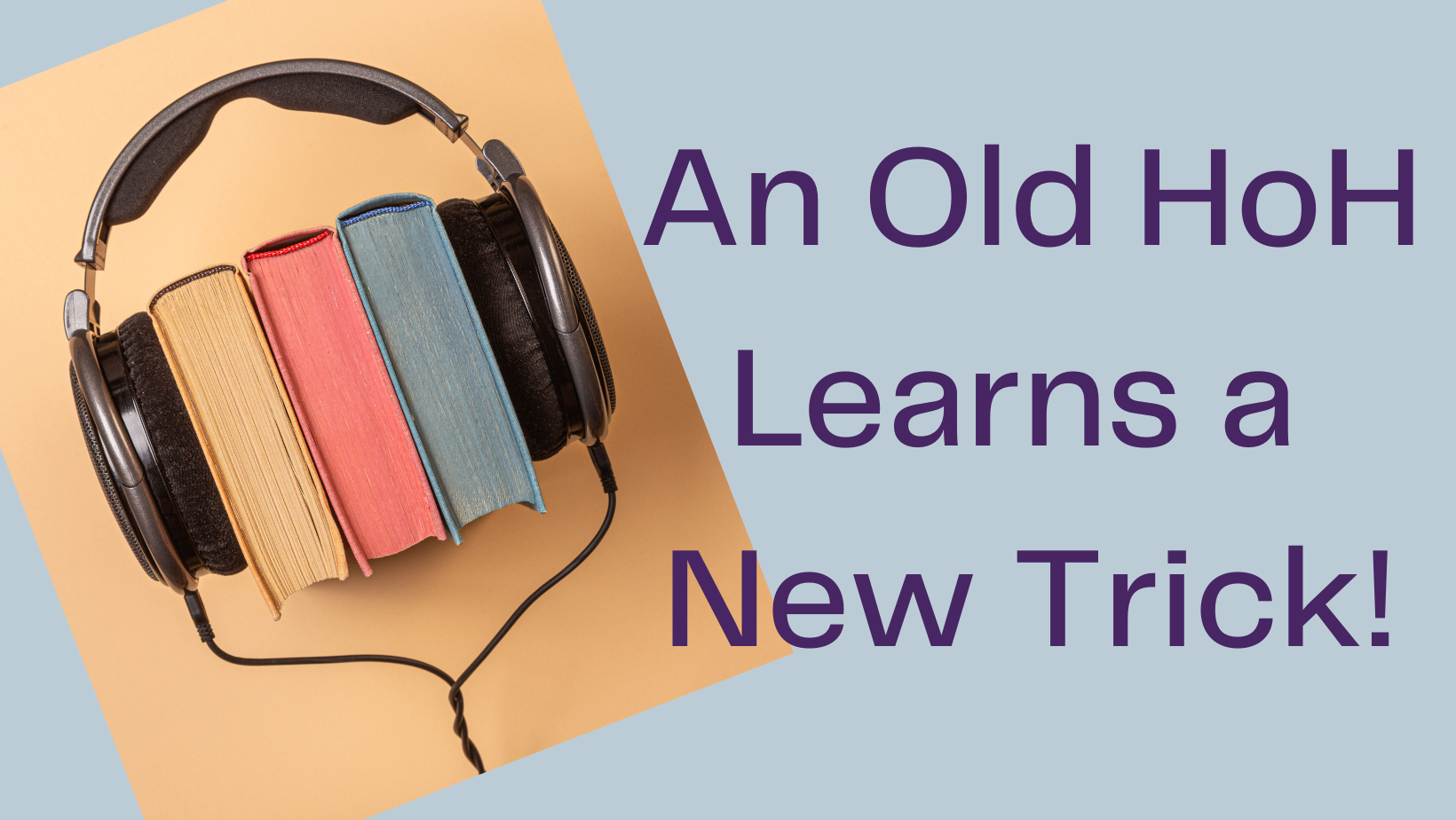
I can listen to books. Me – Gael Hannan, the Happy HoH who depends heavily on visual cues, can listen to books and podcasts. What a game changer!
A few years ago, before receiving my right-side cochlear implant (CI), and before smartphones had evolved to their life-sustaining platform, I never listened to podcasts or audiobooks. My hearing loss had progressed to the point that, even with telecoils, using the phone was a challenge. Perhaps I had become too dependent on text communication.
The CI has given me more high frequency sounds, sometimes to the point of being too high and too frequent, but easily adjustable by fiddling with settings on my smartphone remote. Speech from all sources became clearer and richer.
But when people recommended a podcast, I would internally shudder at the thought of trying to hear something without any visual cues. Sound coming through my ears and nothing in front of my eyes? No way, I can’t do that!
Change started last summer when I got a CI sound processor upgrade, which meant getting a new hearing aid on the same electronic platform. The result was a dynamic duo of improved hearing devices that gave me delicious, clear sound on phone calls, and direct sound when watching TV (through a special streamer) using my computer.
But it was only recently that I realized – I can now listen to podcasts and audiobooks! On walks and in waiting rooms. What finally sparked this delayed discovery? My own book coauthored with Shari Eberts, Hear & Beyond: Live Skillfully with Hearing Loss, has just been released as an audiobook. I downloaded it from Audible to my phone, excited to hear the sound of our creation being narrated by award-winning voice actor Robin Siegerman.
It was a thrill to hear her low-voiced interpretation, suitable for most people with hearing loss. Even so, I missed a few words here and there. Which led me to the next step, an activity that I had let lapse a year or so into my life with a CI: I could listen and read at the same time! This is a wonderful aural rehab exercise, especially when listening with just the CI. This exercise helps train our brain to improve its interpretation of sound through our electronic device.
I’m keen now to do this with other books, although it means getting the Audible book and a text-version. But it’s worth it; this practice pays off in better speech comprehension. If you’re in the US and use Amazon.com, Whispersync offers a reduced price for an Audible book when you buy the eBook (Kindle) at the same time.
While my preference is to read print books – I read quickly and I love the silence – this new ability to listen to books is a gamechanger, a new trick for this old HoH, that expands my ability to enjoy the creativity of other writers and podcasters.