

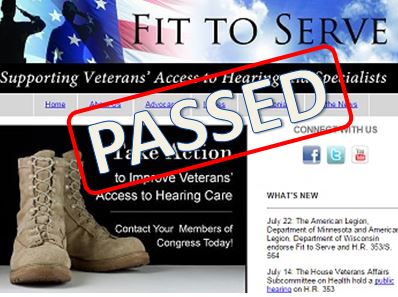
WASHINGTON, DC — The International Hearing Society (IHS) announced today that the US Senate unanimously passed H.R. 3471, commonly referred to as the “Fit to Serve” bill, on November 17, 2016. The bill was backed in the Senate by S. 564 sponsors, Senators Jerry Moran (R-KS) and Jon Tester (D-MT).
H.R. 3471 cleared the US House of Representatives in September of this year, following changes to the bill’s original language, which was amended to reflect the concerns of the three audiology professional organizations (AAA, ASHA and ADA). Jointly, the three organizations maintain that the Veterans Health Administration has the authority to hire hearing instrument specialists, but the revised language of the bill provides “congressional intent” on the role these professionals can play in the VA, restricting their job duties “to reflect their limited training and education.”
New Chapter in VA Hearing Care
The legislation will create a new job classification within the VA for hearing aid specialists, who had previously only been able to work within the VA system as health technicians.
Scott Beall, AuD
“VA health technicians cannot provide hearing tests or perform hearing aid programming adjustments—services that could help alleviate the workload of audiologists and free them up to focus on disability evaluations, complex cases, and other services for which audiologists are uniquely qualified to provide. Having licensed hearing aid specialists on staff to provide those services for which they are permitted through state licensure can provide significant relief while ensuring quality.”
—IHS President, Scott Beall, AuD, CCC-A, ACA, BC-HIS

According to IHS, the legislation will also require the VA to report annually to Congress on appointment wait times and staffing levels, to provide that the VA is “not only incentivized to use hearing aid specialists, but also reduce wait times for veterans seeking care through the VA”.
Having passed the US House of Representatives and now the Senate, H.R. 3471 will now go to the President’s desk for his signature.
Source: International Hearing Society