


Ultrasound emitters are all around us. Sensors in energy-efficient buildings, rodent repelling devices, burglar alarms, security cameras, HVAC system vibrations are some of the areas ultrasonic is used. Also, it might have been used, according to a University of Michigan scientist, in the sonic attacks in Cuba that sickened dozens of American and Canadians.
Kevin Fu, an associate professor of computer science and engineering, and a U of M team showed how ultrasonic signals—outside the range of human hearing—can combine to produce audible and potentially dangerous tones like the undulating, high-pitched chirping that the diplomats described. Fu and his team purport that ultrasound was used as part of plan to eavesdrop on American and Canadian diplomats in Havana, Cuba last week.
Beginning in December 2016, at least two dozen U.S. and Canadian personnel in the nations’ Havana embassies suffered nausea, ear pain, hearing loss, nosebleeds, vertigo and even trouble walking, according to news reports. A recent JAMA report described the injuries as “mild traumatic brain injury” and “a concussion without a concussion.”
Ultrasonic sounds have not been known to harm humans except with exceptionally extreme intensity. It has even been used in some commercially available consumer audio products. Ultrasound, however, when not properly designed can produce audible byproducts capable of harm. When ultrasonic signals containing multiple tones interfere with each other through a phenomenon called intermodulation distortion, audible sound can result. Intermodulation distortion can down-convert the frequency of ultrasound into the audible range—resulting in high-pitched noises
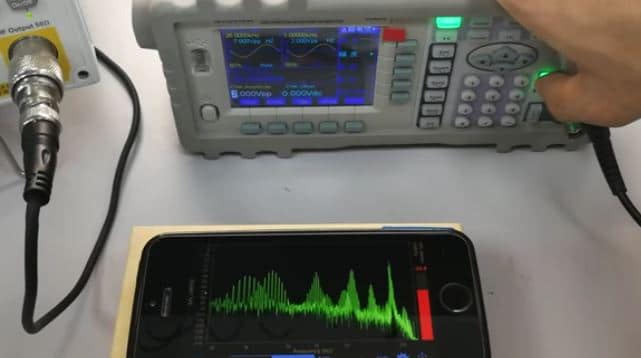
Fu and his colleagues noticed in the acoustic spectral plots in a AP news video suggested that intermodulation distortion might be at work in the sonic attack in Cuba. Intermodulation distortion is a relatively common occurrence in audio devices, including hearing aids. They set out to simulate the phenomenon between multiple ultrasonic signals. Using ultrasound, they generated similar “metallic chirping sounds” at 7 kHz with ripples spaced evenly at 180 Hz, mimicking the arrangement in the AP video.
Fu and his research team generated ultrasound using two ultrasonic emitters—a 25 kHz tone combined with a 180 Hz tone modulated on a 32 kHz carrier. The method works like AM radio, but the researchers used ultrasound instead of radio waves. You can think of 32 kHz as the AM station’s frequency. When the 25 kHz tone interferes with the transmission, audible sound at 7 kHz results. The researchers also built a proof of concept device to simulate covert eavesdropping by playing a song instead of the 180 Hz tone over the 32 kHz ultrasonic carrier.
You can see and (maybe) hear their device here: