



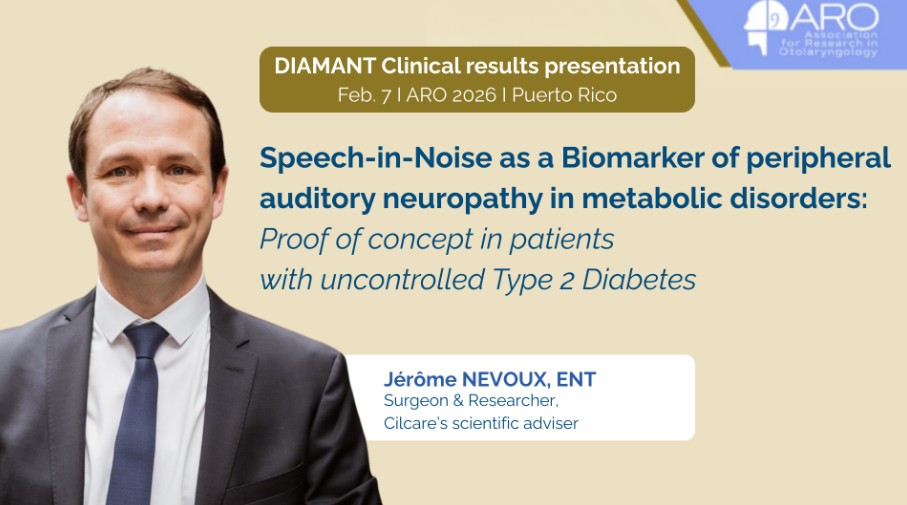
MONTPELLIER, FRANCE — Cilcare announced it will present clinical results from its first observational clinical study, DIAMANT, at the 2026 ARO MidWinter Meeting in Puerto Rico. The results will be presented by Professor Jérôme Nevoux, ENT physician at Bicêtre Hospital, Paris, during a scientific session dedicated to Neural Mechanisms of Speech Perception.
Cilcare said sensorineural hearing loss is an underrecognized comorbidity of Type 2 diabetes, potentially driven by peripheral auditory neuropathies including cochlear synaptopathy, as well as inflammatory mechanisms.
The company said these alterations may lead to early speech-in-noise comprehension deficits despite hearing thresholds remaining within normal limits, a condition commonly referred to as hidden hearing loss.
Study design and objective
Cilcare’s DIAMANT observational clinical study was designed to investigate the prevalence, functional impact, and underlying auditory profiles of hearing dysfunctions in people with Type 2 diabetes, with the objective of identifying clinically relevant functional biomarkers to better characterize early auditory neuropathy in metabolic disorders.
According to the company, 241 participants with uncontrolled Type 2 diabetes underwent a series of auditory and electrophysiology tests.
Key findings reported by Cilcare
- 26% of cognitively preserved diabetic patients presented clinical signs of hidden hearing loss
- Hidden Hearing Loss group had a significant reduction in EchohG Wave I amplitude compared with those with Normal Hearing suggesting that it could be an interesting mechanistic biomarker
- 46% of diabetic patients presented Mild Cognitive Impairment (MoCA < 26) highlighting the need to understand the interplay of hearing, diabetes and cognition.
- Tinnitus was reported by 14% of patients with Hidden Hearing Loss and by 32% of patients with Hearing Loss
Comments
“The DIAMANT study provides new clinical evidence of a strong association between Type 2 diabetes and early, often underdiagnosed auditory nerve dysfunction, including in patients without measurable hearing threshold elevations. Hidden hearing loss is a particularly insidious form of auditory impairment, with a significant impact on daily communication and quality of life, yet it remains frequently underestimated in clinical practice. These findings highlight the importance of looking beyond conventional audiometry and reinforce the need for improved medical recognition of these patients,” said Professor Jérôme Nevoux.
“This presentation at ARO 2026, the leading international conference dedicated to hearing and balance research, represents a major milestone for Cilcare,” said Mathieu Schué, Chief Clinical Operations Officer, Cilcare.
“The DIAMANT data reinforce our vision that metabolic diseases such as diabetes play a critical role in auditory health and validate our strategy to address hidden hearing loss through clinically driven innovation; I would like to sincerely thank all teams involved for their outstanding clinical work.”
Cilcare said the DIAMANT study strengthens its clinical strategy bridging real-world clinical evidence, advanced auditory biomarkers, and therapeutic development. The company added that the data support the ongoing development of CIL001, its lead drug candidate targeting cochlear synaptopathy, and said the findings pave the way for future clinical studies aimed at improving outcomes for patients with hidden hearing loss and beyond.
About Diamant non-interventional clinical study
DIAMANT was a French, multicenter, cross-sectional, prospective study conducted at three diabetology centers, involving 369 participants with uncontrolled Type 2 diabetes. The study aimed to evaluate the prevalence of auditory dysfunctions, with a particular focus on sensorineural hearing loss (SNHL) and to identify effective tools to differentiate auditory profiles.
Eligible participants (aged 25–70, T2D >2 years, HbA1c >7%) underwent a comprehensive battery of auditory and cognitive assessment tests: standard (0.25-8 kHz) and extended high frequency (8–16 kHz) pure-tone audiometry, Speech-in-noise Testing with the French Matrix test (Framatrix), Distortion Product OtoAcoustic Emissions (DPOAE), electrocochleography (EcochG), and cognitive screening via the Montreal Cognitive Assessment (MoCA).
Participants with abnormal otoscopy, tympanometry, conductive / asymmetrical hearing loss were excluded leading to a dataset of 241 analyzable patients.

About Cilcare
Cilcare is a biotechnology company specializing in auditory sciences, developing cutting-edge solutions for the characterization, diagnosis, and treatment of hearing disorders and associated diseases. Founded by three visionary women entrepreneurs, the company now employs a team of 50 international collaborators, supported by a scientific advisory board. Since its creation in 2014, Cilcare has dedicated itself to addressing these global challenges by combining an advanced R&D platform, a promising drug candidate portfolio, and the use of artificial intelligence and machine learning to characterize various forms of hearing loss. For the past 10 years, Cilcare has also made its technology available to industry leaders and researchers in Europe, the United States, and Asia to accelerate the development of drugs, gene and cell therapies, and medical devices for hearing disorders.
Source: Cilcare