

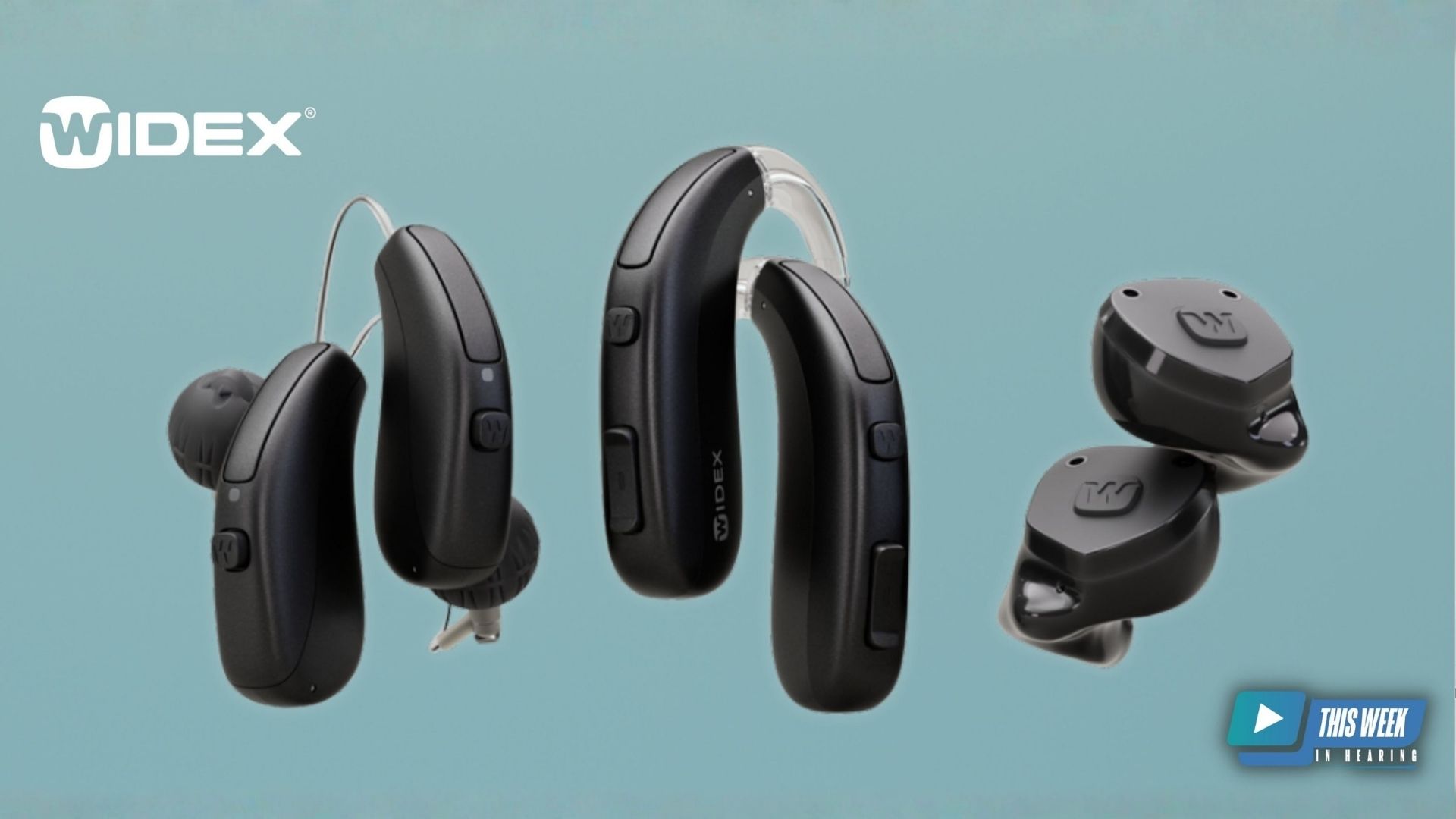
Widex has expanded its Allure™ hearing aid platform with new form factors and charging options, giving hearing care professionals more flexibility across a wider range of patient needs. In this discussion, Dana Helmink, Au.D., Senior Director of Clinical Development at WSA, walks through the addition of a rechargeable Allure BTE, Widex’s first rechargeable ITE, and a new portable charger for the Allure RIC — designed to support travel, active lifestyles, and extended daily use.
The conversation also explores updates to Widex Compass Cloud™, the company’s cloud-based fitting software. Dana explains how frequent rolling updates, precision fitting tools, and in-ear measurement capabilities like the Allure Sensogram are designed to improve first-fit accuracy, reduce follow-up visits, and support more personalized fittings. The shift to cloud-based software allows Widex to release new features on an accelerated schedule without requiring manual software installs. Together, the platform updates reflect Widex’s continued focus on natural sound, speech clarity, and environmental awareness.
The discussion also touches on the role of the W1 chip, backwards-compatible firmware upgrades, AI-supported personalization through the Widex app, and how these advances translate into real-world patient outcomes in complex listening environments.
Full Episode Transcript
Speaker 1: Welcome to This Week in Hearing. Hello, I’m Bob Traynor, your host for this episode, and today my guest is Dana Helmink from Widex. And Dana is the head clinic of clinical development at WSA Audiology, and thank you so much for being with us today, Dana. We appreciate these updates because it, it helps stay on top of all the clinical things we have to do, as well as maybe gives us an idea of which ones of the courses we may or may not want to go to. So, thanks so much again for being with us.
Speaker 2: Thanks, Bob.
Speaker 1: Yes. But, but before we get into the discussion I know that you have quite a clinical audiology history because of a, a meeting we had last year. But I assume that the rest of our group here at This Week in Hearing may not be familiar with your career. Could you give us a update as to how well, really kind of what happened on the journey all the way to
Speaker 2: Sure.
Speaker 1: position here at Widex?
Speaker 2: Sure, yeah. I’m happy to share that. So I have been an audiologist for I think I think it’s going on 25 years now. Yeah. Just a little while. And so I I’m a native Chicagoan. I started my career here in clinical practice in Illinois after graduating from Northern Illinois University, and of course, I, I spent did that time getting that experience in clinical practice. And then I moved into the industry side of things, meaning working for companies and helping them develop products and helping them bring education and training to audiologists and hearing care professionals in the field, and then being out in the field working with those customers, supporting their fittings supporting sometimes their most difficult patients, so staying, you know, very involved and, and connected in those experiences and fittings in the field. And I joined Widex eight years ago as a clinical education specialist, so one of our team members who’s out there in the field day in and day out, providing training and fitting support, and just evolved over the last few years to be able to lead a team that helps to bring high-quality educational content to hearing care professionals within our industry.
Speaker 1: Fabulous, and so nowadays, as the head of clinical development, what kinds of things do you have to do every day, other than talk to me, of course?
Speaker 2: Right. I was just gonna say, I get to talk to you. So I I, I lead a small but mighty team who, really helps to create the educational content that you see across the, the internet in recorded formats and then also delivered live at many of the national and state conventions, and then working with our team of trainers who are out in the field every day helping HCPs to be successful with our products, and with fittings for their patients. And so we’re kind of the backbone to delivering all of that content into various channels within the, the industry.
Speaker 1: Yeah, I totally understand that as, you know, the engineers come back and they say, “Well, this is what we got,” and they go you know, way deep in the weeds, and it’s up to colleagues like yourself to pull the weeds, pull the weeds out and make it so that all of us really understand what the engineers are trying to do. So,
Speaker 2: Exactly.
Speaker 1: … that, that’s a, a fabulous job of making things deliverable to not only the audiology community, but something so that we can actually digest that into the into our discussions with patients and so on.
Speaker 2: Absolutely.
Speaker 1: You know, Widex is kind of known for some sort of a, kind of a naturalness to their sound. What what about the Allure actually creates that, that natural kind of a sound?
Speaker 2: Yeah. You know, Widex, when you really think about us, we’re, we’re built on this history, this legacy of focusing on natural sound. It’s sort of our North Star, right, this thing that we, we put first and foremost in all of our product development, and we, we particularly focus on preserving contrast preserving clarity, preserving environmental awareness. So how do you kind of balance the clarity of speech but the awareness of what’s going on around you? With Allure we have a whole new chip, a, a new processing chip, a new platform, and some new technology and solutions within Allure that really help enhance speech within those challenging environments while still making sure that the wearer is fully immersed in that environment, and it comes across for wearers and proven really in a number of real world studies recently published that-… wearers find Allure immediately sounding natural, immediately sounding clear, and then ultimately, as they wear it over time, that they have a preference for that Allure sound over prior hearing aids that they’ve worn. And so this, you know, really helps to bring that natural sound to more wearers and helps make life easier for hearing care professionals you know in delivering something that is what wearers expect to see, I would or expect to hear, is what I would describe.
Speaker 1: You know, Widex has, I think since what is it, 1956 or something like that, they’ve had that’s always been kind of one of their, one of their one of their one, one of the basis of their, their programs, where they And, and, and so there’s always been a kind of a unique sound to Widex products, at least as far as patients have told me over the years. And so but what updates are gonna, are we gonna see in the Allure portfolio and as well as in the, in the… and we’ll, we’ll, I’m sure, get to it, in the Compass Cloud as well?
Speaker 2: Yeah.
Speaker 1: But Compass, not Campus, Compass, I guess
Speaker 2: Yeah, Compass … is our fitting software and,
Speaker 1: I’m still on, still on a college campus or something, I guess.
Speaker 2: Yeah, right?
Speaker 1: so, what, so where are we with some of the changes that are gonna, we’re gonna see in the Allure portfolio?
Speaker 2: Yeah. So let me start with the, the portfolio, and then we can certainly talk about the software. I love to share for both of those. With the Allure portfolio, what you see is that we’re building on that Allure sound that I just talked about, that clarity, that balance of awareness, and that, that satisfaction with sound, by adding more solutions more form factors and style options to that platform. So we have a new rechargeable BTE that is being added to the Allure platform. That BTE gives a lot of different fitting options different ways that you can couple it, to the ear thin tube, and, regular ear mold options, as well as a range of Bluetooth, Bluetooth connectivity options, including LE audio, a T-coil on board that device and super reliable performance across a, a range of hearing losses. So reaching into that severe to profound hearing loss range when that’s needed. So a great all around BTE option for us. And then we’re excited about this, Widex’s first rechargeable ITE to reach our portfolio. So this is a milestone for Widex in, in really bringing a yet a, a very commonly asked for option among wearers is that rechargeability in an ITE, offering a full day of battery life 19 hours with five hours of streaming in that device, and a, a really great design. Hits all the points on aesthetics and cosmetics and ease of use within that ITE form factor. In fact, I’ll show you quickly if my camera cooperates. It’s great contactless charger for that ITE. So,
Speaker 1: You just set it in there then. You
Speaker 2: Yeah, basically lets you just kind of drop the devices in any which way. And so I think it really hits on what wearers are looking for in a device that’s easy to use in the ear with a programmable push button, easy to use in the charger, and really cosmetically discreet. No contact points on the face of it. So it looks great, sounds great. And we’ve also added a portable charger to our previously launched RIC style products. So that portable charger is gonna provide up to a week of on-the-go freedom so making
Speaker 1: Oh.
Speaker 2: a really great solution for travel work, and active lifestyles.
Speaker 1: Or if you’re out camping for the week or
Speaker 2: Exactly.
Speaker 1: something like that. So well, so and they, and there are some… Is that the main accessory that’s been added to the portfolio, or are there some others?
Speaker 2: So at this point, we’re really looking at what we focused on here is expanding the, the portfolio through those additional form factors of that BTE and that ITE, and the portable charger added to the RIC. And then we’re also focusing a lot on evolving our Compass Cloud fitting software, as you had mentioned earlier. And so all of that comes together in this launch.
Speaker 1: Okay. Well, what kinds of things have been modified in the Compass Cloud Dana? To make I assume it’s to make it, make it an easier fit for… oh, and better target approaches and some of
Speaker 2: Yeah.
Speaker 1: … things as well.
Speaker 2: Absolutely. So, you know, Compass Cloud, for us, this is a, you know, this is a shift to a cloud-based fitting software, and how we leverage that advantage of being cloud-based is by continuously being able to evolve our fitting software. We’re in a really accelerated cadence of adding features and providing updates into-… the in, into that fitting software and rolling that out into the field. Being cloud-based allows for these really seamless updates that you simply arrive at the fitting software and we’ve made those updates immediately available without the, kind of the difficulty and the hurdles of the past of having to constantly be installing new software or being limited in how many software improvements we bring to the market within a year. So we’re, we’re really focusing on this accelerated development and innovation within our fittings software, but the area that we focus the most in is how we can deliver more precise fittings. So we have a, a range of what we call precision fitting tools starting from our, fitting rationale to the algorithms that we use to prescribe gain in, in the fitting and do that accurately upfront. And I think this is all contributing to these really strong satisfaction numbers that we see that, that wearers are immediately happy with the, the sound of Allure, and we hear from clinicians who are fitting Widex Allure how happy patients are in reduced follow-up appointments reduced need for fine-tuning. And so I think it’s all comes down to where we start strong in that Compass Cloud fitting software and then how we add features, like our new Allure Sensogram which is a measurement in-ear with the hearing aids that offers an even greater level of personalized fitting and fine-tuning.
Speaker 1: Yeah, that, of course, we all remember the Sensogram from the old days and
Speaker 2: Absolutely.
Speaker 1: … so so when you said Sensogram, that had kind of a, a very obvious fitting advantage and the other thing I think about that you’re referring to here with being a cloud-based fitting system is it’s always been a little frustrating to hear about all the features that are gonna come out and then and, and you do this with the software, that with the software, but you don’t get the software for a couple of months yet.
Speaker 2: Right.
Speaker 1: So being able to access things on, on the cloud I think is, is advantageous not only for the, for you guys as the manufacturers to update your products, but also for colleagues that are out there in the clinic and and, “Oh, you know, I always wanted to try that. Well but I don’t have the software yet.” And,
Speaker 2: Yeah. It’s a real barrier.
Speaker 1: Might take me two hours to download it, Right. if I wanna download it. So beating the clock
Speaker 2: Yeah, and in some clinics
Speaker 1: …
Speaker 2: having to get their IT department to come in and take care of that, so, you know really, what we’re doing, and since we launched Allure and launched the Compass Cloud fitting software, I think we’ve added over it’s over a dozen, maybe 15 plus features at this point.
Speaker 1: Wow.
Speaker 2: And in a cadence where we are pushing out updates every two months or so, give or take. And so there’s always something new and exciting to kind of find in the available to you in the software and that improves your clinic workday for, you know, the next week and months to come.
Speaker 1: Sure. And well, you know, the other thing too is, is that, you know, many of the chips in, from, from, from many manufacturers these days have so much stuff available on the chip. And it’s kind of like, yeah, the engineers are in the weeds but there’s another whole patch of weeds over here that we can’t get to yet because of this or that or this limitation or power problems or whatever it is, and one thing leads to another, and when those things open up it adds a lot. So a lot of times we don’t see like a whole brand new product. We see a product that’s been there for a little while waiting some modifications so that we can use those various components, and I think I’ve seen that in a couple of manufacturers already just in the last couple months or so. And the idea is that yes, it’s, it’s the same name and it’s the same this and that, but, but you can have a totally different fitting out of the same brand and model of a product with using all these new features that, that we weren’t able to turn on before, or something like that, right?
Speaker 2: Yeah. One of the things I’m really really proud of with Allure, I mean, it is a whole new chip for Widex. It’s our, it’s our W1 chip. It’s four times faster, has four times more memory than our prior chip platform. And one area of sort of memory and capacity that we’ve improved on that chip is the, the way, is the amount of, of kind of memory available for when we push firmware updates into the hearing aid. And that’s something, you know, that Widex does through our through the app that the patient has on their phone if they have downloaded our app and connected,
Speaker 1: Okay.
Speaker 2: and then also something that hearing care professionals can do in the office. But the way we’ve leveraged that historically and continue to do going forward is to make sure that we can always bring the latest and greatest improvements to the wearers who have invested in the Widex sound and invested in our technology. So we’re always able to bring improvements, to keep up with everything that’s happening in streaming and phone connectivity, but sometimes we’re also we have a long history of bringing new and exciting features and capabilities to the hearing aid that are actually backward compatible to the people who bought six months or a year ago. And I think that brings a lot of comfort to hearing aid wearers that they’re not left behind, you know that the day they make their investment is the last, is, is as good as it’s gonna get for them. And so we bring a lot of that technology and we do even more of that now with Allure by the, you know, capabilities that that expanded platform has.
Speaker 1: So what do these improvements and so on, what does that bring to the real world situation?
Speaker 2: Yeah. So when
Speaker 1: It’s all together different in a lab, of course, and
Speaker 2: Right.
Speaker 1: what happens if you go to Mead Killion’s bar where … did all those things over the years and God rest his soul,
Speaker 2: Yes.
Speaker 1: … he left his
Speaker 2: You know, I worked for him for 12 years,
Speaker 1: Oh, wow.
Speaker 2: Yeah. Yeah.
Speaker 1: And and my wife Krista did a number of regulatory affairs things
Speaker 2: Yeah.
Speaker 1: … for, for Mead and he will be definitely missed in our community
Speaker 2: He will.
Speaker 1: for a very long time. Anyway but, so how would this how, how would this perform in Mead Killion’s bar that you, you would take it to at one time or another?
Speaker 2: Yeah. So I mean, we, we really look at this, I, when I think about what the real world impact is, right, I think about it in kind of two perspectives. One is obviously the device itself, so that Allure signal processing and what we’re doing there, and then also the fitting because, you know, you have, a, a, a hearing aid has to be fitted well and accurately and be meeting the audibility needs of the, the wearer. And so I think we’ve, we’ve really focused on kind of two areas. So with these Compass Cloud improvements, we’re looking at how we deliver, how, you know, how, how Compass Cloud delivers these data-driven fittings, supporting accuracy, and more fitting personalization, right, creating tools that give HCPs a really good starting point for their fittings. And then from there, HCPs will go on and they’ll perform real ear verification as part of their protocol perform other measurements and tests as part of their protocols, and and it results in patients who start happier and more confident, right? And then it gives HCPs time to focus on more important things in the time that they spend with their patients, like counseling and, and other elements of patient care. And then for the wearers, they’re benefiting from that Widex sound and really supporting that natural sound, that clear speech, the environmental awareness, and we avoid some of the aggressive sound processing that can make things sound unnatural. So we deliver great outcomes in noise really-… authentic situational hearing and it’s, it’s all really validated by some of our recent studies that show that real world preference for Allure over prior hearing aids or the patient’s own hearing aids up until that point and shows that immediate satisfaction that they experience. And, and I think those are two really important and distinct things to look at is how do we make sure to, to help HCPs get the fitting right, and then how do we make sure that the sound feels right to the wearer when they go back into their lives, you know?
Speaker 1: Well, and, and of course that’s, that’s what we all want to do is we want to make everybody feel like they can communicate and have a high quality of life whenever they’re… whenever they leave the clinic. And and they feel like what they have obtained is of good benefit to them and their family and, and everybody around them.
Speaker 2: Absolutely.
Speaker 1: So now that we’ve talked about some of these things, now how, how would we… How is the How is AI… You know, that’s a big, a big, big term these days, AI.
Speaker 2: Sure is.
Speaker 1: How, how is AI used to provide some of these enhancements that you guys have come up with at Widex?
Speaker 2: Yeah, so Widex supplies AI in a couple different ways today. Certainly that sort of AI learning that is part of, of many product portfolios is, is, is part of how we have developed our sound classification system and trained that system to understand the environment that someone is in. And then but we really apply AI strategically today in our app-based personalization, and that’s a real-time AI where the wearer is able to engage with the app on their phone, to listen to different sound, different modifications to the real-time sound and the real-time environment that they’re in and then adapt that to their personal preferences that can really vary depending on the situation that they’re in. So it, it’s a tool that helps support independence and confidence and really helps them to achieve success in environments that they may not have anticipated and that their HCP can’t do anything about when they come back a week later or a month later talking about, you know, that wedding reception that they were at a, month
Speaker 1: And where was it? Where were they sitting? What, what… Who was talking?
Speaker 2: Yeah.
Speaker 1: And what were the windows and the whole, the whole thing that?
Speaker 2: and then what do you do about it, right?
Speaker 1: That’s
Speaker 2: moment was already… That, that was lost already. And so we, we really look at AI in, in that way today, and I’m super excited about the future of continuing to see AI become part of sound processing. But today Widex focuses on achieving noise management through our Speech Enhancer Pro®. Which is a an algorithm that’s based largely on the Speech Intelligibility Index, a proven method of improving speech intelligibility, speech understanding, and and then leveraging that that technology and that algorithm to produce real tangible clarity of speech. And I look forward to seeing the, how AI develops in the future and within our products as well, but we focus on natural sound quality and we avoid processing that potentially degrades that sound quality. And so we’re pretty you know, we’re pretty laser focused on achieving our goals in the way that we’ve proven them to be successful so far and then looking for that innovation of the future for sure.
Speaker 1: Wow. So, so now you have this, this fabulous team that we talked about a, a while ago, and they’re, they’re small but mighty. What is the, the coolest thing that the team would think ‘Cause I assume your team has other clinicians in there as well.
Speaker 2: Oh, absolutely.
Speaker 1: addition to some of the others that are there, but the, the idea is I guess what I’ve looked for is what, what, what do you think is the coolest thing that Widex has come up with in this new part of the portfolio?
Speaker 2: Yeah, so I mean again, I, I always start with the Widex sound, and while you know, in this launch we, we continue to improve the experience with the Widex sound through improving the Compass Cloud fitting solution and through allowing even greater personalization of that solution. So I, I think that’s one thing that really excites me. I mean when I was in clinical practice myself and when I have been out there helping HCPs, you hate that feeling where a first fit isn’t going the way that you hoped it would. So any time that I see improvements and technology and and software solutions that help achieve a better experience for the patient from the start and enable me as a hearing care provider to address patient needs, I get super excited about that. And then I, I look at this expanded portfolio and think wow, those are some really great choices for HCPs. We have a RIC that has been proven to be successful, well accepted and super popular now with that portable charger that gives all that freedom for wearers, and then I’m super excited about adding this ITE that looks great is comfortable in the ear, and is just so easy to use with its contactless charging solution. I, I think there’s just no need to look further , you know for choices for, for patients and for patients who are looking for some of the best options out there.
Speaker 1: Well, you know, and, and that is a clinician’s way of looking at all the the new things pulling out the weeds so we can all understand what you have learned about a new product. And it’s always refreshing to get these kinds of updates from someone who has a good background and can listen to the engineers and digest that into a way in which we can all translate it into patient care. So today my guest has been Dana Helmink from Widex who’s the head of clinical development at WSA Audiology. And thank you so much for being with us today Dana. We appreciate it very much because these are the kinds of things that get us interested to update our information on one product, another product, and another product of which all of these can be of some benefit to our patients and, and in addition to that, if our patients are happy, then our businesses are happy and and we can all you know, pay the kids’ daycare bill and go to, go to various places that are of interest. So again, thanks so much and thank you guys at Widex for pulling out the weeds and showing us the right way to take care of our patients with these new formats.
Speaker 2: Thanks so much, Bob. It was a real pleasure to talk to you today.
Speaker 1: and to, to those of you out there thanks for tuning in today at This Week in Hearing.
Be sure to subscribe to the TWIH YouTube channel for the latest episodes each week, and follow This Week in Hearing on LinkedIn, Instagram and X.
Prefer to listen on the go? Tune into the TWIH Podcast on your favorite podcast streaming service, including Apple, Spotify, Google and more.
About the Panel
Dana Helmink, AuD, is a Doctor of Audiology and the Senior Director of Clinical Development at Widex USA. As an audiologist, Dana has worked in clinical practice, product development, and education and training. With Widex she strives to make it easy for professionals to embrace new technology and provide patients with access to the best hearing care solutions. She is an author on many publications and presentations on the topic of signal processing and sound quality in amplification.
Robert M. Traynor, Ed.D., is a hearing industry consultant, trainer, professor, conference speaker, practice manager and author. He has decades of experience teaching courses and training clinicians within the field of audiology with specific emphasis in hearing and tinnitus rehabilitation. He serves as Adjunct Faculty in Audiology at the University of Florida, University of Northern Colorado, University of Colorado and The University of Arkansas for Medical Sciences.