

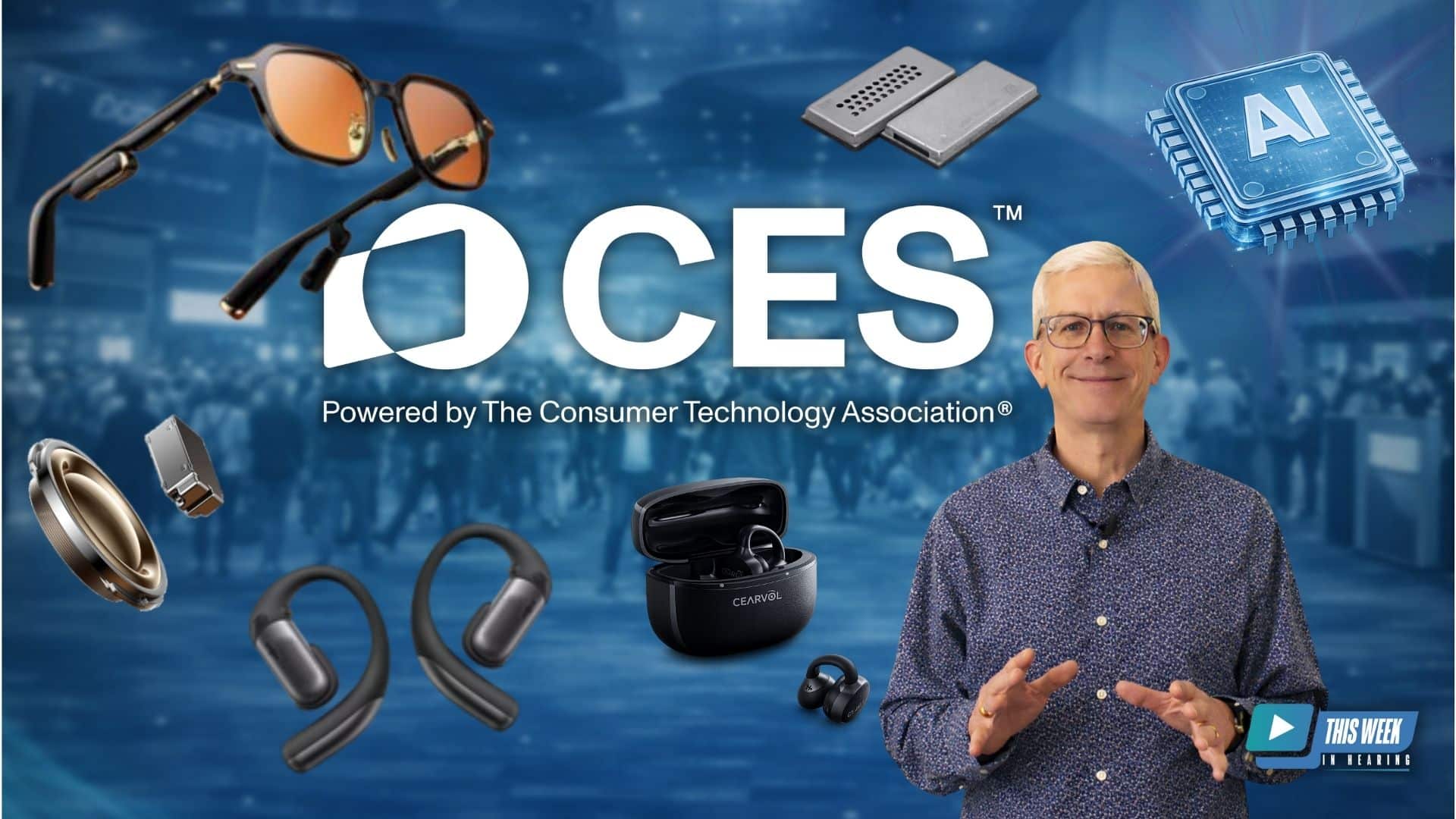
What if the future of hearing technology doesn’t sit inside the ear at all? At CES 2026, one of the most important trends was the rapid rise of open-ear hearing devices — from smart hearing glasses and clip-on assistive audio to the bone-conduction, MEMS and hybrid speaker systems enabling higher performance.
In this special recap, Andrew Bellavia explores how companies including Cearvol, Shokz, Knowles, and xMEMS are driving the convergence of consumer audio and hearing healthcare. The episode also examines major advances in AI noise reduction, beamforming, and licensable hearing software from companies such as Mimi, Absolute Audio Labs, and their partner Aizip, technologies that are enabling new crossover devices capable of supporting hearing, music, and everyday listening in a single platform.
While hearing technology may not dominate CES headlines, the innovations showcased here point toward a future where intelligent, personalized hearing solutions and OTC become more accessible across a wide range of devices and price points.

Full Episode Transcript
Hello, everyone, and welcome to This Week in Hearing. At CES, I spend five days here so you don’t have to. An interesting and emerging category in hearing devices this year is open ear. Open ear in hearing devices was really kicked off with the introduction of Nuance glasses, and I remember how skeptical I was that that could even work when they invited me to Milan two and a half years ago to try the original prototypes and how surprised and delighted I was at how well they worked. Since that time, the category has grown, both for music devices and also for hearing, with each one influencing the other. As the category has developed, so has the infrastructure to support it because there are particular needs in the speakers, for example, microphones, and the software to run it all. Let’s take a look at some devices, including what’s happening at a major consumer brand you’ll instantly recognize, as well as take a peek under the hood. One indication that a category has legs is that the supply infrastructure develops products specifically for it. A lot of interesting things happening there too. Let’s go take a tour. Hi, Heather. And thanks for … a little time with me. Yeah. Tell Absolutely. a little bit about yourself and your role at Cearvol. Yeah. So I am a doctor of audiology. I’ve been at I’m still fairly new at Cearvol. I got started not too long ago, but it’s very exciting what they’re doing here. I’ve been working with the OTC market for probably about seven years now, so just seeing all the new products Okay. how things are going, it’s really great. Yeah. Excellent. Excellent. Now, I see in CES at, in the, in the in-ear world, open ear, it seems to be like the coming trend. Yeah. And you see it in hearing devices as well. Mm-hmm. For example, from the original Nuance Audio glasses. And now I see, you have a set of hearing glasses as well. Mm-hmm. So tell me about the open ear hearing glasses. Yeah. So one of the biggest problems we have when people first start wearing hearing aids is occlusion, which is kind of a plugged-up feeling in your ears. So by opening that up, we get a little bit more of a natural sound quality. It’s not for everybody. It’s great for a mild hearing loss. Some people who have more moderate, severe hearing losses, they still need the closed earplugs. But for a mild hearing loss, this really gives you a lot more of a natural sound flow, and it feels a lot better in your ears. Okay. And what are the main use cases for it? I’m assuming it’s situational. You don’t have all-day wear for those glasses. Is that correct? Yeah. Yeah. Right now, it is. I mean it’s, so the glasses themselves, you can bend down the, the hearing aid part and bend it up as needed. So really, it’s for more, you know, like I said, it’s for people with mild hearing loss who might have difficulty in certain situations, like noisy areas and certain people that they can’t understand very well, women and children’s voices are tough a lot of times. Right. it’d be great for those kind of thing. And what features do you have to support hearing and noise for people with mild to moderate hearing loss? Yeah. So the, all of them have directional microphones. So we’ve got two microphones on the top and one on the bottom. So we can orient the, the sound a little bit better. We can focus in on more on what is, what’s in front of you. Okay. And less on what’s behind you. And you also have the open ear clip-on style. Mm-hmm. Yes. And so, are those also for mild to moderate hearing loss? Also, yeah. More for a mild hearing loss. So still the open concept. It looks more like an earbud, so it’s a little more camouflaged than most hearing aids. And you can accessorize it a little bit further too, so you can make it, you can personalize Okay. a little bit more too. So it’s And I’m assuming both of these being very open in the ear, it’s more about people with mild to moderate high frequency roll-off. Correct? Yes. Exactly. Exactly. Not so much for low frequency or medically complicated hearing losses. Okay. Yes. And then, are you doing directional microphones in the open ear one as well? Absolutely. Are you doing binaural or within each ear? Each, each ear. Okay. … separately. Yeah. For people who have different levels of hearing loss in each ear. But yes. They still use directional microphones to help control the noise and, you know, listen to Any other noise filtering going on in there? It’s mostly the directionality. Yeah. Yeah. Okay. But there is a noise filter in it as well. So you’re getting, what, say maybe 5 dB of SNR improvement going forward? Yeah. I mean, maybe a little bit better than that. A little bit better than that? Okay. Mm-hmm. And how have the two open ear devices been received, both when you were showing them at EUHA earlier and here at CES? What’s the reaction? they, they have been really popular. They’re, I mean, it’s, it’s eye-catching. It looks different obviously, and when people put it on, their eyes get big and they’re like, “Wow, that really does sound a lot different, a lot better.” So it’s not on the market yet. I haven’t talked to many consumers about it yet, but as far as the shows like this, it’s been really exciting. A lot of people like it. And when will the glasses and the clips be in the market? I think the clips are coming out in March, I believe, and then the glasses are supposed to come out later this year. Okay. Yeah. Well, great. Thanks for All some time with me. Thank you. Thank you so much. I briefly tried the Cearvol clips. While I didn’t have enough time to put them through a proper trial, I could hear that they did offer some improvement, even though my hearing is out of bounds for an OTC. The most intriguing new offering in open ear OTC is coming from the well-known brand Shokz, who began making bone conduction headsets aimed at sport. Now, they are offering both bone conduction and open ear music earphones. More relevant to this conversation is that they have created a division called Shokz Hear to make open ear hearing devices. I attended the Shokz press conference where their new music earphone model, OpenFit Pro, was announced. OpenFit Pro doesn’t use bone conduction, but is an open ear model with a new dual diaphragm speaker. It’s designed to deliver full spectrum sound while resting in front of the ear canal without sealing it. Later, I went to their booth to try it. The sound was indeed excellent and the ANC was functional, even if not as strong as your typical in-ear earbud. I thought to myself, what a great hearing device this would be. Unlike Nuance glasses or other open ear designs, they could do noise reduction instead of just adding gain to the existing environment. But that may be for the future. The hearing device they showed at EUHA, and again at CES, is like their classic bone conduction model with a rigid band that runs around the back of your head. I tried it, but the contact on my head wasn’t firm enough unless I pressed on it gently. Then I could tell it was really working. The effect was a lot like Nuance glasses in that voices in front of me were made more intelligible. Still, I have a hard time believing this form factor will achieve mainstream success. I also suspect this is more of a proving ground for their software than anything else. Remember the Bose hearing aid that was used to get FDA self-fitting approval? The form factor used to apply under the De Novo process was rather beside the point. It was all about the fitting software. I’m waiting with bated breath to see if Shokz is moving in a similar direction. After all, their popularity could move the needle on earlier hearing care adoption if they offer a device attractive to their customer base. Open ear devices impose particular needs on the speakers, which, unlike in traditional loose-fitting earbuds, must be smaller to fit modern device form factors, especially glasses. Because the ear is not sealed, supporting ANC requires a good deal of base power. Add hearing assistance and the challenges increase since additional treble output is also needed. There’s a lot of innovation going on here, as seen by these two companies at CES. Well, thanks a lot, Kalyan, for spending some time with me. I see Knowles is doing a lot of work in open ear devices. Mm-hmm. So tell me, first off, what is it, what do you see in the open ear market that would cause Knowles to expend resources? How do you see open ear growing in the years ahead? Oh, nice seeing you Andy. Yes. So Knowles has been investigating the open ear form factor mainly because of comfort. As you know nowadays everyone tries to wear their earpieces, TWS, or any of the listening device for almost for the whole day. And so comfort becomes one of the key parameters that a end user will use to determine which product will be, he actually or she actually uses. And open fit form factor actually has a leg up on the conventional hearing devices, such as TWS or over-the-head devices. And as you can see here, we have either the clip design or the glass design that’s currently very popular in the marketplace. And what Knowles is trying to do is how can we bring value to the end customer, whether it be in terms of listening or whether it be in terms of music listening experience. As you know, with the open fit form factor, you tend to lose a lot of low frequency content. So considering that the final manufacturers are trying to focus on the low frequency, Knowles is trying to focus more on the speech region and also on the high frequency content. Okay, so that implies then that you’re you’re really developing around hybrid solutions with a standard dynamic speaker or moving coil speaker for the base end. Mm-hmm. And then a tweeter for the high frequencies. Yes. Stuff I worked on years ago Oh. You know it more than me Not for open, though. Open is new, right? Yes. Okay. And so how does it work in the … case, and what advantages does it bring to go hybrid with a BA tweeter, balanced armature tweeter, versus just using a dynamic speaker for everything? Oh. You have a very good question, Andy. So the thing is we need to understand that the amount of energy available in a given device is limited. If a dynamic driver is focusing on the low frequency content, it can’t really produce the high frequency or the mid-range, which is really important for the clarity of speech. So that’s where similar to a home theater system, where you have a woofer and a tweeter that gives you a more complete experience of the audio quality, it becomes almost necessary to have a hybrid system, where you have a certain transducer focusing on each segment that is critical to the end user, whether it be low frequency, whether it be speech in the mid-frequency range, or the music for the high-frequency range. Okay, excellent. You’ve got a demo here. I want to get my punk rock All right. the demo. It might not go over your glasses, so you might have Yeah. Oh, I have to take all the devices off. I’ve gotta take two senses gone, right? Now, of course, as people who watch the podcast know, I’ve got a big scoop in the middle, so I’m gonna hear the treble very even if the mid-range is a little bit recessed, so you gotta like that. So here is your player. And as usual, we have Hotel California. Or it’s up to you to pick your, I’ve heard Hotel California about six times today. It’s fine. And the good thing about this demo is that we have a selective switch right over here where you can turn on or turn off the balanced armature tweeter. Oh, okay. Great. Plenty of the Hotel California. Any time of Okay. I can hear it. Yeah, you can hear it from there, right? Yes. Okay, very nice. And then, of course, we’re talking about ordinary music listening, something you might do with a set of smart glasses you’re going about, but then what advantages does the balanced armature tweeter bring for the hearing case, if you were to do hearing glasses or hearing enhancement in a smart glasses? Oh, definitely. That’s actually one of the main uses, is we need to understand where is a typical hearing loss. as you might very well know, most of the hearing loss happens in the frequency range around 5kHz, right, typically. So most of the balanced armatures that we use for enhancing the high frequency also has a significant amount of energy in the speech region, because as you know, all the balanced armatures traditionally have been used in hearing aids for over 70 years. I’m preaching to the choir, but still. So because of which, right, there is a good synergy between using a balanced armature to improve audio quality, but at the same time, using it to improve the speech clarity or to be able to boost the speech in the loss region. So it will be helpful for manufacturers to use all the additional bandwidth to compensate hearing loss, and that’s actually something that is mildly used in terms of personalization, but in the case of hearing loss, it can also be used to compensate for the loss. Okay, got it. And when would I expect both in the clip form factor glasses form factor, when will I see hybrid designs in the market? I would say in the clip form factor, we already have a product that’s just released last year that includes a hybrid solution with a dynamic driver and a balanced armature already included into it. And Who’s the manufacturer to this one? It’s Baseus. Okay. XC1. Got it. And what about in the glasses form factor? The glasses, we just started this year. So as you mentioned, it’s still in the cyberpunk fashion, so we’re trying to convince the the manufacturers to look into it. And we have had many customers who have actually visited our booth for CES 2026 and were impressed with this form factor and the improvement to the audio quality and enhancing the mid-range. So hopefully, fingers crossed, by next year, we might have a product on the marketplace where they might be introducing a hybrid solution with balanced armature tweeters. Looking forward to seeing it and trying it when it comes out, maybe Definitely. … CES 2027. Absolutely. Looking forward to it. Okay. See you again in one ear. See you again in a ear. Thank you. I’m at xMEMS with Mike Householder. Thanks a lot for spending some time with me. My pleasure. So tell me what you’re doing in the open-ear category, both for ordinary listening devices and for hearing. Absolutely. So last year, we announced a product xMEMS Sycamore. It’s the world’s first near-field loudspeaker. And what we’re demonstrating this year is just a natural maturation of the technology and some new form factors that are better optimized for glasses ………………………. And what do you mean by near-field form factor? So These are MEMS speakers that are full-range audio but they’re near field. They’re good for three, five, 10 centimeters. So not good enough for a smartphone, but certainly good enough for things that are on the body, near the body, or close to the ear. Okay, and I see you have some glasses here. Absolutely. which is the device that’s in these glasses? So this is our Sycamore N version N for narrow. So the goal here is to get the frames, you know, very narrow, very stylish and you know, really to have them look like regular glasses. All right. Let’s give a listen. Absolutely. Of course, people who know me know I have to take off all the devices to listen to a set of, smart glasses, right? There we go. Okay. All right. So we’ve Oh, yeah. Those are very light. so they might not stay on your head that well. We’ve got good old Hotel California, but … A staple in the-Reference listening world. Exactly. But you’re welcome to… Okay, turn the volume up a bit, please. Okay. That will be the max volume for, for this one. Okay. Oh, it’s got a pleasant sound. Yeah. … there’s always a caveat with me because my hearing loss has a big scoop in the middle, so I know I’m gonna have a little recessed mid-range. Yeah. But I’m listening to the treble quality, Yeah. it’s good, and the bass is clean and not muddy. Yep. And then we can go to a podcast and go to voice only. Yeah, let’s do voice only. If, if that would be helpful. Oh. That’s music. That is music in a podcast. There we, there we go. My mom and dad broke off. He had a flat . Yeah. Quite good. Excellent. So that’s gonna make your glasses thinner and lighter. We take out about 90% of the weight attributed to a conventional dynamic coil speaker. Okay. 90% less weight, so all-day wear comfort will definitely improve. Sure, because you don’t have a magnet in it, and magnets are heavy. That makes a lot of sense. Of course. And so does this have the amount of treble headroom that would support hearing devices, and are you working on any hearing devices? Yeah, absolutely. So just like any piezomem speaker, they just have a, a linear gain out to the higher frequencies. So you definitely have some treble headroom to play with. Now, we tuned this for music. Mm-hmm. But you could definitely retune it for, for different use cases. And in terms of customer engagements, we got plenty of, you know, AI glasses engagements. But, yes, we have indeed found a few customers focused on hearing assistance glasses, and they have some of our early samples and are working towards products. And when would you expect, roughly speaking, those hearing glasses to hit the market? Yeah, so the… Right now, everything with Sycamore is pre-production. We will get this into production by the end of the year. So basically 20… Mid, you know, second half of 2027 and beyond is when we’re really gonna see these Sycamore products get to market. Okay. And I saw out there you also have a ear clip open-air form factor as well. Correct. So our first generation products were really optimized to be mems tweeters and we have a as you saw, we have a clip out there that is a two-way. So you’ve got a dynamic drive for the low end, and you have the mems tweeter providing the enhanced treble region. So that product launched back in December from a Japanese supplier, and moving forward, they’re all looking to go to Sycamore, get rid of the dynamic driver, take out weight, optimize the size, and go to full range in-ear clip. Okay. And so when I think about the two-way with a, with a separate tweeter, that, that to me speaks to hearing devices because you probably have a lot more headroom in the tweeter. Yes. You think there are gonna be clip hearing devices using that as well? Yes, absolutely. Okay. So again, with Sycamore as well, we’ll now deliver all the bass that they want for music play, but you have all that enhanced treble for, for hearing assistance. Okay, and then just to wrap it up, explain what the value proposition is for the mems speakers versus ordinary speakers. Yeah. Especially thinking about hearing, but also for full-range music. Yeah, absolutely. With, with the mems speakers, these are kind of sound from ultrasound. We’re delivering full-range audio in a one-millimeter-thick package. So you’re removing about two-thirds of the thickness of the of the driver, and with that comes a significant weight reduction. So, particularly for any device that’s going to be on your head, in your ears, on your body all day, size and weight are key for long-term comfort. Okay, thanks a lot. Appreciate you spending a few minutes with me. Yep. Thanks, Andy. Licensable hearing aid software is also advancing quickly. In step with advances in standard chips anyone can buy, one can already create hearing aids in traditional form factors with … battery life using chips sold on the open market. Now more options are opening up to create hearing aids with full-spectrum music and ANC. In other words, crossover devices for both hearing and play. Of course, there is already the AirPods Pro, but these use a proprietary chip. That’s now becoming unnecessary. One of the biggest innovations in hearing devices is the addition of AI denoising. Rather than just trying to acoustically filter out noise, AI denoising actually separates speech from noise and reduces just the noise while enhancing the speech. If you want to learn more, see my description of the technique within the This Week in Hearing episode covering the Phonak Sphere launch. Standard chips are now adding the capability to run AI denoising, and hearing aid software companies are rushing in. Here are two examples seen at CES which are capable of supporting a variety of form factors, including traditional, earbuds, and open-ear. So thanks a lot for spending some time with me, showing your work in the open-ear format. So I’ve got open-ear glasses running Mimi software right now. What am I about to experience? Exactly. So Mimi has been working on sound personalization for a decade now, and sound personalization has two components. One is the hearing test, and the second component is the processing that we do on the speakers or headphones. And for open-ear form factor, we’re dealing with a challenge that is unique and that is the exposure to the environmental noise while you’re wearing the devices. And the, the noise that you’re experiencing is actually causing something that we call situational hearing loss that is conceptually very similar to the hearing loss that we tackle with sound personalization processing. So what you hear what you see here is that, a chart that shows how hearing loss that threshold, the increase in the threshold is how, how it is competing with the content the audio content that you’re consuming. And if there are, specific frequencies, if this threshold is competing with that signal that means you’re having difficulties hearing that part of the signal. Got it, and we’re talking streaming audio here, right? Exactly. when I’m listening to streaming audio and noise, then I have a problem when the noise starts to get into the threshold and it, I can no longer understand correctly. Yes. In open-ear form, the background noise works in a very similar fashion, and and that’s this concept we named situational hearing loss, is, is the, this is the problem we’re tackling here with the processing. So what we did is we took the the, the processing we had in personalization and optimized it for the, the daily life noise that you might be dealing with wearing these smart glasses Okay, so let’s try one of your music samples here. Yeah. I’ll just jump to the audio demo. The first one is a classical music demo, and I’ll let you listen. You, oh, we will also hear simulated noise playing in the background, and you will see a purple line appearing when the processing is activated. Okay. Yeah, classical music is a great example because it’s a wide dynamic range. Exactly. So what are you actually doing here to improve the sound quality in that noisy environment while I’m streaming? Yeah, so when, in this case, you saw the, the content without the, the processing on it. It is blending into the noise so that it’s they’re, they’re competing again. And we don’t wanna have that, and it’s, it’s, it’s the cognitive load that’s that, that’s, that’s coming with it. And if you apply the processing on top, you’re avoiding the, the need for turning up the volume on a device. And so what are you actually doing? What we’re doing is the … It’s a compressor-based algorithm, again, and, and it’s tackling the parts of the signal that are falling below that threshold that is defined by the noise level. Okay, so yeah. The, when it, when it … You’ve got the the noise level is is bleeding into the music in terms of volume level. Exactly. And so especially in classical, you’re losing the whole, the nuance at the lower end because it’s such wide dynamic range, so you’re applying dynamic compression to That’s right. to make that music more clear. That’s right. And it’s dynamic because you don’t wanna compress when it’s quiet, mean, music doesn’t sound as good, but you’re making a compromise when it’s noisy by compressing to give more clarity to the music. How does it work with voices? Like, I’m listening to a podcast or having a phone call. That’s a good question because then, and you also have this issue of speech intelligibility if you’re consuming podcasts or listening to a voice call. So I, we have a speech demo here as well. I’ll just jump to that one, And the thing I have to say, because I have hearing loss, this is not ideal listening for me, right? Because you’re not doing hearing correction right now. And yet, I can still tell it’s better. Exactly, yeah. That’s good to hear. Nice. And, and speaking of hearing then, because you have all this functionality, of course, you’re Mimi and you’ve been doing this a long time, what live listening experiences can I get? So for live listening, we actually have a different solution named Voice Clarity, which is a combination of a beamforming module and a AI denoiser module. And the AI denoiser is selectively enhancing the speech signal while suppressing the noise, so we’re gaining a few debits there. And the beamforming is just making a Yeah. … geometric calculation and enhancing the signal that is you’re doing beamforming first, and then you’re doing AI denoising. And what kind of SNR improvement in a typical actual product would I experience with both of those running? 10 to 15 decibels to be exact. I didn’t want to So with the two of them together, beamforming and AI noise reduction, I’m getting 10 to 15 DB of SNR improvement? Exactly. That’s nice. Yeah, so the the idea is that going forwards, I think this is gonna be more and more common that we see a combination of these features on smart glasses, where we don’t need to, as a user, we don’t need to interact with the app and toggle things on and off. And these modules will speak with each other and understand which is the right situation. Well, and that’s really what smart glasses are about, right? I put the smart glasses on. Say I’m out on the street. I’m getting voice navigation as I walk, but it’s noisy, right? So you apply your streaming features to make the voice navigation more clear. I put some music on. Music sounds great. I get on the metro. Music clarity is still good. I get out and go to a noisy restaurant. You’re gonna revert to beam-forming mode, put in some AI noise reduction, and I’ll be able to hear you better in a noisy restaurant, all seamlessly, correct? Exactly. It’s for, to do that, the device needs to know, of course which type of scene are you in. And for that, we also have a, a separate module that’s called scene detection, and that is actually working hand-in-hand with all these modules keeping the, the device with the skill of understanding what we, what type of room you’re in what is the noise that you’re exposed to, or what type of content you’re listening to. And ideally, these features will converge in the future and and become more So even streaming, then, the scene classifier knows I’m listening to an audio podcast versus music and will adjust the compressor accordingly. And then when I’m in live listening mode, your scene classifier will do directionality and noise reduction seamlessly when I walk into a loud restaurant, for example. Yeah, these are wonderful examples. Okay, excellent, and all that is possible with your software stack? Exactly. Excellent. Thanks a lot for Thank you. … and, allowing me to try it. You’re welcome. Another company who has developed licensable hearing aid software is Absolute Audio Labs. I first met them at CES two years ago and recorded the experience. It’s worth listening to a snippet. I’m here with Aernout of Absolute Audio Labs. They have announced their partnership with Renesas, and they’re demonstrating their PureAudio system for music-enhanced hearing aids. Please tell us what you’re demonstrating today. What we’re demonstrating today is basically building hearing aids using standard audio socks. So you’re reusing the chips that you can find in regular TWS earbuds, and we add the speech intelligibility to that. So the great benefit that you get, you get standard connectivity. You get great music great sound, great audio, and the speech intelligibility can be brought on par with the best hearing aids in the world. So this is really like a breakthrough in the hearing aid market. Back then, I also tried their hearing aid software PYOUR Audio 2. Now they’re up to version 3 and are also collaborating with tiny AI experts, Aizip, with whom I have a relationship, to incorporate AI denoising into their hearing aid software suite. You can read about that in HHTM. At CES, Aizip showcased their combined solution at their booth, generating much interest. Given the rapid advances in both standard chips and software, what was once available only in high-end hearing devices is now possible at lower price points to serve the global need. CES is a consumer show with a big focus on generating wow moments in consumer tech. As such, hearing always takes a back seat. Even so, innovations that can move the global industry forward are there if one looks carefully. I, for one, remain excited about the future where there’s a device available for every circumstance and region around the world. Thanks for watching or listening to this edition of This Week in Hearing from CES 2026.
Be sure to subscribe to the TWIH YouTube channel for the latest episodes each week, and follow This Week in Hearing on LinkedIn, Instagram and X.
Prefer to listen on the go? Tune into the TWIH Podcast on your favorite podcast streaming service, including Apple, Spotify, Google and more.
About the Host
Andrew Bellavia is the Founder of AuraFuturity. He has experience in international sales, marketing, product management, and general management. Audio has been both of abiding interest and a market he served professionally in these roles. Andrew has been deeply embedded in the hearables space since the beginning and is recognized as a thought leader in the convergence of hearables and hearing health. He has been a strong advocate for hearing care innovation and accessibility, work made more personal when he faced his own hearing loss and sought treatment All these skills and experiences are brought to bear at AuraFuturity, providing go-to-market, branding, and content services to the dynamic and growing hearables and hearing health spaces.